

Table of Contents
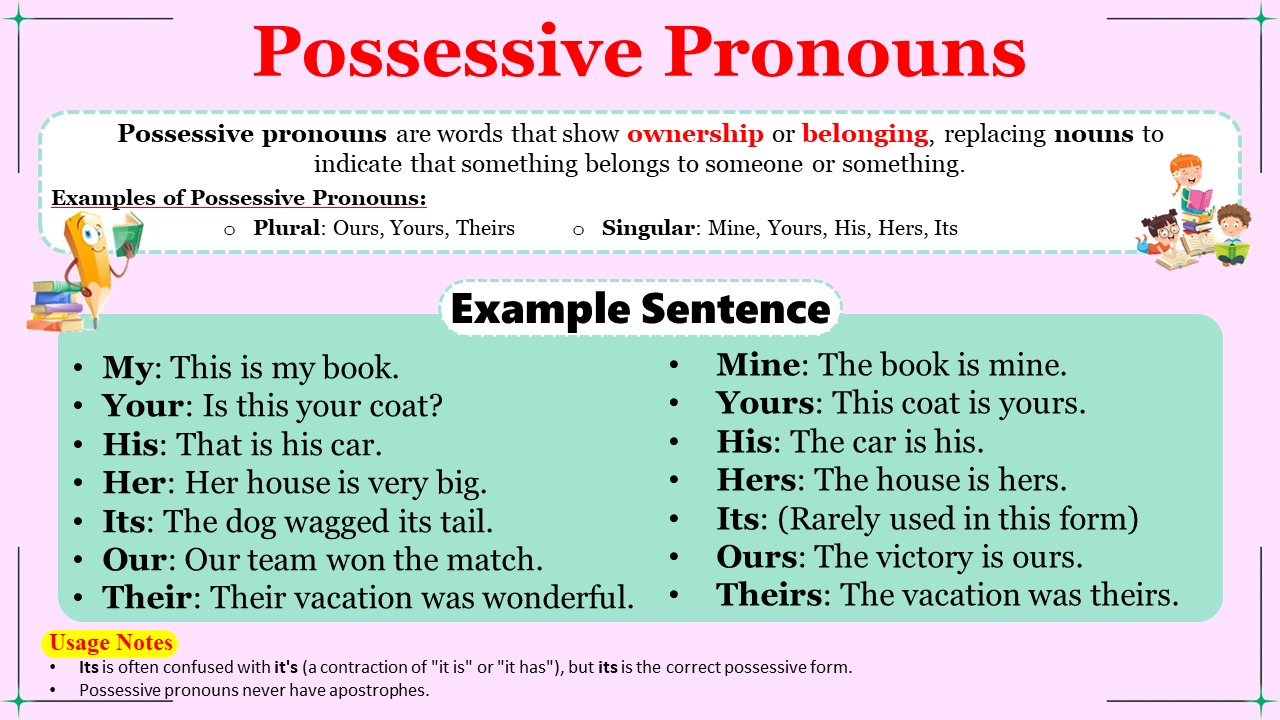
Possessive pronouns are words that show ownership or belonging without repeating the noun that has already been mentioned. Common possessive pronouns include mine, yours, his, hers, ours, and theirs.
For example:
This is my book. That book is yours.
In the second sentence, yours shows ownership and replaces the need to repeat your book.
Possessive pronouns help make sentences clearer and less repetitive. Unlike possessive adjectives such as my, your, her, and their, possessive pronouns can stand alone without a noun after them.
In this guide, you’ll learn how to identify and use possessive pronouns correctly with simple rules and examples.
What Are Possessive Pronouns?
A possessive pronoun is a pronoun that shows ownership or belonging and can replace a possessive noun phrase. Unlike words such as my, your, her, our, and their, a possessive pronoun stands alone and is not followed by a noun.
Examples:
- That pen is hers.
Hers replaces her pen. - These shoes are ours.
Ours replaces our shoes. - Is this bag yours?
Yours replaces your bag.
How to Identify Possessive Pronouns
A possessive pronoun can be identified by looking at its meaning and position in a sentence. It shows ownership or belonging and usually stands alone without a noun directly after it.
To identify a possessive pronoun, check these points:
- It shows who owns or has something.
- It does not need a noun after it.
- It often replaces a possessive adjective + noun combination.
Examples:
- This laptop is mine.
Mine shows ownership and stands alone. - Is that seat yours?
Yours shows who the seat belongs to. - Their house is larger than ours.
Ours replaces our house. - These keys are hers.
Hers shows who owns the keys.
Possessive pronouns usually refer to something that is already clear from the sentence or context, so the noun does not need to be repeated.
List of Possessive Pronouns
The main possessive pronouns in English are mine, yours, his, hers, ours, and theirs.
| Subject Pronoun | Possessive Pronoun | Example |
|---|---|---|
| I | mine | This book is mine. |
| you | yours | This seat is yours. |
| he | his | That jacket is his. |
| she | hers | The blue bag is hers. |
| we | ours | This house is ours. |
| they | theirs | Those bicycles are theirs. |
Note: Yours can refer to one person or more than one person.
Unlike the other forms in the table, English does not normally use its as a standalone possessive pronoun.
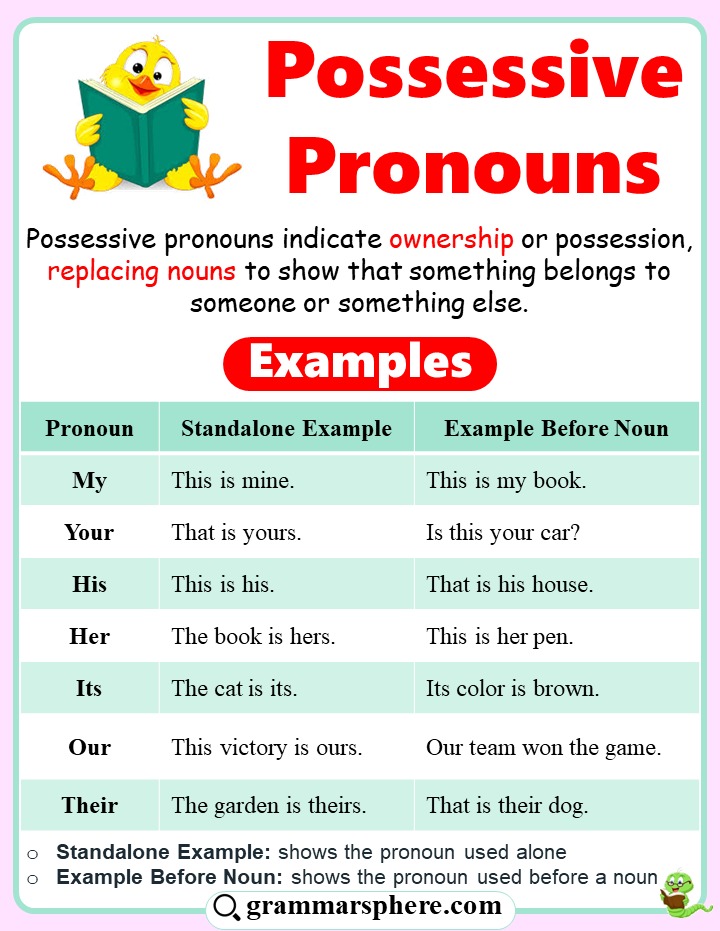
Note: The word its is less common as a possessive pronoun because English speakers often use other structures such as the leg of it or its leg. The word yours is used for both singular and plural when speaking to one or more people.
Difference Between Possessive Pronouns and Possessive Adjectives
Possessive pronouns and possessive adjectives both show ownership or belonging, but they are used differently in a sentence.
A possessive adjective comes before a noun, while a possessive pronoun stands alone and replaces the possessive adjective + noun combination.
| Possessive Adjective | Possessive Pronoun |
|---|---|
| my | mine |
| your | yours |
| his | his |
| her | hers |
| our | ours |
| their | theirs |
Examples:
- This is my book. → This book is mine.
- That is her car. → That car is hers.
- These are our bags. → These bags are ours.
- Is that your coat? → Is that coat yours?
- Those are their seats. → Those seats are theirs.
Key Point: A possessive pronoun is not used directly before a noun.
Incorrect: This is mine book.
Correct: This is my book.
Correct: This book is mine.
Using Possessive Pronouns in Sentences
Possessive pronouns can stand alone in a sentence to show who owns or has something. They are used when the person or thing being referred to is already clear from the context.
Examples:
- The red umbrella is mine.
- This seat is yours.
- The jacket on the chair is his.
- The blue bag is hers.
- That table near the window is ours.
- The house at the end of the street is theirs.
- Is this notebook yours?
- My phone is new, but hers is older.
In each example, the possessive pronoun shows ownership or belonging without requiring a noun directly after it.
Possessive Pronouns with “of”
Possessive pronouns can be used after of to show a relationship, connection, or possession. This structure is common in everyday English.
Structure:
noun + of + possessive pronoun
Examples:
- Sarah is a friend of mine.
- That idea of yours is interesting.
- He is a colleague of hers.
- We met some friends of theirs.
- Is David a relative of yours?
In these expressions, possessive pronouns such as mine, yours, hers, and theirs come after of.
Remember: Do not use a possessive adjective in this structure.
Incorrect: She is a friend of my.
Correct: She is a friend of mine.
Common Mistakes with Possessive Pronouns
Learners sometimes confuse possessive pronouns with other possessive forms. Here are some common mistakes to avoid.
Using a Possessive Pronoun Before a Noun
Possessive pronouns stand alone and are not normally used directly before nouns.
Incorrect: This is mine book.
Correct: This is my book.
Correct: This book is mine.
Using a Possessive Adjective Without a Noun
Possessive adjectives such as my, your, her, our, and their normally need a noun after them.
Incorrect: This bag is my.
Correct: This bag is mine.
Incorrect: That house is their.
Correct: That house is theirs.
Adding an Apostrophe to Possessive Pronouns
Possessive pronouns do not take apostrophes.
Incorrect: That coat is her’s.
Correct: That coat is hers.
Incorrect: The final decision is your’s.
Correct: The final decision is yours.
Choosing the Wrong Possessive Pronoun
The possessive pronoun should match the person or people who own something.
Incorrect: Sarah said the bag was his.
Correct: Sarah said the bag was hers.
FAQs About Possessive Pronouns
1. What are possessive pronouns?
Possessive pronouns are words that show ownership or belonging without using a noun directly after them. The main possessive pronouns are mine, yours, his, hers, ours, and theirs.
2. What are some examples of possessive pronouns?
Examples of possessive pronouns include mine, yours, his, hers, ours, and theirs.
For example:
- This book is mine.
- That bag is hers.
- These seats are ours.
- The bicycles are theirs.
3. What is the difference between possessive pronouns and possessive adjectives?
A possessive adjective comes before a noun, while a possessive pronoun stands alone.
Possessive adjective: This is my book.
Possessive pronoun: This book is mine.
4. Can possessive pronouns be used before nouns?
No. Possessive pronouns such as mine, yours, hers, ours, and theirs are not normally used directly before nouns.
Incorrect: This is mine bag.
Correct: This is my bag.
Correct: This bag is mine.
5. Do possessive pronouns need apostrophes?
No. Possessive pronouns do not take apostrophes.
Incorrect: The bag is her’s.
Correct: The bag is hers.
Incorrect: This seat is your’s.
Correct: This seat is yours.
You May Also Like

Leave a Comment