


Table of Contents
English can express actions, qualities, and ideas in different ways. Sometimes a verb or adjective has a related noun form, which allows the same idea to be expressed as a noun.
This change is called nominalization in English. In this article, you will learn how nouns are formed from verbs and adjectives, how nominalization can change a sentence, and how it is used in formal and academic writing.
What Is Nominalization?
Nominalization is the process of forming a noun from another word, especially a verb or an adjective.
For example:
- decide → decision
- kind → kindness
- possible → possibility
Compare:
They decided to leave.
Their decision surprised us.
In the first sentence, decided is a verb. In the second sentence, decision expresses the same basic idea as a noun.
So, nominalization changes a verb or adjective into a noun.
Nominalization of Verbs
Many verbs have related noun forms. These nouns can express an action, process, event, or result.
For example:
- improve → improvement
- arrive → arrival
- refuse → refusal
- perform → performance
- choose → choice
- grow → growth
Compare:
The manager approved the plan.
The manager’s approval of the plan came yesterday.
In the first sentence, approved is a verb. In the second sentence, it changes to the noun approval.
Notice another change:
approved the plan
becomes:
approval of the plan
Nominalization can also affect other words in the sentence.
Compare:
The company expanded rapidly.
The company’s rapid expansion created new jobs.
Here, expanded becomes expansion. The adverb rapidly changes to the adjective rapid because rapid now describes the noun expansion.
Nominalization of Adjectives
Adjectives can also have related noun forms. These nouns usually express a quality, state, condition, or characteristic.
For example:
- happy → happiness
- strong → strength
- patient → patience
- accurate → accuracy
- important → importance
Compare:
The method is effective.
The effectiveness of the method was clear.
In the first sentence, effective is an adjective describing the method. In the second sentence, effective changes to the noun effectiveness.
Another example:
The measurements were accurate.
The accuracy of the measurements was checked carefully.
Here, accurate changes from an adjective to the noun accuracy.
Nominalization allows the quality described by an adjective to be expressed as a noun.mmatical position in the sentence.
Common Nominalization Suffixes and Other Form Changes
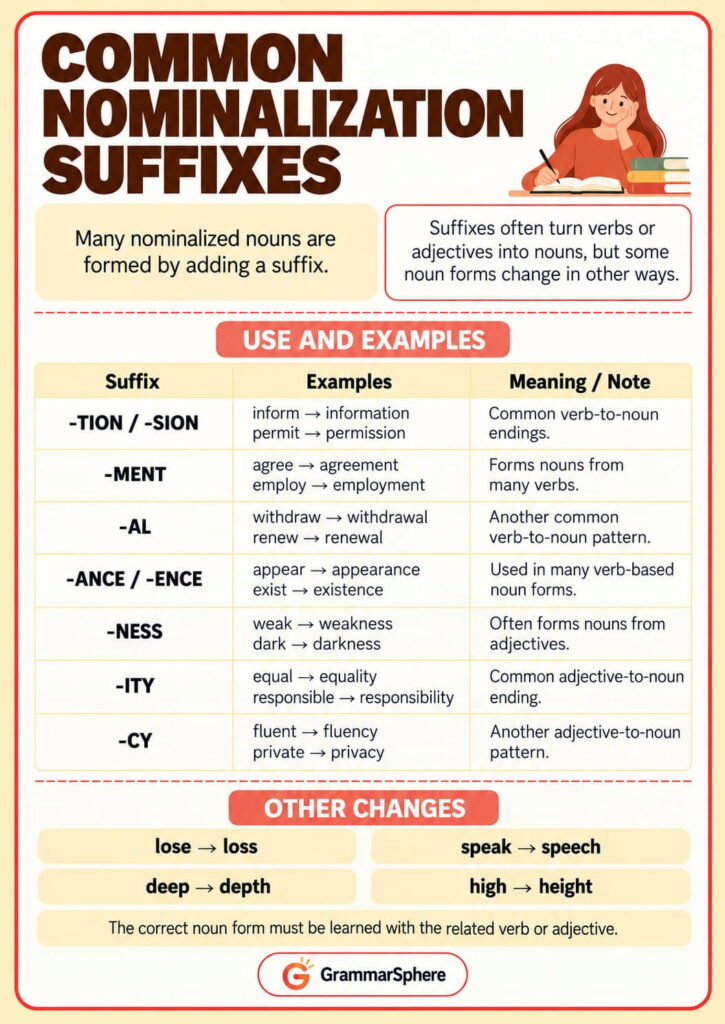
Many nouns are formed from verbs or adjectives by adding a suffix. A suffix is a group of letters added to the end of a word.
Common noun-forming suffixes include:
- -tion / -sion: inform → information, permit → permission
- -ment: agree → agreement, employ → employment
- -al: withdraw → withdrawal, renew → renewal
- -ance / -ence: appear → appearance, exist → existence
- -ness: weak → weakness, dark → darkness
- -ity: equal → equality, responsible → responsibility
- -cy: fluent → fluency, private → privacy
Some words change more than just their ending.
For example:
- lose → loss
- speak → speech
- choose → choice
- grow → growth
- deep → depth
- high → height
These endings can help learners recognize noun forms, but noun formation does not always follow one fixed rule.
For example:
decide → decision
not:
decidement ✗
Similarly:
strong → strength
not:
strongness ✗
For this reason, it is useful to learn the correct noun form together with its related verb or adjective..
How Nominalization Changes Sentence Structure
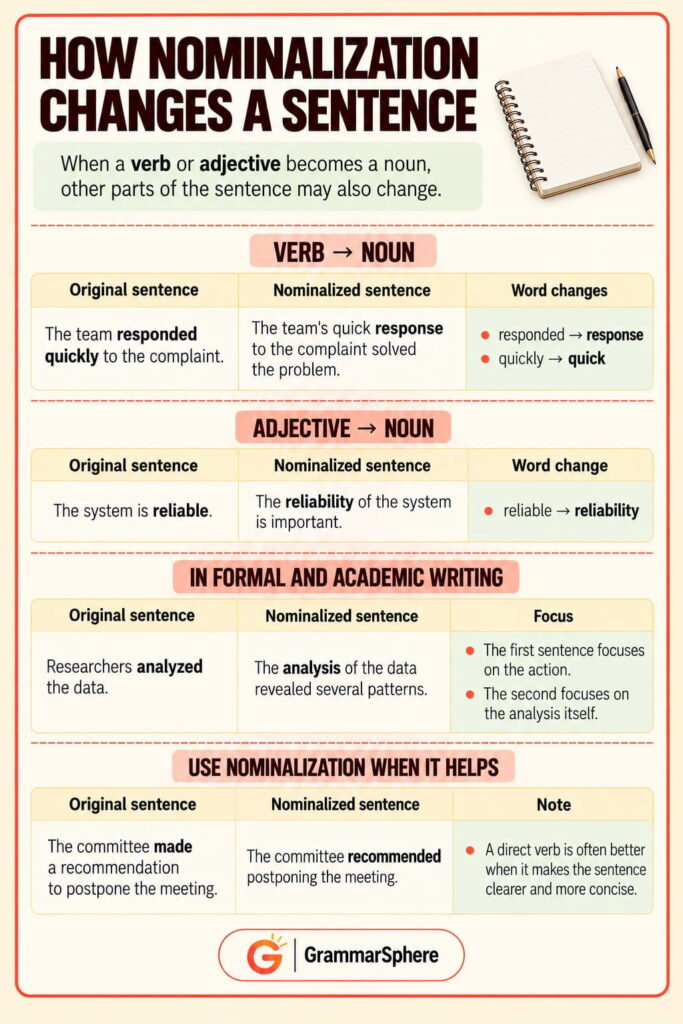
When a verb or adjective changes into a noun, other words in the sentence may also need to change.
Compare:
The team responded quickly to the complaint.
The team’s quick response to the complaint solved the problem.
Several changes take place:
- responded → response
- quickly → quick
- the team → the team’s
The verb responded becomes the noun response. Because response is a noun, the adverb quickly changes to the adjective quick.
Nominalization can also change how an object is connected to the new noun.
Compare:
The committee rejected the proposal.
The committee’s rejection of the proposal caused concern.
In the first sentence, the proposal is the object of the verb rejected. After rejected changes to the noun rejection, we use of:
rejection of the proposal
A similar change can happen when an adjective becomes a noun.
Compare:
The system is reliable.
The reliability of the system is important.
Here, reliable changes to the noun reliability.
So, nominalization can change not only the main word but also the grammar around it.be treated as a structural change, not as a mechanical one-word substitution.
Nominalization in Formal and Academic Writing
Nominalization is common in formal and academic writing because it allows the writer to focus on an action, process, result, or idea instead of the person doing the action.
Compare:
Researchers analyzed the data.
The analysis of the data revealed several trends.
The first sentence focuses on researchers and what they did. The second focuses on the analysis itself.
Nominalization can also help connect ideas from one sentence to the next.
For example:
The company expanded rapidly last year. This expansion created several new jobs.
The noun expansion refers back to the verb expanded in the previous sentence. This allows the same idea to continue as the topic of the next sentence.
It can also reduce the focus on the person or group responsible for an action.
Compare:
The committee decided to postpone the meeting.
The decision to postpone the meeting was announced yesterday.
The first sentence focuses on the committee. The second focuses on the decision.
However, nominalization does not always make writing better. Too much nominalization can make a sentence long and heavy.
Compare:
The committee made a recommendation for the postponement of the meeting.
The committee recommended postponing the meeting.
The second sentence is shorter and more direct.
Nominalization is most useful when the noun form helps the writer focus on an idea, connect information, or organize the sentence more clearly.
How to Identify Nominalization
To identify nominalization, first look for a noun that is related to a verb or adjective.
For example:
- movement ← move
- accuracy ← accurate
- development ← develop
Next, check how the word is used in the sentence.
The movement surprised everyone.
Her accuracy improved with practice.
The development took several years.
In these sentences, movement, accuracy, and development are all used as nouns.
Some suffixes can help you recognize nominalized nouns, such as:
- -tion
- -ment
- -ness
- -ity
However, not every nominalized noun has an obvious suffix.
For example:
- choose → choice
- lose → loss
- strong → strength
- grow → growth
A simple way to identify nominalization is to ask:
- Is the word a noun?
- Is it related to a verb or adjective?
- Does it express an action, process, quality, state, or result?
These questions make nominalized nouns easier to recognize.
Common Mistakes with Nominalization
1. Using the wrong noun form
Their decide surprised everyone. ✗
Their decision surprised everyone. ✓
The sentence needs a noun, so decide must change to decision.
2. Using the wrong suffix
His strongness impressed everyone. ✗
His strength impressed everyone. ✓
Not every noun is formed by adding a common suffix. The correct noun form of strong is strength.
3. Keeping the verb structure after forming a noun
The approval the plan came yesterday. ✗
The approval of the plan came yesterday. ✓
The verb approve can take an object directly:
approve the plan
But the noun approval normally uses of:
approval of the plan
4. Using an adverb before the new noun
The company’s rapidly expansion continued. ✗
The company’s rapid expansion continued. ✓
Rapidly is an adverb, but expansion is a noun. We therefore use the adjective rapid before it.
5. Using too much nominalization
The committee made a decision about the cancellation of the event.
This sentence is grammatically possible, but it sounds heavy.
A clearer version is:
The committee decided to cancel the event.
Nominalization is useful when the noun form helps express the meaning clearly, but a simple verb is often better when the action should remain direct.
Nominalization Exercises with Answers
A. Form the Correct Noun
Change the word in brackets into the correct noun form.
- Their ______ surprised everyone. (decide)
- The company’s rapid ______ created new jobs. (expand)
- Her ______ improved with practice. (accurate)
- The ______ of the team was excellent. (perform)
- His ______ helped him deal with the problem calmly. (patient)
B. Rewrite Using Nominalization
Rewrite each sentence using the noun given.
- The committee rejected the proposal.
Use rejection. - The company expanded rapidly.
Use expansion. - The system is reliable.
Use reliability. - Researchers analyzed the data.
Use analysis.
C. Correct the Mistakes
- Their decidement surprised us.
- The company announced its rapidly expansion.
- The approval the proposal came yesterday.
Answers
- decision
- expansion
- accuracy
- performance
- patience
- The committee’s rejection of the proposal caused concern.
- The company’s rapid expansion created new jobs.
- The reliability of the system is important.
- The analysis of the data revealed several trends.
- Their decision surprised us.
- The company announced its rapid expansion.
- The approval of the proposal came yesterday.
FAQs About Nominalization in English
Why is nominalization common in academic writing?
Nominalization allows an action, process, quality, or result to be expressed as a noun. This helps writers focus on ideas and connect information more easily.
Is nominalization always better than using a verb?
No. Sometimes a verb is clearer and more direct.
Compare:
The committee made a decision to postpone the meeting.
The committee decided to postpone the meeting.
The second sentence is shorter and more direct.
How can I recognize a nominalized noun?
Look for a noun that is related to a verb or adjective.
For example:
- develop → development
- accurate → accuracy
- strong → strength
Also check that the word is actually being used as a noun in the sentence.
Can nominalization change other words in a sentence?
Yes. Other words may also need to change when a verb or adjective becomes a noun.
Compare:
The company expanded rapidly.
The company’s rapid expansion created new jobs.
Here, expanded becomes expansion, and rapidly changes to rapid.
Is a gerund the same as nominalization?
Not exactly. A gerund is an -ing form that is used in a noun-like way.
For example:
Swimming is good exercise.
Nominalization is broader and includes many nouns formed from verbs and adjectives:
- decide → decision
- develop → development
- strong → strength
So, nominalization is not limited to -ing forms.
You May Also Like





Leave a Comment