

Table of Contents
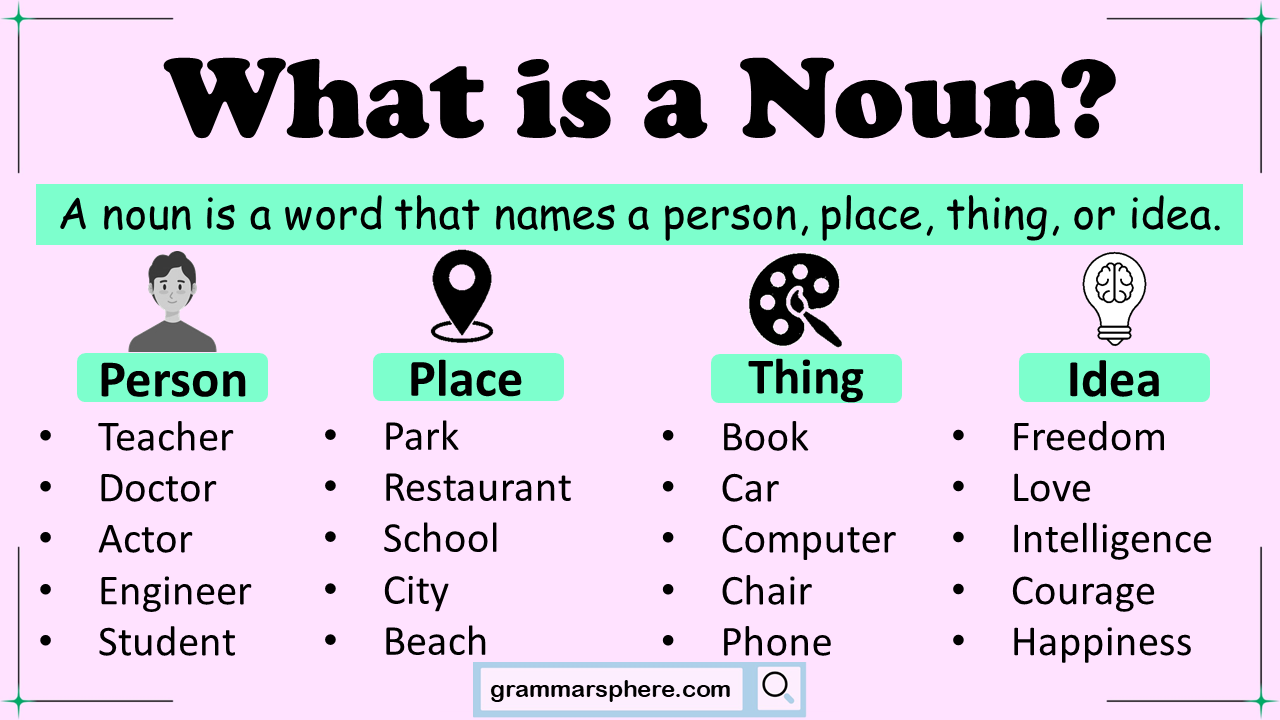
A noun is a word that names a person, place, thing, or idea. Nouns help us talk about the world around us. They can be the subject or object in a sentence, making it easier to understand who or what we are talking about. Learning about types of nouns helps us understand and use nouns correctly in English.
What Is a Noun?
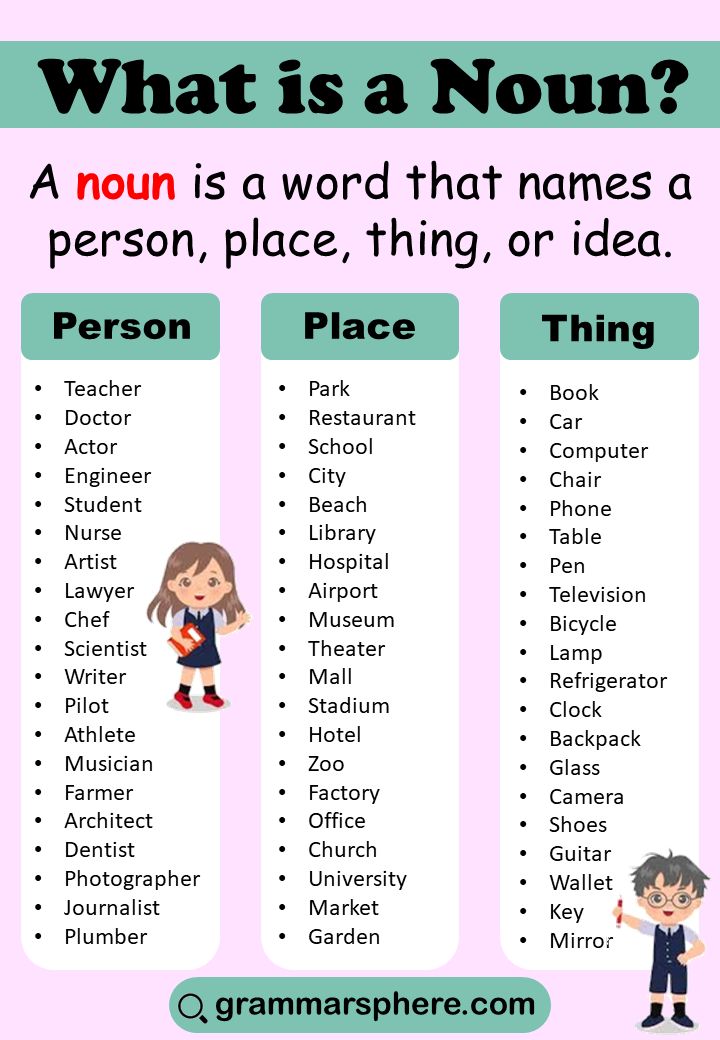
A noun is a word that names a person, place, thing, or idea. Words like cat, city, book, and happiness are all nouns. Nouns help us identify and talk about different parts of our world.
Example Sentences:
- The dog barked loudly.
- She lives in a small village.
- The book is on the table.
How to Identify a Noun in a Sentence
To identify a noun in a sentence, look for a word that names a person, place, thing, or idea. You can also use these simple clues:
- A noun can be the subject of a sentence: Ali plays cricket.
- A noun can be the object of a verb: She bought a book.
- A noun often comes after words like a, an, or the: I saw a bird.
- Some nouns name things we cannot see or touch, such as love, happiness, and freedom.
Example:
The teacher gave the students a lesson.
Here, teacher, students, and lesson are nouns because they name people or things.
Types of Nouns
- Common Nouns
- Proper Nouns
- Concrete Nouns
- Abstract Nouns
- Collective Nouns
- Countable Nouns
- Uncountable Nouns
- possessive nouns
- compound nouns
Nouns can be classified into several types based on their characteristics and usage:
1. Common Nouns
These nouns are general names for a person, place, thing, or idea. They are not specific and are not capitalized unless they start a sentence.
- The dog barked all night.
- She bought a new car.
- He visited a small village.
2. Proper Nouns
They are specific names for particular people, places, things, or ideas. Proper nouns are always capitalized.
- New York is a bustling city.
- Tom is my best friend.
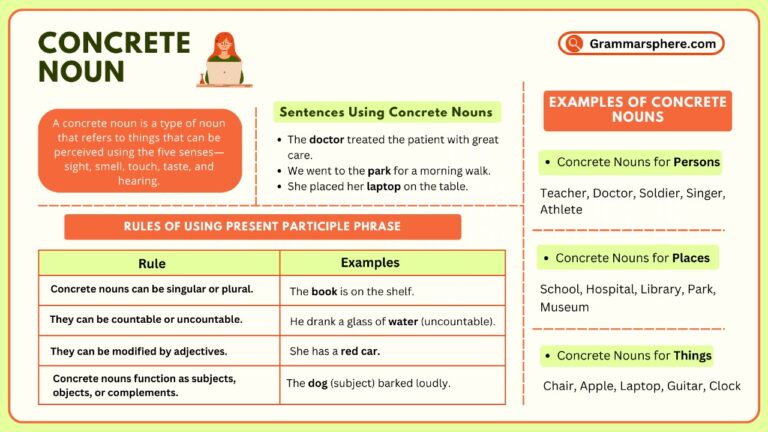
3. Concrete Nouns
They are used to refer to things that can be perceived through the five senses (sight, hearing, touch, taste, smell). Concrete nouns are tangible and can be experienced physically.
- The dog chased its tail.
- She bought a new dress.
4. Abstract Nouns
These refer to ideas, qualities, or conditions that cannot be perceived through the five senses. Abstract nouns represent concepts or feelings.
- Knowledge is power.
- They fought for justice.
5. Collective Nouns
They refer to a group or collection of people, animals, or things considered as a single unit. Collective nouns can be singular or plural, depending on the context.
- The family went on vacation.
- The class started their project.
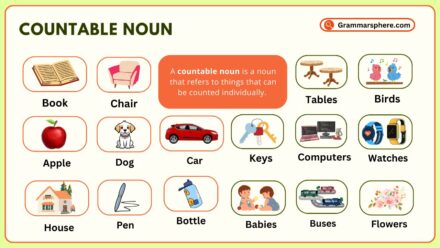
6. Countable Nouns
These refer to things that can be counted easily. Countable nouns have both singular and plural forms, and they can be preceded by numbers or articles (a, an, the).
- She has three cats.
- He bought five books.
7. Uncountable Nouns
They are used to refer to things that cannot be counted individually. Uncountable nouns are generally not used in the plural and are usually not preceded by numbers or the indefinite articles a or an.
- Knowledge is valuable.
- He spilled milk on the table.
8. Compound Nouns
Compound nouns are nouns made up of two or more words combined to create a single meaning. They can be written as one word (closed), separate words (open), or hyphenated (hyphenated).
- Notebook (closed)
- Ice cream (open)
- Father-in-law (hyphenated)
Example Sentences:
- Fatima bought a notebook for her English class.
- Bilal loves ice cream on hot days.
9. Possessive Nouns
A possessive noun shows ownership or belonging. It is formed by adding ‘s or just an apostrophe (‘) to the noun, depending on whether it is singular or plural.
Examples:
- Aisha’s book is on the table.
- The students’ classroom is spacious.
Note: A noun can belong to more than one type. For example, book is a common, concrete, and countable noun.
How Are Nouns Used in Sentences?
1. Nouns as Subjects
When a noun is the subject, it tells us who or what the sentence is about. It usually comes before the verb.
- The dog barks.
- The cat sleeps.
2. Nouns as Objects
Nouns can also receive the action of the verb. There are two main types of objects:
- Direct Object – receives the action directly.
- He writes a letter.
- She reads a book.
- Indirect Object – tells us to whom or for whom the action is done.
- She gave her friend a gift.
- He sent his mother a card.
Singular vs. Plural Nouns
What Is a Singular Noun?
A singular noun refers to one person, place, thing, or idea. It is used when talking about just one of something.
Examples:
- Dog (This means one dog.)
- Cat (This means one cat.)
- Lion (This means one lion.)
What Is a Plural Noun?
A plural noun refers to more than one person, place, thing, or idea. In English, plural nouns are often formed by adding -s or -es to the end of the singular noun.
Examples:
- Dogs (This means more than one dog.)
- Books (This means more than one book.)
- Houses (This means more than one house.)
Difference:
Singular nouns name one person, place, thing, or idea.
Plural nouns name more than one person, place, thing, or idea.
Rules for Forming Plural Nouns
| Rule | Singular | Plural |
|---|---|---|
| Add -s to most nouns | book | books |
| Add -es to nouns ending in -s, -sh, -ch, -x, -z | box | boxes |
| Change -y to -ies if preceded by a consonant | baby | babies |
| Add -s if -y is preceded by a vowel | toy | toys |
| Some nouns have irregular plural forms | child | children |
Examples of Singular vs. Plural Nouns
Singular: car → Plural: cars
Singular: bus → Plural: buses
Singular: city → Plural: cities
Singular: woman → Plural: women
Singular: mouse → Plural: mice
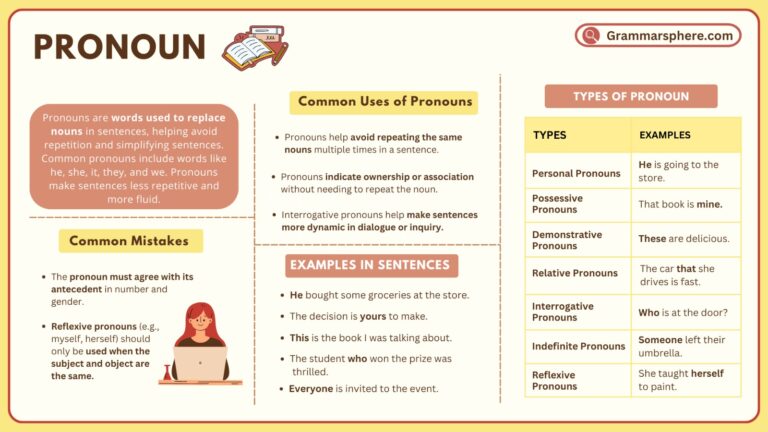
Nouns vs. Pronouns
Nouns name people, places, things, or ideas.
Pronouns replace nouns to avoid repetition.
Examples:
- Noun: Anna loves reading books.
- Pronoun: She loves reading books.
- Noun: The house is beautiful.
- Pronoun: It is beautiful.
- Noun: I saw Jack and Emily at the park.
- Pronoun: I saw them at the park.
Common Mistakes with Nouns
1. Not Capitalizing Proper Nouns
❌ ali lives in pakistan.
✅ Ali lives in Pakistan.
2. Using a or an with Uncountable Nouns
❌ She gave me an advice.
✅ She gave me some advice.
3. Using the Wrong Plural Form
❌ The childs are playing outside.
✅ The children are playing outside.
4. Confusing Possessive Nouns with Plural Nouns
❌ The teachers book is on the table.
✅ The teacher’s book is on the table.
5. Confusing Nouns with Other Parts of Speech
A word should be identified by how it is used in the sentence.
- Love is important. → Love is a noun.
- I love this book. → Love is a verb.
FAQs About Nouns
1. What is a noun in English grammar?
A noun is a word that names a person, place, thing, or idea.
2. What are the main types of nouns?
The main types include common, proper, concrete, abstract, collective, countable, uncountable, compound, and possessive nouns.
3. How do you identify a noun in a sentence?
Look for a word that names a person, place, thing, or idea. A noun can also function as the subject or object of a sentence.
4. What is the difference between common and proper nouns?
A common noun is a general name, such as city or boy, while a proper noun is the specific name of a person, place, or thing, such as Lahore or Ahmed.
5. What is the difference between countable and uncountable nouns?
Countable nouns can be counted and usually have singular and plural forms, such as book/books. Uncountable nouns are not normally counted individually, such as water or information.
FAQs About Nouns
1. What is a noun in English grammar?
A noun is a word that names a person, place, thing, or idea.
2. What are the main types of nouns?
The main types include common, proper, concrete, abstract, collective, countable, uncountable, compound, and possessive nouns.
3. How do you identify a noun in a sentence?
Look for a word that names a person, place, thing, or idea. A noun can also function as the subject or object of a sentence.
4. What is the difference between common and proper nouns?
A common noun is a general name, such as city or boy, while a proper noun is the specific name of a person, place, or thing, such as Lahore or Ahmed.
5. What is the difference between countable and uncountable nouns?
Countable nouns can be counted and usually have singular and plural forms, such as book/books. Uncountable nouns are not normally counted individually, such as water or information.
You May Also Like
Leave a Comment