

Table of Contents
Adjectives help us describe things, people, or places. But what happens when we need to compare two or more things? That’s where comparative and superlative adjectives come into play.
Mastering comparative and superlative adjectives is essential for improving both written and spoken English. Whether you’re writing an essay, delivering a presentation, or engaging in casual conversation, knowing how to properly compare and contrast things can make your communication clearer and more effective.
What Are Comparative Adjectives?
Comparative adjectives are used to compare two things. They help us describe differences by showing whether one thing is larger, smaller, faster, slower, or has another quality to a greater or lesser degree than the other.
Example Sentences:
- This book is larger than that one.
- My cat is faster than my dog.
- Her house is smaller than mine.
How to Form Comparative Adjectives
The way we form a comparative adjective depends mainly on the length and spelling of the adjective.
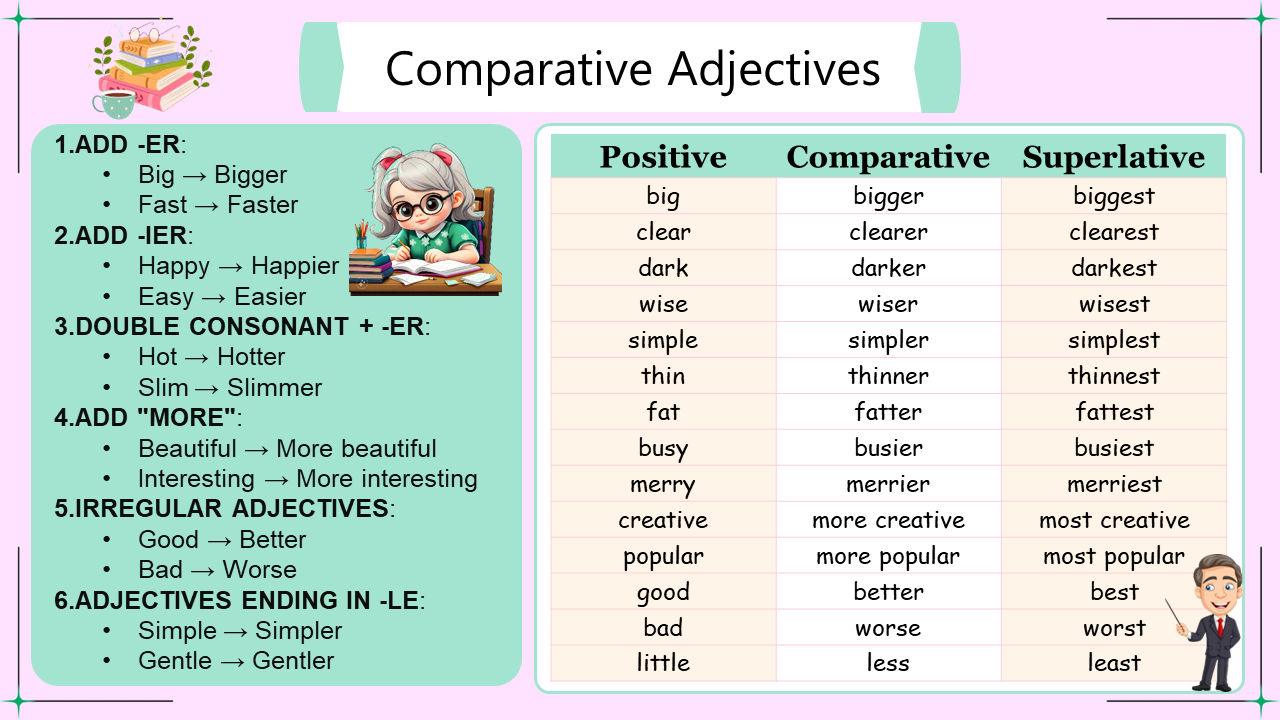
| Type of Adjective | Rule | Examples |
|---|---|---|
| Most one-syllable adjectives | Add -er | fast → faster, small → smaller |
| Adjectives ending in -e | Add -r | large → larger, nice → nicer |
| Short adjectives ending in consonant-vowel-consonant | Double the final consonant and add -er | big → bigger, hot → hotter |
| Two-syllable adjectives ending in -y | Change -y to -ier | happy → happier, angry → angrier |
| Most adjectives with two or more syllables | Use more before the adjective | careful → more careful, beautiful → more beautiful |
| Irregular adjectives | Use an irregular comparative form | good → better, bad → worse |
How Are Irregular Adjectives Formed?
Some adjectives have irregular comparative and superlative forms. They do not follow the usual -er/-est or more/most patterns, so their forms need to be learned separately.
For example, good becomes better in the comparative form and best in the superlative form. Similarly, bad changes to worse and worst.
| Adjective | Comparative | Superlative |
|---|---|---|
| good | better | best |
| bad | worse | worst |
| far | farther / further | farthest / furthest |
| little | less | least |
| much | more | most |
| many | more | most |
| old | older / elder | oldest / eldest |
Comparative Adjectives in Sentences
- The red dress is prettier than the blue one.
- This test is harder than the last one.
- This movie is more exciting than the one we watched last week.
- Her explanation was clearer than his.
What Are Superlative Adjectives?
Superlative adjectives are used to compare three or more things and show which one has the highest or lowest degree of a quality in a group.
Example Sentences:
- This is the most exciting game I have ever played.
- She is the smartest student in the class.
- This is the least expensive option available.
How to Form Superlative Adjectives?
| Type of Adjective | Rule | Example |
|---|
| One-syllable adjectives | Add -est to the end of the word | small → smallest, fast → fastest |
| Two syllables ending in -y | Change -y to -iest | happy → happiest, angry → angriest |
| Two or more syllables | Use most or least before the adjective | beautiful → most beautiful, difficult → most difficult |
| Irregular adjectives | No specific rule, irregular form | good → best, bad → worst |
Irregular Superlative Forms
Some adjectives have irregular superlative forms that do not follow the usual -est or most patterns. These forms need to be learned separately.
| Adjective | Comparative | Superlative |
|---|---|---|
| good | better | best |
| bad | worse | worst |
| far | farther / further | farthest / furthest |
| little | less | least |
| much | more | most |
Irregular Superlative Adjectives in Sentences
- She is the best student in the class.
- That was the worst day of the trip.
- This shop is the farthest from my house.
- This option requires the least effort.
- This project requires the most time.
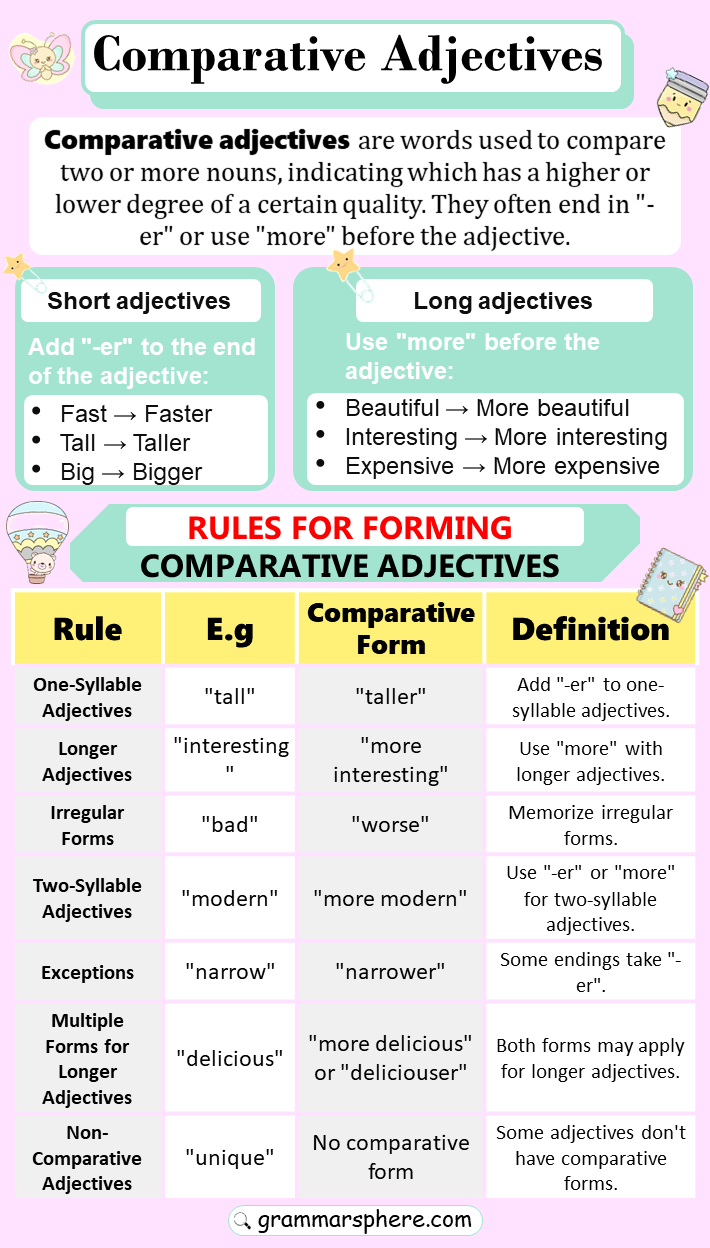
Rules for Using Comparative and Superlative Adjectives
The form of a comparative or superlative adjective depends mainly on the adjective’s length and spelling.
1. One-Syllable Adjectives
For most one-syllable adjectives, add -er to form the comparative and -est to form the superlative.
- tall → taller → tallest
- fast → faster → fastest
- cold → colder → coldest
If the adjective already ends in -e, add -r for the comparative and -st for the superlative.
- large → larger → largest
- nice → nicer → nicest
For short adjectives ending in a consonant-vowel-consonant pattern, double the final consonant before adding -er or -est.
- big → bigger → biggest
- hot → hotter → hottest
- thin → thinner → thinnest
2. Two-Syllable Adjectives Ending in -y
For two-syllable adjectives ending in -y, change y to i and add -er for the comparative and -est for the superlative.
- happy → happier → happiest
- easy → easier → easiest
- busy → busier → busiest
3. Other Two-Syllable Adjectives
Many two-syllable adjectives form the comparative with more and the superlative with most.
- careful → more careful → most careful
- peaceful → more peaceful → most peaceful
However, some two-syllable adjectives can also take -er and -est, depending on the word.
- simple → simpler → simplest
- narrow → narrower → narrowest
4. Adjectives with Three or More Syllables
Most adjectives with three or more syllables use more for the comparative and most for the superlative.
- beautiful → more beautiful → most beautiful
- expensive → more expensive → most expensive
- intelligent → more intelligent → most intelligent
5. Irregular Adjectives
Some adjectives have irregular comparative and superlative forms and do not follow the usual rules.
- good → better → best
- bad → worse → worst
- little → less → least
- much/many → more → most
- far → farther/further → farthest/furthest
Differences Between Comparative and Superlative Adjectives
The main difference between comparative and superlative adjectives is how many people, places, things, or ideas are being compared. Comparative adjectives usually compare two, while superlative adjectives identify the highest or lowest degree of a quality within a group.
| Comparative Adjectives | Superlative Adjectives |
|---|---|
| Compare two people, places, things, or ideas | Compare three or more people, places, things, or ideas |
| Often use -er or more | Often use -est or most |
| Commonly followed by than when both things are mentioned | Commonly used with the |
| Example: Ali is taller than Ahmed. | Example: Ali is the tallest student in the class. |
| Example: This book is more interesting than that one. | Example: This is the most interesting book in the series. |
In short: Use the comparative when comparing two things and the superlative when showing which one stands out within a group.
Other Ways to Make Comparisons
We do not always use -er, -est, more, or most to make comparisons. English also uses other structures to show whether people or things are equal or different.
as + adjective + as shows that two people or things are equal in a particular quality.
- Ali is as tall as Ahmed.
- This book is as interesting as that one.
not as + adjective + as shows that one person or thing has less of a quality than another.
- This car is not as expensive as that one.
- Sara is not as tall as her sister.
less + adjective + than shows a lower degree of a quality.
- This exercise is less difficult than the previous one.
- The second option is less expensive than the first.
the least + adjective shows the lowest degree of a quality in a group.
- This is the least expensive option.
- It was the least difficult question on the test.
Modifying Comparative Adjectives
We can use words such as much, far, a lot, a little, and a bit before comparative adjectives to show how big or small the difference is.
Use much, far, or a lot to show a large difference.
- This house is much bigger than our old one.
- The new test was far more difficult than the previous one.
- This laptop is a lot cheaper than that one.
Use a little or a bit to show a small difference.
- My brother is a little taller than me.
- This exercise is a bit easier than the last one.
Remember: Do not normally use very directly before a comparative adjective.
- ❌ This car is very faster than mine.
- ✓ This car is much faster than mine.
Common Mistakes with Comparative and Superlative Adjectives
Here are some common mistakes to avoid when using comparative and superlative adjectives.
1. Using more with an -er comparative
Do not normally use more together with an adjective that already has the comparative -er form.
- ❌ She is more taller than her sister.
- ✓ She is taller than her sister.
2. Using most with an -est superlative
Do not normally use most together with an adjective that already has the superlative -est form.
- ❌ He is the most fastest runner.
- ✓ He is the fastest runner.
3. Using than with a superlative
Use than with comparative adjectives when making a direct comparison, not normally with superlatives.
- ❌ Ali is the tallest than Ahmed.
- ✓ Ali is taller than Ahmed.
- ✓ Ali is the tallest student in the class.
4. Forgetting the spelling change
Remember that some adjectives change their spelling before -er and -est are added.
- ❌ happy → happyer → happyest
- ✓ happy → happier → happiest
- ❌ big → biger → bigest
- ✓ big → bigger → biggest
5. Using regular forms for irregular adjectives
Some adjectives have irregular comparative and superlative forms.
- ❌ good → gooder → goodest
- ✓ good → better → best
- ❌ bad → badder → baddest
- ✓ bad → worse → worst
FAQS
1. What is the difference between comparative and superlative adjectives?
Comparative adjectives compare one person or thing with another, while superlative adjectives show which person or thing has the highest or lowest degree of a quality within a group.
2. When do we use -er and -est?
We usually use -er to form the comparative and -est to form the superlative of short adjectives.
3. When do we use more and most with adjectives?
We generally use more and most with longer adjectives. More forms the comparative, while most forms the superlative.
4. When do we use “than” with comparative adjectives?
We commonly use than after a comparative adjective when directly comparing two people or things.
5. Do we always use “the” before a superlative adjective?
We commonly use the before a superlative adjective when comparing someone or something with the rest of a group. However, the is not required in every superlative structure.
6. What are irregular comparative and superlative adjectives?
Irregular comparative and superlative adjectives do not follow the usual -er/-est or more/most patterns. Common examples include good → better → best and bad → worse → worst.
You May Also Like
Leave a Comment