

Table of Contents
Adjectives are words that describe or give more information about nouns. They help us describe a person, place, thing, or idea more clearly.
There are different types of adjectives, including descriptive, quantitative, demonstrative, and possessive adjectives. Each type has a different function and helps us add specific details to our sentences, making our English clearer and more meaningful.
What Is an Adjective?
An adjective is a word that describes or gives more information about a noun or pronoun. It can tell us about a person, place, thing, or idea, such as its quality, size, color, quantity, or condition.
Example Sentences:
- She wore a red dress.
Red describes the color of the dress. - She has a bright smile.
Bright describes the quality of her smile. - They live in a small house.
Small describes the size of the house.
How to Identify Adjectives in a Sentence
To identify an adjective in a sentence, look for a word that describes or gives more information about a noun or pronoun. An adjective may tell you about a person’s or thing’s quality, size, color, shape, number, or other characteristics.
A useful way to identify adjectives is to ask questions such as:
- What kind? → a beautiful garden
- Which one? → that book
- How many? → three students
- How much? → some water
- Whose? → her bag
Adjectives commonly appear before nouns or after linking verbs.
- She bought a new car.
- The house is large.
- They seem happy.
In each example, the adjective describes or gives more information about a noun or pronoun.
Types of Adjectives
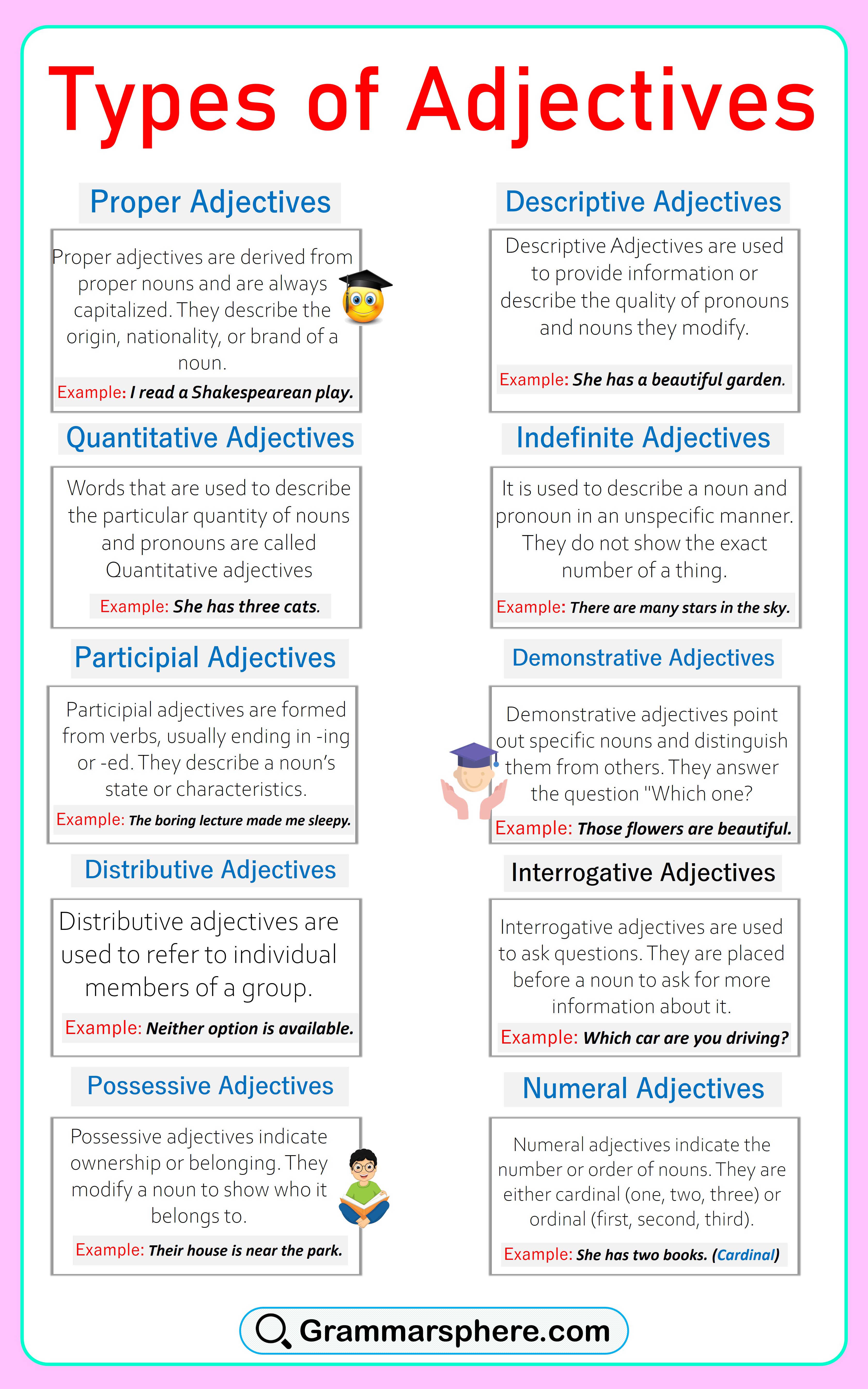
There are several types of adjectives in English. Each type gives us different information about a noun.
- Descriptive Adjectives
- Quantitative Adjectives
- Demonstrative Adjectives
- Possessive Adjectives
- Interrogative Adjectives
- Indefinite Adjectives
- Proper Adjectives
- Articles
- Distributive Adjectives
- Numeral Adjectives
- Participial Adjectives
1. Descriptive Adjectives
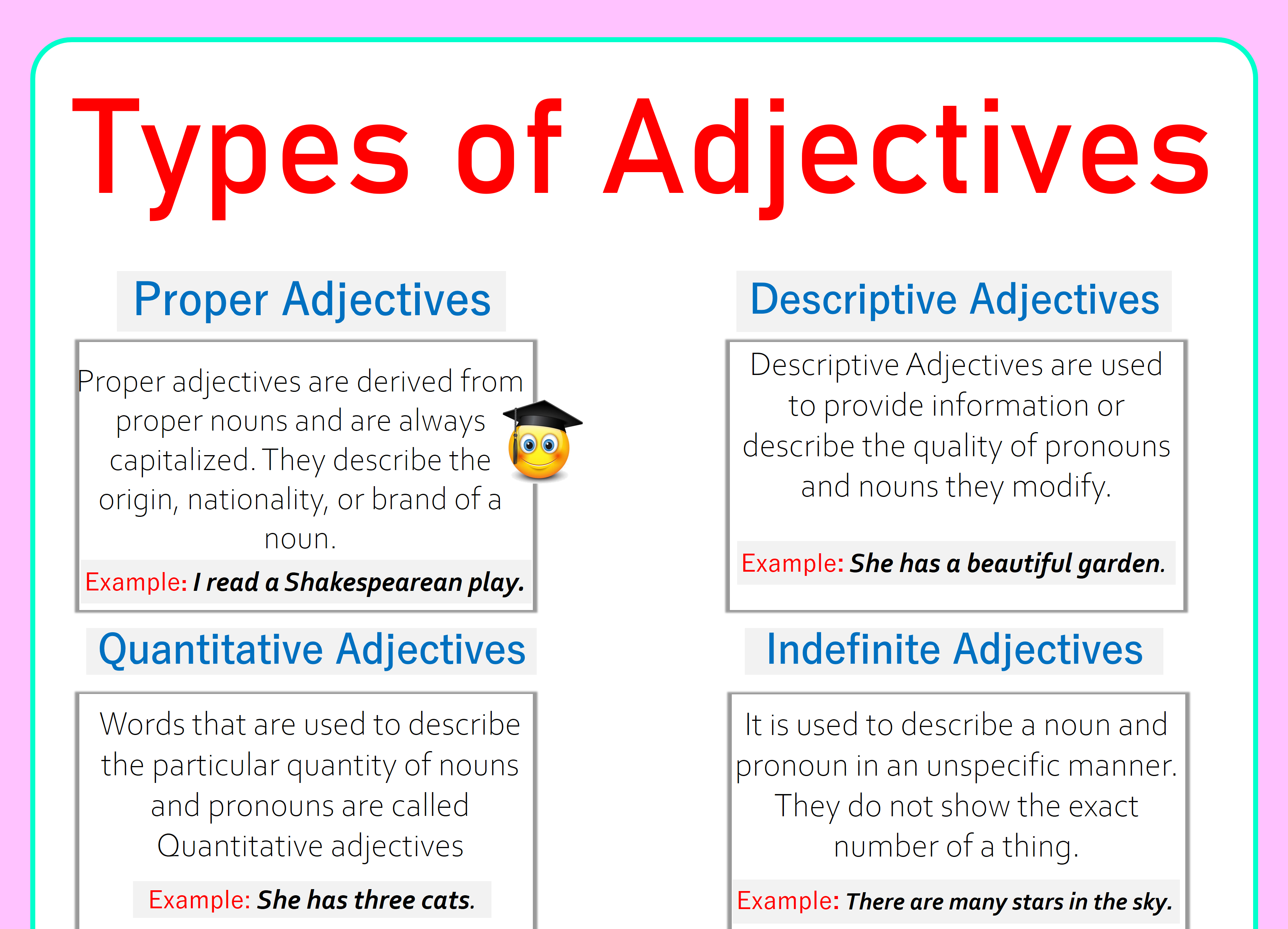
Descriptive adjectives describe the qualities or characteristics of a noun. They tell us what someone or something is like.
- The tall man is standing at the door.
- She has a beautiful garden.
In these examples, tall describes the man, while beautiful describes the garden.
2. Quantitative Adjectives
Quantitative adjectives tell us how much of something there is. They are commonly used to describe an amount rather than an exact number.
- We need some sugar.
- There is little water left.
Some refers to an unspecified amount of sugar, while little shows a small amount of water.
3. Demonstrative Adjectives
Demonstrative adjectives point to specific nouns. The main demonstrative adjectives are this, that, these, and those.
- This book is interesting.
- Those flowers are beautiful.
This points to a specific book, while those points to particular flowers.
4. Possessive Adjectives
Possessive adjectives show possession or belonging. Common possessive adjectives include my, your, his, her, its, our, and their.
- This is her bike.
- Their house is near the park.
Her shows who the bike belongs to, while their shows who the house belongs to.
5. Interrogative Adjectives
Interrogative adjectives are used with nouns to ask questions. Common interrogative adjectives include which, what, and whose.
- Which car are you driving?
- Whose pen is this?
Which asks about a particular car, while whose asks who the pen belongs to.
6. Indefinite Adjectives
Indefinite adjectives give non-specific information about the amount or number of a noun. Common examples include some, any, many, few, several, and all.
- Many students attended the class.
- Several people asked questions.
Many and several give an idea of number without stating an exact number.
7. Proper Adjectives
Proper adjectives are formed from proper nouns and are usually capitalized. They often describe nationality, origin, culture, or a connection with a particular person or place.
- She loves Italian food.
- We studied a Shakespearean play.
Italian is derived from Italy, while Shakespearean is derived from Shakespeare.
8. Articles
The articles a, an, and the come before nouns and help show whether we are referring to something general or specific.
- The dog is barking.
- I saw a bird.
The refers to a particular dog, while a introduces a non-specific bird.
Note: In traditional grammar, articles are sometimes grouped with adjectives because they modify or limit nouns. In modern grammar, they are generally classified as determiners.
9. Distributive Adjectives
Distributive adjectives refer to members of a group individually rather than collectively. Common examples include each, every, either, and neither.
- Each student must submit an assignment.
- Neither option is available.
Each considers the students individually, while neither means not one or the other of two choices.
10. Numeral Adjectives
Numeral adjectives show the number or order of nouns. Cardinal numbers show quantity, while ordinal numbers show position or order.
- She has two books. (Cardinal)
- This is my first car. (Ordinal)
Two shows the exact number of books, while first shows order.
11. Participial Adjectives
Participial adjectives are formed from verb forms and commonly end in -ing or -ed. They function as adjectives by describing a noun or pronoun.
- The boring lecture made me sleepy.
- He was bored during the meeting.
Boring describes the lecture, while bored describes how he felt.
How Adjectives Are Formed
Adjectives can be formed from nouns, verbs, and other words by adding prefixes or suffixes. Learning these common patterns can help you recognize and understand new adjectives.
Adjectives Formed from Nouns
Many adjectives are formed by adding a suffix to a noun.
- beauty → beautiful
- danger → dangerous
- care → careful
- hope → hopeful
- cloud → cloudy
Adjectives Formed from Verbs
Some adjectives are formed from verbs, often with suffixes such as -able, -ive, -ed, and -ing.
- enjoy → enjoyable
- attract → attractive
- excite → excited / exciting
- bore → bored / boring
Common Adjective Suffixes
Some common suffixes used to form adjectives include:
- -ful: helpful, careful
- -less: careless, hopeless
- -ous: dangerous, famous
- -able / -ible: comfortable, possible
- -al: natural, personal
- -ive: active, creative
- -y: cloudy, rainy
Adjectives Formed with Prefixes
Prefixes can also be added to adjectives to change their meaning, often to create an opposite or negative meaning.
- happy → unhappy
- possible → impossible
- regular → irregular
- honest → dishonest
These word-formation patterns are useful, but not every adjective follows the same rule.
How to Use Adjectives in Sentences
Adjectives commonly appear before the noun they describe.
- She bought a new car.
- They live in a small house.
Adjectives can also come after linking verbs such as be, seem, become, look, feel, and sound.
- The car is blue.
- She looks tired.
- The soup smells delicious.
Order of Adjectives
When two or more adjectives come before a noun, they usually follow a natural order:
- Opinion – beautiful, lovely
- Size – big, small
- Age – old, new
- Shape – round, square
- Color – red, blue
- Origin – French, Italian
- Material – wooden, metal
- Purpose – sleeping, cooking
Examples:
- She bought a beautiful old wooden table.
- He lives in a large modern French house.
- She has a small black leather bag.
Following this order helps adjective combinations sound more natural in English.
Comparative and Superlative Adjectives
Comparative adjectives are used to compare two people, places, things, or ideas. They are commonly formed with -er or more.
- This room is larger than that one.
- She is more intelligent than her brother.
Superlative adjectives show the highest or lowest degree of a quality within a group. They are commonly formed with -est or most.
- This is the largest room in the house.
- She is the most intelligent student in the class.
Some adjectives have irregular forms:
- good → better → best
- bad → worse → worst
Adjectives vs. Adverbs
Adjectives and adverbs have different functions in a sentence. Adjectives describe nouns or pronouns, while adverbs commonly modify verbs, adjectives, or other adverbs.
Compare:
- She is a quick runner.
Quick is an adjective describing the noun runner. - She runs quickly.
Quickly is an adverb modifying the verb runs.
Many adverbs end in -ly, but not all of them do. For example, fast, hard, and well can function as adverbs.
- He is a careful driver.
- He drives carefully.
Common Mistakes with Adjectives
Here are some common mistakes to avoid when using adjectives.
1. Using adjectives in the wrong order
When several adjectives come before a noun, they usually follow a natural order.
❌ She bought a wooden small old table.
✓ She bought a small old wooden table.
2. Confusing adjectives and adverbs
Use an adjective to describe a noun and an adverb to modify a verb.
❌ He runs quick.
✓ He runs quickly.
3. Using double comparatives or superlatives
Do not normally use two comparative or superlative forms together.
❌ This book is more better than that one.
✓ This book is better than that one.
❌ She is the most smartest student in the class.
✓ She is the smartest student in the class.
4. Using quantity words with the wrong type of noun
Some quantity words are used with countable nouns, while others are used with uncountable nouns.
❌ I don’t have many water.
✓ I don’t have much water.
❌ There aren’t much students in the class.
✓ There aren’t many students in the class.
FAQs
1. What is an adjective in English grammar?
An adjective is a word that describes or gives more information about a noun or pronoun. It can describe qualities such as size, color, shape, quantity, or condition.
2. What are the main types of adjectives?
The main types commonly taught in English include descriptive, quantitative, demonstrative, possessive, interrogative, indefinite, proper, distributive, numeral, and participial adjectives. Articles are also traditionally grouped with adjectives in some grammar systems.
3. How do you identify an adjective in a sentence?
Look for a word that describes or gives more information about a noun or pronoun.
- She has a beautiful garden.
- He bought a new car.
Here, beautiful describes garden, while new describes car.
4. What is the difference between descriptive and quantitative adjectives?
Descriptive adjectives describe the quality or characteristics of a noun, while quantitative adjectives tell us about its amount.
- a beautiful flower (descriptive)
- some water (quantitative)
5. Where are adjectives used in a sentence?
Adjectives commonly appear before nouns or after linking verbs.
- She bought a new car.
- The car is new.
6. What is the correct order of adjectives in English?
When several adjectives come before a noun, they generally follow this order:
Opinion → Size → Age → Shape → Color → Origin → Material → Purpose
For example: a beautiful old wooden table.
You May Also Like
Leave a Comment