

Table of Contents
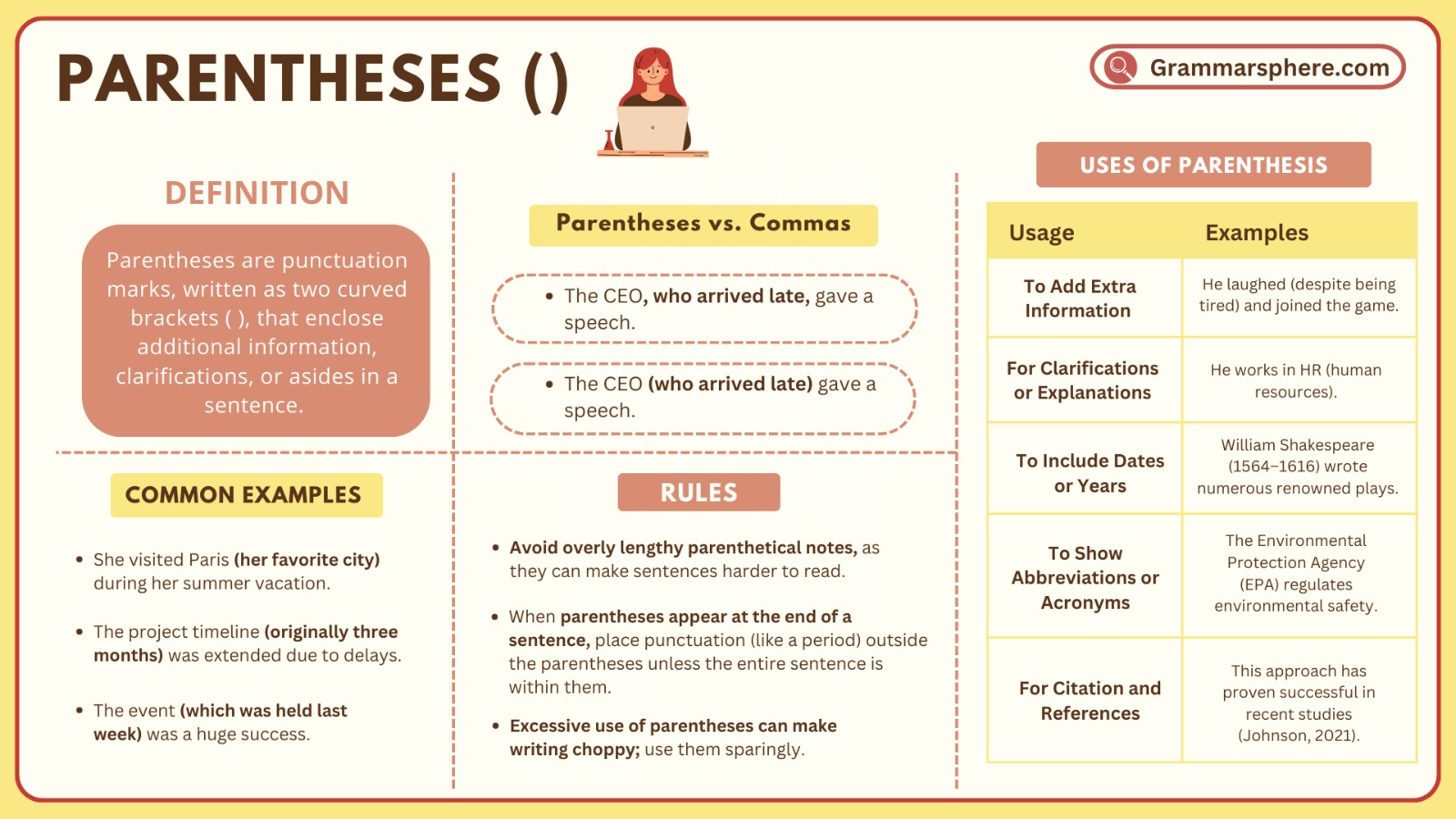
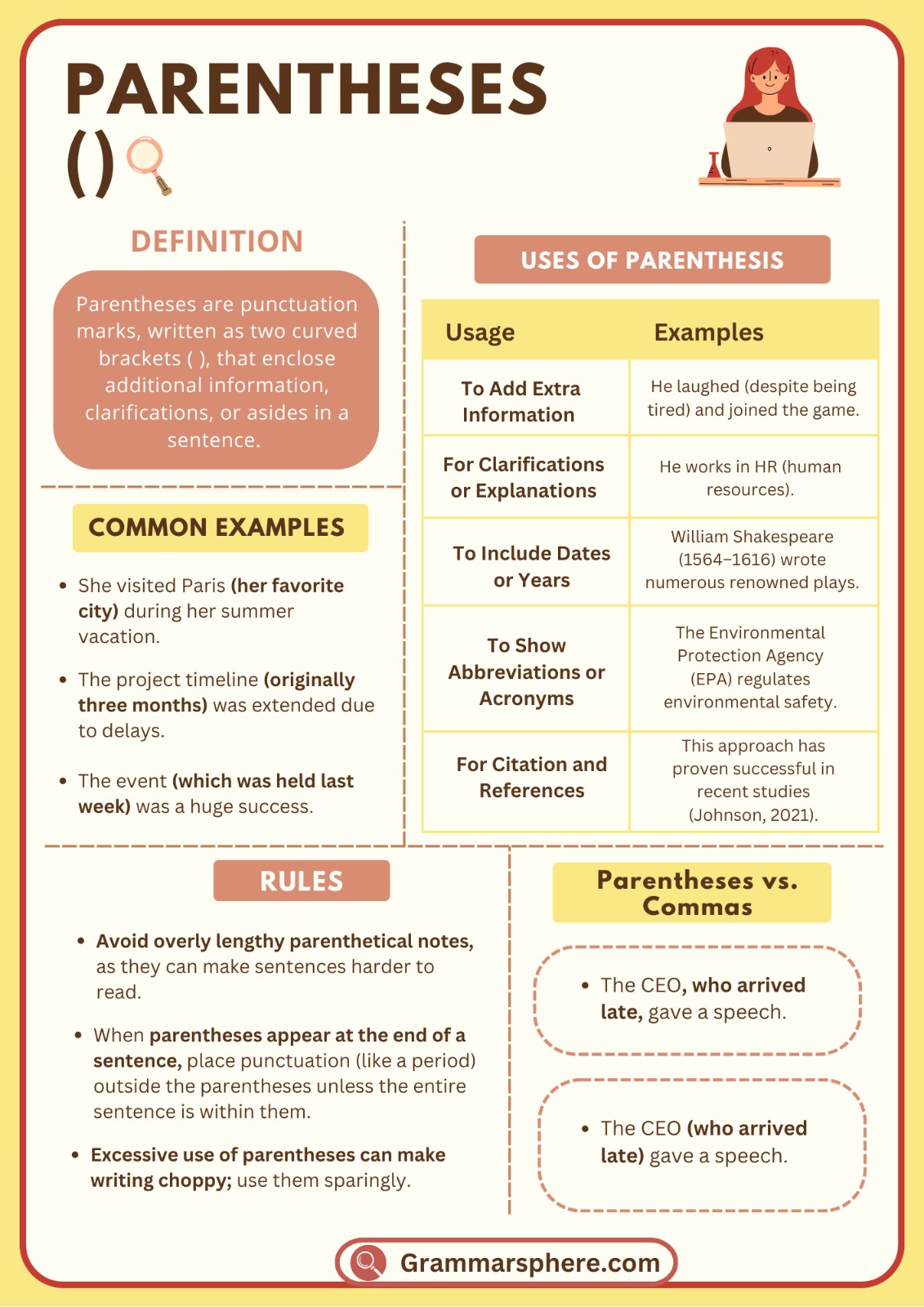
Parentheses ( ) are punctuation marks used to enclose additional information, explanations, examples, or clarifications within a sentence. The information inside parentheses adds useful detail but is usually not essential to the main meaning of the sentence.
Parentheses can contain a word, phrase, number, or even a complete sentence. They help separate extra information from the main text and make the intended meaning clearer.
Example:
Sarah moved to Lahore (the capital of Punjab) last year.
What Are Parentheses?
Parentheses ( ) are a pair of curved punctuation marks used to set off supplementary or nonessential information from the main part of a sentence. The information inside parentheses may provide an explanation, example, clarification, or additional detail.
A sentence should usually still make sense if the information inside the parentheses is removed.
Examples:
- The meeting will take place on Monday (October 12) at 10 a.m.
- Maya visited Kyoto (a historic city in Japan) during her trip.
- Please submit the application (including all required documents) by Friday.
In each example, the information inside the parentheses adds useful detail, but the main sentence remains understandable without it.
When to Use Parentheses
Parentheses are used to include additional information that is helpful but not essential to the main meaning of a sentence. They can be used in several common situations.
Adding Extra Information
Parentheses can add supplementary details or background information.
- The concert (which was sold out) was amazing.
- Our new teacher (who recently moved from Canada) starts on Monday.
Adding Explanations or Clarifications
Parentheses can provide a brief explanation or clarification without interrupting the main sentence.
- The students visited the laboratory (a room used for scientific experiments).
- The final payment (including the service charge) is due tomorrow.
Introducing Abbreviations
Parentheses are commonly used to give an abbreviation after its full form.
- The World Health Organization (WHO) was established in 1948.
- She works in human resources (HR).
Adding Dates or Other Supplementary Details
Parentheses can include dates, locations, or other details when the information is supplementary to the main sentence.
- William Shakespeare (1564–1616) was an English playwright.
- The conference will be held in Islamabad (Pakistan) this year.
Giving Citations or References
In some academic citation styles, parentheses are used to provide source information within the text.
- Regular exercise can improve overall well-being (Smith, 2022).
Parenthesis vs. Parentheses
The words parenthesis and parentheses are closely related, but they are not used in exactly the same way. Parenthesis is singular, while parentheses is plural.
| Term | Meaning | Example |
|---|---|---|
| Parenthesis | The singular form. It can refer to one parenthetical mark or to information inserted as an aside in a sentence. | He left early (before the meeting started). The inserted information is a parenthesis. |
| Parentheses | The plural form. It commonly refers to the pair of curved marks ( ) used to enclose additional information. | She bought apples (her favorite fruit) and oranges. The marks ( ) are parentheses. |
Key Point: Use parenthesis when referring to the singular form and parentheses when referring to the pair of punctuation marks.
Rules for Using Parentheses
When using parentheses, follow these basic punctuation rules to keep your writing clear and correct.
Place Sentence Punctuation Outside Parentheses
When the information in parentheses is part of a larger sentence, the punctuation that ends the main sentence usually comes after the closing parenthesis.
- We visited the museum (which opened in 1950).
- She bought several items (books, pens, and notebooks).
Punctuate a Complete Parenthetical Sentence Correctly
When an entire sentence appears independently inside parentheses, begin it with a capital letter and place its ending punctuation inside the closing parenthesis.
- The meeting was canceled. (The manager announced the decision this morning.)
When a complete sentence appears parenthetically within another sentence, it does not normally take a period before the closing parenthesis.
- The meeting (we had expected it to last two hours) ended early.
Do Not Add Unnecessary Punctuation Before Parentheses
Avoid placing a comma, colon, or semicolon immediately before an opening parenthesis unless that punctuation is required by the structure of the sentence.
- Correct: The conference (held every year) attracts hundreds of visitors.
- Incorrect: The conference, (held every year) attracts hundreds of visitors.
Avoid Overusing Parentheses
Too many parentheses can interrupt the flow of writing and make sentences difficult to read. Use them when the additional information is useful but secondary to the main point.
- Clear: The new library (opened in May) has more than 20,000 books.
Make Sure the Main Sentence Still Works
Information inside parentheses is usually supplementary. The main sentence should generally remain grammatically complete and understandable when the parenthetical information is removed.
- The new library (near the university) closes at 8 p.m.
- Without the parentheses: The new library closes at 8 p.m.
Parentheses vs. Brackets
Parentheses ( ) and brackets [ ] are different punctuation marks. Parentheses are commonly used to add supplementary or nonessential information to a sentence, while brackets are mainly used to add or change information within quoted material.
| Punctuation Mark | Main Use | Example |
|---|---|---|
| Parentheses ( ) | Add supplementary information to the writer’s own sentence | The museum (which opened in 1995) attracts many visitors. |
| Brackets [ ] | Add clarification or information within quoted material | “She [Maria] arrived before noon.” |
Key Point: Parentheses usually add extra information to your own writing, while brackets are commonly used to insert clarification into someone else’s quoted words.
Parentheses Examples in Sentences
Parentheses can be used in different situations to add supplementary information without changing the main meaning of a sentence. Here are some common examples:
- My brother (who lives in Toronto) is visiting us next month.
- The meeting will take place on Monday (October 12) at 10 a.m.
- The World Health Organization (WHO) was established in 1948.
- Sarah bought a new laptop (her third one in five years) for work.
- William Shakespeare (1564–1616) wrote many famous plays.
- The conference will be held in Lahore (Pakistan) this year.
- We finally reached the hotel (after a three-hour delay) before midnight.
- The final exam (worth 40% of the course grade) will be held next week.
- Ahmed invited his cousins (Ali and Hassan) to the wedding.
- The new library (which opened last month) has more than 20,000 books.
In each example, the information inside the parentheses provides an additional detail, explanation, clarification, or context while the main sentence remains understandable without it.
Common Mistakes with Parentheses
Parentheses are simple to use, but incorrect punctuation or unnecessary parenthetical information can make a sentence confusing. Here are some common mistakes to avoid.
Putting the Final Period in the Wrong Place
When the parenthetical information is part of a larger sentence, the period normally comes after the closing parenthesis.
Incorrect: We visited the museum (which opened last year.)
Correct: We visited the museum (which opened last year).
Using an Unnecessary Comma Before Parentheses
Do not place a comma immediately before an opening parenthesis unless the sentence itself requires it.
Incorrect: My brother, (who lives in Canada) is visiting us.
Correct: My brother (who lives in Canada) is visiting us.
Putting Essential Information in Parentheses
Parentheses generally contain supplementary information. Do not place information inside parentheses if it is necessary to understand the basic meaning of the sentence.
Unclear: Students must submit (the final assignment) by Friday.
Better: Students must submit the final assignment by Friday.
Using Too Many Parentheses
Too many parentheses can interrupt the flow of a sentence and make it difficult to read.
Unclear: The manager (who joined last year) (from our London office) (with ten years of experience) led the meeting.
Better: The manager, who joined last year from our London office and has ten years of experience, led the meeting.
Forgetting the Closing Parenthesis
Every opening parenthesis should have a corresponding closing parenthesis.
Incorrect: The event (scheduled for Friday will begin at noon.
Correct: The event (scheduled for Friday) will begin at noon.
FAQs
1. What are parentheses used for?
Parentheses ( ) are used to add extra or nonessential information to a sentence. This information may include an explanation, clarification, example, date, abbreviation, or additional detail.
Example: The museum (which opened in 1995) attracts many visitors.
2. Does punctuation go inside or outside parentheses?
When the information in parentheses is part of a larger sentence, the final punctuation usually goes outside the closing parenthesis.
Example: We visited the museum (which opened last year).
If a complete sentence stands independently inside parentheses, its ending punctuation goes inside the closing parenthesis.
Example: The museum was closed. (We returned the next day.)
3. What is the difference between parentheses and brackets?
Parentheses ( ) usually add supplementary information to a sentence. Brackets [ ] are commonly used to add clarification or information within quoted material.
Parentheses: Sarah moved to Lahore (the capital of Punjab) last year.
Brackets: “She [Sarah] moved there last year.”
4. What is the difference between parenthesis and parentheses?
Parenthesis is the singular form, while parentheses is the plural form. When referring to the pair of curved punctuation marks ( ), use parentheses.
5. Can parentheses be used in formal writing?
Yes. Parentheses can be used in formal and academic writing to provide supplementary information, dates, abbreviations, citations, or brief clarifications. However, they should be used carefully because too many parentheses can make writing difficult to read.
You May Also Like

Leave a Comment