

Table of Contents
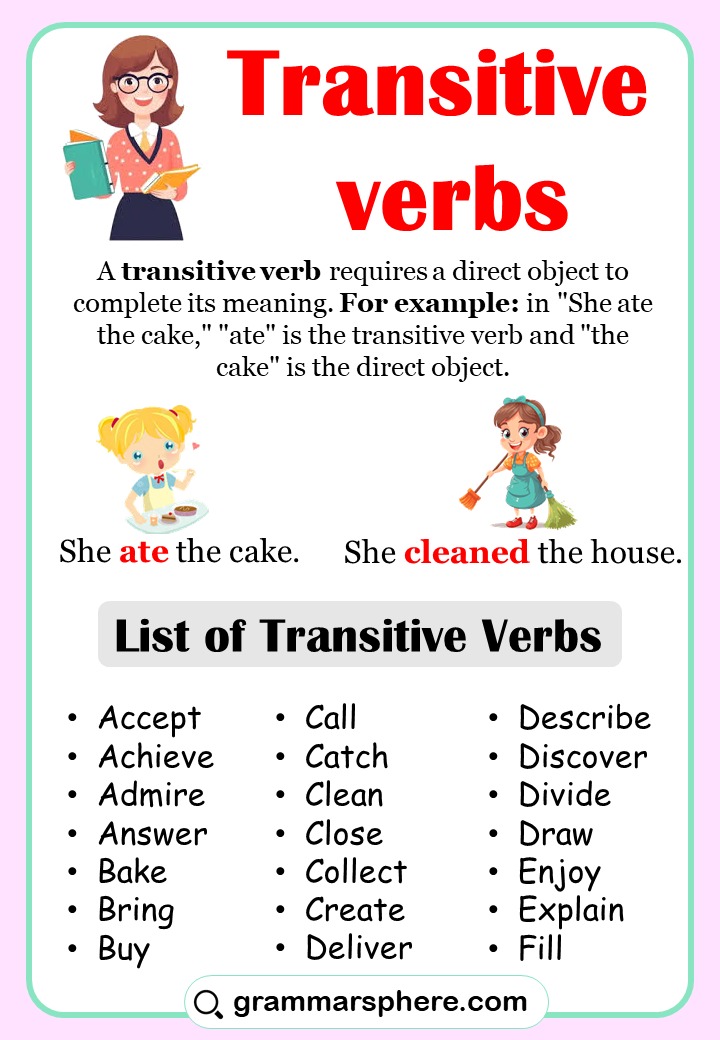
Transitive verbs are action words that need a direct object to complete their meaning. Without the object, the sentence feels incomplete. For example, in She writes a letter, writes is a transitive verb, and a letter is the direct object.
Transitive verbs are important for clear communication in English. This post will explain how to identify and use them with examples, rules, and common mistakes. Let’s make learning transitive verbs easy for you!
What Is a Transitive Verb?
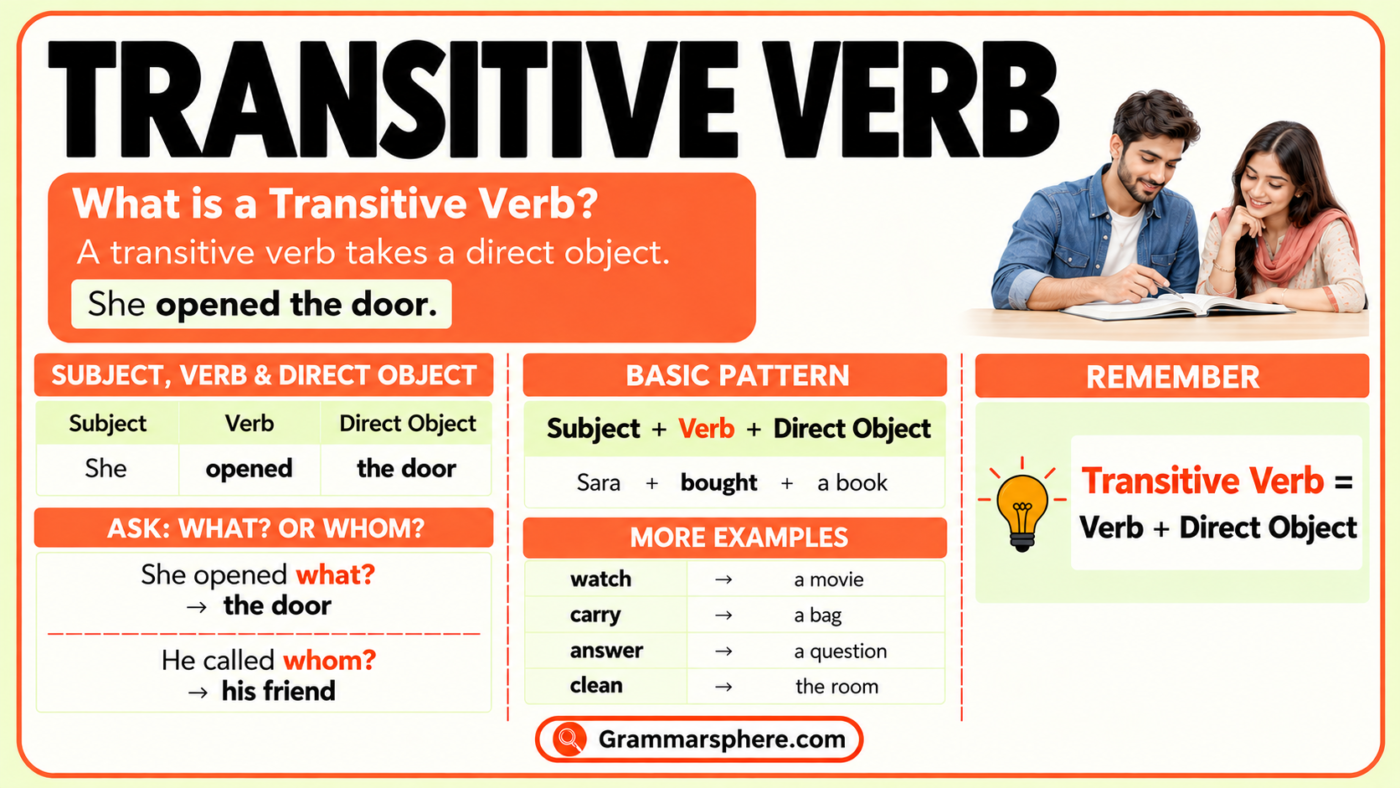
A transitive verb is a verb that takes a direct object.
Look at this sentence:
The boy kicked the ball.
- Subject: the boy
- Transitive Verb: kicked
- Direct Object: the ball
The direct object tells us who or what is directly affected by the action.
We can ask:
The boy kicked what?
Answer: the ball
So kicked is being used transitively.
Another example:
Maya called her friend.
Called whom?
her friend
Therefore, called is transitive and her friend is its direct object.
A common basic sentence pattern is:
Subject + Transitive Verb + Direct Object
For example:
Sara + bought + a book.
More examples:
- We watched the movie.
- He carried the bag.
- She answered the question.
- The teacher praised the students.
- I need your help.
The direct object can be a noun, pronoun, or noun phrase.
She opened the window.
window = noun functioning as the direct object
I called him.
him = object pronoun functioning as the direct object
She bought a beautiful red dress.
a beautiful red dress = noun phrase functioning as the direct object
The central idea is simple:
Transitive Verb + Direct Object
Types of Transitive Verbs
Transitive verbs can appear in different sentence patterns depending on what follows the verb. Three useful patterns are monotransitive, ditransitive, and complex transitive.
Monotransitive Verbs
A monotransitive verb takes one direct object.
The pattern is:
Subject + Verb + Direct Object
For example:
She opened the window.
- She = Subject
- opened = Verb
- the window = Direct Object
More examples:
He bought a laptop.
We watched the match.
The child broke the glass.
Each verb has one direct object.
Ditransitive Verbs
A ditransitive verb can take two objects: an indirect object and a direct object.
For example:
She gave me a book.
- She = Subject
- gave = Verb
- me = Indirect Object
- a book = Direct Object
The direct object usually identifies the thing involved:
gave what? → a book
The indirect object commonly identifies the recipient:
gave a book to whom? → me
Another example:
The teacher taught us English.
- us = Indirect Object
- English = Direct Object
Common verbs that can occur in ditransitive patterns include:
give, send, show, tell, teach, lend, offer
With many such verbs, the recipient can also appear in a prepositional phrase:
She gave me a book.
She gave a book to me.
The structures differ, but both can express a similar relationship between the action, the thing transferred, and the recipient.
Complex Transitive Verbs
A complex transitive verb occurs in a pattern containing a direct object followed by an object complement.
The object complement gives more information about the direct object, such as what it becomes, what it is considered to be, or a resulting state.
For example:
They elected him president.
- They = Subject
- elected = Verb
- him = Direct Object
- president = Object Complement
The word president gives additional information about him.
Another example:
She painted the door red.
- the door = Direct Object
- red = Object Complement
The adjective red describes the resulting state of the door.
More examples:
They named the baby Adam.
The news made her happy.
We found the room empty.
The important pattern is:
Subject + Verb + Direct Object + Object Complement

How to Identify Transitive Verbs
To identify a transitive verb, focus on the relationship between the verb and its direct object.
1. Find the main verb.
Consider:
The students completed the assignment.
The verb is completed.
2. Ask what? or whom? after the verb.
Completed what?
the assignment
3. Check whether the answer is the direct object.
In this sentence, the assignment is directly connected to the action of completed.
Therefore:
completed = Transitive Verb
the assignment = Direct Object
Consider another sentence:
Maria invited her friends.
Invited whom?
her friends
So invited is transitive.
Compare this with:
The children laughed loudly.
Laughed what?
Laughed whom?
There is no direct object. Loudly is an adverb describing how they laughed.
Therefore, laughed is intransitive in this sentence.
The what? or whom? test is useful for learners, but it should not be used mechanically. Always check whether the answer actually functions as the direct object of the verb.

Common Transitive Verbs
Many everyday English verbs commonly take direct objects.
| Verb | Example |
|---|---|
| answer | She answered the question. |
| bring | Please bring your ID. |
| buy | He bought a laptop. |
| carry | She carried the box. |
| contact | Please contact the manager. |
| enjoy | We enjoyed the trip. |
| find | I found my keys. |
| like | She likes coffee. |
| need | We need more time. |
| open | He opened the door. |
| receive | She received a message. |
| take | He took my umbrella. |
| use | I use this computer. |
| want | They want a new car. |
| watch | We watched the match. |
These examples show the verbs with direct objects. However, you should not assume that every verb always has the same transitivity.
Transitive and Intransitive Uses
The main difference between a transitive and an intransitive use is the presence or absence of a direct object.
A transitive verb use has a direct object:
She opened the door.
Opened what?
the door
An intransitive verb use has no direct object:
The door opened.
There is no direct object after opened.
Some verbs can therefore be used both transitively and intransitively.
Compare:
We ate dinner.
dinner = Direct Object
→ Transitive use
We already ate.
No direct object
→ Intransitive use
Another example:
He drives a truck.
a truck = Direct Object
→ Transitive use
He drives carefully.
carefully = Adverb
No direct object
→ Intransitive use
And:
She started the car.
the car = Direct Object
→ Transitive use
The car started.
No direct object
→ Intransitive use
This is why it is often more useful to examine how a verb is being used in a particular sentence instead of assuming that the verb must always belong to only one category.
Transitive Verbs with Prepositional Phrases
A transitive verb can have a direct object followed by a prepositional phrase.
For example:
She put the bag on the table.
- put = Verb
- the bag = Direct Object
- on the table = Prepositional Phrase
Another example:
He placed the keys in the drawer.
- the keys = Direct Object
- in the drawer = Prepositional Phrase
It is important to distinguish a direct object from the object of a preposition.
Compare:
She entered the room.
Here, the room is the direct object of entered.
But:
She walked into the room.
Here, the room follows the preposition into. It is the object of the preposition, not the direct object of walked.
Similarly:
I heard the radio.
the radio = Direct Object
But:
I listened to the radio.
the radio is the object of the preposition to.
A noun appearing after a verb is therefore not automatically a direct object. Its grammatical relationship with the verb must be checked.
Transitive Verbs in the Passive Voice
Transitive constructions are closely connected with the passive voice because the direct object of an active sentence can typically become the subject of the corresponding passive sentence.
Consider:
Active: The chef prepared the meal.
In the active sentence:
- the chef = Subject
- prepared = Transitive Verb
- the meal = Direct Object
In the passive:
Passive: The meal was prepared by the chef.
The original direct object the meal becomes the subject of the passive sentence.
Another example:
Active: Sara wrote the letter.
Passive: The letter was written by Sara.
And:
Active: The police arrested the man.
Passive: The man was arrested by the police.
This relationship can help learners understand why transitivity matters in passive constructions.
However, passive transformation should not be treated as the only test for identifying transitive verbs. Some grammatically possible passive constructions may be uncommon or unnatural in normal usage.

Common Mistakes with Transitive Verbs
One common mistake is adding an unnecessary preposition after a verb that takes its object directly.
Incorrect:
We discussed about the problem.
Correct:
We discussed the problem.
The verb discuss can take the problem directly as its object.
Another common mistake is using an unnecessary preposition with enter when it means to go into a place.
Incorrect:
She entered into the room.
Correct:
She entered the room.
Another mistake is using the wrong pronoun form as the direct object.
Incorrect:
The teacher called he.
Correct:
The teacher called him.
Because the pronoun is functioning as an object, the object form him is required.
Learners should also avoid assuming that every word after a verb is its direct object.
He slept peacefully.
peacefully is an adverb, not a direct object.
She walked into the building.
the building is the object of the preposition into, not the direct object of walked.
Transitive Verbs Exercise
Identify the transitive verb and its direct object. If the verb is being used intransitively, write intransitive.
- Sara closed the window.
- The baby slept peacefully.
- He bought a new phone.
- The children laughed loudly.
- We watched the match.
- The door opened slowly.
- My sister wrote a letter.
- They arrived yesterday.
- The dog chased the cat.
- He drives carefully.
- She sent me an email.
- They painted the wall blue.
Answers
- closed — Direct Object: the window
- slept — Intransitive
- bought — Direct Object: a new phone
- laughed — Intransitive
- watched — Direct Object: the match
- opened — Intransitive
- wrote — Direct Object: a letter
- arrived — Intransitive
- chased — Direct Object: the cat
- drives — Intransitive in this sentence
- sent — Indirect Object: me; Direct Object: an email
- painted — Direct Object: the wall; Object Complement: blue
FAQs
What is a transitive verb?
A transitive verb is a verb that takes a direct object. In “She opened the door,” opened is transitive and the door is its direct object.
What is an example of a transitive verb?
Buy can be used as a transitive verb:
She bought a book.
The direct object is a book.
How can I identify a transitive verb?
Find the verb and check whether it has a direct object. Asking what? or whom? after the verb can help, but you should also make sure the answer actually functions as the direct object.
What are the main types of transitive verbs?
Three useful patterns are monotransitive verbs, which take one direct object; ditransitive verbs, which can take a direct and an indirect object; and complex transitive verbs, which take a direct object followed by an object complement.
Can a verb be both transitive and intransitive?
Yes. Compare “She opened the door” with “The door opened.” The first use is transitive because it has a direct object; the second is intransitive because it does not.
Is a noun after a verb always a direct object?
No. In “She walked into the room,” the room is the object of the preposition into, not the direct object of walked.
Can transitive verbs be used in the passive voice?
Transitive constructions can typically form passive constructions because the direct object of the active sentence can become the subject of the passive sentence. For example, “Sara wrote the letter” can become “The letter was written by Sara.”
Final Takeaway
A transitive verb takes a direct object.
The basic pattern is:
Subject + Transitive Verb + Direct Object
She opened the door.
Transitive verbs can occur in different patterns, including monotransitive, ditransitive, and complex transitive structures. Some verbs can also be used either transitively or intransitively depending on the sentence.
The most important habit is to examine the verb in its actual sentence and check whether it has a direct object.
You May Also Like
Leave a Comment