

Table of Contents
The past perfect continuous tense describes an action or situation that continued for a period of time before another point or event in the past. It is formed with had been + verb-ing and is especially useful for emphasizing the duration or ongoing nature of an earlier past activity.
She had been studying for two hours before her friend arrived.
The tense can sometimes be confused with the past perfect, but the two forms do not always have the same focus. The past perfect continuous often emphasizes an ongoing activity or its duration, while the past perfect commonly focuses on a completed action or result.
This lesson explains the meaning, structure, uses, and examples of the past perfect continuous tense, including its negative and question forms and its important differences from the past perfect tense.
Past perfect continuous tense
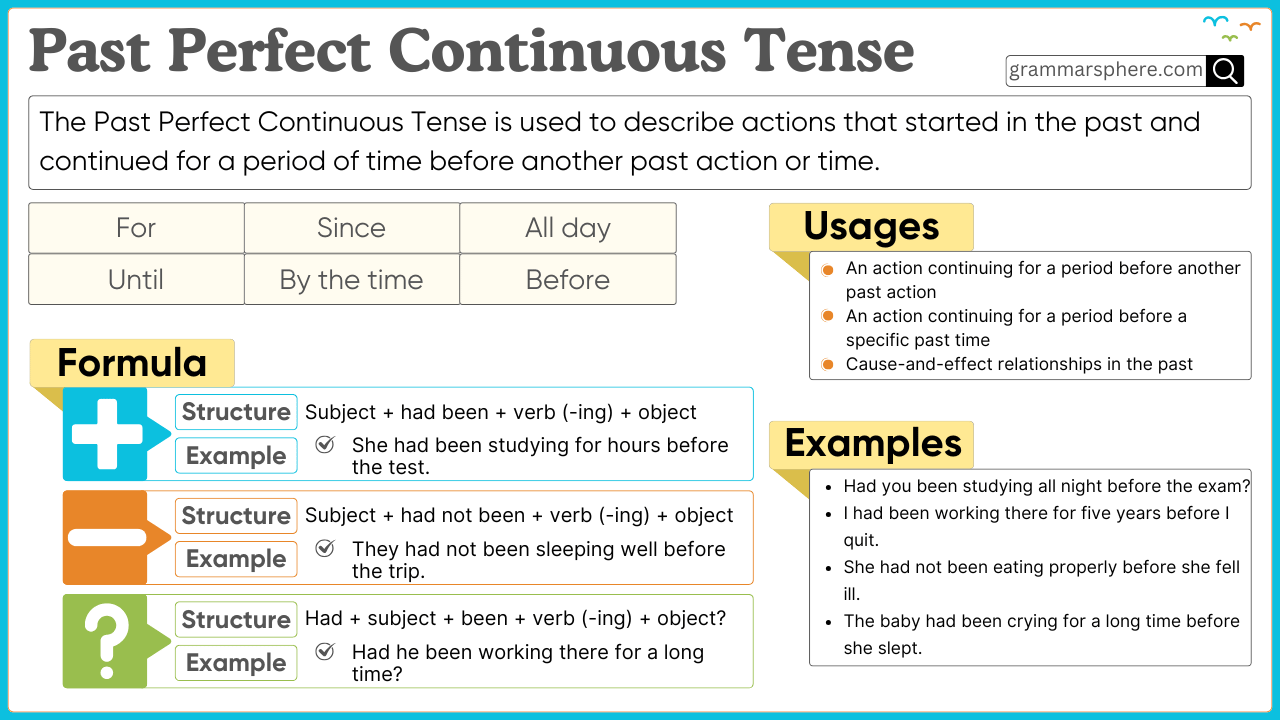
It describes an action or situation that started in the past and continued for a period of time before another past action or point in time. It usually emphasizes the duration or ongoing nature of the earlier activity.
She had been studying for two hours before her friend arrived.
Here, the studying continued for two hours before the friend’s arrival.
Structure of the Past Perfect Continuous Tense
The Past Perfect Continuous Tense is formed with had been + the -ing form of the verb.
Basic Structure:
Subject + had + been + verb(-ing)
The auxiliary verb had is used with all subjects.
Affirmative Sentences
Structure:
Subject + had been + verb(-ing) + rest of the sentence
- Aisha had been reading for two hours before she fell asleep.
- They had been playing football since morning before the rain started.
- He had been working all day before he went home.
Negative Sentences
Structure:
Subject + had not been + verb(-ing) + rest of the sentence
- Aisha had not been sleeping well before the exam.
- They had not been waiting long when the bus arrived.
- He had not been feeling well before he went to the doctor.
The contraction hadn’t been is also common:
- She hadn’t been working there for very long.
Interrogative Sentences
Structure:
Had + subject + been + verb(-ing) + rest of the sentence?
- Had Aisha been reading for two hours before she fell asleep?
- Had they been waiting long before the bus arrived?
- Had he been working all day?
Wh-Questions
Structure:
Wh-word + had + subject + been + verb(-ing) + rest of the sentence?
- How long had Aisha been reading before she fell asleep?
- Why had they been waiting outside?
- What had he been doing before you arrived?
- Where had she been working before she moved?

Time Expressions in the Past Perfect Continuous Tense
Time expressions are commonly used with the Past Perfect Continuous Tense to show how long an action had been continuing, when it started, or when it stopped in relation to another past event.
For — Duration
Use for to show the length of time an action continued.
- I had been studying for three hours before the power went out.
- They had been waiting for twenty minutes when the bus arrived.
Since — Starting Point
Use since to show when an action or situation started.
- She had been working there since 2015 before she resigned.
- He had been living in Karachi since January when he received the job offer.
Before — Earlier Past Action
Use before to connect an ongoing past action with another event that happened later.
- They had been playing football before the rain started.
- She had been studying before her friend called.
Until — Ending Point
Use until to show that an activity continued up to a particular past time or event.
- We had been waiting until the shop opened.
- He had been working until the manager arrived.
Other Common Time Expressions
The Past Perfect Continuous can also appear with expressions such as all day, all morning, all night, and for a long time.
- She had been working all morning before she took a break.
- It had been raining all night before the weather cleared.
- They had been living there for a long time before they moved.
Key Point: For shows a duration, since shows a starting point, and before and until help show the time relationship between past events.
Uses of the Past Perfect Continuous Tense
The Past Perfect Continuous Tense is mainly used to describe an ongoing or repeated activity that continued for a period of time before another point or event in the past.
Duration Before Another Past Event
Use the Past Perfect Continuous to show how long an action had been continuing before another past event occurred.
- Ahmed had been studying for three hours before he took a break.
- They had been waiting for the bus for 30 minutes when it finally arrived.
- Sara had been working there for five years before she moved to another company.
This use often appears with for and since.
Cause of a Past Situation or Result
Use the Past Perfect Continuous when an earlier ongoing activity explains the cause of a later past situation or result.
- She was exhausted because she had been working all day.
- His clothes were dirty because he had been playing football.
- The ground was wet because it had been raining.
Here, the earlier activity explains why the later situation existed.
Repeated Activities Before a Past Point
The Past Perfect Continuous can also describe an activity that happened repeatedly over a period of time before another past event or point.
- He had been calling her every day before she finally answered.
- They had been practicing for months before the final performance.
- She had been visiting the library regularly before she moved away.
In these examples, the activity happened repeatedly over a period leading up to a later point in the past.
Adverb Placement
Adverbs can be used with the Past Perfect Continuous Tense to give more information about an ongoing past action. Their position depends on the type of adverb.
Between “had” and “been”
Adverbs such as always, often, and never commonly appear between had and been.
- She had always been working hard.
- They had often been discussing the problem.
- He had never been sleeping well before he changed jobs.
After the Main Verb or Object
Adverbs of manner usually come after the main verb or its object.
- She had been working carefully on the project.
- They had been practicing football seriously before the tournament.
- He had been driving the car slowly because of the fog.
Key Point: The position of an adverb depends on its type. Frequency adverbs often appear within had been, while adverbs of manner usually come after the main verb or object.
Past Perfect Continuous vs. Present Perfect Continuous
The Past Perfect Continuous and Present Perfect Continuous both describe actions continuing over a period of time. The main difference is the time reference.
| Past Perfect Continuous | Present Perfect Continuous |
|---|---|
| had been + verb-ing | has/have been + verb-ing |
| Refers to a period before a point or event in the past | Refers to a period that continues up to the present or has a present connection |
| I had been studying for two hours before Ali arrived. | I have been studying for two hours. |
| She had been working there for five years before she resigned. | She has been working there for five years. |
Compare:
- I had been waiting for an hour before the bus arrived.
→ The waiting happened before another past event. - I have been waiting for an hour.
→ The waiting has continued up to now.
Past Perfect Continuous Tense Examples
The following examples show how the Past Perfect Continuous Tense is used in affirmative, negative, and interrogative sentences.
Affirmative
- Fatima had been cooking for an hour when the guests arrived.
- We had been working on the project since morning when the meeting started.
- The baby had been crying for several minutes before his mother picked him up.
- The teacher had been explaining the topic when the bell rang.
- The students had been waiting anxiously for the exam results.
- It had been raining all night, so the roads were wet.
Negative
- Bilal had not been sleeping well before his exams began.
- They had not been attending classes regularly before the final test.
- She had not been working on the assignment for very long when the deadline approached.
- We had not been practicing enough before the tournament began.
- I had not been studying regularly before the mock test.
- He had not been feeling well for several days before he visited the doctor.
Interrogative
- Had your brother been studying for long before the test started?
- Had they been exercising regularly before the competition?
- Had she been working on the project for several weeks before the deadline?
- Had he been learning Arabic before he traveled abroad?
- Had you been waiting long before the gates opened?
- Had it been raining before you left the house?
Common Mistakes with the Past Perfect Continuous Tense
Learners often make mistakes with the verb form, helping verbs, and time expressions when using the Past Perfect Continuous Tense.
Using the Base Form Instead of the -ing Form
Use the -ing form of the main verb after had been.
❌ He had been play football before it started raining.
✅ He had been playing football before it started raining.
❌ She had been work all morning.
✅ She had been working all morning.
Using the Past Participle After “Had Been”
Do not use the past participle when forming the Past Perfect Continuous.
❌ She had been lived there for five years before she moved.
✅ She had been living there for five years before she moved.
Using “Has Been” or “Have Been” Instead of “Had Been”
Use had been when the ongoing activity occurred before another point or event in the past.
❌ They have been waiting for an hour before the bus arrived.
✅ They had been waiting for an hour before the bus arrived.
Confusing “For” and “Since”
Use for with a duration and since with a starting point.
❌ He had been working there since three years.
✅ He had been working there for three years.
❌ She had been studying for 8 o’clock.
✅ She had been studying since 8 o’clock.
Using the Past Perfect Continuous for a Completed Result
The Past Perfect Continuous usually emphasizes the duration or ongoing nature of an activity, not simply its completion.
❌ She had been writing three reports before the meeting.
✅ She had written three reports before the meeting.
Use the Past Perfect when the important point is the completed result or number of completed items.
Key Point: Use had been + verb-ing for an activity that had been continuing before another past time or event.
FAQs
1. What is the Past Perfect Continuous Tense?
The Past Perfect Continuous Tense describes an activity that had been continuing for a period of time before another event or point in the past.
Example: She had been studying for two hours before her friend arrived.
2. What is the formula of the Past Perfect Continuous Tense?
The basic formula is:
Subject + had + been + verb-ing
Example: They had been waiting for an hour.
For negative sentences, use had not been + verb-ing. For questions, place had before the subject.
3. When do we use the Past Perfect Continuous Tense?
We mainly use it to show duration before another past event, explain the cause of a past situation, or describe an activity that happened repeatedly over a period before a past point.
Example: He was tired because he had been working all day.
4. What is the difference between Past Perfect and Past Perfect Continuous?
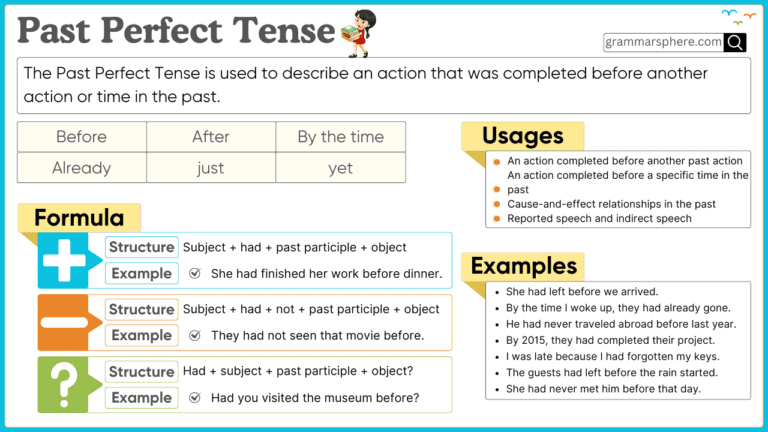
The Past Perfect usually emphasizes a completed action or result, while the Past Perfect Continuous emphasizes the duration or ongoing nature of an earlier activity.
- She had written three reports before lunch. → completed result
- She had been writing reports all morning. → ongoing activity
5. What is the difference between Present Perfect Continuous and Past Perfect Continuous?
The Present Perfect Continuous connects an earlier activity with the present, while the Past Perfect Continuous describes an activity continuing before a point or event in the past.
- I have been studying for two hours. → connected to now
- I had been studying for two hours before Ali arrived. → before a past event
Read More


Leave a Comment