

Table of Contents
Many learners find the past perfect tense confusing because it describes actions completed before another past event. When should you use “had” + past participle? How does it differ from the simple past tense? This blog post helps learn past perfect tense with clear rules, structure, and examples. Mastering this tense will improve your ability to describe sequences of past events accurately.
What Is the Past Perfect Tense?
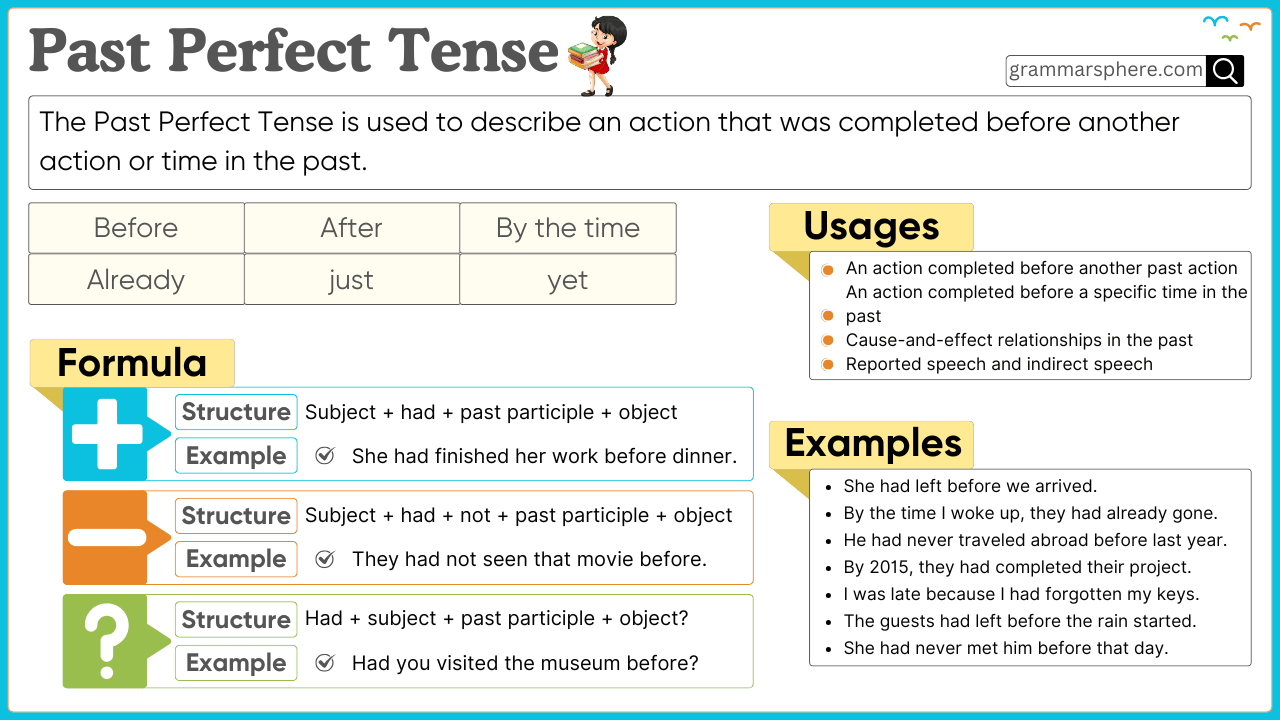
The Past Perfect Tense is used to describe an action that was completed before another action or a specific time in the past. It helps show which of two past actions happened first.
The Past Perfect is formed with had + past participle (V3).
Example:
She had finished her homework before her mother came home.
In this sentence, had finished happened first, and came home happened later.
Past Perfect Tense Structure and Examples
The Past Perfect Tense is formed using had + past participle (V3). The auxiliary verb had is used with all subjects.
Affirmative Sentences
Structure: Subject + had + past participle (V3) + rest of the sentence
- Aisha had finished her homework before dinner.
- They had left the office before I arrived.
Negative Sentences
Structure: Subject + had not + past participle (V3) + rest of the sentence
- Aisha had not finished her homework before dinner.
- They had not left the office when I arrived.
The contraction hadn’t can also be used instead of had not.
- Aisha hadn’t finished her homework before dinner.
Interrogative Sentences
Structure: Had + subject + past participle (V3) + rest of the sentence?
- Had Aisha finished her homework before dinner?
- Had they left the office when you arrived?
Wh-Questions
Structure: Wh-word + had + subject + past participle (V3) + rest of the sentence?
- Why had Aisha finished her homework so early?
- When had they left the office?
- Where had he gone before the meeting started?
Adverb Placement in the Past Perfect Tense
Adverbs can appear in different positions in the Past Perfect Tense, depending on the type of adverb and the meaning of the sentence.
- Between “had” and the past participle: She had always wanted to visit Turkey.
- At the end of the sentence: They had completed the project successfully.
- Before “had” for emphasis: She never had experienced anything like it before.
Uses of the Past Perfect Tense
The Past Perfect Tense is used to talk about actions or situations that happened before another action or point in the past. Here are its main uses.
To Show the Sequence of Past Events
The Past Perfect helps show that one past action happened before another.
- Ahmed had left before we reached the station.
- The guests had already eaten when we arrived at the party.
To Describe a Completed Action Before a Specific Time
The Past Perfect can describe an action that was completed before a particular time in the past.
- By 10 p.m., they had finished their work.
- By the time she turned 18, Aisha had visited five countries.
To Talk About Unreal Past Conditions
The Past Perfect is used in the if-clause of the third conditional to talk about an unreal or hypothetical situation in the past.
- If he had studied, he would have passed the exam.
- If they had left earlier, they wouldn’t have missed the flight.
To Describe a State or Situation Before a Past Event
The Past Perfect can describe a state or situation that continued for a period of time before another past event.
- She had worked there for five years before she moved to another city.
- They had lived in Istanbul for a decade before they relocated to Dubai.
- He had known her for years before they started working together.
Common Time Expressions with the Past Perfect Tense
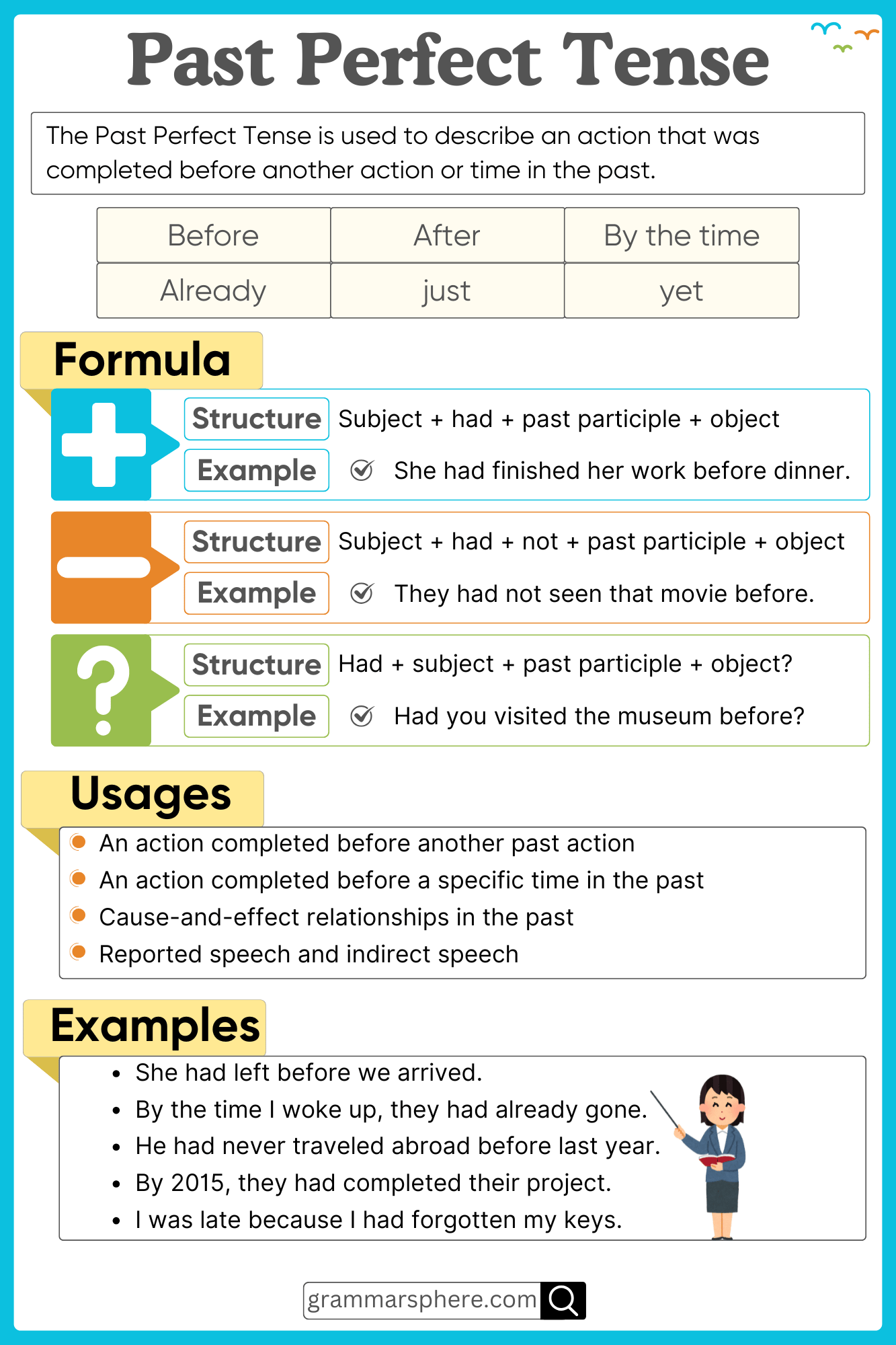
Several time expressions are commonly used with the Past Perfect Tense to show the order or timing of past actions.
- Before: She had left before I arrived.
- After: After she had finished her work, she went home.
- By the time: By the time we arrived at the station, the train had left.
- Already: He had already completed the project before the deadline.
- Just: I had just finished my meal when he called.
- Never: She had never visited London before that trip.
- Until then: Until then, I had never seen snow.
Uses of the Past Perfect Tense
1. To Show the Sequence of Past Events
The past perfect tense helps clarify that one event happened before another in the past.
- Ahmed had left before we reached the station.
- The guests had already eaten when we arrived at the party.
2. To Describe a Completed Action Before a Specific Time
When an action is finished before a certain past time, we use the past perfect tense.
- By 10 PM, they had finished their work.
- By the time she turned 18, Aisha had traveled to five countries.
3. To Indicate an Unreal Condition in the Past
In conditional sentences (third conditional), the past perfect tense is used to talk about hypothetical situations that did not happen in the past.
- If he had studied, he would have passed the exam.
- If they had left earlier, they wouldn’t have missed the flight.
4. To Emphasize Duration Before Another Past Action
The past perfect tense is also used to highlight how long an action lasted before another past event occurred.
- She had worked there for five years before she moved to another city.
- They had lived in Istanbul for a decade before they relocated to Dubai.
Use of “Had” with All Subjects
In the Past Perfect Tense, the auxiliary verb had is used with all subjects, whether singular or plural.
| Subject | Auxiliary Verb |
|---|---|
| I | had |
| We | had |
| You | had |
| They | had |
| He | had |
| She | had |
| It | had |
Examples:
- I had finished my work.
- She had left before noon.
- They had completed the project.
Past Perfect vs. Simple Past
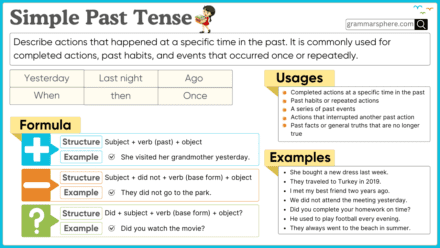
The Past Perfect and Simple Past both describe past actions, but they are used differently. The Simple Past describes an action that happened and finished in the past, while the Past Perfect shows that an action was completed before another past action or past point.
| Tense | Structure | Main Use | Example |
|---|---|---|---|
| Simple Past | Subject + past form (V2) | A completed action in the past | Aisha finished her homework at 7 p.m. |
| Past Perfect | Subject + had + past participle (V3) | An action completed before another past action or point | Aisha had finished her homework before her friend arrived. |
Compare these sentences:
- Ahmed left the office at 5 p.m.
→ This simply tells us about a completed past action. - Ahmed had left the office before I arrived.
→ The Past Perfect shows that Ahmed left first, and I arrived later.
When two past actions are mentioned, the Past Perfect can be used for the earlier action and the Simple Past for the later action.
- The train had left before we reached the station.
- She had completed the report before the meeting started.
- They had eaten dinner before the guests arrived..
Past Perfect Tense Examples
Here are examples of the Past Perfect Tense in affirmative, negative, and interrogative sentences.
Affirmative Sentences
- Aisha had packed her bags before the taxi arrived.
- We had locked the doors before we left the house.
- He had saved enough money before he bought a car.
- The guests had left before it started raining.
- I had completed my project before the deadline.
Negative Sentences
- Sara had not seen that movie before yesterday.
- They had not met each other before the event.
- I had not finished my homework before dinner.
- Ahmed had not heard about the new rule before the meeting.
- We had not visited that place before the trip.
Interrogative Sentences
- Had she cleaned the room before the guests arrived?
- Had you ever traveled abroad before that year?
- Had the baby fallen asleep before they returned?
- Had he called you before making the decision?
- Had we met before the conference?
Common Mistakes with the Past Perfect Tense
Learners often make mistakes with the Past Perfect Tense when choosing the verb form, using had, or deciding when the tense is necessary. Here are some common mistakes to avoid.
Using the Past Tense Instead of the Past Participle
After had, always use the past participle (V3), not the simple past form.
❌ He had went to the market before it rained.
✅ He had gone to the market before it rained.
❌ We had ate lunch before noon.
✅ We had eaten lunch before noon.
Using the Base Form After “Had”
Do not use the base form of the main verb directly after had.
❌ She had see that movie before.
✅ She had seen that movie before.
❌ They had leave before we arrived.
✅ They had left before we arrived.
Using “Has” or “Have” Instead of “Had”
The Past Perfect uses had with all subjects.
❌ She has finished the work before I arrived.
✅ She had finished the work before I arrived.
❌ They have left before the meeting started.
✅ They had left before the meeting started.
Using “Did” with the Past Perfect
Do not use did to form Past Perfect questions or negative sentences. Use had instead.
❌ Did she had finished her work before dinner?
✅ Had she finished her work before dinner?
❌ He did not had completed the task.
✅ He had not completed the task.
Using the Past Perfect for Both Actions Unnecessarily
When two past actions are mentioned, the Past Perfect usually identifies the earlier action, while the later action can use the Simple Past.
❌ She had left before I had arrived.
✅ She had left before I arrived.
Using the Past Perfect for both actions is often unnecessary when the sequence is already clear.
FAQs About the Past Perfect Tense
1. What is the Past Perfect Tense?
The Past Perfect Tense describes an action or situation that happened before another action or a particular point in the past. It is formed with had + past participle (V3).
Example: She had finished her work before the guests arrived.
2. When do we use the Past Perfect Tense?
We use the Past Perfect Tense mainly to show that one action happened before another past action or past reference point.
Example: The train had left before we reached the station.
The train left first, and we reached the station later.
3. What is the difference between Past Perfect and Simple Past?
The Simple Past describes a completed past action, while the Past Perfect shows that an action happened before another past action or point in time.
Simple Past: She left at 8 p.m.
Past Perfect: She had left before I arrived.
When two past actions are discussed, the Past Perfect can make it clear which action happened first.
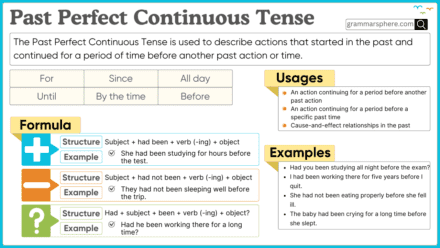
4. What is the difference between Past Perfect and Past Perfect Continuous?
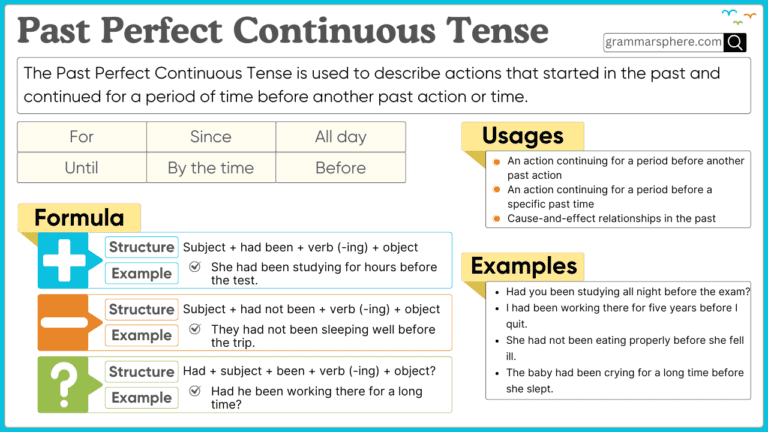
The Past Perfect usually focuses on the completion or result of an action, while the Past Perfect Continuous usually focuses on the duration or continuation of an activity before a past point.
Past Perfect: She had written five pages before dinner.
Past Perfect Continuous: She had been writing for two hours before dinner.
The first sentence focuses on the result, while the second focuses on duration.
5. Can we use the Past Perfect without another past action?
Yes. The Past Perfect can be used without another past action being directly stated when the past reference point is clear from the sentence or context.
Example: By 2015, she had written three books.
Here, 2015 provides the past reference point, so another past action is not necessary.
Read More

Leave a Comment