

Table of Contents
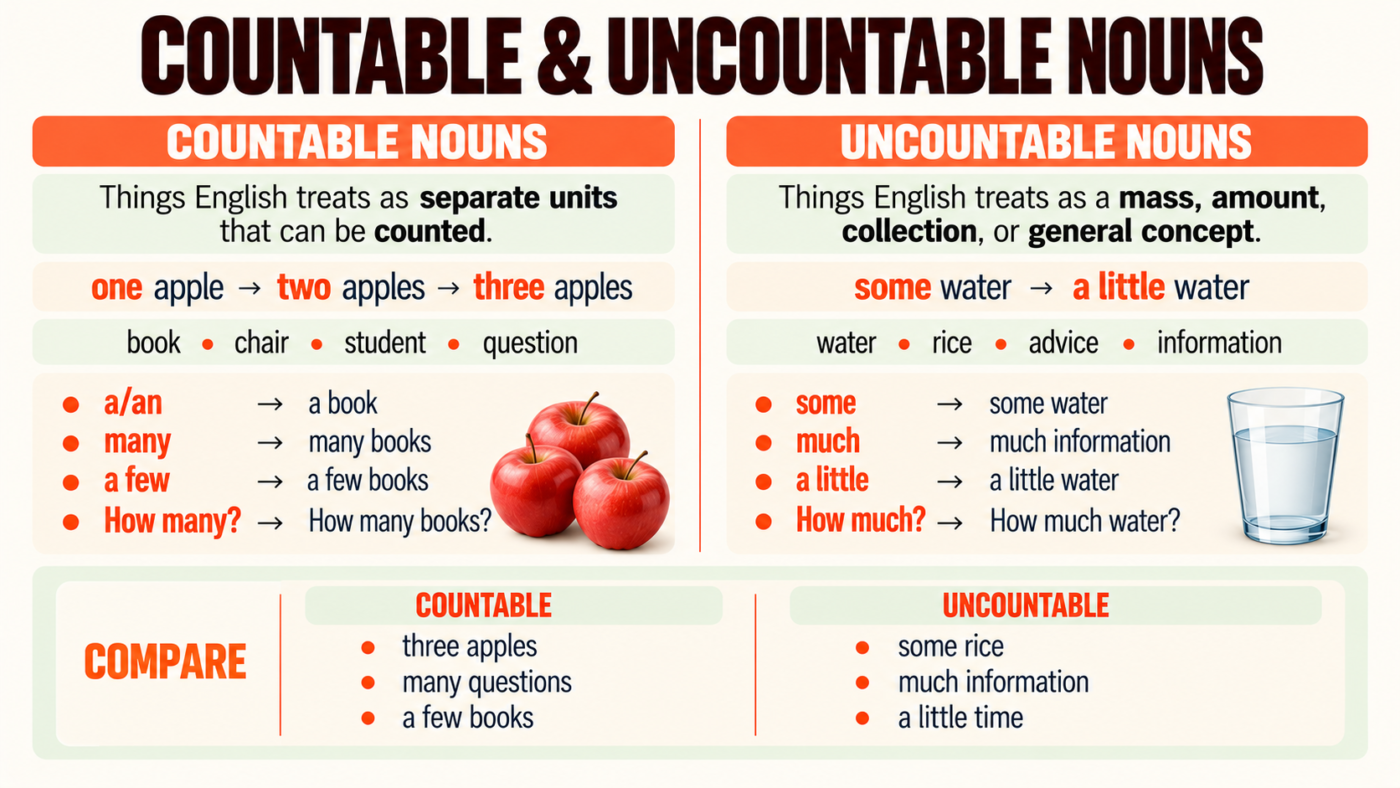
Countable and uncountable nouns are two important groups of nouns in English. The difference depends on whether a noun is treated as a separate unit that can be counted or as a mass, amount, collection, or general concept.
Compare:
- one apple → two apples → three apples
- some water → a little water → two bottles of water
This difference affects more than counting. It also affects singular and plural forms, articles, determiners, quantity words, and subject–verb agreement.
Some nouns are always or usually used in one way, while others can be countable or uncountable depending on their meaning. For this reason, countability should be understood from the noun’s actual use in a sentence.
Countable and Uncountable Nouns Definition
A countable noun refers to a person, place, thing, or idea that can be treated as a separate unit and counted.
Examples:
book, chair, student, apple, question, idea
We can say:
- one book
- two books
- five books
- an idea
- several ideas
An uncountable noun refers to something that English normally treats as a mass, amount, collection, substance, activity, or general concept rather than as separate countable units.
Examples:
water, rice, information, advice, furniture, knowledge
We normally say:
- some water
- a little rice
- some information
- much knowledge
We do not normally say:
- ❌ an information
- ❌ two advices
- ❌ three furnitures
The grammatical property of being countable or uncountable is called countability.
Identifying Countable and Uncountable Nouns
Several clues can help you identify how a noun is being used.
Check whether it can be counted directly.
- one chair → two chairs
- one question → five questions
These nouns are countable.
Check whether it has singular and plural forms in that meaning.
- student → students
- idea → ideas
- mistake → mistakes
By contrast, nouns such as information, advice, furniture, and equipment do not normally have plural forms when used uncountably.
Check whether a/an can be used directly before it.
- a book ✓
- an apple ✓
- an idea ✓
- an advice ✗
- an information ✗
Check the quantity words used with it.
- many books
- a few students
- much information
- a little water
Most importantly, check the noun’s meaning in context.
Compare:
The window is made of glass.
Here, glass means a material and is uncountable.
There are four glasses on the table.
Here, glasses means drinking containers and is countable.
These tests are useful, but no single test works in every situation. Some nouns have both countable and uncountable uses. When you are unsure, check how the particular meaning is labelled and used in a reliable learner’s dictionary.
Countable Nouns
Countable nouns refer to things that English treats as separate units.
Examples:
teacher, house, phone, apple, chair, mistake, question, idea
They normally have both singular and plural forms.
| Singular | Plural |
|---|---|
| book | books |
| apple | apples |
| box | boxes |
| city | cities |
| child | children |
| person | people |
Countable nouns can be used directly with numbers:
- one student
- three students
- six questions
- ten chairs
A singular countable noun can be used with a/an:
- a teacher
- a house
- an apple
- an idea
Plural countable nouns can be used with expressions such as:
- many students
- several questions
- a few mistakes
- these books
- those houses
A particularly important rule is that a singular countable common noun normally needs a determiner.
❌ I bought book yesterday.
✓ I bought a book yesterday.
❌ She spoke to teacher.
✓ She spoke to the teacher.
Other determiners can also complete the noun phrase:
- my book
- this chair
- every student
- another question
Uncountable Nouns
Uncountable nouns are normally treated as a mass, amount, whole, collection, substance, activity, or general concept rather than as separate units.
Examples:
water, milk, rice, advice, information, furniture, equipment, knowledge, traffic
They are not normally counted directly in their uncountable meanings:
❌ two informations
✓ some information
They are not normally used with a/an:
❌ an advice
✓ some advice
They do not normally take a plural ending in their uncountable meanings:
❌ furnitures
✓ furniture
❌ equipments
✓ equipment
Common Categories of Uncountable Nouns
Many common uncountable nouns belong to recognizable meaning groups.
Materials and substances
- water
- milk
- rice
- gold
- wood
Ideas, qualities, and abstract concepts
- advice
- information
- knowledge
- luck
- progress
Activities and general concepts
- work
- homework
- research
- travel
Collections
- furniture
- equipment
- luggage
Weather and natural phenomena
- weather
- rain
- snow
- thunder
These groups are useful learning patterns, but they are not absolute tests. The grammatical use and meaning of the noun remain more important than the category it belongs to.
Countable vs Uncountable Nouns
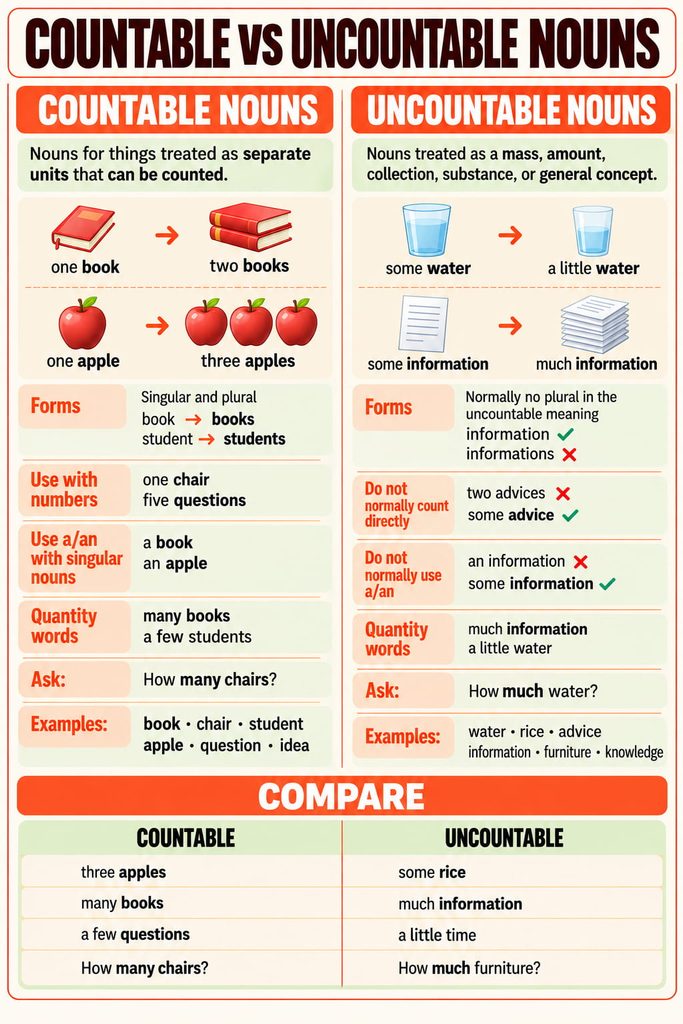
The main differences can be summarized as follows:
| Feature | Countable Nouns | Uncountable Nouns |
|---|---|---|
| Can normally be counted directly | Yes | No |
| Singular and plural forms | Yes | Normally no plural in the uncountable meaning |
| Numbers directly before the noun | Yes | Normally no |
| a/an | With singular countable nouns | Normally no |
| many | Yes, with plural nouns | No |
| much | No | Yes |
| a few | Yes, with plural nouns | No |
| a little | No | Yes |
| how many | Yes, with plural nouns | No |
| how much | No | Yes |
| some/any | With plural nouns | Yes |
Compare:
I bought three apples.
I bought some rice.
How many chairs do we need?
How much furniture do we need?
It is important not to identify an uncountable noun simply by asking whether something is physically difficult to count.
For example:
information, advice, homework, knowledge, progress
are normally uncountable even though they are not liquids or physical masses.
Countability is a grammatical property of the noun in a particular meaning
Singular Countable, Plural Countable and Uncountable Nouns
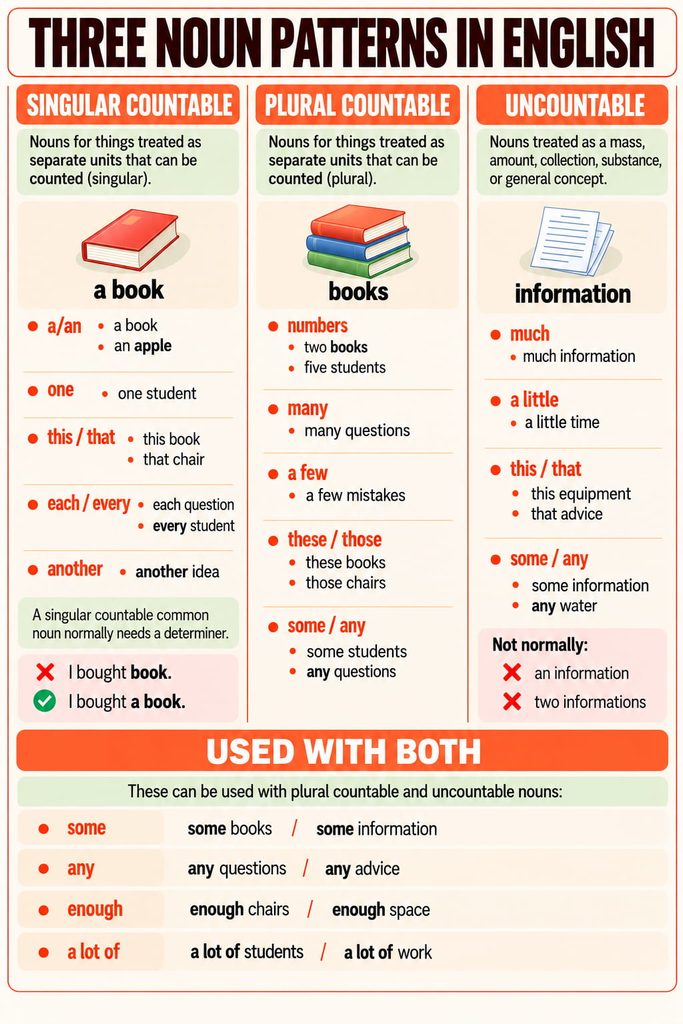
For many grammar choices, it is useful to think of three noun patterns:
- singular countable
- plural countable
- uncountable
Compare:
| Grammar | Singular Countable | Plural Countable | Uncountable |
|---|---|---|---|
| a/an | a book | — | — |
| number | one book | two books | — |
| this/that | this book | — | this information |
| these/those | — | these books | — |
| many | — | many books | — |
| much | — | — | much information |
| a few | — | a few books | — |
| a little | — | — | a little information |
| some | — | some books | some information |
| any | — | any books | any information |
This three-way distinction is especially useful because articles, demonstratives, and quantity words do not behave in exactly the same way with all countable nouns.
Articles with Countable and Uncountable Nouns
Countability affects which articles can be used before a noun.
A and An
Use a/an with a singular countable noun:
- a teacher
- a chair
- an apple
- an idea
Do not normally use a/an directly before an uncountable noun:
❌ an advice
❌ an information
❌ a furniture
Use an uncountable expression:
- some advice
- some information
- some furniture
Or introduce a countable unit:
- a piece of advice
- a piece of information
- an item of furniture
The
The can be used with singular countable, plural countable, and uncountable nouns when the reference is specific or otherwise identifiable in context.
The book on the table is mine.
The books on the table are mine.
The information in this email is useful.
The water in this bottle is cold.
Zero Article
Plural countable nouns and uncountable nouns can appear without an article when we speak generally.
Books are useful.
Here, books means books in general.
Water is essential for life.
Here, water means water generally.
Compare these with specific reference:
The books on my desk are new.
The water in this glass is cold.
So article choice depends on both countability and meaning/reference.
Determiners with Countable and Uncountable Nouns
Determiners come before nouns and help specify which thing, how much, how many, or whose thing we mean.
Different determiners work with different noun patterns.
Singular Countable Nouns
Common determiners include:
a/an, each, every, another, this, that
Examples:
- a student
- every student
- each question
- another idea
- this book
- that chair
Plural Countable Nouns
Common determiners include:
many, several, both, a few, these, those
Examples:
- many students
- several questions
- both answers
- a few mistakes
- these books
- those chairs
Uncountable Nouns
Common determiners and quantity expressions include:
much, a little, this, that
Examples:
- much information
- a little time
- this equipment
- that advice
Plural Countable and Uncountable Nouns
Several determiners and quantity expressions work with both plural countable nouns and uncountable nouns:
some, any, enough, most, all, no, a lot of
Compare:
- some books / some information
- enough chairs / enough space
- no mistakes / no money
- a lot of students / a lot of work
The correct choice therefore often depends on whether the noun is singular countable, plural countable, or uncountable.
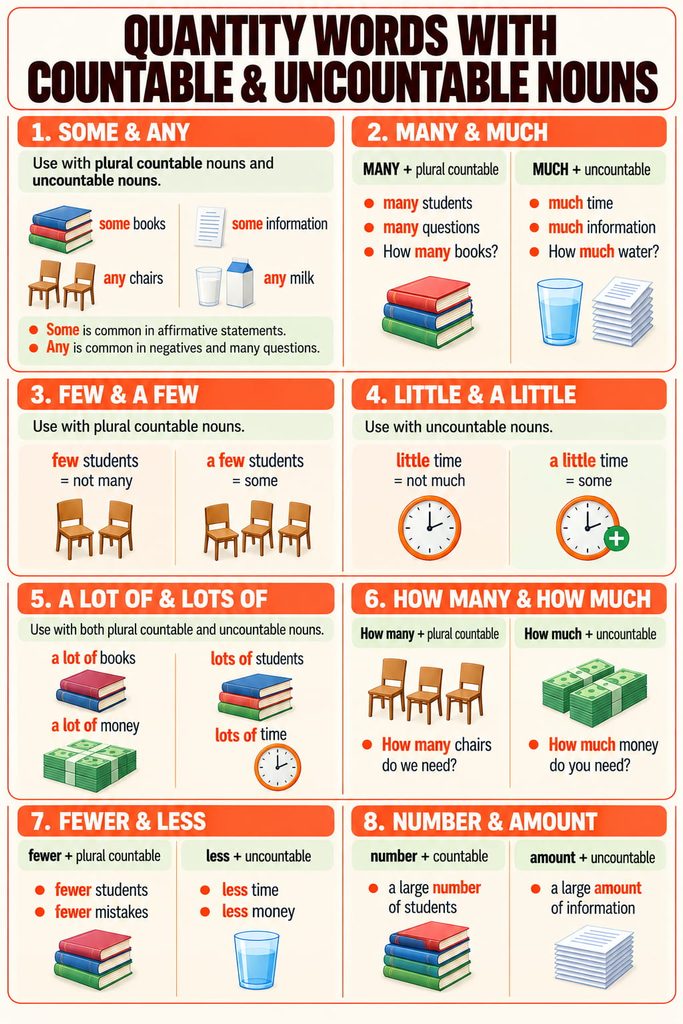
Quantity Words with Countable and Uncountable Nouns
Quantity words tell us how many or how much of something there is.
Some and Any
Some and any can be used with plural countable nouns and uncountable nouns.
Plural countable:
I bought some apples.
We don’t have any chairs.
Uncountable:
I need some information.
There isn’t any milk left.
Some is common in affirmative statements:
We bought some books.
She needs some help.
Any is common in negative statements and many questions:
We don’t have any tickets.
Is there any coffee?
However, some is commonly used in offers and requests:
Would you like some tea?
Can I have some water?
So the simple rule “use any in all questions” is not accurate.
Many and Much
Use many with plural countable nouns:
- many students
- many questions
- many books
How many books did you buy?
Use much with uncountable nouns:
- much time
- much money
- much information
How much water do you need?
In affirmative everyday English, a lot of is often more natural than much:
She has a lot of work to do.
Few, A Few, Little and A Little
Use few and a few with plural countable nouns:
- few opportunities
- a few questions
- a few friends
Use little and a little with uncountable nouns:
- little hope
- a little water
- a little time
The presence of a changes the meaning.
Few students attended the class.
= not many students
A few students attended the class.
= some students
There is little hope.
= not much hope
There is a little hope.
= some hope
A Lot Of and Lots Of
A lot of and lots of can be used with plural countable and uncountable nouns.
a lot of books
a lot of money
lots of students
lots of time
They are especially common in everyday English.
How Many and How Much
Use how many with plural countable nouns:
How many students are coming?
How many chairs do we need?
Use how much with uncountable nouns:
How much money do you need?
How much time do we have?
Fewer and Less
The basic standard distinction is:
fewer + plural countable noun
- fewer students
- fewer mistakes
- fewer cars
less + uncountable noun
- less time
- less money
- less traffic
Compare:
There were fewer mistakes in the second report.
We have less time today.
In everyday English, less is also commonly found with measurements and expressions of time, money, distance, and similar quantities. The basic fewer/countable and less/uncountable distinction is nevertheless useful for learners.
Number and Amount
Use number with countable nouns:
a large number of students
a small number of mistakes
Use amount with uncountable nouns:
a large amount of information
a small amount of water
Counting Uncountable Nouns
Uncountable nouns cannot normally be counted directly, but their pieces, items, containers, measures, portions, and other units can be counted.
Pieces and Items
- a piece of advice
- two pieces of information
- three pieces of equipment
- four items of furniture
The number applies to the countable noun piece or item, not directly to the uncountable noun.
Containers
- a bottle of water
- two cups of coffee
- three bags of rice
- a jar of honey
Measures
- a litre of milk
- two kilos of rice
- three metres of cloth
Portions and Other Units
- a slice of bread
- two loaves of bread
- a bar of chocolate
- a grain of rice
Compare:
❌ three advices
✓ three pieces of advice
❌ two furnitures
✓ two pieces of furniture
❌ four breads
✓ four loaves of bread
The unit chosen depends on what is being measured, contained, divided, or counted.
Common Uncountable Nouns in English
Some nouns cause frequent problems because they may be countable in other languages but are normally uncountable in English.
| Uncountable Noun | Correct Use |
|---|---|
| advice | some advice / a piece of advice |
| information | some information / a piece of information |
| furniture | some furniture / an item of furniture |
| equipment | some equipment / a piece of equipment |
| luggage | some luggage / a piece of luggage |
| homework | some homework |
| research | some research |
| progress | some progress |
| knowledge | some knowledge |
| traffic | heavy traffic |
| weather | bad weather |
| money | much money / a lot of money |
| news | some news |
| work | a lot of work |
Examples:
She gave me some useful advice.
I need more information.
We bought some new furniture.
The equipment is ready.
He has a lot of homework tonight.
They are doing important research.
You are making good progress.
These nouns should be learned together with their grammatical patterns rather than simply memorized as vocabulary items
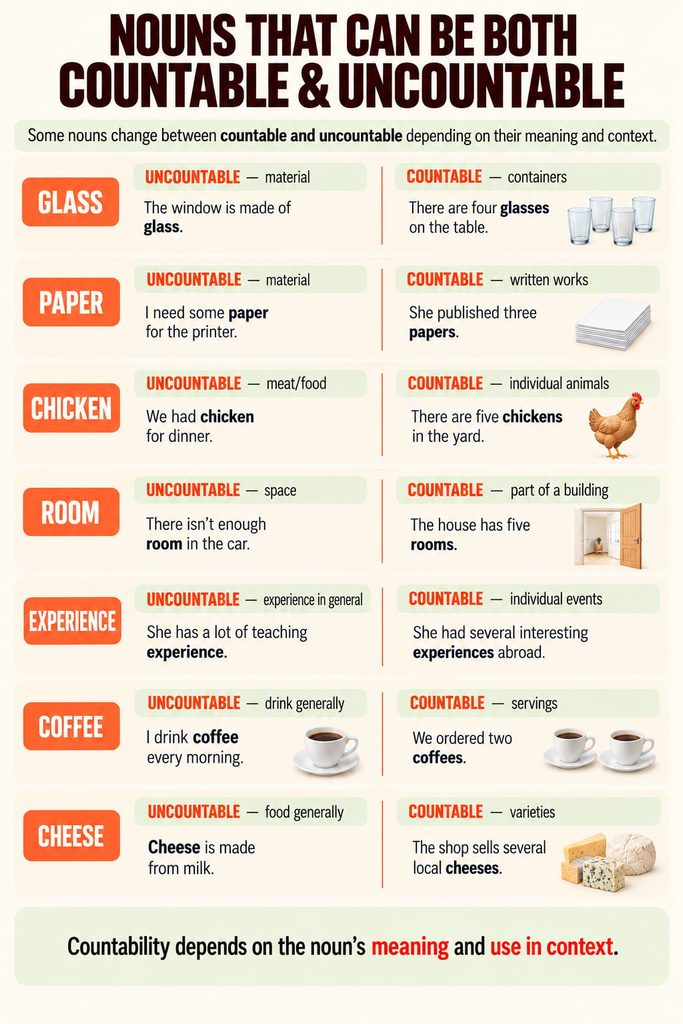
Nouns That Can Be Both Countable and Uncountable
Some nouns can be countable in one context and uncountable in another.
The difference usually comes from a change in meaning or reference.
Different Meanings
glass
The window is made of glass.
Glass = material → uncountable
There are four glasses on the table.
Glasses = drinking containers → countable
paper
I need some paper for the printer.
Paper = material → uncountable
She published three papers last year.
Papers = written or academic works → countable
chicken
We had chicken for dinner.
Chicken = meat → uncountable
There are five chickens in the yard.
Chickens = individual animals → countable
room
There isn’t enough room in the car.
Room = space → uncountable
The house has five rooms.
Rooms = separate parts of a building → countable
General and Specific Meanings
Some abstract nouns are uncountable when they express a general concept but countable when they refer to particular examples, events, or instances.
experience
She has a lot of teaching experience.
general experience → uncountable
She had several interesting experiences abroad.
individual events → countable
difficulty
He had difficulty understanding the instructions.
difficulty in general → uncountable
We faced several difficulties during the project.
individual problems → countable
time
I don’t have much time today.
time generally → uncountable
We had a wonderful time at the party.
a particular experience or occasion → countable use
Servings and Portions
A food or drink noun that is normally uncountable can sometimes become countable when it means a serving or portion.
I drink coffee every morning.
coffee generally → uncountable
We ordered two coffees.
two servings of coffee → countable
There is some tea in the pot.
tea generally → uncountable
We ordered three teas.
three servings of tea → countable
In an appropriate context, two waters can similarly mean two bottles, glasses, or servings of water.
Types and Varieties
A normally uncountable noun can sometimes become countable when referring to different types or varieties.
Cheese is made from milk.
cheese generally → uncountable
The shop sells several local cheeses.
different varieties → countable
This change in meaning explains why a word that normally appears without a plural can sometimes legitimately have one.
Plural Forms of Countable and Uncountable Nouns
Countable nouns normally have singular and plural forms:
- book → books
- city → cities
- child → children
- person → people
Uncountable nouns normally do not take a plural ending when they are being used uncountably:
- information
- advice
- furniture
- equipment
However, the rule should not be simplified to “uncountable nouns can never have plurals.”
Some words develop a countable meaning:
paper → papers
individual documents or academic works
coffee → coffees
servings or varieties
experience → experiences
individual events
cheese → cheeses
different varieties
The accurate rule is:
A noun used uncountably normally has no plural in that meaning, but the same word may have a countable meaning that allows a plural form.
Subject–Verb Agreement with Uncountable Nouns
Uncountable nouns normally take a singular verb.
The information is useful.
The furniture looks expensive.
The equipment has arrived.
The traffic is getting worse.
The research shows promising results.
A particularly important example is news:
❌ The news are good.
✓ The news is good.
Although news ends in -s, it is normally treated as an uncountable singular noun.
Compare this with plural countable nouns:
The books are useful.
The chairs look expensive.
Common Mistakes with Countable and Uncountable Nouns
Using a/an directly with an uncountable noun
❌ She gave me an advice.
✓ She gave me some advice.
✓ She gave me a piece of advice.
Advice is normally uncountable, so a/an cannot be used directly before it.
Adding a plural ending to an uncountable noun
❌ I need more informations.
✓ I need more information.
To count separate items:
✓ I need two pieces of information.
Making furniture or equipment plural
❌ We bought new furnitures.
✓ We bought new furniture.
❌ They need several equipments.
✓ They need some equipment.
For individual units:
✓ three pieces of furniture
✓ several pieces of equipment
Using many with an uncountable noun
❌ She doesn’t have many money.
✓ She doesn’t have much money.
Use much with uncountable nouns.
Using much with a plural countable noun
❌ How much books did you buy?
✓ How many books did you buy?
Use many with plural countable nouns.
Confusing a few and a little
❌ We have a few water left.
✓ We have a little water left.
❌ There are a little students outside.
✓ There are a few students outside.
Use a few with plural countable nouns and a little with uncountable nouns.
Using the wrong demonstrative
❌ These information is useful.
✓ This information is useful.
Use this/that, not these/those, with an uncountable noun used as a singular mass.
Using a singular countable noun without a determiner
❌ She bought car last week.
✓ She bought a car last week.
A singular countable common noun normally requires an appropriate determiner.
Using plural agreement with an uncountable noun
❌ The news are surprising.
✓ The news is surprising.
Assuming a noun always has the same countability
❌ Paper is always uncountable.
Compare:
I need some paper.
material → uncountable
I submitted two papers.
documents → countable
Countability can depend on meaning and context.
Countable and Uncountable Nouns Practice Exercise
Choose the correct answer or complete each sentence.
- She gave me some useful advice / advices.
- How much / many chairs do we need?
- There isn’t much / many milk left.
- I bought three bottle / bottles of water.
- We need an information / some information about the course.
- There are a few / a little students waiting outside.
- Add a few / a little sugar to the tea.
- This / These equipment is very expensive.
- The news is / are surprising.
- I bought two ______ of bread.
loaves / breads - She gave me three ______ of advice.
pieces / advices - There were fewer / less mistakes in the second report.
- We have fewer / less time today.
- There is a large ______ of information in this report.
number / amount - A large ______ of students joined the course.
number / amount - Choose the sentence in which chicken is countable.
a. We had chicken for dinner.
b. We saw three chickens in the yard.
- Choose the sentence in which paper is uncountable.
a. I need some paper for the printer.
b. She published three papers.
- Choose the correct sentence.
a. I bought book yesterday.
b. I bought a book yesterday.
- Choose the sentence in which coffee means separate servings.
a. I don’t drink much coffee.
b. We ordered two coffees.
- Choose the sentence that talks about water generally.
a. Water is essential for life.
b. The water in this bottle is cold.
- Choose the correct expression.
a. many information
b. much information
- Choose the correct expression.
a. a few questions
b. a little questions
- Choose the correct sentence.
a. The furniture looks expensive.
b. The furnitures look expensive.
- Decide whether the bold noun is countable (C) or uncountable (U) in the sentence:
She has a lot of teaching experience.
- Decide whether the bold noun is countable (C) or uncountable (U):
She had several interesting experiences while travelling.
Answers
- advice
- many
- much
- bottles
- some information
- a few
- a little
- This
- is
- loaves
- pieces
- fewer
- less
- amount
- number
- b
- a
- b
- b
- a
- b
- a
- a
- U
- C
FAQs
What are countable and uncountable nouns?
Countable nouns refer to things that can normally be treated as separate units and counted, such as book, student, chair, and idea. Uncountable nouns are normally treated as a mass, amount, collection, substance, activity, or general concept, such as water, information, advice, furniture, and knowledge.
How can I identify a countable or uncountable noun?
Look at how the noun behaves in its particular meaning. Countable nouns normally have singular and plural forms, can be used with numbers, and allow a/an in the singular. Uncountable nouns are not normally counted directly and do not normally take a/an or a plural ending. Because some nouns can be used both ways, always consider meaning and context.
Can a noun be both countable and uncountable?
Yes. Some nouns change their countability according to meaning. Glass is uncountable when it means a material but countable when it means a drinking container. Paper, chicken, experience, coffee, room, and many other nouns can also have both uses.
Can we use a or an with uncountable nouns?
Not directly when the noun is being used uncountably. Say some advice, not an advice. To refer to one unit, use an appropriate countable expression such as a piece of advice.
Is information countable or uncountable?
Information is normally uncountable in English. Say some information, much information, or two pieces of information, not an information or two informations.
Is advice countable or uncountable?
Advice is normally uncountable. Use expressions such as some advice, a little advice, or a piece of advice. Do not normally say an advice or advices.
Is furniture countable or uncountable?
Furniture is normally uncountable. Say some furniture or use a countable unit such as an item of furniture or three pieces of furniture.
Is news countable or uncountable?
News is normally uncountable and takes a singular verb: The news is good. The final -s does not make news a plural noun.
Which words are used with countable and uncountable nouns?
Use many, a few, few, and fewer with plural countable nouns. Use much, a little, little, and less with uncountable nouns. Expressions such as some, any, enough, and a lot of can be used with both plural countable and uncountable nouns.
Why can we say “two coffees” if coffee is uncountable?
When coffee refers to the drink generally, it is normally uncountable. In two coffees, the meaning changes to two servings, cups, or portions of coffee, so the noun is being used countably.
Do all uncountable nouns have no plural form?
An uncountable noun normally has no plural form in its uncountable meaning. However, the same word may have another countable meaning. For example, paper is uncountable when it means the material, but papers can mean separate documents or academic works.
Can uncountable nouns be counted?
They cannot normally be counted directly, but they can be counted through suitable units or measures. For example, we say two pieces of advice, three bottles of water, two kilos of rice, and four loaves of bread.
You May Also Like
Leave a Comment