

Table of Contents
Most countable nouns in English form their plural by adding -s or -es. For example, book becomes books, teacher becomes teachers, and box becomes boxes. However, some nouns do not follow these usual plural rules.
These nouns are commonly called irregular plural nouns.
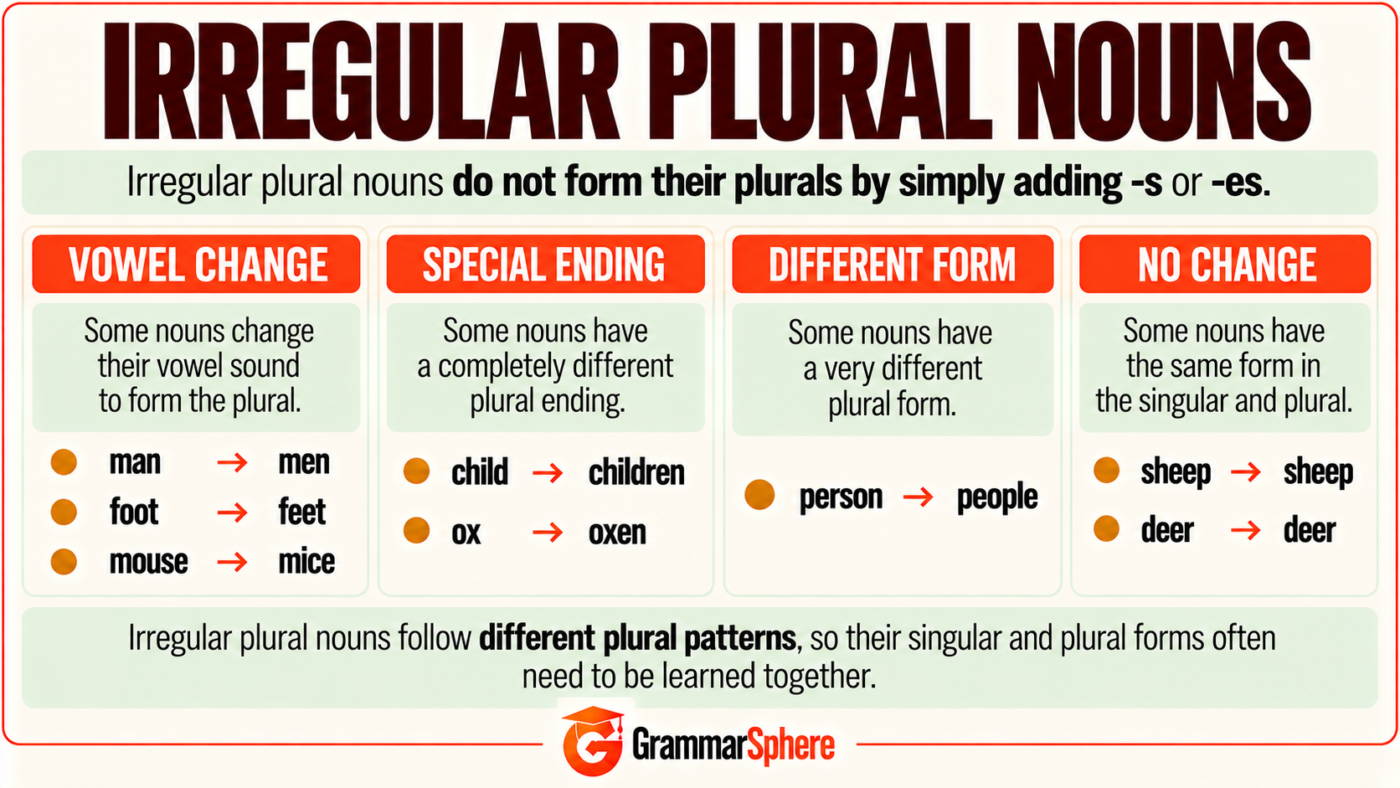
Instead of simply adding -s or -es, an irregular plural may change a vowel, take a special ending, change considerably, or remain exactly the same as the singular form.
For example:
- man → men
- woman → women
- child → children
- tooth → teeth
- mouse → mice
- person → people
- sheep → sheep
English also contains borrowed nouns with special plural forms, such as criterion → criteria and analysis → analyses, as well as nouns that allow more than one plural form in different contexts.
Because there is no single rule for every irregular plural noun, learners need to understand the main patterns, recognize important exceptions, and learn common singular and plural forms together.
What Are Irregular Plural Nouns?
An irregular plural noun is a noun whose plural does not follow the ordinary pattern of simply adding -s or -es to the singular form.
Compare:
| Singular | Plural | Type |
|---|---|---|
| book | books | regular |
| car | cars | regular |
| class | classes | regular |
| man | men | irregular |
| child | children | irregular |
| mouse | mice | irregular |
| sheep | sheep | unchanged plural |
For example:
- one man → two men
- one child → three children
- one mouse → several mice
- one sheep → five sheep
Incorrect:
- ✗ mans
- ✗ childs
- ✗ mouses
- ✗ sheeps
Correct:
- ✓ men
- ✓ children
- ✓ mice
- ✓ sheep
The irregular form itself expresses plural meaning, so another plural -s is not normally added.
Regular vs Irregular Plural Nouns
The main difference between regular and irregular plural nouns is how the plural is formed.
Regular Plural Nouns
Regular nouns follow normal plural-forming patterns.
- cat → cats
- book → books
- bus → buses
- box → boxes
Some regular plural spelling rules involve a spelling change:
- baby → babies
- wife → wives
- potato → potatoes
These forms follow recognizable spelling patterns, even though they do not all simply add -s.
Irregular Plural Nouns
Irregular plurals have forms that cannot be produced reliably by applying the ordinary plural rules.
- man → men
- child → children
- mouse → mice
- person → people
- sheep → sheep
Compare:
| Regular | Irregular |
|---|---|
| car → cars | man → men |
| bus → buses | child → children |
| baby → babies | mouse → mice |
| book → books | person → people |
This distinction is important because not every plural with a spelling change is a truly irregular plural.
Why Are Some Plural Nouns Irregular?
English has developed over many centuries and has been influenced by different languages.
Some irregular plurals preserve older English plural patterns:
- man → men
- foot → feet
- child → children
- ox → oxen
Other special plural forms entered English through words borrowed from languages such as Latin and Greek:
- criterion → criteria
- phenomenon → phenomena
- analysis → analyses
This is why modern English does not have one rule that explains every irregular plural.
Learners do not need to study the complete history of these words. What matters is recognizing the main modern patterns and learning forms that cannot be predicted reliably.
Types of Irregular Plural Nouns
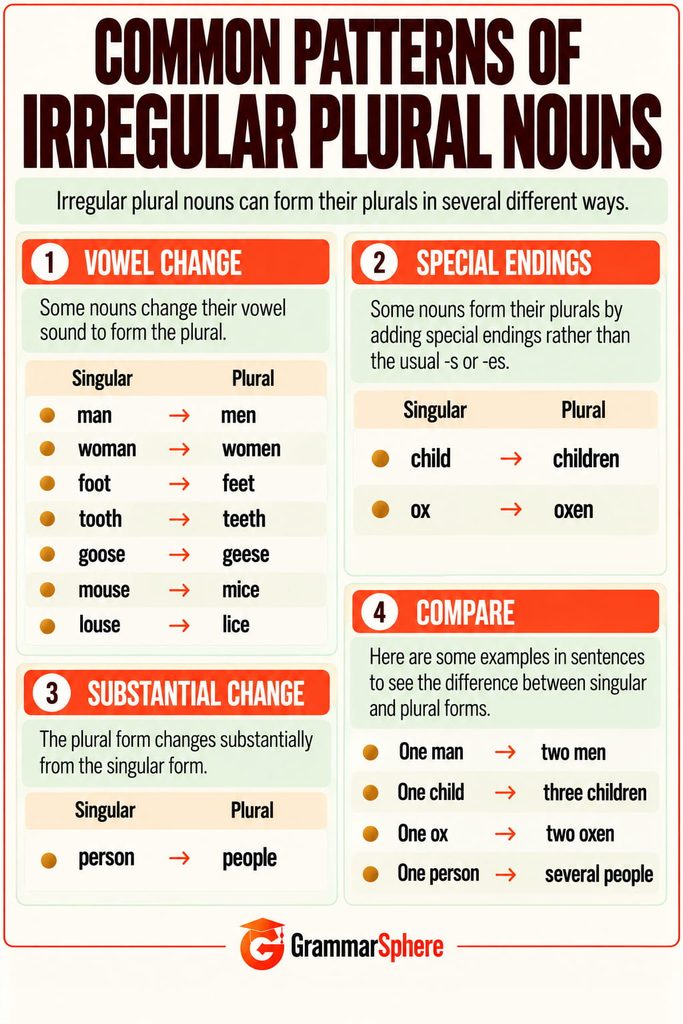
Irregular plural nouns can be organized into several useful groups.
Internal Vowel Change
The vowel inside the noun changes:
- man → men
- foot → feet
- mouse → mice
Special Ending
The noun takes an unusual plural ending:
- child → children
- ox → oxen
Substantial Change
The plural changes considerably:
- person → people
No Change
The singular and plural forms are identical:
- sheep → sheep
- deer → deer
- species → species
Foreign or Classical Plural
A borrowed noun retains or uses a special plural form:
- analysis → analyses
- criterion → criteria
- phenomenon → phenomena
These groups make irregular plurals easier to learn than one long, unorganized list.
Irregular Plurals with Internal Vowel Changes
Several common English nouns form their plurals by changing a vowel inside the word.
| Singular | Plural |
|---|---|
| man | men |
| woman | women |
| foot | feet |
| tooth | teeth |
| goose | geese |
| mouse | mice |
| louse | lice |
Examples:
- One man was waiting outside.
- Three men were waiting outside.
- My foot hurts.
- Both my feet hurt.
- The baby has one tooth.
- The child has several teeth.
- We saw a mouse in the kitchen.
- We saw two mice in the kitchen.
Do not add the regular plural ending:
- ✗ mans → ✓ men
- ✗ foots → ✓ feet
- ✗ tooths → ✓ teeth
- ✗ mouses → ✓ mice
These forms should be learned as singular–plural pairs.
Irregular Plurals with Special Endings
A small number of English nouns form their plurals with unusual endings instead of the regular -s or -es endings.
Child → Children
The plural of child is children.
- one child
- two children
- many children
Examples:
- The child is playing.
- The children are playing.
Do not add another plural ending:
- ✗ childs
- ✗ childrens
- ✓ children
Ox → Oxen
The plural of ox is oxen.
- one ox
- two oxen
Example:
- Two oxen were pulling the cart.
The ending -en is not a productive plural rule in modern English. Learners should therefore learn ox → oxen as an individual pair rather than adding -en to other nouns.
Irregular Plurals That Change Substantially
Some singular and plural forms are quite different from each other.
The most important example for everyday English is:
person → people
Examples:
- One person is waiting.
- Five people are waiting.
This form cannot be predicted from an ordinary spelling rule, so it needs to be learned individually.
Person, People, Persons and Peoples
The forms person, people, persons, and peoples are related, but they are not interchangeable.
Person → People
In ordinary English, people is the normal plural of person.
- one person
- two people
- many people
Examples:
- One person entered the room.
- Several people entered the room.
For normal everyday use:
person → people
Persons
Persons is also a possible plural of person, especially in formal, legal, official, or administrative contexts where separate individuals are being counted.
For example:
- The lift has a maximum capacity of eight persons.
In everyday English, people is normally the natural choice.
A People → Peoples
People can also mean a particular nation, ethnic group, or community. In this meaning, it can be countable.
- a people
- different peoples
For example:
- The region is home to several indigenous peoples.
Compare:
- people = more than one person
- a people = a nation or community
- peoples = different nations or communities
Irregular Plurals That Do Not Change
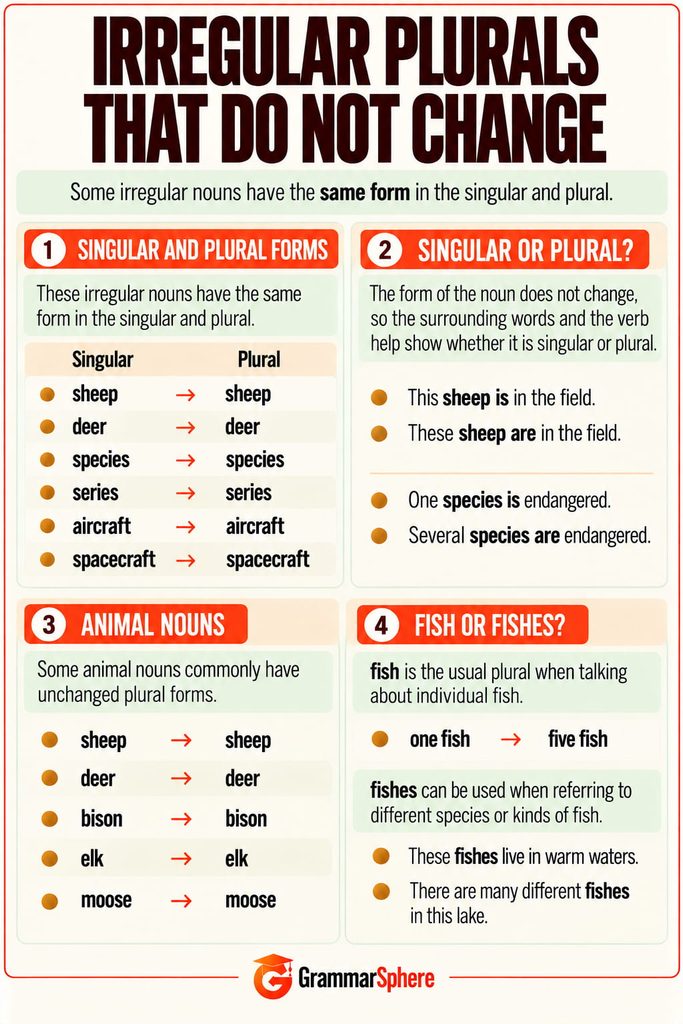
Some nouns have exactly the same form in the singular and plural.
These are often called unchanged plurals or zero plurals.
Common examples include:
| Singular | Plural |
|---|---|
| sheep | sheep |
| deer | deer |
| species | species |
| series | series |
| aircraft | aircraft |
| spacecraft | spacecraft |
Examples:
- one sheep → ten sheep
- one deer → four deer
- one species → several species
- one aircraft → three aircraft
Do not add an unnecessary -s:
- ✗ sheeps
- ✓ sheep
- ✗ deers
- ✓ deer
- ✗ aircrafts
- ✓ aircraft
How to Tell Singular and Plural Apart
Because the noun itself does not change, look at the surrounding words.
Compare:
- This sheep is young.
- These sheep are young.
- One species is endangered.
- Several species are endangered.
- That aircraft has landed.
- Those aircraft have landed.
Determiners, numbers, quantifiers, and verbs help show whether the noun is singular or plural.
Animal Nouns with Unchanged or Variable Plurals
Animal names make up an important group of nouns whose singular and plural forms can be identical.
Examples include:
- sheep → sheep
- deer → deer
- fish → fish
- bison → bison
- elk → elk
- moose → moose
Examples:
- We saw three deer.
- Several bison were grazing.
- Two moose crossed the road.
However, some animal nouns have alternative plural forms or special usage. Fish is the most important example for learners.
Fish vs Fishes
Both fish and fishes exist, but they are normally used differently.
Fish
Fish is the usual plural when referring to individual fish.
- one fish
- two fish
- many fish
Example:
- We caught five fish.
Fishes
Fishes is used especially when referring to different species or kinds of fish, particularly in scientific contexts.
Example:
- The reef is home to many tropical fishes.
For ordinary English, learners should normally use:
one fish → two fish
Irregular Plurals with More Than One Accepted Form
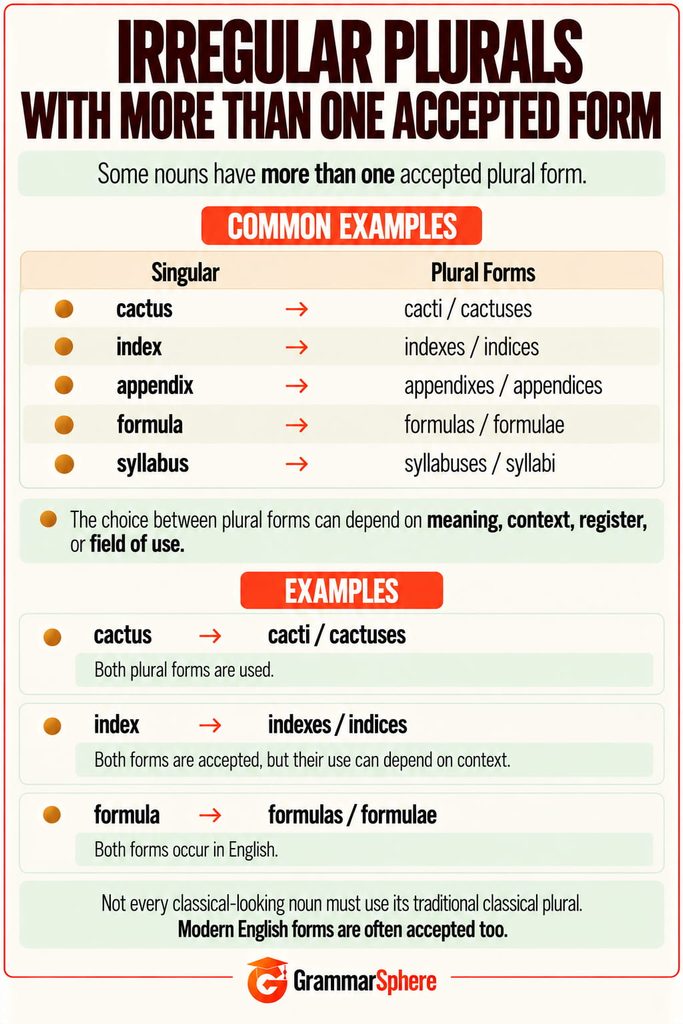
Some English nouns have more than one accepted plural.
Examples include:
| Singular | Possible Plurals |
|---|---|
| cactus | cacti / cactuses |
| index | indexes / indices |
| appendix | appendixes / appendices |
| formula | formulas / formulae |
| syllabus | syllabuses / syllabi |
The alternatives are not always used in exactly the same contexts.
For some words:
- one form may be more common in everyday English;
- another may be more common in academic or technical English;
- different plural forms may develop different meanings.
Therefore, learners should not assume that two accepted plurals are always completely interchangeable.
When usage is uncertain, check the individual noun in a current learner’s dictionary.
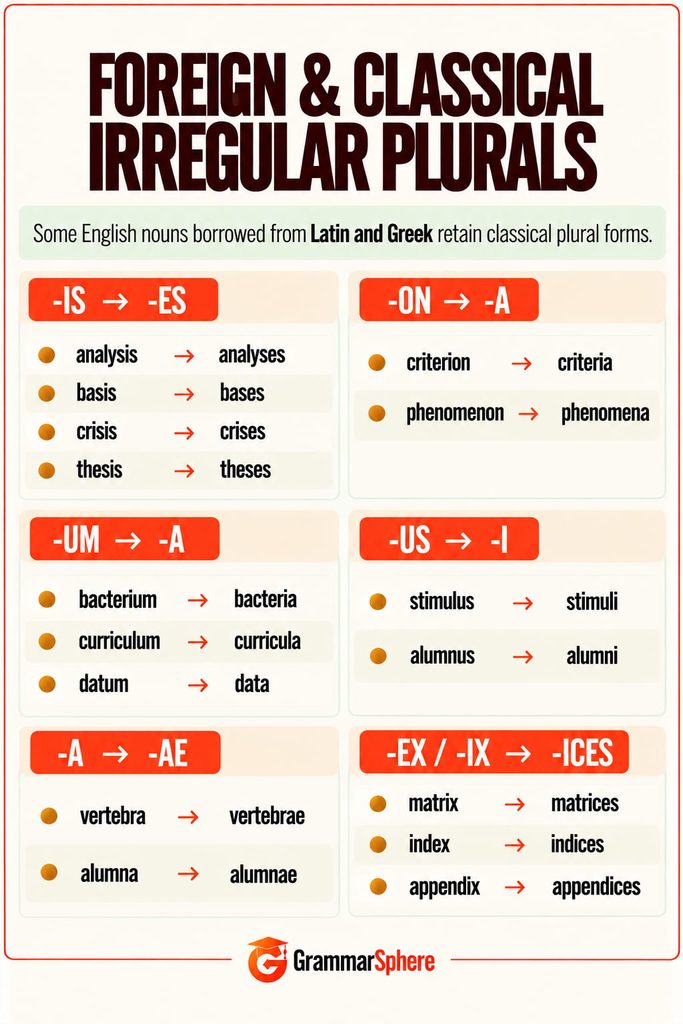
Foreign and Classical Irregular Plurals
English contains many nouns borrowed from Latin and Greek. Some retain traditional plural patterns.
These forms are particularly common in academic, scientific, medical, and formal English.
Nouns Ending in -is: -is → -es
Some nouns ending in -is form their plurals by changing -is to -es.
| Singular | Plural |
|---|---|
| analysis | analyses |
| basis | bases |
| crisis | crises |
| diagnosis | diagnoses |
| hypothesis | hypotheses |
| thesis | theses |
Examples:
- one analysis → several analyses
- one crisis → several crises
- one hypothesis → two hypotheses
The pronunciation changes as well as the spelling.
Nouns Ending in -on: -on → -a
Some Greek-derived nouns ending in -on have traditional plurals ending in -a.
| Singular | Plural |
|---|---|
| criterion | criteria |
| phenomenon | phenomena |
Examples:
- one criterion → several criteria
- one phenomenon → several phenomena
Common mistakes:
- ✗ a criteria
- ✓ a criterion
- ✗ one phenomena
- ✓ one phenomenon
Nouns Ending in -um: -um → -a
Some Latin-derived nouns ending in -um traditionally form their plurals in -a.
Examples:
- bacterium → bacteria
- curriculum → curricula
- datum → data
- medium → media
However, modern usage varies from word to word.
For example, media has developed broader uses in modern English, while mediums is used for some meanings of medium.
This is why classical plural patterns should not be applied mechanically.
Nouns Ending in -us: -us → -i
Some Latin-derived nouns ending in -us traditionally have plurals in -i.
Examples:
- alumnus → alumni
- stimulus → stimuli
- cactus → cacti
- fungus → fungi
But not every noun ending in -us follows this pattern, and some nouns also accept an English plural.
For example:
- cactus → cacti / cactuses
Do not assume:
every -us noun → -i
Learn individual forms instead.
Nouns Ending in -a: -a → -ae
Some classical nouns ending in -a traditionally form their plurals in -ae.
Examples include:
- formula → formulae
- vertebra → vertebrae
Some also have regular English alternatives:
- formula → formulas / formulae
Again, actual modern usage depends on the individual word and context.
Nouns Ending in -ex or -ix: → -ices
Some classical nouns ending in -ex or -ix have traditional plurals ending in -ices.
Examples:
- index → indices
- appendix → appendices
- matrix → matrices
Some also have regularized English plurals:
- index → indexes
- appendix → appendixes
Different forms can sometimes be preferred in different meanings or fields.
Classical vs Modern English Plurals
Classical plural patterns are useful, but they are not universal rules of modern English.
Some borrowed nouns preserve their traditional plural:
- criterion → criteria
- phenomenon → phenomena
Some allow both traditional and regular English forms:
- cactus → cacti / cactuses
- formula → formulae / formulas
- index → indices / indexes
Other foreign words simply take an ordinary English plural.
Therefore, do not create a plural only by looking at the final letters of a borrowed noun.
When in doubt, check a current dictionary.
Irregular Plurals in Compound Nouns
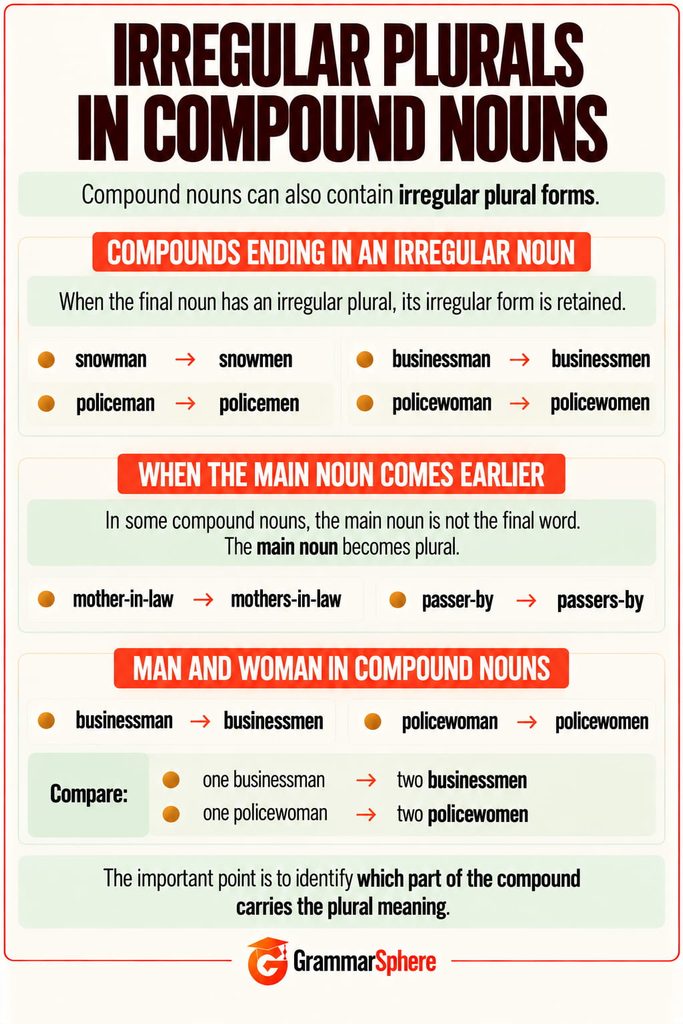
Compound nouns contain two or more elements that function together as one noun.
The plural normally appears on the main noun in the compound.
Compounds Ending in an Irregular Noun
When the main noun has an irregular plural, that irregular form is retained.
Examples:
- snowman → snowmen
- policeman → policemen
- policewoman → policewomen
- businessman → businessmen
- businesswoman → businesswomen
Examples:
- One policeman arrived.
- Three policemen arrived.
Compounds with the Main Noun Earlier
In some compound nouns, particularly compounds containing prepositions, the main noun comes before the end.
Examples:
- mother-in-law → mothers-in-law
- father-in-law → fathers-in-law
- sister-in-law → sisters-in-law
- brother-in-law → brothers-in-law
- passer-by → passers-by
Incorrect:
- ✗ mother-in-laws
- ✓ mothers-in-law
The important principle is to identify the main noun rather than automatically pluralizing the final word.
Man and Woman in Compound Nouns
Some compounds containing man or woman preserve their irregular plural changes.
Examples:
- businessman → businessmen
- businesswoman → businesswomen
- policeman → policemen
- policewoman → policewomen
Some open combinations can also change man/woman when plural:
- woman doctor → women doctors
Because compound structures vary, learners should check unfamiliar forms rather than assuming that every compound behaves identically.
Irregular Plurals vs Special Plural Spelling Patterns
Learner resources often use irregular plurals broadly to include forms such as wife → wives and potato → potatoes.
However, it is useful to distinguish these predictable or semi-predictable spelling patterns from strongly irregular forms such as:
- man → men
- child → children
- person → people
The following patterns are related to plural formation but should not be confused with completely irregular forms.
Nouns Ending in -f or -fe
Some nouns ending in -f or -fe change to -ves.
Examples:
- wife → wives
- knife → knives
- life → lives
- leaf → leaves
- loaf → loaves
- wolf → wolves
- shelf → shelves
However, other nouns simply add -s:
- roof → roofs
- chief → chiefs
- belief → beliefs
- chef → chefs
- cliff → cliffs
Compare:
| Change to -ves | Add -s |
|---|---|
| leaf → leaves | roof → roofs |
| wife → wives | chief → chiefs |
| knife → knives | belief → beliefs |
| wolf → wolves | chef → chefs |
Do not automatically change every final f to v.
Nouns Ending in -o
Some nouns ending in -o take -es:
- potato → potatoes
- tomato → tomatoes
- hero → heroes
- echo → echoes
Others take -s:
- photo → photos
- piano → pianos
- radio → radios
- video → videos
Because similar-looking -o nouns can behave differently, learners should check unfamiliar forms.
Irregular Plural Nouns vs Plural-Only Nouns
Irregular plurals should not be confused with plural-only nouns.
An irregular plural has a related singular form:
- child → children
- man → men
- mouse → mice
A plural-only noun is normally used only in a plural form.
Examples include:
- scissors
- trousers
- jeans
- shorts
- binoculars
- glasses
- clothes
Compare:
Irregular plural
- one child
- two children
Plural-only noun
- a pair of scissors
- two pairs of scissors
Plural-only nouns such as scissors and trousers normally take plural verbs:
- These scissors are sharp.
- My trousers are new.
When referring to one item consisting of two parts, we often use a pair of:
- a pair of scissors
- a pair of trousers
- a pair of glasses
Irregular Plural Nouns vs Uncountable Nouns
An unchanged irregular plural is also different from an uncountable noun.
Compare:
sheep
- one sheep
- two sheep
- five sheep
The noun is countable even though its plural form does not change.
information
- some information
- a lot of information
We do not normally say:
- ✗ two informations
So:
sheep → sheep = countable noun with an unchanged plural
information = normally uncountable; it does not have an ordinary plural in its uncountable meaning
Other common uncountable nouns include:
- advice
- furniture
- equipment
- luggage
- knowledge
A noun having no visible -s plural does not automatically make it an irregular plural noun.
How Irregular Plural Nouns Are Used in Sentences
Irregular plural nouns behave like other plural count nouns once the correct plural form has been chosen.
Their plural meaning affects articles, determiners, numbers, quantifiers, and verb agreement.
Articles and Determiners with Irregular Plurals
A singular countable noun can normally be used with a/an, but a plural noun cannot.
Compare:
- a child → children
- a man → men
- a woman → women
- a mouse → mice
Correct:
- a child
- three children
- the children
- some children
Incorrect:
- ✗ a children
Demonstratives also change according to number:
- this child → these children
- that man → those men
- this mouse → these mice
- that person → those people
Examples:
- This child is tired.
- These children are tired.
- That person was helpful.
- Those people were helpful.
Numbers and Quantifiers with Irregular Plurals
Irregular plural count nouns can be used with numbers:
- two men
- three women
- four children
- five mice
- six sheep
They can also be used with plural quantity words:
- many children
- several people
- a few mice
- many women
- several criteria
- a few sheep
The unusual form of the noun does not change its status as a plural count noun.
Subject–Verb Agreement with Irregular Plural Nouns
Irregular plural nouns normally take plural verbs.
Compare:
- The child is sleeping.
- The children are sleeping.
- The man works here.
- The men work here.
- The mouse was hiding.
- The mice were hiding.
This is also true when the singular and plural noun forms look identical:
- One sheep is missing.
- Three sheep are missing.
- This species is endangered.
- These species are endangered.
Do not decide verb agreement from the appearance of the noun alone. Determine whether its meaning is singular or plural.
Possessive Forms of Irregular Plural Nouns
Plural formation and possession are different.
When an irregular plural does not end in -s, add ‘s to form the possessive.
Examples:
- children → children’s
- men → men’s
- women → women’s
- people → people’s
- mice → mice’s
- geese → geese’s
Examples in phrases:
- the children’s toys
- the men’s changing room
- women’s clothing
- people’s opinions
- the mice’s food
Compare with a regular plural ending in -s:
- students → students’
- teachers → teachers’
Incorrect:
- ✗ childrens’ toys
Correct:
- ✓ children’s toys
Children is already plural. The ‘s shows possession.
Pronunciation of Common Irregular Plurals
Irregular plural formation can involve pronunciation as well as spelling.
For example:
- man → men
- woman → women
- foot → feet
- tooth → teeth
- mouse → mice
- goose → geese
The plural women is particularly important because its pronunciation changes more than the spelling may suggest.
Borrowed plurals can also change pronunciation:
- analysis → analyses
- crisis → crises
- thesis → theses
Learners should therefore learn important irregular plurals as spoken and written forms, not only as spelling pairs.
How to Identify an Irregular Plural Noun
There is no single ending that identifies every irregular plural. Use the following process.
1. Find the noun.
Example:
The children are playing outside.
The noun is children.
2. Decide whether the noun is singular or plural.
Children refers to more than one child, so it is plural.
3. Find the singular form.
children → child
4. Compare the singular and plural forms.
The noun does not form its plural as childs. It changes to children.
5. Identify the irregular pattern.
child → children uses a special irregular ending.
Another example:
Three sheep are standing near the gate.
- noun → sheep
- meaning → plural
- singular → sheep
- plural → sheep
- pattern → unchanged plural
Context is especially important when the singular and plural forms are identical.
How to Learn and Remember Irregular Plural Nouns
Irregular plural nouns become easier when they are learned in organized groups.
Learn singular and plural together.
Instead of learning only mice, learn:
mouse → mice
Instead of learning only children, learn:
child → children
Group similar patterns.
Vowel change:
- man → men
- foot → feet
- tooth → teeth
- mouse → mice
Special ending:
- child → children
- ox → oxen
No change:
- sheep → sheep
- deer → deer
- species → species
Classical forms:
- analysis → analyses
- criterion → criteria
- phenomenon → phenomena
Use the forms in sentences.
Do not memorize only:
child → children
Also practise:
- One child is outside.
- Three children are outside.
This connects plural formation with actual grammar.
Notice exceptions rather than inventing rules.
For example:
- leaf → leaves
- roof → roofs
Do not assume that every similar-looking word follows the same pattern.
Check unfamiliar plurals.
A reliable learner’s dictionary is especially useful for:
- borrowed nouns;
- nouns with two accepted plurals;
- compound nouns;
- uncommon irregular nouns.
Common Irregular Plural Nouns by Pattern
Vowel Change
| Singular | Plural |
|---|---|
| man | men |
| woman | women |
| foot | feet |
| tooth | teeth |
| goose | geese |
| mouse | mice |
| louse | lice |
Special or Substantial Change
| Singular | Plural |
|---|---|
| child | children |
| ox | oxen |
| person | people |
No Change
| Singular | Plural |
|---|---|
| sheep | sheep |
| deer | deer |
| fish | fish |
| bison | bison |
| elk | elk |
| moose | moose |
| aircraft | aircraft |
| spacecraft | spacecraft |
| series | series |
| species | species |
Common Classical Forms
| Singular | Plural |
|---|---|
| analysis | analyses |
| basis | bases |
| crisis | crises |
| diagnosis | diagnoses |
| hypothesis | hypotheses |
| thesis | theses |
| criterion | criteria |
| phenomenon | phenomena |
| bacterium | bacteria |
| stimulus | stimuli |
| matrix | matrices |
Common Mistakes with Irregular Plural Nouns
Adding -s to a noun that already has an irregular plural
- ✗ childrens
- ✓ children
- ✗ mens
- ✓ men
- ✗ mices
- ✓ mice
Using a regular plural instead of the irregular form
- ✗ mans
- ✓ men
- ✗ tooths
- ✓ teeth
- ✗ mouses
- ✓ mice
Adding -s to an unchanged plural
- ✗ sheeps
- ✓ sheep
- ✗ deers
- ✓ deer
Using a plural form as singular
- ✗ a criteria
- ✓ a criterion
- ✗ one phenomena
- ✓ one phenomenon
Using singular verb agreement with a plural noun
- ✗ The children is playing.
- ✓ The children are playing.
- ✗ The people was waiting.
- ✓ The people were waiting.
Forgetting plural agreement with an unchanged noun
- ✗ Three sheep is outside.
- ✓ Three sheep are outside.
Using the wrong demonstrative
- ✗ this children
- ✓ these children
- ✗ that people
- ✓ those people
Pluralizing the wrong part of a compound noun
- ✗ mother-in-laws
- ✓ mothers-in-law
- ✗ passer-bys
- ✓ passers-by
Applying -ves to every noun ending in -f
- ✗ rooves
- ✓ roofs
- ✗ cheves
- ✓ chiefs
Confusing irregular plurals with uncountable nouns
- ✗ two informations
- ✓ two pieces of information
But:
- ✓ two sheep
Adding an apostrophe to make a plural
- ✗ three child’s
- ✓ three children
An apostrophe does not normally form an ordinary plural.
Forming an irregular plural possessive incorrectly
- ✗ childrens’ books
- ✓ children’s books
Irregular Plural Nouns Practice
Write the correct plural form.
- man → ______
- woman → ______
- child → ______
- foot → ______
- tooth → ______
- mouse → ______
- goose → ______
- person → ______
- sheep → ______
- deer → ______
- analysis → ______
- criterion → ______
- phenomenon → ______
- ox → ______
- mother-in-law → ______
Choose the correct answer.
- Three man / men were waiting outside.
- The childs / children are playing.
- We saw six sheep / sheeps in the field.
- These woman / women work together.
- Several mouse / mice were hiding behind the cupboard.
- We considered several criterion / criteria.
- Scientists observed several phenomenon / phenomena.
- Two mother-in-laws / mothers-in-law attended the meeting.
- The people is / people are waiting.
- Three deer was / deer were standing near the road.
- I bought two knifes / knives.
- The building has two roofs / rooves.
Choose the correct singular or plural form.
- One important ______ was missing from the report.
criterion / criteria - Several unusual ______ were observed.
phenomenon / phenomena - This ______ is endangered.
species / specieses - These ______ are endangered.
species / specieses
Correct the mistakes.
- The childrens are playing outside.
- I saw three deers in the forest.
- That people are waiting for us.
- One criteria is especially important.
- The womans are working upstairs.
- My two sister-in-laws live nearby.
- These sheeps are very young.
- The mouses were under the table.
- Three person were waiting outside.
- The childrens’ books are on the desk.
Answers
- men
- women
- children
- feet
- teeth
- mice
- geese
- people
- sheep
- deer
- analyses
- criteria
- phenomena
- oxen
- mothers-in-law
- men
- children
- sheep
- women
- mice
- criteria
- phenomena
- mothers-in-law
- people are
- deer were
- knives
- roofs
- criterion
- phenomena
- species
- species
- The children are playing outside.
- I saw three deer in the forest.
- Those people are waiting for us.
- One criterion is especially important.
- The women are working upstairs.
- My two sisters-in-law live nearby.
- These sheep are very young.
- The mice were under the table.
- Three people were waiting outside.
- The children’s books are on the desk.
FAQs
What is an irregular plural noun?
An irregular plural noun is a noun that does not form its plural by simply adding -s or -es. Instead, the word may change internally, take a special ending, or remain unchanged. Examples include man → men, child → children, mouse → mice, and sheep → sheep.
What are some common irregular plural nouns?
Common irregular plural nouns include man → men, woman → women, child → children, person → people, foot → feet, tooth → teeth, mouse → mice, goose → geese, sheep → sheep, deer → deer, and fish → fish.
What are the main types of irregular plural nouns?
The main types include nouns that change an internal vowel, such as foot → feet; nouns with special plural forms, such as child → children; nouns that stay the same, such as sheep → sheep; and borrowed or classical plurals, such as criterion → criteria and phenomenon → phenomena.
Is children already plural?
Yes. Children is already the plural form of child, so you should not add -s to it.
- ✓ one child → two children
- ✗ two childrens
Is people the plural of person?
Yes. In everyday English, people is the normal plural of person.
- one person
- two people
- many people
Persons is also correct in certain formal, legal, and official contexts.
Is fish or fishes the correct plural of fish?
Both fish and fishes are correct, but they are used differently. Fish is the usual plural when referring to individual fish, while fishes is mainly used for different species or kinds of fish.
- We caught five fish.
- The reef contains many species of fishes.
Final Takeaway
Irregular plural nouns do not form their plurals simply by following the ordinary -s/-es pattern.
Their plural forms may involve:
- an internal vowel change: man → men
- a special ending: child → children
- a substantial change: person → people
- no visible change: sheep → sheep
- a classical or borrowed form: criterion → criteria
- irregularity within a compound: snowman → snowmen
Some nouns also have more than one accepted plural, while related forms such as wife → wives follow special spelling patterns rather than the same kind of irregularity as child → children.
To use irregular plurals correctly:
- learn common singular–plural pairs;
- group similar forms by pattern;
- distinguish irregular plurals from plural-only and uncountable nouns;
- use plural determiners, quantifiers, and verbs with plural forms;
- learn alternative and classical plurals individually where necessary;
- check a reliable dictionary when a plural is uncertain.
Understanding the patterns is useful, but irregular plurals cannot all be predicted from one rule. Learning the most common forms in context is the most reliable way to use them accurately.
You May Also Like
Leave a Comment