

Table of Contents
Pronouns allow us to refer to people, things, and ideas without repeating the same nouns again and again. For example, instead of saying Sara picked up Sara’s bag because Sara needed the bag, we naturally say Sara picked up her bag because she needed it. For the sentence to remain clear, the reader or listener must be able to understand exactly who or what each pronoun refers to.
This connection is called pronoun reference in English. Understanding pronoun reference helps learners identify who or what a pronoun refers to, choose an appropriate pronoun, and avoid unclear or confusing reference in speaking and writing.
What Is Pronoun Reference?
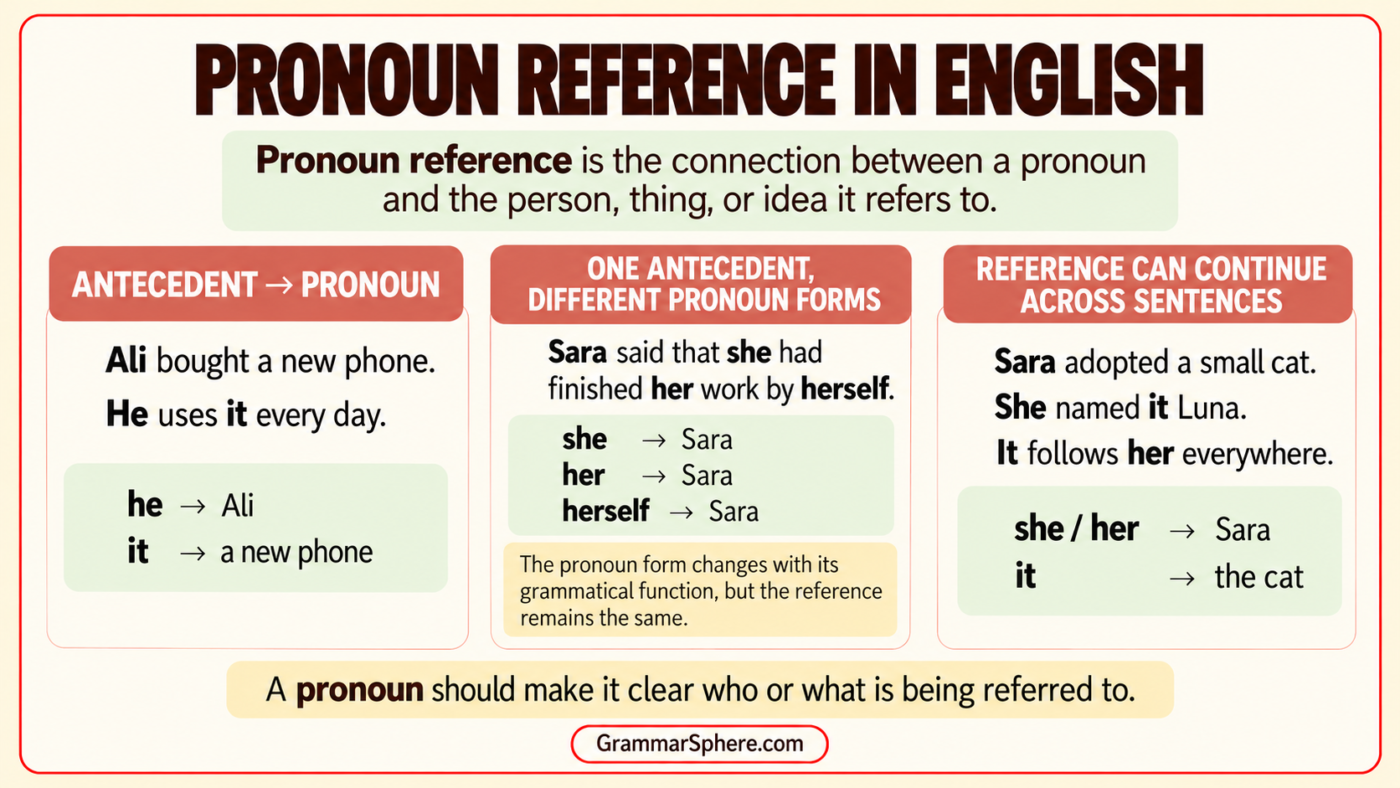
Pronoun reference is the connection between a pronoun and the person, thing, or idea it refers to.
For example:
Ali bought a new phone. He uses it every day.
Here:
- he → Ali
- it → a new phone
The noun or noun phrase that a pronoun refers to is commonly called its antecedent.
For example:
Maria lost her keys.
Here:
- Maria → antecedent
- her → pronoun referring to Maria
A pronoun should make it easy for the reader or listener to understand who or what is being referred to. If the reference is unclear, the meaning of the sentence can also become unclear.
Pronouns and Their Antecedents
An antecedent is the noun or noun phrase that a pronoun refers to.
For example:
The students finished their work.
Here:
- the students → antecedent
- their → pronoun referring to the students
Another example is:
The dog wagged its tail.
Here:
- the dog → antecedent
- its → pronoun referring to the dog
An antecedent can be a single noun, such as dog or students, or a complete noun phrase.
For example:
The new teacher from Lahore introduced herself.
The complete noun phrase the new teacher from Lahore is the antecedent of herself.
The same antecedent can also be referred to by different pronoun forms.
Consider:
Sara said that she had finished her work by herself.
Here:
- she → Sara
- her → Sara
- herself → Sara
All three pronouns refer to the same antecedent, Sara, but their forms are different because they perform different grammatical jobs in the sentence.
The antecedent tells us who or what the pronoun refers to, while the form of the pronoun depends on how it is used in the sentence.
Pronouns Before and After Their Antecedents
A pronoun usually refers to a noun or noun phrase that has already been mentioned.
For example:
Sara entered the room. She sat near the window.
Here:
- Sara → antecedent
- she → refers back to Sara
This is the most common order: the antecedent comes first, and the pronoun comes later.
Sometimes, however, a pronoun appears before the noun or noun phrase it refers to.
For example:
When she entered the room, Sara smiled.
Here, she appears before Sara, but the reference is still clear.
Another example is:
Because he was tired, Ahmed went home early.
Here, he refers forward to Ahmed.
This kind of forward reference is possible when the sentence makes the connection clear. If more than one person or thing could match the pronoun, however, the reference may become confusing.
Pronoun Reference Across Sentences
A pronoun does not have to refer to an antecedent in the same sentence. It can also refer to a noun or noun phrase mentioned in an earlier sentence.
For example:
Ali bought a new laptop. He uses it for work.
Here:
- he → Ali
- it → a new laptop
The same reference can continue across several sentences:
Sara adopted a small cat. She named it Luna. It follows her everywhere.
Here:
- she and her → Sara
- it → the cat
The reference remains clear because the reader can easily connect each pronoun with the correct antecedent.
If several new people or things are introduced, however, the reference may become harder to follow. In that case, repeating the noun can be clearer than using another pronoun.
Pronoun Reference and Pronoun–Antecedent Agreement
Pronoun reference and pronoun–antecedent agreement are closely related, but they are not the same.
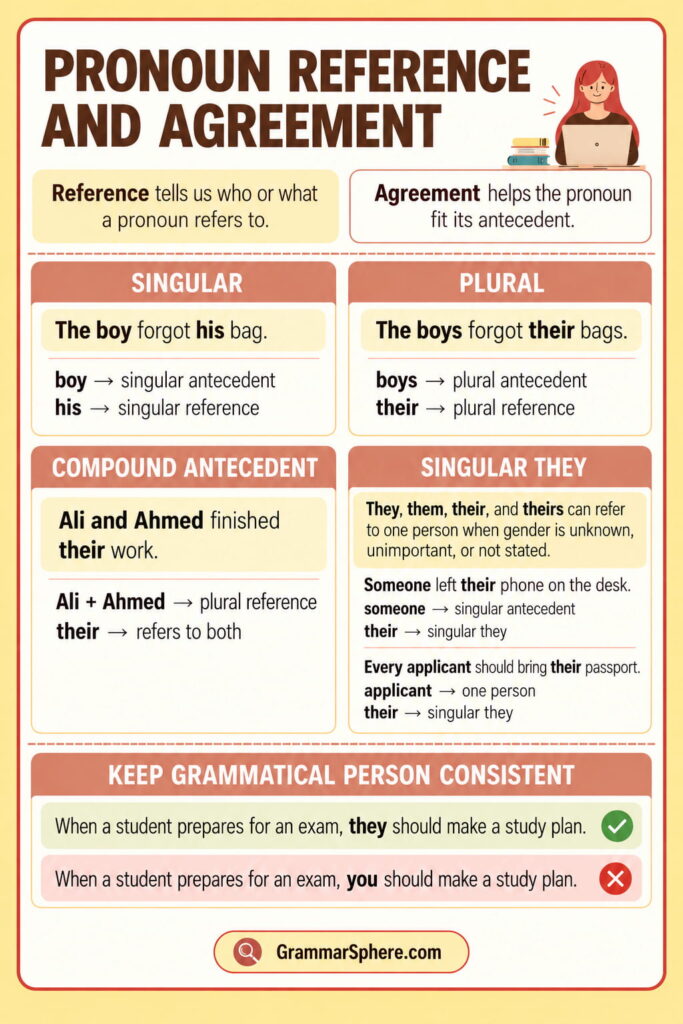
Pronoun reference tells us who or what a pronoun refers to.
For example:
Sara said that she was ready.
Here, she refers to Sara.
Pronoun–antecedent agreement helps make sure the pronoun has the appropriate form for its antecedent.
Compare:
The boy forgot his bag.
- the boy → singular antecedent
- his → singular pronoun
The boys forgot their bags.
- the boys → plural antecedent
- their → plural pronoun
Agreement also involves grammatical person:
- I finished my work.
- You finished your work.
- They finished their work.
When a gendered pronoun such as he or she is used, it should clearly refer to the intended person.
For example:
Sara said that she was ready.
Here, she refers to Sara.
The difference is simple:
- pronoun reference tells us who or what the pronoun refers to
- pronoun–antecedent agreement helps make sure the pronoun has the appropriate form for its antecedent
A sentence can have correct agreement but still have unclear reference.
For example:
Ali spoke to Ahmed because he was worried.
The pronoun he is singular, so there is no obvious agreement problem. However, the reference is unclear because he could refer to either Ali or Ahmed.
Pronoun Reference with Compound Antecedents
A pronoun can refer to two or more nouns or noun phrases together. These form a compound antecedent.
When two antecedents are joined by and, they normally take a plural pronoun.
For example:
- Ali and Ahmed finished their work.
- Sara and Ayesha said they were ready.
In both sentences, the pronoun refers to both people.
When antecedents are joined by or or nor, they present alternatives rather than one combined group.
For example:
Either Ali or Ahmed should bring their ID.
Here, singular they naturally refers to whichever person is meant.
The pronoun should always make it clear who or what the compound antecedent refers to.
Pronoun Reference with Indefinite Pronouns
Indefinite pronouns refer to people or things without saying exactly who or what they are.
Some indefinite pronouns are grammatically singular:
- everyone
- someone
- anyone
- nobody
- each
Modern English commonly uses singular they with these pronouns.
For example:
- Everyone has finished their work.
- Someone left their phone on the desk.
- Nobody said they wanted to leave.
Other indefinite pronouns are plural:
- both
- few
- many
- several
These normally take plural pronouns:
Several forgot their books.
Some indefinite pronouns, such as some, all, most, and none, can refer either to an amount or to more than one person or thing.
Compare:
Some of the milk has lost its freshness.
Some of the students have finished their work.
The correct pronoun depends on what the indefinite pronoun refers to in the sentence.
Keeping Pronoun Reference Consistent
Pronoun reference can become confusing when a sentence switches unnecessarily from one grammatical person to another.
Consider:
When a student prepares for an exam, you should make a study plan. ✗
The sentence begins with a student but then changes to you.
A consistent version is:
When a student prepares for an exam, they should make a study plan.
Another possible version is:
When you prepare for an exam, you should make a study plan.
Both sentences keep the same point of view throughout.
A similar problem occurs when a sentence switches unnecessarily between you and one:
If you want to improve, one should practise regularly. ✗
A clearer version is:
If you want to improve, you should practise regularly.
Pronouns should change only when the person, number, or intended reference genuinely changes.
How to Identify Pronoun Reference
To identify pronoun reference, begin with the pronoun and ask who, what, or which idea it refers to.
Consider:
The girl picked up her bag because she was leaving.
Here:
- her → the girl
- she → the girl
A useful method is:
- Find the pronoun.
- Ask who, what, or which idea it refers to.
- Identify the antecedent if there is one.
- Check whether the pronoun matches the antecedent appropriately.
- Check whether another noun could also be the antecedent.
- Make sure the reference remains clear throughout the sentence or paragraph.
For example:
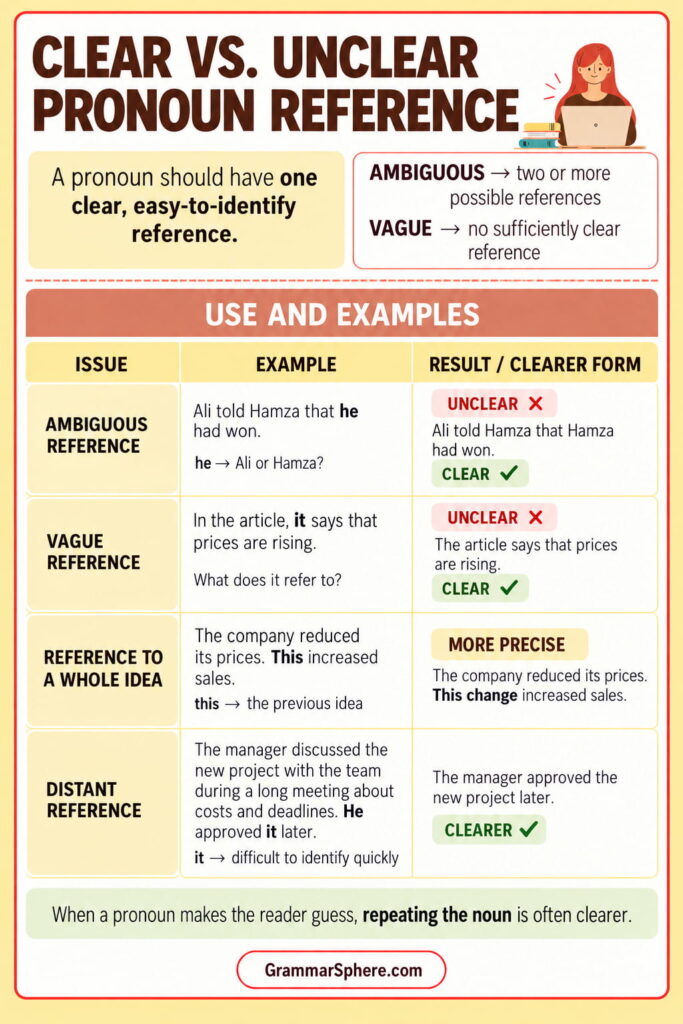
When Ahmed met Bilal, he smiled.
The pronoun he could refer to either Ahmed or Bilal, so the reference is ambiguous.
A clearer version is:
Ahmed smiled when he met Bilal.
The pronoun he now clearly refers to Ahmed.
Common Mistakes with Pronoun Reference
1. Giving a Pronoun More Than One Possible Antecedent
When Ali called Ahmed, he was driving. ✗
The pronoun he could refer to either Ali or Ahmed.
A clearer version is:
Ali was driving when he called Ahmed.
2. Using a Pronoun Without a Clear Reference
In the report, it says that sales increased. ✗
The report says that sales increased. ✓
In the first sentence, it does not clearly refer to anything.
3. Using a Pronoun That Does Not Agree with Its Antecedent
The students submitted its project. ✗
The students submitted their project. ✓
The antecedent students is plural, so the pronoun should be their.
4. Changing Grammatical Person Unnecessarily
If you want to improve your English, one should practise every day. ✗
If you want to improve your English, you should practise every day. ✓
The corrected sentence keeps the same grammatical person throughout.
5. Using This or That Too Broadly
The company lost several customers. This was a problem.
The meaning is understandable, but the reference can be made more precise:
The company lost several customers. This loss was a problem.
Adding a noun such as change, decision, result, loss, problem, or event can make a broad reference clearer.
6. Placing a Pronoun Too Far from Its Antecedent
When several nouns or ideas appear between a pronoun and its antecedent, the reader may have difficulty identifying the intended reference.
In that case, repeating the noun is often clearer than using another pronoun.
7. Assuming Every Pronoun Must Have a Noun Antecedent
Not every pronoun refers to a noun mentioned elsewhere.
For example:
It is raining.
Here, it does not refer to a particular noun.
Similarly, I and you usually get their meaning from the speaking situation rather than from an antecedent.
Pronoun Reference Exercises with Answers
A. Identify What Each Pronoun Refers To
- Sara forgot her notebook.
- The boys finished their homework.
- The dog followed its owner.
- Ayesha said she would arrive early.
- Ali bought a laptop. He uses it every day.
B. Identify the Pronoun Reference Problem
- When Ali spoke to Ahmed, he was angry.
- In the article, it says that exercise is useful.
- The students submitted its project.
- If a person wants to improve, you should practise regularly.
- The company changed its policy. This upset many workers.
C. Rewrite the Sentences to Make the Reference Clear
- When Sara met Ayesha, she was tired.
- The students told the teachers that they needed more time.
- In the report, it says that prices have increased.
- When a student studies regularly, you can improve your results.
- The school changed the timetable. This caused confusion.
Answers
- her → Sara
- their → the boys
- its → the dog
- she → Ayesha
- he → Ali; it → a laptop
- He could refer to either Ali or Ahmed, so the reference is ambiguous.
- It has no clear antecedent.
- Its does not agree with the plural antecedent students.
- The sentence changes unnecessarily from a person to you.
- This refers broadly to the previous idea. This policy change would make the reference more precise.
Possible Corrections
- Sara was tired when she met Ayesha.
- If the students needed more time:
The students told the teachers, “We need more time.”
If the teachers needed more time:
The students told the teachers that the teachers needed more time.
- The report says that prices have increased.
- When a student studies regularly, they can improve their results.
- The school changed the timetable. This change caused confusion.
FAQs About Pronoun Reference
What is the difference between pronoun reference and pronoun agreement?
Pronoun reference tells us who or what a pronoun refers to. Pronoun agreement tells us whether the pronoun has the appropriate form for its antecedent.
The students finished their work.
Here, their refers to the students, and the plural pronoun matches the plural antecedent.
Can a pronoun come before the noun it refers to?
Yes. A pronoun can sometimes appear before its antecedent.
When she arrived, Sara sat down.
Here, she refers forward to Sara.
Can a pronoun refer to a whole idea instead of one noun?
Yes. Words such as this, that, and which can refer to a whole idea or clause.
The train was delayed. This caused several problems.
Here, this refers to the fact that the train was delayed.
Can they refer to one person?
Yes. Singular they can refer to one person whose gender is unknown, unimportant, or not stated.
Someone left their bag here.
Singular they can also refer to a particular person who uses they/them pronouns.
Does every pronoun need an antecedent?
No. Pronouns such as I and you can refer directly to the speaker or listener.
The pronoun it can also appear without referring to a particular noun:
It is raining.
When a pronoun does refer to an antecedent, the connection should be clear.
You May Also Like


Leave a Comment