

Table of Contents
Irregular verbs are verbs that do not follow the regular -ed or -d pattern when forming the past tense and past participle. Instead, their forms may change in different ways.
For example, go becomes went in the past tense and gone in the past participle, while write becomes wrote and written.
Common irregular verbs include go, come, see, take, write, eat, speak, and begin. Learning irregular verbs and their different forms helps you use English verbs correctly in speaking and writing.
What Is an Irregular Verb?
An irregular verb is a verb that does not follow the regular -ed or -d pattern to form its past tense and past participle. Instead, irregular verbs have different forms that need to be learned.
For example:
- write → wrote → written
- buy → bought → bought
- run → ran → run
Example Sentences:
- Sarah wrote a letter to her friend.
- Bilal bought a new car last week.
- Aisha ran in the marathon yesterday.
In these examples, wrote, bought, and ran are irregular past-tense forms because they are not formed by simply adding -ed to the base verb.
Regular Verbs vs. Irregular Verbs
The main difference between regular and irregular verbs is how they form the past tense and past participle. Regular verbs usually add -ed or -d, while irregular verbs do not follow this regular pattern.
| Type | Base Form | Past Tense | Past Participle |
|---|---|---|---|
| Regular | play | played | played |
| Irregular | eat | ate | eaten |
| Irregular | take | took | taken |
| Regular | work | worked | worked |
For example, play becomes played by adding -ed, but eat changes to ate in the past tense and eaten in the past participle. This difference makes irregular verbs different from regular verbs.
Common Irregular Verb Patterns
Although irregular verbs do not follow the regular -ed or -d pattern, many of them can be grouped according to how their base form, past tense, and past participle change. Learning these common patterns can make irregular verbs easier to remember.
• Same Form in All Three Verb Forms
Some irregular verbs have the same base form, past tense, and past participle.
put → put → put
- Ahmad puts the book on the table every day.
- Ahmad put the book on the table yesterday.
- Ahmad has put the book on the table.
Other examples include cut → cut → cut and hit → hit → hit.
• Past Tense and Past Participle Are the Same
Some irregular verbs have different base forms, but their past tense and past participle are the same.
sleep → slept → slept
- Maryam sleeps early every night.
- Maryam slept early last night.
- Maryam has slept well.
Other examples include buy → bought → bought and teach → taught → taught.
• All Three Forms Are Different
Some irregular verbs have a different base form, past tense, and past participle.
go → went → gone
- Ali goes to school every day.
- Ali went to school yesterday.
- Ali has gone to school.
Other examples include write → wrote → written and begin → began → begun.
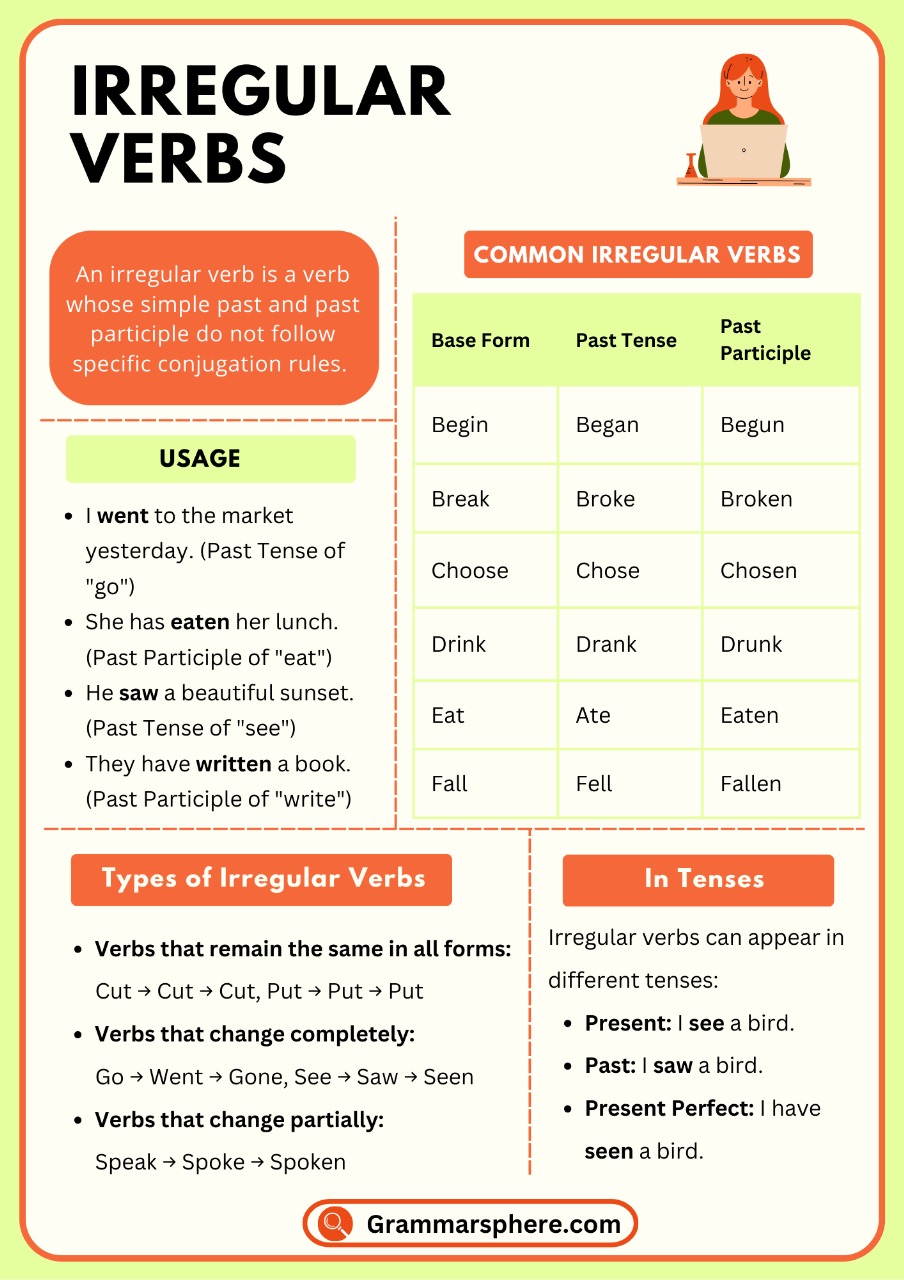
List of Common Irregular Verbs in English
The table below shows some common irregular verbs in English with their base form, past tense, and past participle.
| Base Form | Past Tense | Past Participle |
|---|---|---|
| be | was/were | been |
| begin | began | begun |
| break | broke | broken |
| bring | brought | brought |
| buy | bought | bought |
| choose | chose | chosen |
| come | came | come |
| do | did | done |
| drink | drank | drunk |
| drive | drove | driven |
| eat | ate | eaten |
| find | found | found |
| get | got | got/gotten |
| give | gave | given |
| go | went | gone |
| know | knew | known |
| run | ran | run |
| see | saw | seen |
| speak | spoke | spoken |
| take | took | taken |
| think | thought | thought |
| write | wrote | written |
These irregular verbs do not form their past tense and past participle by simply adding -ed or -d. Learning their different forms will help you use them correctly in English sentences.
Rules for Using Irregular Verbs
Knowing the correct forms of irregular verbs is important when using them in different tenses and sentence structures. Here are some basic rules to remember.
• Do Not Add -ed to Irregular Verbs
Irregular verbs do not form their past tense by simply adding -ed or -d. Use the correct irregular form instead.
✓ She went to the store yesterday.
✗ She goed to the store yesterday.
✓ He took the book.
✗ He taked the book.
• Use the Past-Tense Form for Simple Past
When talking about a completed action in the simple past, use the past-tense form of the irregular verb.
- She wrote a letter yesterday.
- We saw him last week.
- He bought a new phone.
• Use the Past Participle with Have, Has, or Had
In perfect tenses, use the past participle, not the simple past form.
✓ She has written a letter.
✗ She has wrote a letter.
✓ They have gone home.
✗ They have went home.
• Use the Past Participle in the Passive Voice
Irregular verbs also use their past participle form in passive constructions.
- The letter was written by Sarah.
- The window was broken yesterday.
- The food was eaten quickly.
• Use the Base Form After “Did”
When did or didn’t is used in a simple past question or negative sentence, use the base form of the verb.
✓ Did you go there?
✗ Did you went there?
✓ She didn’t take the bus.
✗ She didn’t took the bus.
Learning the base form, past tense, and past participle of common irregular verbs will help you use them correctly in different English sentence structures.
Irregular Verbs in Different Tenses
Irregular verbs use different forms depending on the tense. The past tense is used for completed actions in the past, while the past participle is commonly used with have, has, and had in perfect tenses.
For example, the irregular verb write has three main forms:
write → wrote → written
| Tense | Example |
|---|---|
| Present Simple | She writes a letter every week. |
| Past Simple | She wrote a letter yesterday. |
| Present Perfect | She has written a letter. |
| Past Perfect | She had written the letter before dinner. |
Another example is go → went → gone:
- I go to work every day.
- I went to work yesterday.
- I have gone there many times.
- I had gone home before he arrived.
Remember that the past tense and past participle are not always the same. For example, went is the past tense of go, while gone is its past participle.
Irregular Verbs with More Than One Form
Some English verbs have more than one accepted past tense or past participle form. These variations are sometimes related to differences between British and American English.
| Base Form | Past Tense | Past Participle |
|---|---|---|
| burn | burned / burnt | burned / burnt |
| dream | dreamed / dreamt | dreamed / dreamt |
| learn | learned / learnt | learned / learnt |
| smell | smelled / smelt | smelled / smelt |
| spell | spelled / spelt | spelled / spelt |
For example:
- She learned English at school.
- She learnt English at school.
Both forms are correct. However, one form may be more common than the other depending on whether British or American English is being used.
Learning these alternative forms can help you recognize irregular verbs in different varieties of English.
Common Mistakes with Irregular Verbs
Learners often make mistakes with irregular verbs because their past forms do not follow the regular -ed or -d pattern. Here are some common mistakes to avoid.
• Adding -ed to an Irregular Verb
Do not add -ed to an irregular verb that has its own past form.
✗ She goed to school yesterday.
✓ She went to school yesterday.
✗ He buyed a new phone.
✓ He bought a new phone.
• Using the Past Tense Instead of the Past Participle
After have, has, or had, use the past participle.
✗ She has wrote a letter.
✓ She has written a letter.
✗ They have went home.
✓ They have gone home.
• Using the Past Form After “Did”
After did or didn’t, use the base form.
✗ Did you went there?
✓ Did you go there?
✗ She didn’t took the bus.
✓ She didn’t take the bus.
• Confusing the Past Tense and Past Participle
Some irregular verbs have different past-tense and past-participle forms.
✗ He has drank the water.
✓ He has drunk the water.
✗ She has sang this song before.
✓ She has sung this song before.
Learning the base form, past tense, and past participle together can help you avoid these common irregular verb mistakes.
FAQs
What are irregular verbs?
Irregular verbs are verbs that do not follow the regular -ed or -d pattern when forming their past tense and past participle. For example, go → went → gone and write → wrote → written.
What are some common irregular verbs?
Common irregular verbs include be, go, come, see, take, give, write, eat, speak, buy, bring, know, and think.
What is the difference between regular and irregular verbs?
Regular verbs usually form their past tense and past participle by adding -ed or -d, such as work → worked → worked. Irregular verbs do not follow this regular pattern, such as take → took → taken.
How can you identify an irregular verb?
A verb is irregular if its past tense or past participle does not follow the normal -ed or -d pattern. For example, see becomes saw and go becomes went in the past tense.
Do irregular verbs have rules?
Irregular verbs do not follow one single formation rule, but many have recognizable patterns. For example, some remain unchanged, such as cut → cut → cut, while others have the same past tense and past participle, such as buy → bought → bought.
How can I learn irregular verbs easily?
Learn the three main forms together: base form → past tense → past participle. You can also group verbs with similar patterns, such as sing → sang → sung and drink → drank → drunk.
What is the past participle of an irregular verb?
The past participle is the third form of the verb. It is commonly used with have, has, and had and in passive constructions. For example, written is the past participle of write, and gone is the past participle of go.
You May Also Like


Leave a Comment