

Table of Contents
The Future Perfect Continuous Tense is used to describe actions that will have been continuing for a certain period of time up to a specific point in the future. Many learners find it difficult to use will have been + verb-ing correctly and distinguish this tense from other future tenses.
In this lesson, you will learn the rules, structure, uses, and examples of the Future Perfect Continuous Tense and how to use it correctly in English.
What Is the Future Perfect Continuous Tense?
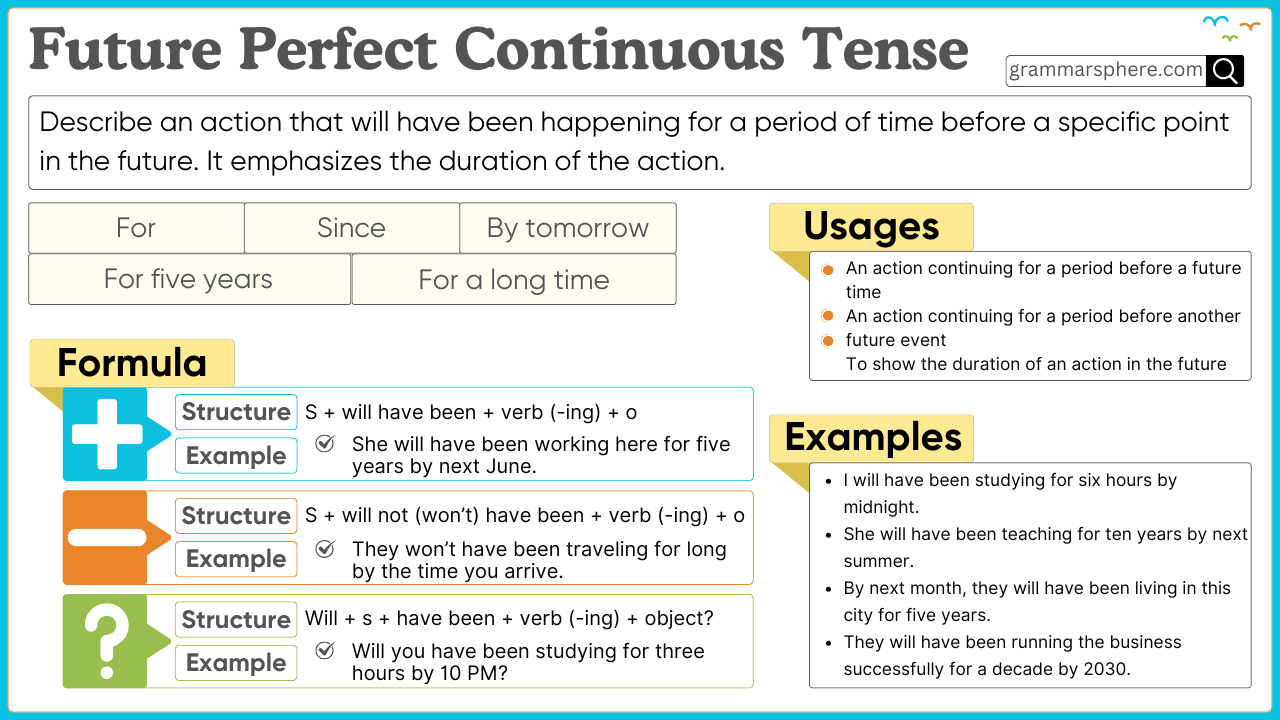
The Future Perfect Continuous Tense describes an action that will have been continuing for a period of time up to a specific point in the future. It mainly emphasizes the duration or continuity of the action.
For example:
By 8 p.m., they will have been traveling for six hours.
By next month, she will have been working here for five years.
Structure of the Future Perfect Continuous Tense
The Future Perfect Continuous Tense is formed using:
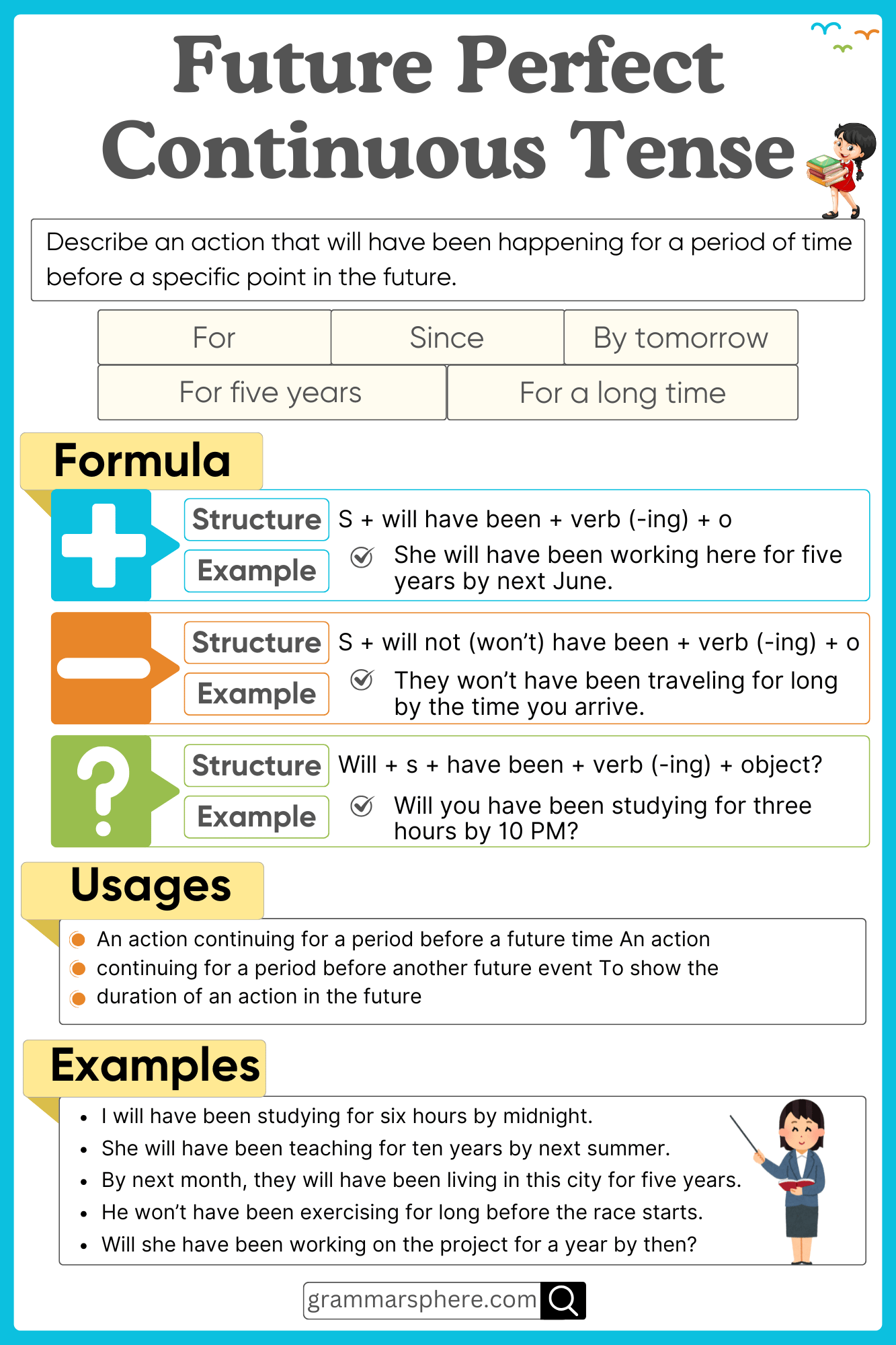
Subject + will have been + verb-ing + rest of sentence
Affirmative Sentences
Structure: Subject + will have been + verb-ing + rest of sentence
- Aisha will have been studying for five hours by 6 p.m.
- They will have been traveling for two days by tomorrow.
Negative Sentences
Structure: Subject + will not have been + verb-ing + rest of sentence
- Aisha will not have been studying for five hours by 6 p.m.
- They will not have been traveling for two days by tomorrow.
Interrogative Sentences
Structure: Will + subject + have been + verb-ing + rest of sentence?
- Will Aisha have been studying for five hours by 6 p.m.?
- Will they have been traveling for two days by tomorrow?
Wh-Questions
Structure: Wh-word + will + subject + have been + verb-ing + rest of sentence?
- How long will Aisha have been studying by 6 p.m.?
- Why will they have been traveling for two days by tomorrow?
Subject Agreement
The structure will have been remains the same with all subjects:
- I will have been working
- She will have been working
- They will have been working
Unlike some other verb forms, will does not change according to the subject.
Time Expressions in the Future Perfect Continuous Tense
Time expressions are commonly used with the Future Perfect Continuous Tense to show how long an action will have continued or the future point up to which it will continue.
For — Duration
Use for to show the length of time an action will have continued.
- By next year, I will have been working here for ten years.
- By 5 p.m., they will have been driving for six hours.
Since — Starting Point
Use since to show when the action started.
- By December, he will have been studying medicine since 2020.
- By next month, she will have been living here since June.
By — Future Point
Use by to identify the future point up to which the duration is measured.
- By 5 p.m., they will have been driving for six hours.
- By next year, I will have been working here for ten years.
By the Time / Before
By the time and before can introduce another future event that acts as the reference point.
- By the time you arrive, I will have been waiting for two hours.
- She will have been working for six hours before the meeting starts.
Uses of the Future Perfect Continuous Tense
1. Actions Continuing Up to a Specific Future Time
Use the Future Perfect Continuous to describe an action that will have continued for a period of time up to a particular point in the future.
- By next month, Aisha will have been working at the company for five years.
- He will have been studying for hours before the exam starts.
2. Cause of a Future Situation
It can also explain the cause of a future situation by emphasizing an activity that will have been continuing.
- She will be tired because she will have been traveling all day.
- They will be exhausted because they will have been working for hours.
Stative Verbs and the Future Perfect Continuous
The Future Perfect Continuous Tense is not normally used with stative verbs because these verbs describe states rather than ongoing actions.
Common stative verbs include know, believe, understand, own, belong, like, love, and need.
With these verbs, we usually use the Future Perfect Tense instead.
- ❌ By next year, I will have been knowing him for ten years.
- ✅ By next year, I will have known him for ten years.
- ❌ By December, she will have been owning the house for five years.
- ✅ By December, she will have owned the house for five years.
Note: Some verbs can describe either a state or an activity depending on their meaning. When they describe an activity, a continuous form may be possible.
Future Perfect Continuous vs. Future Perfect Tense
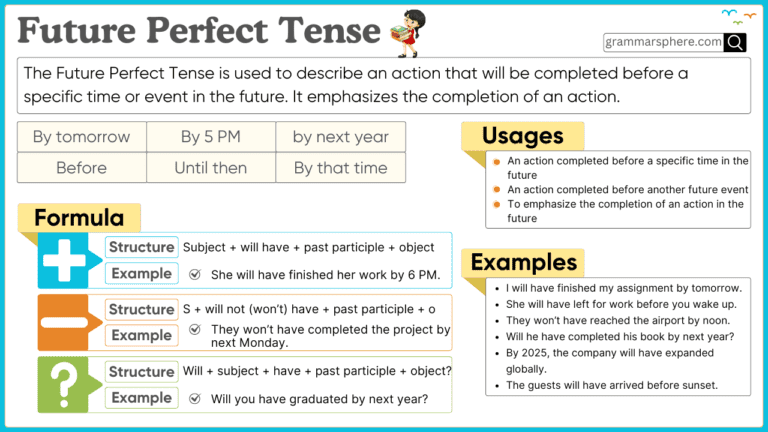
The Future Perfect Continuous generally emphasizes the duration or continuity of an activity, while the Future Perfect generally emphasizes its completion or result.
| Feature | Future Perfect Continuous | Future Perfect |
|---|---|---|
| Structure | will have been + verb-ing | will have + past participle |
| Main Emphasis | Duration or continuity | Completion or result |
| Example | She will have been writing for three hours. | She will have written the report. |
Compare:
- By 6 p.m., she will have been writing for three hours. → emphasizes duration
- By 6 p.m., she will have written the report. → emphasizes completion/result
Examples of the Future Perfect Continuous Tense
Affirmative Sentences
- I will have been living in this city for five years by next June.
- They will have been working on the project for six months before the deadline.
- Fatima will have been studying for hours before the exam starts.
- We will have been traveling for two days by the time we reach our destination.
- Ahmed will have been practicing football for weeks before the tournament.
Negative Sentences
- He will not have been sleeping for long before his alarm rings.
- We will not have been waiting at the station for more than an hour.
- She will not have been cooking all day before the guests arrive.
- They will not have been working at the company for a year by December.
- I will not have been exercising regularly before the marathon.
Interrogative Sentences
- Will she have been preparing for the exam for weeks?
- Will they have been living in this house for a decade by next year?
- Will Ahmed have been practicing his speech before the event?
- Will we have been driving for hours before reaching the hotel?
- Will the students have been studying for the final exams for months?
Common Mistakes with the Future Perfect Continuous Tense
1. Using the Wrong Verb Form
Use the -ing form of the verb after will have been.
❌ He will have been play football for two hours.
✅ He will have been playing football for two hours.
2. Leaving Out “Been”
The Future Perfect Continuous requires will have been + verb-ing.
❌ She will have working here for five years by June.
✅ She will have been working here for five years by June.
3. Confusing “For” and “Since”
Use for with a duration and since with a starting point.
❌ By June, she will have been working here since five years.
✅ By June, she will have been working here for five years.
❌ By December, he will have been studying medicine for 2020.
✅ By December, he will have been studying medicine since 2020.
4. Using Stative Verbs in the Continuous Form
Stative verbs such as know, believe, own, and understand are not normally used in continuous tenses.
❌ By next year, I will have been knowing him for ten years.
✅ By next year, I will have known him for ten years.
5. Confusing the Future Perfect Continuous with the Future Perfect
Use the Future Perfect Continuous when emphasizing duration or continuity, and the Future Perfect when emphasizing completion or result.
❌ By Friday, she will have been completing the report.
✅ By Friday, she will have completed the report.
But:
✅ By Friday, she will have been working on the report for five days.
FAQs
1. What is the Future Perfect Continuous Tense?
The Future Perfect Continuous Tense describes an action that will have been continuing for a period of time up to a specific point in the future.
2. What is the formula of the Future Perfect Continuous Tense?
The formula is:
Subject + will have been + verb-ing + rest of sentence
Example: She will have been studying for three hours by 6 p.m.
3. What are the uses of the Future Perfect Continuous Tense?
It is mainly used to show the duration of an action up to a future point or to explain the cause of a future situation.
Example: By next month, he will have been working here for five years.
4. What are some examples of the Future Perfect Continuous Tense?
- I will have been living here for ten years by June.
- She will have been studying for four hours by 8 p.m.
- They will have been traveling for two days by tomorrow.
5. What is the difference between Future Perfect and Future Perfect Continuous?
The Future Perfect emphasizes completion or result, while the Future Perfect Continuous emphasizes duration or continuity.
- She will have completed the project. → completion
- She will have been working on the project for three months. → duration
Read More
Leave a Comment