

Table of Contents
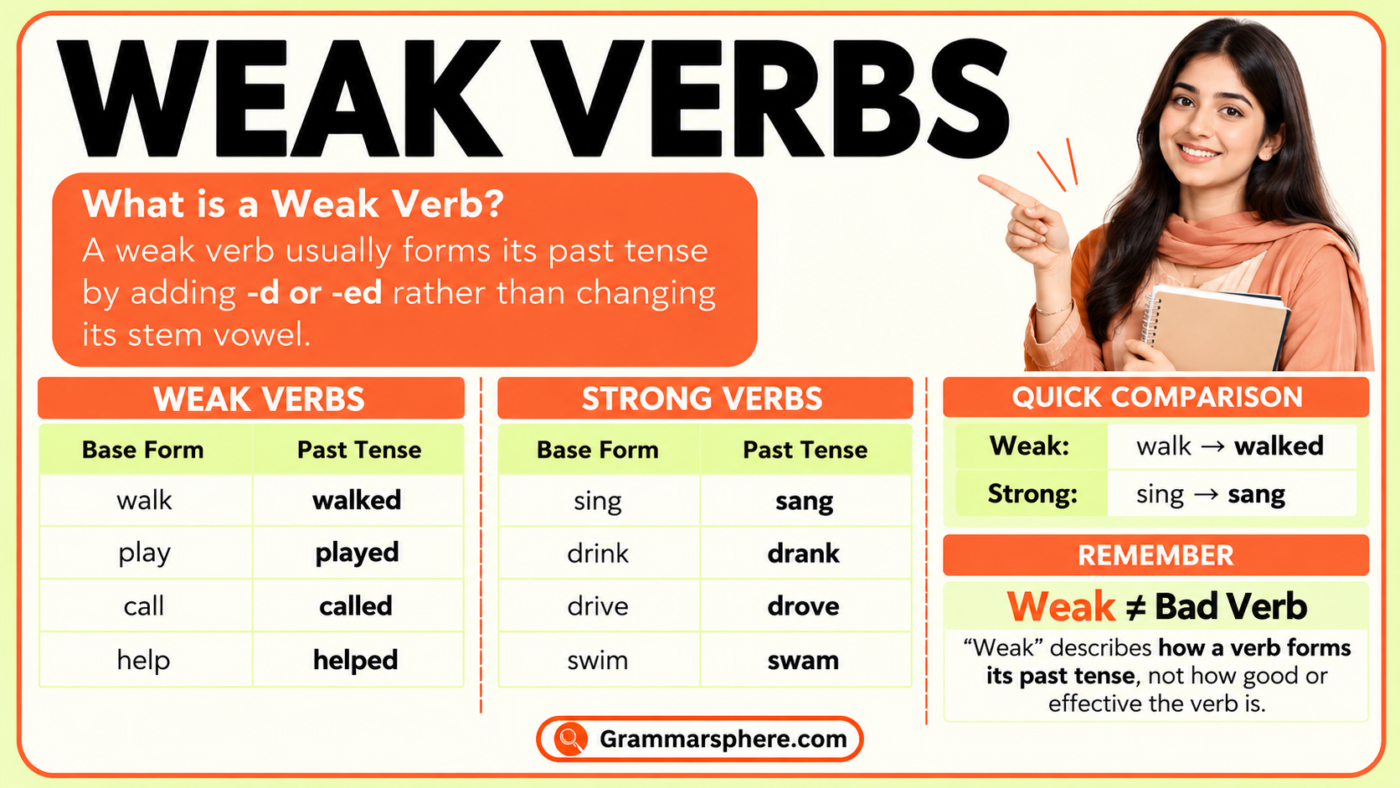
Weak verbs are an important traditional class of English verbs. They form their past forms through an inflectional ending rather than primarily through the internal vowel changes associated with strong verbs.
For example:
walk → walked → walked
play → played → played
open → opened → opened
The word weak does not mean that these verbs are unimportant, incorrect, or ineffective. In grammar, it describes the way a verb forms its different forms. Collins defines a weak verb as one whose conjugation relies on inflectional endings rather than internal vowel gradation.
In this lesson, you will learn how weak verbs form their past forms, the major spelling patterns, the pronunciation of -ed, how to identify and use weak verbs, and how weak verbs relate to regular, irregular, and strong verbs.
What Is a Weak Verb?
A weak verb is traditionally a verb that forms its past forms through an inflectional ending rather than through the internal vowel-gradation pattern characteristic of strong verbs.
Consider:
talk → talked → talked
The verb talk forms its past simple and past participle by adding an ending.
Now compare:
sing → sang → sung
The verb sing changes its internal vowel as part of the traditional strong-verb pattern.
Therefore:
Weak: talk → talked → talked
Strong: sing → sang → sung
Regular verbs provide the clearest weak-verb examples for modern learners:
- work → worked → worked
- clean → cleaned → cleaned
- help → helped → helped
- open → opened → opened
- watch → watched → watched
Most English verbs are regular, and regular verbs normally form both the past simple and past participle with -ed, subject to spelling changes.
However, weak and regular should not automatically be treated as perfect synonyms. The weak/strong distinction and the modern regular/irregular distinction come from different ways of classifying verbs.

How Weak Verbs Form the Past Tense
To understand weak verbs, start with three important verb forms:
Base Form → Past Simple → Past Participle
For example:
work → worked → worked
love → loved → loved
study → studied → studied
The past simple describes past situations or actions:
She worked yesterday.
The past participle appears in structures such as the perfect:
She has worked here before.
With regular verbs, the past simple and past participle normally have the same form:
open → opened → opened
love → loved → loved
watch → watched → watched
Cambridge identifies the base form, past form, and -ed form as basic verb forms and confirms that regular verbs normally form the latter two with -ed.
However, adding the ending is not always as simple as attaching -ed. The spelling depends on the ending of the base verb.
Adding -ed to Weak Verbs
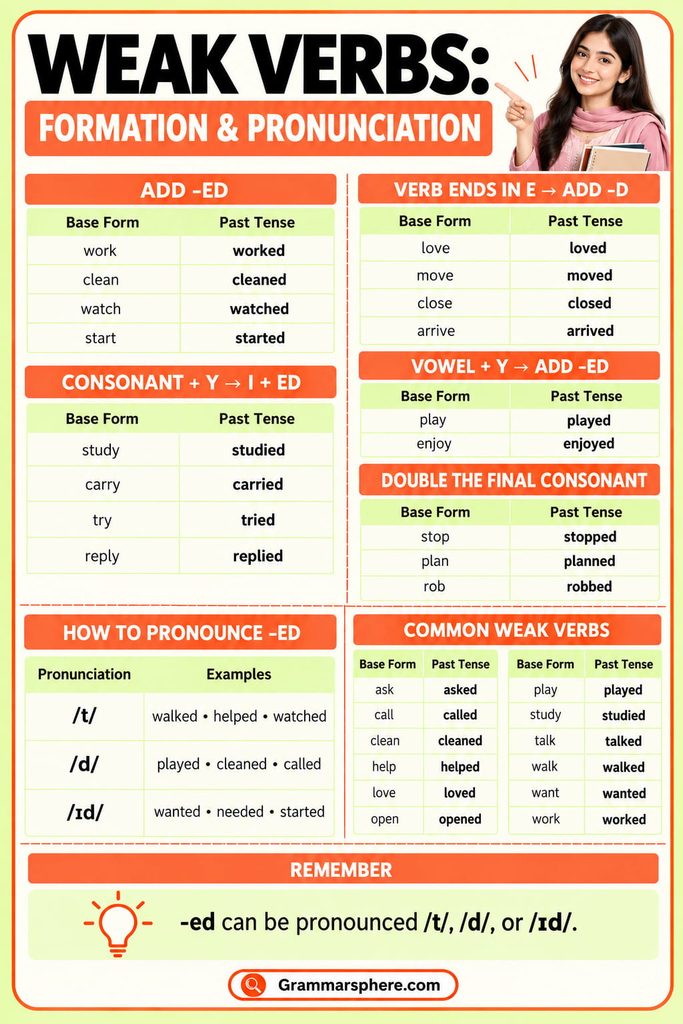
For most regular weak verbs, add -ed to the base form.
work → worked
clean → cleaned
watch → watched
help → helped
start → started
Examples:
They worked all day.
She cleaned her room.
We watched the match.
The same forms can function as past participles:
They have worked together before.
She has cleaned her room.
We have watched that film.
This is the standard regular pattern and the simplest way to see weak formation in modern English.
Adding -d to Verbs Ending in e
When the base verb already ends in e, add only -d.
love → loved
move → moved
close → closed
live → lived
agree → agreed
Examples:
They moved last year.
She closed the window.
We loved the movie.
Because the final e is already present, another e is unnecessary:
love → loved
not:
love → loveed
Cambridge identifies -e + d as the regular spelling pattern for these forms.
Changing y to i Before -ed
When a regular verb ends in consonant + y, the final y normally changes to i before -ed is added.
The resulting ending is -ied.
study → studied
carry → carried
try → tried
worry → worried
cry → cried
Examples:
She studied English yesterday.
He carried the bags upstairs.
The baby cried all night.
The basic pattern is:
consonant + y → change y to i + ed
So:
study → studied
not:
study → studyed
Cambridge confirms this regular spelling pattern for verbs such as study, hurry, try, and worry.
When y Stays Before -ed
When a regular verb ends in vowel + y, the y normally remains and -ed is added.
play → played
enjoy → enjoyed
stay → stayed
Examples:
The children played outside.
We enjoyed the meal.
She stayed at home.
Compare:
study → studied
consonant + y
with:
play → played
vowel + y
So the useful learner rule is:
Consonant + y → change y to i
Vowel + y → keep y
However, learners should not apply this mechanically to every verb ending in y. For example, pay → paid and say → said are exceptions to the ordinary spelling pattern. Cambridge specifically identifies these exceptional forms.
Doubling the Final Consonant Before -ed
Some regular weak verbs double the final consonant before -ed is added.
Common examples include:
stop → stopped
plan → planned
drop → dropped
Examples:
The bus stopped suddenly.
We planned the trip carefully.
She dropped her phone.
With many short one-syllable verbs ending in a single vowel followed by a consonant, the final consonant doubles:
stop → stopped
not:
stop → stoped
With longer verbs, stress becomes important. Cambridge explains that when a base form ends in a vowel followed by a single consonant and the final syllable is stressed, the consonant is normally doubled, as in:
prefer → preferred
commit → committed
But when the final syllable is not stressed, it normally remains single:
develop → developed
visit → visited
This means consonant doubling should be learned as a spelling pattern rather than as “double every final consonant.”
Pronunciation of -ed in Weak Verbs
The regular past ending is written -ed, but it does not always have the same pronunciation.
There are three main pronunciations:
| Ending | Examples |
|---|---|
| /d/ | played, cleaned, loved |
| /t/ | watched, helped, stopped |
| /ɪd/ | wanted, needed, started |
The pronunciation depends primarily on the final sound of the base verb.
After many voiced sounds, -ed is pronounced /d/:
play → played
clean → cleaned
After many voiceless consonant sounds, it is pronounced /t/:
watch → watched
help → helped
After /t/ or /d/, it is pronounced /ɪd/ and forms an additional syllable:
want → wanted
need → needed
Cambridge confirms these three regular -ed pronunciations.
The important point is that spelling and pronunciation are not identical. A word may end in written -ed without that ending being pronounced /ɪd/.
How to Identify Weak Verbs
After learning the main formation patterns, identifying a weak verb becomes much easier.
1. Find the base verb.
Example:
walk
2. Check its past forms.
walk → walked → walked
3. Examine how those forms are created.
The verb uses an inflectional ending rather than the internal vowel-gradation pattern associated with traditional strong verbs.
Therefore, walk is weak.
Another example:
open → opened → opened
Again, the weak pattern is clear.
Compare:
sing → sang → sung
Here, internal vowel change is central to the traditional strong pattern.
For a beginner, regular -ed/-d verbs are therefore the easiest weak verbs to recognize.
However, do not use this shortcut:
ends in -ed = weak; does not end in -ed = strong
That is too absolute because some historically weak verbs have irregular modern forms. The modern regular/irregular distinction does not align perfectly with the traditional weak/strong distinction.
Using Weak Verbs in Sentences
Weak verbs behave like other English verbs in sentences. The label weak describes their formation; it does not limit them to one tense or sentence type.
Consider work:
Present simple:
I work every day.
Past simple:
I worked yesterday.
Present perfect:
I have worked here for two years.
Past perfect:
I had worked there before I moved.
The past form appears directly in affirmative past-simple sentences:
She cleaned the room.
But after did or didn’t, the main verb returns to its base form:
Did she clean the room?
She didn’t clean the room.
Not:
Did she cleaned the room?
She didn’t cleaned the room.
The past participle can appear after have:
She has cleaned the room.
It can also occur in a passive construction:
The room was cleaned yesterday.
Cambridge distinguishes these functions of the base, past, and past-participle/-ed forms.
Common Regular Weak Verbs with Examples
Regular verbs provide the most straightforward examples of weak verbs for learners.
| Base Form | Past Simple | Past Participle | Example |
|---|---|---|---|
| ask | asked | asked | She asked a question. |
| call | called | called | He called his friend. |
| clean | cleaned | cleaned | We cleaned the room. |
| close | closed | closed | She closed the door. |
| cook | cooked | cooked | He cooked dinner. |
| enjoy | enjoyed | enjoyed | They enjoyed the trip. |
| finish | finished | finished | I finished my work. |
| help | helped | helped | She helped her friend. |
| listen | listened | listened | We listened carefully. |
| live | lived | lived | They lived nearby. |
| love | loved | loved | She loved the story. |
| move | moved | moved | We moved last year. |
| open | opened | opened | He opened the box. |
| play | played | played | They played football. |
| start | started | started | The lesson started early. |
| study | studied | studied | She studied English. |
| talk | talked | talked | We talked for an hour. |
| try | tried | tried | He tried again. |
| walk | walked | walked | They walked home. |
| want | wanted | wanted | She wanted some water. |
| watch | watched | watched | We watched a film. |
| work | worked | worked | He worked yesterday. |
This section deliberately combines two closely related learner needs: regular weak verbs and a weak verbs list with examples. Creating separate H2s for both would largely duplicate the same information.
Cambridge confirms that most English verbs are regular and that regular verbs form their past and past-participle/-ed forms predictably.
Weak Verbs with Irregular Forms
This is where the difference between weak/strong and regular/irregular becomes important.
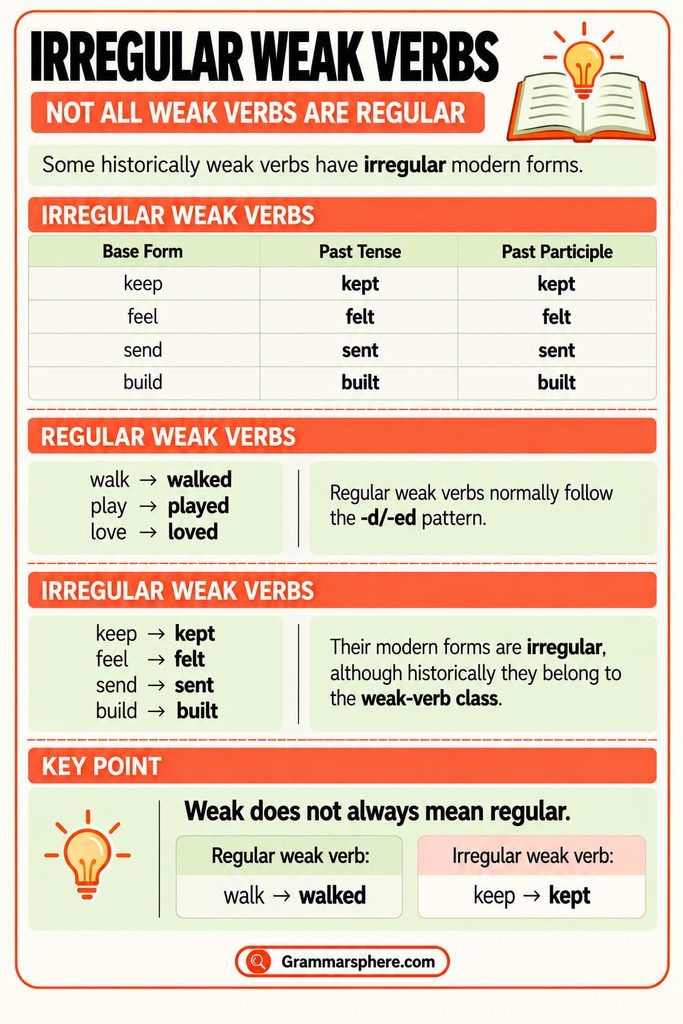
Some verbs do not follow the productive modern -ed rule:
keep → kept → kept
feel → felt → felt
send → sent → sent
build → built → built
Modern learner grammar treats these as irregular verbs because their past forms cannot be created simply by applying the ordinary regular -ed rule. Cambridge lists forms such as feel → felt, send → sent, and build → built among irregular forms.
However, the traditional weak/strong classification is not simply another name for regular/irregular.
This means:
Regular → normally weak
but:
Irregular → not necessarily strong
For beginner learners, forms such as kept, felt, sent, and built are best learned as irregular forms. The historical weak classification becomes more relevant when studying the traditional structure and development of English verbs.
Weak Verbs vs Strong Verbs
The traditional distinction between weak and strong verbs concerns how their past forms are created.
A weak verb characteristically relies on an inflectional ending:
walk → walked → walked
A strong verb characteristically uses internal vowel gradation:
sing → sang → sung
Compare:
| Weak Verb | Past Simple | Past Participle |
|---|---|---|
| walk | walked | walked |
| play | played | played |
| open | opened | opened |
| talk | talked | talked |
| Strong Verb | Past Simple | Past Participle |
|---|---|---|
| sing | sang | sung |
| drive | drove | driven |
| write | wrote | written |
| swim | swam | swum |
Collins defines the grammatical weak pattern through inflectional endings and contrasts it with internal vowel gradation.
The words weak and strong therefore do not describe meaning, usefulness, or expressive power.
And the following equation should not be treated as absolute:
weak = regular
strong = irregular
The systems overlap considerably, but they are not identical.
Weak Verbs in Grammar and Writing
The expression weak verb has another common use, especially in writing advice.
This meaning is different from the grammatical classification taught above.
Weak Verb in Grammar
In grammar, weak describes how a verb forms its past forms.
Example:
walk → walked
Weak Verb in Writing
In writing advice, a verb may be described as weak when it is vague, general, or less precise than another possible choice.
For example:
She walked quickly across the room.
A writer might choose:
She hurried across the room.
Or:
He looked angrily at me.
could become:
He glared at me.
Here, hurried and glared communicate more specific meanings.
Writing guidance often recommends precise verbs instead of vague verb-plus-modifier combinations, but that is a stylistic judgment, not the traditional grammatical weak/strong classification. Google’s technical-writing guidance similarly recommends precise, specific verbs rather than vague or generic ones.
Therefore:
Weak verb in grammar → verb formation
Weak verb in writing → stylistic description of verb choice
A verb can be grammatically weak without being stylistically weak.
Common Mistakes with Weak Verbs
Several common learner mistakes occur when forming and using regular weak verbs.
Changing final y incorrectly
Incorrect:
study → studyed
Correct:
study → studied
Cambridge specifically identifies forms such as studyed as incorrect.
Changing y when it should stay
Incorrect:
play → plaied
Correct:
play → played
Forgetting consonant doubling
Incorrect:
stop → stoped
Correct:
stop → stopped
Cambridge identifies stopped and planned as forms requiring consonant doubling.
Doubling a consonant unnecessarily
Incorrect:
develop → developped
Correct:
develop → developed
Cambridge specifically identifies developped as incorrect.
Using the past form after did
Incorrect:
She did not worked yesterday.
Correct:
She did not work yesterday.
After did/didn’t, use the base form.
Applying -ed to an irregular verb
Incorrect:
spend → spended
Correct:
spend → spent
Irregular forms must be learned separately rather than produced automatically with -ed.
Thinking weak means grammatically inferior
A weak verb is not a bad verb:
She worked yesterday.
The term simply describes a grammatical pattern.
Weak Verbs Practice Exercise
Write the correct past form.
- work → ______
- love → ______
- study → ______
- play → ______
- stop → ______
- carry → ______
- enjoy → ______
- plan → ______
Choose the correct form.
- a) She studyed English yesterday.
b) She studied English yesterday. - a) They plaied football.
b) They played football. - a) The bus stoped suddenly.
b) The bus stopped suddenly. - a) She did not worked yesterday.
b) She did not work yesterday.
Identify the traditional pattern as weak or strong.
- walk → walked → walked
- sing → sang → sung
- open → opened → opened
- drive → drove → driven
Choose the pronunciation of the -ed ending.
- played — /d/, /t/, or /ɪd/?
- watched — /d/, /t/, or /ɪd/?
- wanted — /d/, /t/, or /ɪd/?
Answers
- worked
- loved
- studied
- played
- stopped
- carried
- enjoyed
- planned
- b) She studied English yesterday.
- b) They played football.
- b) The bus stopped suddenly.
- b) She did not work yesterday.
- Weak
- Strong
- Weak
- Strong
- /d/
- /t/
- /ɪd/
FAQs
What is a weak verb?
A weak verb belongs to a traditional class of verbs whose conjugation relies on an inflectional ending rather than the internal vowel gradation associated with strong verbs. Walk → walked → walked is a clear example.
What are some examples of weak verbs?
Common regular examples include walk, work, play, clean, open, help, watch, study, talk, and start.
How do weak verbs form the past tense?
Regular weak verbs normally form the past with -ed or -d, with spelling changes where required: work → worked, love → loved, study → studied, and stop → stopped.
How can I identify a weak verb?
Look at how its past forms are created. Regular -ed/-d verbs provide the clearest weak pattern. Compare walk → walked with the traditional strong pattern sing → sang → sung.
Are weak verbs the same as regular verbs?
Not completely. Regular English verbs follow the weak pattern, but the traditional weak/strong distinction and modern regular/irregular distinction are not perfectly identical.
Do all weak verbs end in -ed?
No. Regular weak verbs normally show -ed/-d formation, but historically weak verbs can have irregular modern forms. Therefore, “ends in -ed” is useful for recognizing regular weak verbs but is not a complete definition of the whole weak class.
Why does y change to i in studied?
Because study ends in consonant + y. In regular past forms, the y changes to i before -ed: study → studied.
Why does y stay in played?
Because a vowel comes before the final y in play. Regular vowel + y verbs normally keep the y when -ed is added: play → played.
Why is the final consonant doubled in stopped?
In regular one-syllable verbs such as stop, a final consonant following a single vowel is doubled before -ed: stop → stopped. Stress also matters in longer verbs.
How is -ed pronounced?
The regular -ed ending commonly has three pronunciations: /d/, /t/, and /ɪd/. Compare played, watched, and wanted.
What is the difference between weak and strong verbs?
Weak verbs traditionally form their past forms through inflectional endings, whereas strong verbs characteristically use internal vowel gradation. Compare talk → talked with **sing → sang
You May also Like

Leave a Comment