

Table of Contents
A noun phrase is a word or group of words built around a noun or pronoun. Noun phrases are extremely common in English and can be very short or quite detailed.
Compare:
- students
- the students
- the new students
- the new students in my class
Each example is a noun phrase. In the last example, students is the central word, while the other words give more information about it.
Noun phrases can perform different functions in sentences:
- The new student asked a question.
- I bought a new laptop.
- She spoke to the manager.
To understand noun phrases properly, we need to know their head, structure, modifiers, complements, and functions in sentences.
What Is a Noun Phrase?
A noun phrase is a phrase whose head is normally a noun or pronoun. The head is the central element around which the rest of the phrase is built.
For example:
the old house
The noun house is the head. The words the and old provide additional information about it.
A noun phrase does not always contain several words. A single noun or pronoun can function as a complete noun phrase:
- Ali smiled.
- Children were playing.
- She laughed.
- I called him.
Noun phrases can also contain several elements:
- the tall boy
- those three old buildings
- the woman in the blue dress
- the book that you gave me
A complete noun phrase functions as one grammatical unit.
For example:
The woman in the blue dress is my teacher.
The complete subject is the woman in the blue dress. Within that phrase, woman is the head.
The Head of a Noun Phrase
The head is the central element of a noun phrase. The other elements in the phrase relate to or provide information about the head.
Consider:
the three old houses near the river
The head is houses.
The other elements add information:
- the helps specify the noun
- three gives its number
- old describes it
- near the river tells us which houses are meant
The head often determines important grammatical features of the phrase, including whether it is singular or plural.
We can often remove some modifiers while keeping the head:
the three old houses near the river
→ the old houses
→ the houses
→ houses
The amount of information changes, but houses remains the central element.
Nouns as Heads
Most noun phrases have a noun as their head.
- the car
- a beautiful garden
- those young children
- the house on the corner
- the student who won the prize
The head may be a common noun or a proper noun:
- students
- my brother
- Pakistan
- Sara
In:
the beautiful garden behind the house
the head is garden.
Everything else in the phrase relates to that noun.
Pronouns as Heads
Pronouns can also function as complete noun phrases.
- I understand.
- She called yesterday.
- I saw them.
- Someone is waiting outside.
- Nobody answered.
Some pronouns can also occur with modifiers:
- someone interesting
- something strange
- those who applied
This means a noun phrase does not always need to contain an ordinary lexical noun.
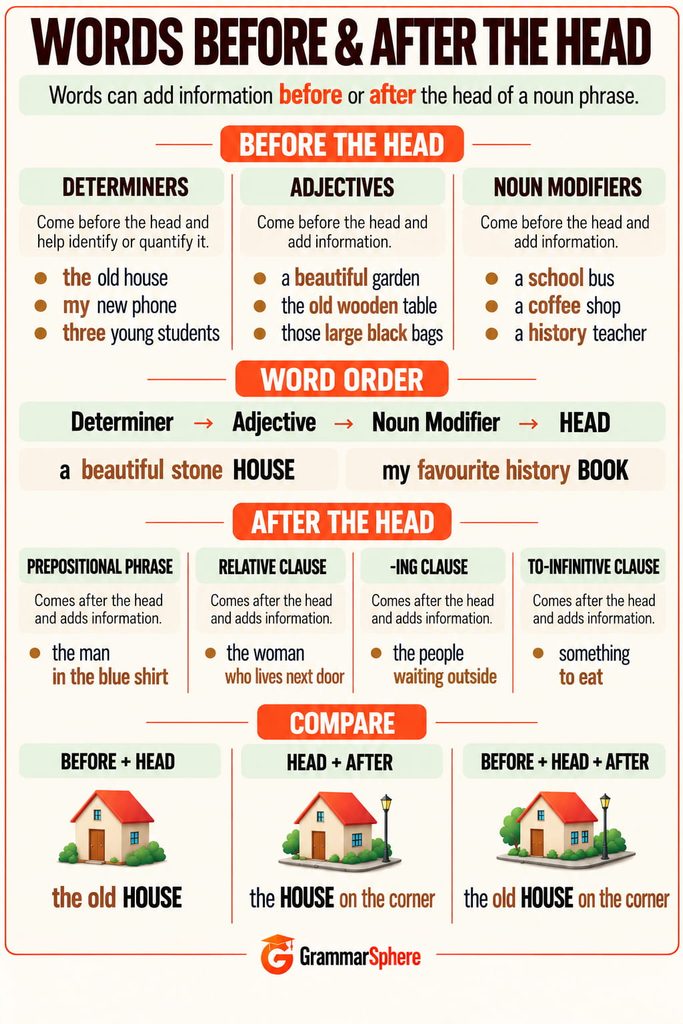
Structure of a Noun Phrase
A noun phrase can contain several elements around its head.
A useful general pattern is:
determiner + premodifier(s) + head + postmodifier/complement
For example:
the beautiful house on the hill
- the → determiner
- beautiful → premodifier
- house → head
- on the hill → postmodifier
However, not every noun phrase contains all of these elements.
A noun phrase can consist of only a head:
Students arrived.
It can contain a determiner and head:
The students arrived.
It can contain a premodifier and head:
English students arrived.
It can contain a determiner, premodifier, and head:
The new students arrived.
It can contain a head followed by a postmodifier:
The students in my class arrived.
Or it can contain several elements:
Those three talented students from my class
Here:
- those → determiner
- three → number
- talented → premodifier
- students → head
- from my class → postmodifier
The head is the central part of the structure. Other elements are added according to the meaning we want to express.
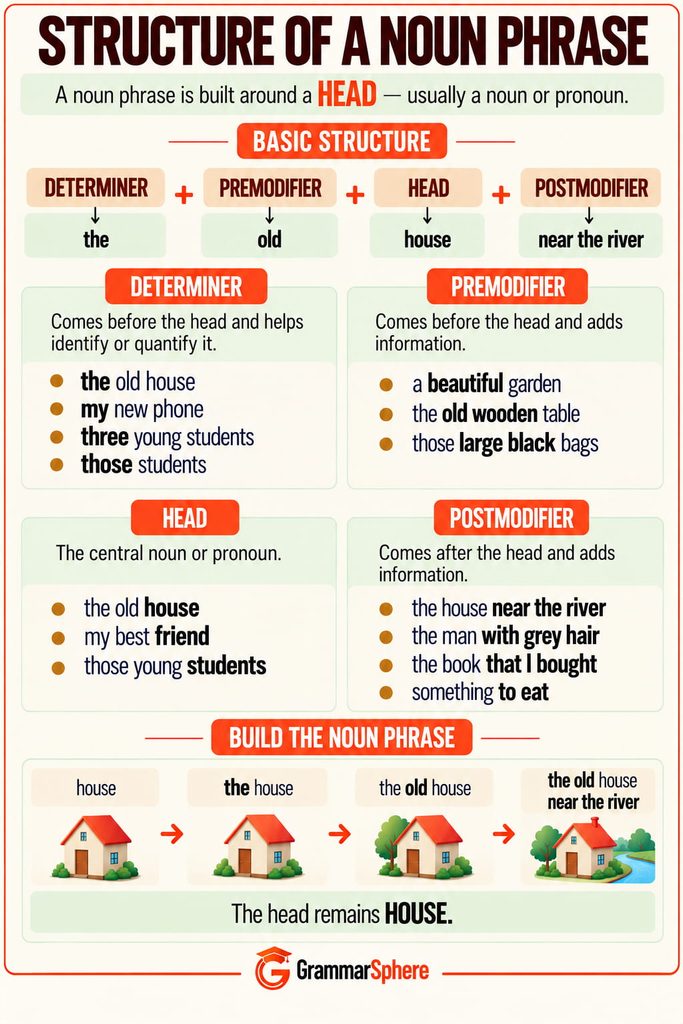
Determiners in Noun Phrases
Determiners occur before nouns and help identify, specify, quantify, or show possession.
Common determiners include:
- a, an, the
- this, that, these, those
- my, your, his, her, its, our, their
- some, any, no
- each, every, either, neither
- many, much, few, little
- all, both
Examples:
- a teacher
- the house
- this book
- those students
- my brother
- some information
- every student
Compare:
book
a book
this book
my book
The head remains book, but the determiner changes how the speaker refers to it.
Not every noun phrase requires a determiner:
- Water is essential.
- Children need sleep.
- Sara arrived early.
Whether a determiner is required depends on factors such as the type of noun, number, countability, and intended meaning.
Premodifiers in Noun Phrases
A premodifier occurs before the head and adds information about it.
Compare:
car
new car
expensive new car
an expensive new car
The head remains car, while the elements before it provide more information.
Adjectives as Premodifiers
Adjectives commonly function as premodifiers before nouns.
- a beautiful garden
- an old house
- the red car
- a difficult question
- those young students
More than one adjective can occur before the head:
- a beautiful old house
- a small black bag
- an interesting new book
English has preferences for the order of multiple adjectives. For example, we normally say:
a beautiful old house
rather than:
an old beautiful house
Detailed adjective order is a separate topic, but the important point here is that adjectives occurring before the head can form part of the noun phrase.
Nouns as Premodifiers
A noun can also modify another noun.
- school bus
- coffee shop
- football match
- office chair
- computer screen
In:
school bus
the head is bus, while school modifies it.
In:
coffee shop
the head is shop, while coffee tells us what kind of shop it is.
Noun premodifiers are commonly singular:
- shoe shop
- car door
- book cover
However, there are established expressions containing plural forms, so this should not be treated as an absolute rule.
Postmodifiers in Noun Phrases
A postmodifier comes after the head and provides additional information about it.
Compare:
the man
the man in the office
the man who called me
the man waiting outside
The head remains man, while each postmodifier gives more information about him.
Several grammatical structures can function as postmodifiers.
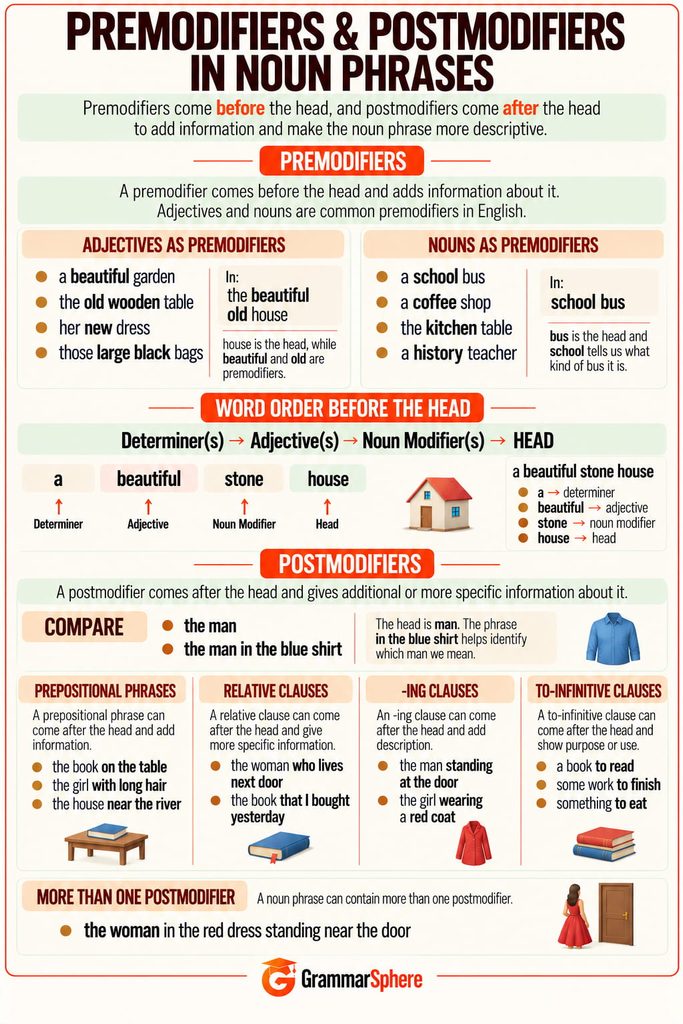
Prepositional Phrases
Prepositional phrases commonly occur after nouns as postmodifiers.
- the book on the table
- the girl with long hair
- the house at the end of the street
- the students in my class
- the man from London
In:
the book on the table
the head is book, and on the table helps identify which book is meant.
Relative Clauses
A relative clause can postmodify a noun.
- the man who called me
- the book that I bought
- the woman who lives next door
- the car which was parked outside
For example:
The student who answered the question received a prize.
The head is student, while who answered the question tells us which student is being referred to.
-ing Clauses
An -ing clause can occur after a noun as a postmodifier.
- the man standing at the door
- the children playing outside
- the woman wearing a red coat
- the people waiting for the bus
For example:
The girl sitting near the window is my sister.
The head is girl, while sitting near the window provides additional information about her.
To-Infinitive Clauses
A to-infinitive clause can occur after a noun or pronoun.
- something to eat
- a book to read
- the first person to arrive
- a place to stay
- a decision to leave
For example:
I need something to drink.
The to-infinitive to drink helps specify what kind of something is needed.
Complements in Noun Phrases
Some elements following a noun are closely connected to its meaning and help complete or specify that meaning. These can be analysed as complements rather than simply as optional modifiers.
Consider:
the belief that he was innocent
The clause that he was innocent gives the content of the belief.
Other examples include:
- the fact that she had left
- their decision to leave
- his interest in science
- the possibility of rain
A useful distinction is that a modifier generally adds descriptive or identifying information, while a complement is more closely related to the meaning of the head noun.
Compare:
the book on the table
Here, on the table identifies or describes the book.
her belief in democracy
Here, in democracy specifies the content of her belief.
The distinction between complements and modifiers is not equally clear in every case, so learners do not need to force every example into one category. The important point is to recognize that not everything following a noun has exactly the same relationship with the head.
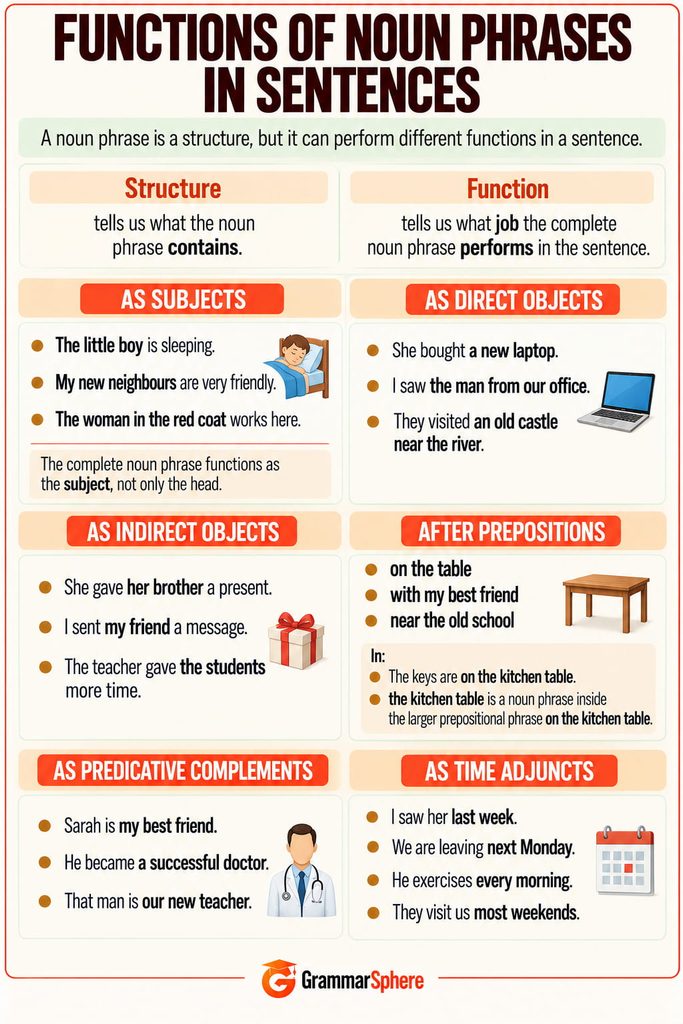
Functions of Noun Phrases in Sentences
Noun phrases can perform several grammatical functions in sentences. The phrase type remains a noun phrase, but its function depends on how it is used.
Subject
The young boy opened the door.
The noun phrase the young boy functions as the subject.
Direct object
She bought a new laptop.
The noun phrase a new laptop functions as the direct object.
Indirect object
He gave his sister a present.
The noun phrase his sister functions as the indirect object.
Complement of a preposition
We spoke to the new manager.
The noun phrase the new manager functions as the complement of the preposition to.
Predicative complement
Sara is an excellent teacher.
The noun phrase an excellent teacher functions as a predicative complement and identifies or describes Sara.
Adjunct
We met last Friday.
The noun phrase last Friday functions as a time adjunct.
These examples show an important distinction:
Noun phrase describes the type of phrase.
Subject, object, complement, and adjunct describe the function that a phrase performs in a sentence.
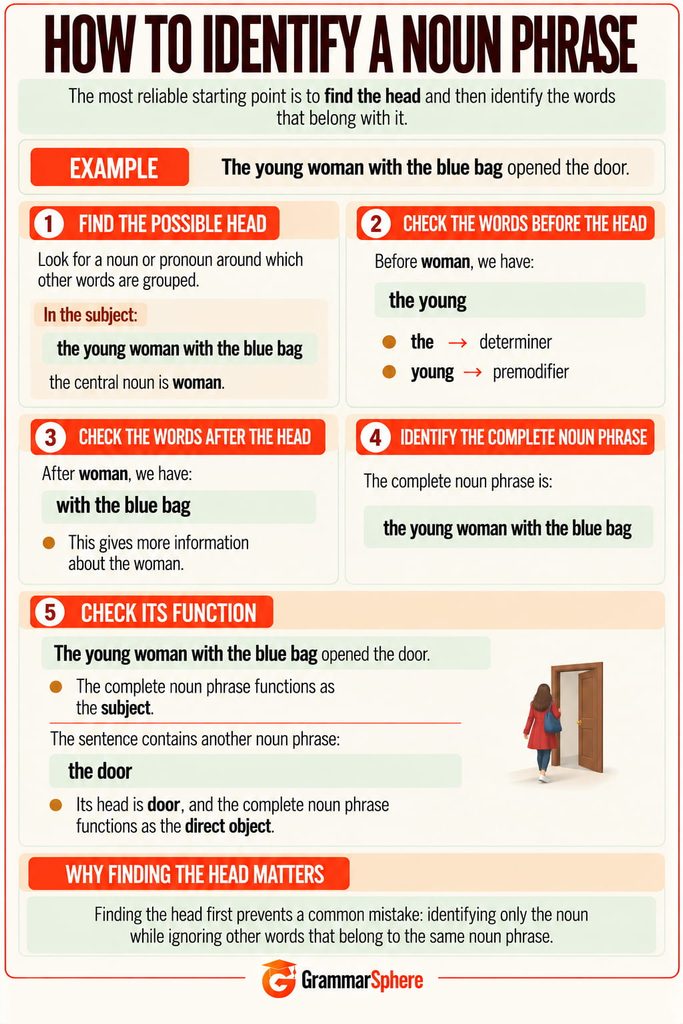
How to Identify a Noun Phrase
The most useful way to identify a noun phrase is to find its head and then determine which words belong with it.
Consider:
The young woman in the black coat smiled.
1. Find the head.
The central noun is:
woman
2. Look before the head.
The words the and young belong with woman.
3. Look after the head.
The prepositional phrase in the black coat also modifies woman.
4. Identify the complete noun phrase.
The complete noun phrase is:
the young woman in the black coat
Now consider:
The three old houses near the river were sold.
Head:
houses
Complete noun phrase:
the three old houses near the river
It is important to distinguish the head from the complete noun phrase.
Noun Phrases and Subject–Verb Agreement
When a noun phrase functions as the subject, the verb normally agrees in number with the head of that noun phrase.
Consider:
The box of old books is heavy.
The head is box, which is singular. Therefore, the singular verb is is correct.
Not:
The box of old books are heavy. ✗
The nearby plural noun books does not control the agreement.
Compare:
The students in my class are ready.
The head is students, so the plural verb are is used.
Another example:
The list of names is on the desk.
Head: list
Correct verb: is
But:
The effects of the new policy are becoming clear.
Head: effects
Correct verb: are
Long noun phrases can sometimes make subject–verb agreement more difficult because another noun appears between the head and the verb. Finding the head helps identify the correct verb form.
Common Mistakes with Noun Phrases
Mistake 1: Identifying only the head instead of the complete noun phrase
Sentence:
The tall boy near the door is my brother.
Head: boy
Complete noun phrase: the tall boy near the door
The head is part of the noun phrase, but it is not necessarily the whole phrase.
Mistake 2: Choosing the wrong head
Consider:
the box of chocolates
The head is box, not chocolates.
The phrase of chocolates provides information about the box.
Mistake 3: Using the wrong verb because of a nearby noun
Incorrect:
The box of chocolates are on the table. ✗
Correct:
The box of chocolates is on the table. ✓
The head box is singular.
Mistake 4: Incorrect placement of an adjective
Incorrect:
a car red ✗
Correct:
a red car ✓
When an adjective is used attributively as a premodifier, it normally comes before the noun.
Mistake 5: Confusing modifiers with the head
In:
those beautiful old houses
the head is houses.
those, beautiful, and old provide information about the head.
Mistake 6: Confusing phrase type with sentence function
In:
The new teacher arrived.
the new teacher is a noun phrase, and its function is subject.
In:
I met the new teacher.
the new teacher is still a noun phrase, but its function is now direct object.
Noun Phrase Practice
A. Identify the complete noun phrase in each sentence.
- The little girl smiled.
- My new English teacher is very friendly.
- The man in the blue shirt called me.
- Those beautiful flowers need water.
- The students waiting outside are from my class.
B. Identify the head of each noun phrase.
- the old wooden bridge
- those three large boxes
- the woman near the window
- an extremely difficult question
- the students who passed the examination
C. Identify the function of the bold noun phrase.
- The new student asked a question.
- Sara bought a beautiful dress.
- I gave my brother the keys.
- We spoke to the manager.
- Ahmed is a doctor.
D. Choose the correct verb.
- The box of books is / are heavy.
- The students in this class is / are ready.
- The list of names is / are on the desk.
- The houses near the river looks / look beautiful.
- The colour of these walls has / have changed.
Answers
- The little girl
- My new English teacher
- The man in the blue shirt
- Those beautiful flowers
- The students waiting outside
- bridge
- boxes
- woman
- question
- students
- Subject
- Direct object
- Indirect object
- Complement of a preposition
- Predicative complement
- is
- are
- is
- look
- has
FAQs
FAQs
What is a noun phrase?
A noun phrase is a word or group of words whose head is normally a noun or pronoun, such as students, the new students, or the students in my class.
What is the head of a noun phrase?
The head is the central noun or pronoun in a noun phrase. In the beautiful old house, house is the head.
Can a noun phrase be one word?
Yes. A single noun or pronoun can function as a noun phrase. In Children laughed, Children is a noun phrase.
What is the structure of a noun phrase?
A noun phrase can contain a determiner, premodifiers, a head, and postmodifiers or complements. Not every noun phrase contains all of these elements.
What is the difference between a noun and a noun phrase?
A noun is a word class, while a noun phrase is a phrase whose head is normally a noun or pronoun. For example, house is a noun, while the old house on the corner is a noun phrase.
You May Also Like
Leave a Comment