

Table of Contents
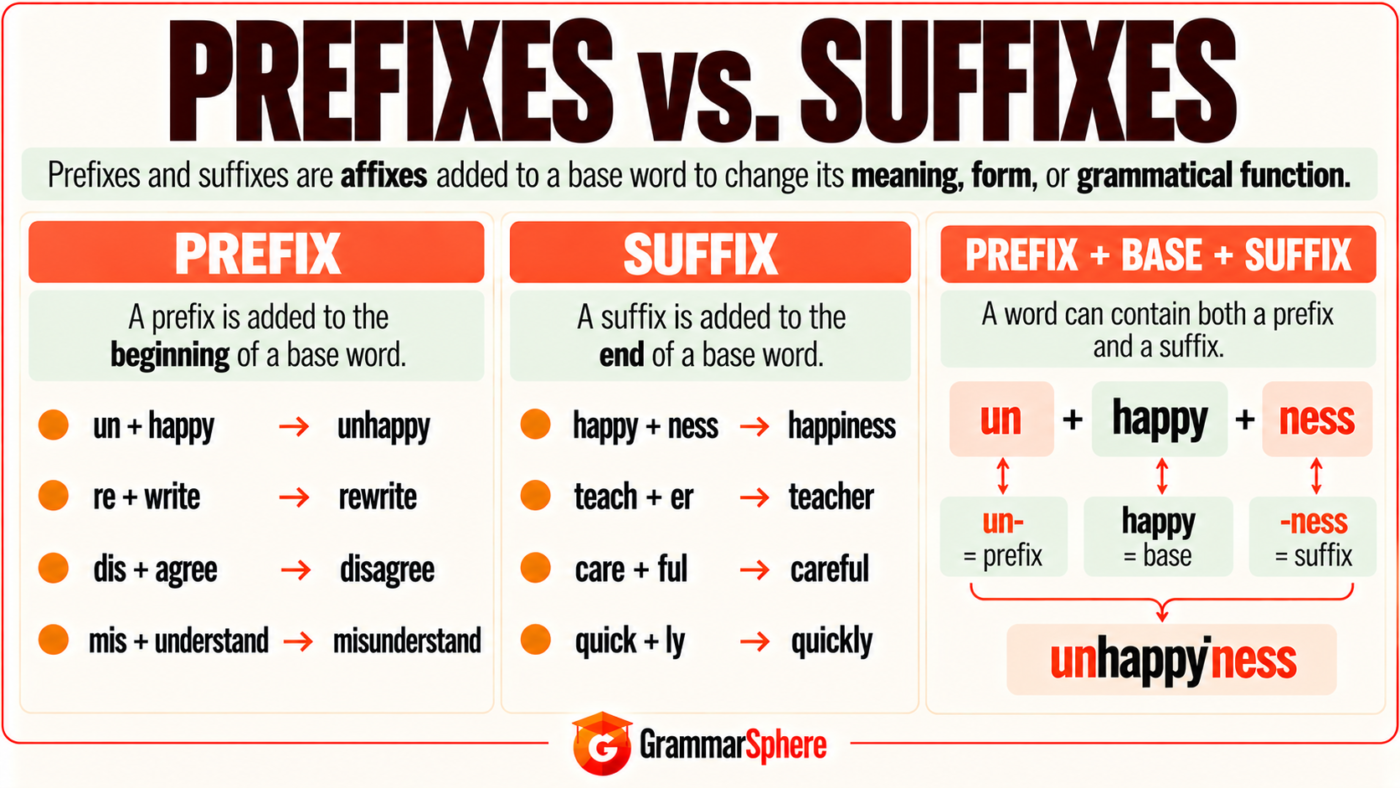
Prefixes and suffixes are groups of letters added to words to change their meaning, form, or grammatical function.
A prefix is added to the beginning of a word:
un + happy → unhappy
A suffix is added to the end of a word:
happy + ness → happiness
Prefixes and suffixes are both types of affixes. Learning them can help you understand unfamiliar words, recognize word classes, and form new words correctly.
What Are Prefixes and Suffixes?
A prefix is a letter or group of letters added to the beginning of a base word or stem to form a new word or change its meaning.
Examples:
- happy → unhappy
- write → rewrite
- understand → misunderstand
- possible → impossible
A suffix is a letter or group of letters added to the end of a base or stem.
Examples:
- happy → happiness
- teach → teacher
- care → careful
- quick → quickly
The word or form to which an affix is added is called a base.
For example:
un + help + ful
- un- = prefix
- help = base
- -ful = suffix
A word can have a prefix, a suffix, or both.
Prefix vs. Suffix: What Is the Difference?
The main difference between a prefix and a suffix is their position and function.
| Feature | Prefix | Suffix |
|---|---|---|
| Position | Before the base | After the base |
| Example | un + happy | happy + ness |
| New word | unhappy | happiness |
| Common effect | Changes meaning | Can change meaning or word class |
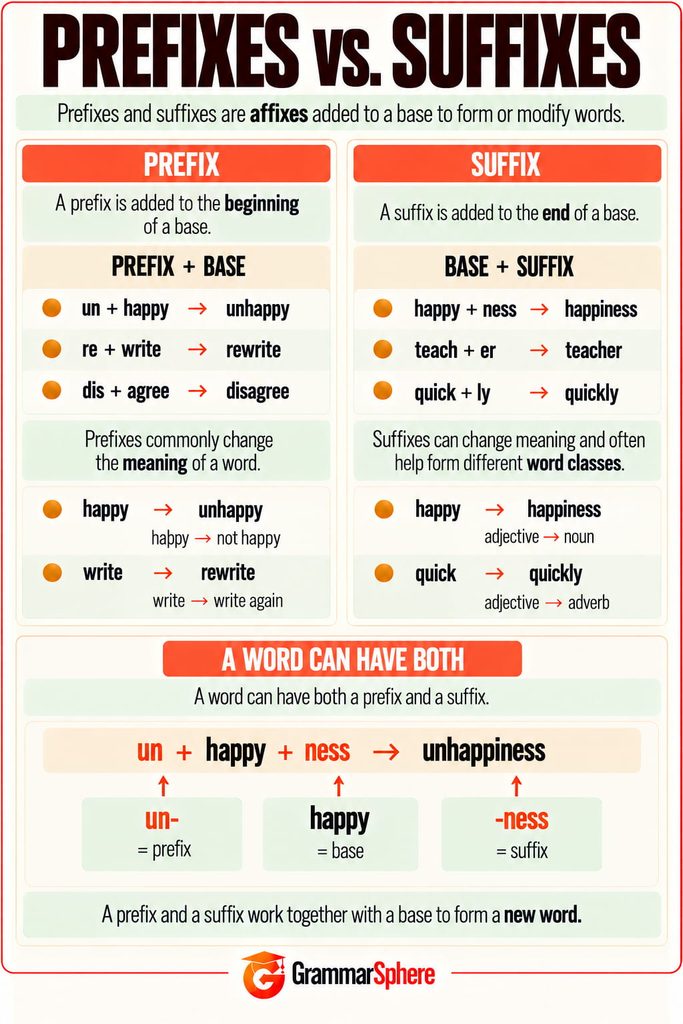
Prefixes commonly change the meaning of a word:
- happy → unhappy
- write → rewrite
- agree → disagree
Suffixes often form words belonging to particular word classes:
- teach → teacher
- happy → happiness
- care → careful
- quick → quickly
However, these are general patterns rather than absolute rules. Not every suffix changes word class, and the effect of an affix depends on the particular word.
Common Prefixes in English
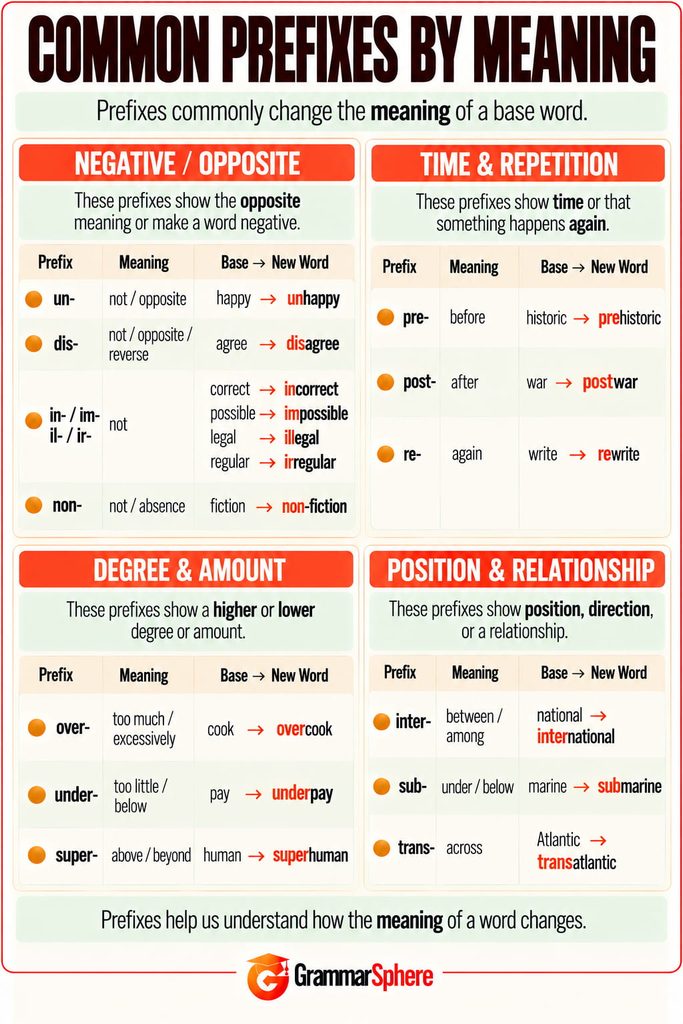
Here are some common English prefixes and their meanings:
| Prefix | Common Meaning | Examples |
|---|---|---|
| un- | not; reverse | unhappy, unfair, unlock |
| dis- | not; opposite; reverse | disagree, dishonest, disconnect |
| in- | not | inactive, incorrect |
| im- | not | impossible, impolite |
| il- | not | illegal, illogical |
| ir- | not | irregular, irresponsible |
| re- | again | rewrite, rebuild |
| mis- | wrongly; badly | misunderstand, mispronounce |
| pre- | before | prepay, prehistoric |
| post- | after | postwar, postgraduate |
| non- | not | non-smoker, non-fiction |
| over- | too much; above | overcook, overwork |
| under- | too little; below | underpay, underestimate |
| inter- | between; among | international, interact |
| sub- | under; below | submarine, substandard |
| super- | above; beyond | superhuman, superstar |
| trans- | across | transatlantic, transnational |
The meaning of a prefixed word is often related to the meaning of the prefix, but learners should still learn words in context because meanings are not always completely predictable.
Prefixes by Meaning
Prefixes can be grouped according to the kinds of meanings they commonly express. These are useful meaning-based groups, not rigid grammatical types.
Negative and Opposite Prefixes
Several prefixes can create negative or opposite meanings.
un-
- happy → unhappy
- fair → unfair
- certain → uncertain
dis-
- agree → disagree
- honest → dishonest
- connect → disconnect
in-
- correct → incorrect
- active → inactive
The negative prefix in- has related forms im-, il-, and ir- depending on the beginning of the base word:
- possible → impossible
- legal → illegal
- regular → irregular
non- also expresses absence or negation:
- non-fiction
- non-smoking
- non-payment
These prefixes are not freely interchangeable. English uses established combinations, so forms such as impossible and irregular should be learned as words rather than created by guessing.
Prefixes of Time and Repetition
Some prefixes express time, sequence, or repetition.
pre- means before:
- prehistoric
- prewar
- prepay
post- means after:
- postwar
- postgraduate
- post-election
re- commonly means again:
- rewrite
- rebuild
- reconsider
For example:
She rewrote the report.
Here, re- indicates that the action of writing was performed again.
Prefixes of Degree and Amount
Some prefixes indicate degree, amount, or extent.
over- can mean too much or excessively:
- overcook
- overwork
- overcharge
under- can mean too little, insufficiently, or below:
- undercook
- underestimate
- underpay
super- can express something above, beyond, or unusually great:
- superhuman
- superstar
The exact meaning depends on the word in which the prefix occurs.
Prefixes of Position and Relationship
Some prefixes express position, movement, or relationships between things.
inter- commonly means between or among:
- international
- interact
- interconnect
sub- commonly means under or below:
- submarine
- substandard
trans- can mean across or beyond:
- transatlantic
- transnational
These prefixes are especially common in academic, technical, and formal vocabulary.
Common Suffixes in English
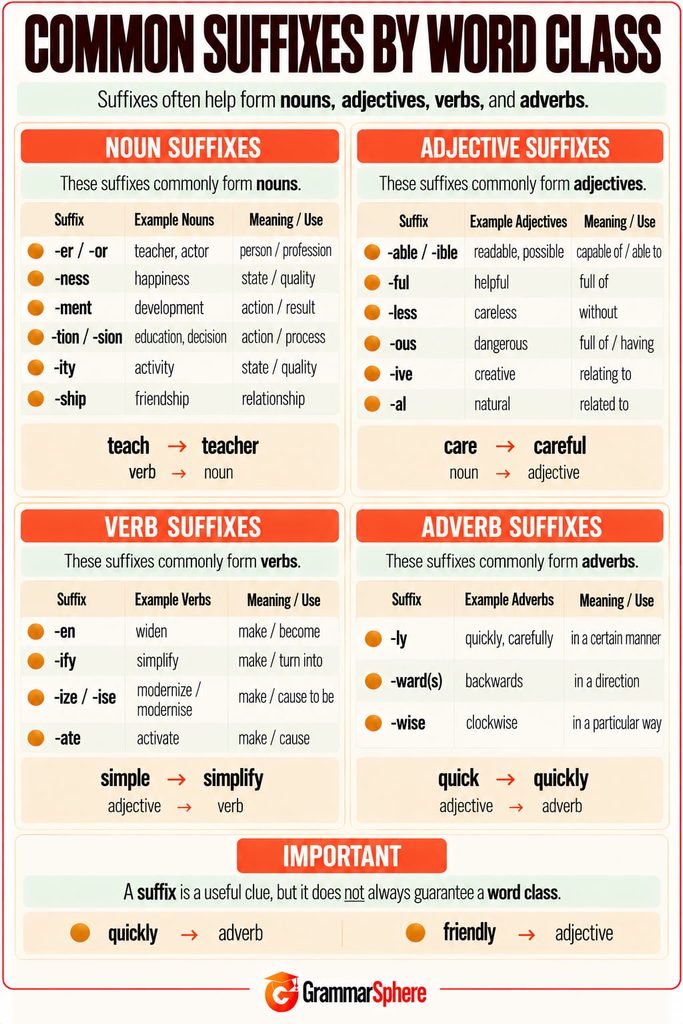
Suffixes are especially useful in word formation because many of them are associated with particular word classes.
For example:
teach → teacher
verb → noun
care → careful
noun → adjective
modern → modernize
adjective → verb
quick → quickly
adjective → adverb
A suffix can often provide a clue about whether a word is a noun, adjective, verb, or adverb, although there are exceptions.
Noun Suffixes
Common noun-forming suffixes include:
| Suffix | Examples |
|---|---|
| -er / -or | teacher, writer, actor |
| -ness | happiness, kindness |
| -ment | development, achievement |
| -tion / -sion | education, decision |
| -ity | activity, possibility |
| -ship | friendship, membership |
| -hood | childhood, neighbourhood |
| -ist | artist, scientist |
Examples:
teach → teacher
happy → happiness
develop → development
decide → decision
These suffixes can form nouns referring to people, actions, processes, results, states, qualities, relationships, and other concepts.
Adjective Suffixes
Common adjective-forming suffixes include:
| Suffix | Examples |
|---|---|
| -able / -ible | readable, possible |
| -ful | helpful, useful |
| -less | careless, hopeless |
| -ous | dangerous, famous |
| -ive | active, creative |
| -al | natural, cultural |
| -y | rainy, cloudy |
Examples:
help → helpful
danger → dangerous
care → careless
create → creative
These suffixes commonly form words that describe people, things, states, or qualities.
Verb Suffixes
Some suffixes are commonly used to form verbs.
| Suffix | Examples |
|---|---|
| -en | widen, strengthen |
| -ify | clarify, simplify |
| -ize / -ise | modernize, realize/realise |
| -ate | activate, motivate |
Examples:
wide → widen
simple → simplify
modern → modernize
The spelling -ize is common in American English, while both -ise and -ize occur in British English depending on style and word.
Adverb Suffixes
The most common adverb-forming suffix is -ly.
- quick → quickly
- careful → carefully
- slow → slowly
- happy → happily
Other adverbial endings include -ward(s) and -wise:
- homeward
- backwards
- clockwise
However, an ending does not guarantee a particular word class. For example, friendly and lovely end in -ly but are normally adjectives.
How Prefixes and Suffixes Change Words
Prefixes and suffixes can affect words in different ways.
Prefixes commonly change meaning:
- happy → unhappy
- write → rewrite
- understand → misunderstand
- agree → disagree
In these examples, the prefixed word remains closely related to the meaning of the base, but the prefix changes that meaning.
Suffixes often form a different word class:
- teach → teacher
verb → noun - happy → happiness
adjective → noun - care → careful
noun → adjective - quick → quickly
adjective → adverb - strength → strengthen
noun → verb
This is one reason suffixes can help learners recognize word classes.
However, the relationship is not completely predictable. A suffix may have different effects in different words, and not every word ending in the same letters necessarily contains the same suffix.
Words with Both Prefixes and Suffixes
A word can contain both a prefix and a suffix.
Consider:
unhappiness
un + happy + ness
- un- = prefix
- happy = base
- -ness = suffix
Other examples include:
disagreement
dis + agree + ment
unemployment
un + employ + ment
misunderstanding
mis + understand + ing
Prefixes and suffixes can therefore work together in the same word.
Compare:
happy → unhappy → unhappiness
The prefix un- changes the meaning of happy, while the suffix -ness forms a noun.
Spelling Rules for Prefixes and Suffixes
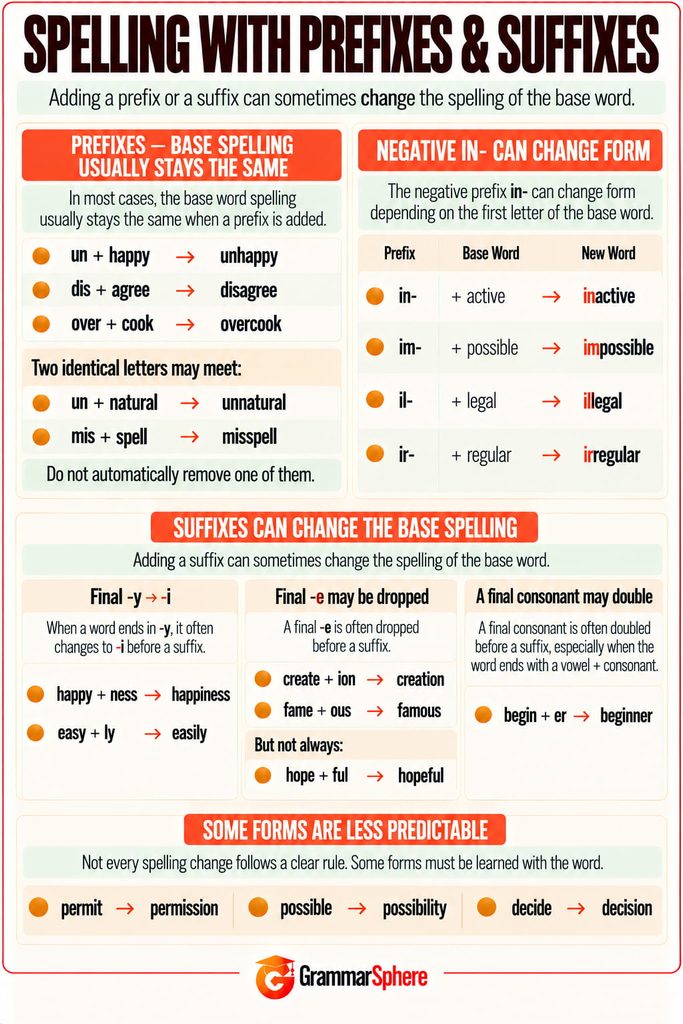
Adding an affix can affect spelling, especially when a suffix is added. English spelling patterns are useful, but exceptions also occur.
Spelling Rules for Prefixes
Adding a prefix normally does not require changing the spelling of the base.
- un + happy → unhappy
- dis + agree → disagree
- mis + spell → misspell
- over + cook → overcook
Sometimes this creates double letters:
- un + natural → unnatural
- mis + spell → misspell
Do not remove one of the letters simply because two identical letters meet.
The negative prefix in- changes form before certain sounds:
- in- + legal → illegal
- in- + possible → impossible
- in- + regular → irregular
These forms are commonly written il-, im-, and ir-.
Some prefixed words are written with a hyphen, while others are written as one word:
- non-smoking
- post-war
- rewrite
- unhappy
Hyphenation is not completely predictable, so a reliable dictionary should be checked when necessary.
Spelling Rules for Suffixes
Adding a suffix can change the spelling of the base.
Final -y can change to -i:
- happy + -ness → happiness
- easy + -ly → easily
- heavy + -ness → heaviness
A final -e may be dropped before some suffixes:
- create + -ion → creation
- fame + -ous → famous
But the final e is not always dropped:
- hope + -ful → hopeful
A final consonant may be doubled in some formations:
- begin + -er → beginner
Other suffixes can produce less straightforward spelling changes:
- permit → permission
- possible → possibility
- decide → decision
Because suffix spelling is not always predictable, learners should learn common derived words as part of their word families.
Commonly Confused Prefixes and Suffixes
Some affixes have similar meanings or functions but are not interchangeable.
un- and dis-
Both can express negative or opposite meanings:
- happy → unhappy
- agree → disagree
- honest → dishonest
We cannot simply choose either prefix:
- unhappy ✓
- dishappy ✗
- disagree ✓
- unagree ✗
The correct form depends on the established word.
in-, im-, il- and ir-
These are related forms of the negative prefix in-.
- inactive
- impossible
- illegal
- irregular
Their form is influenced by the sound at the beginning of the base.
-ful and -less
These suffixes can sometimes express contrasting meanings:
- helpful / helpless
- useful / useless
- careful / careless
-ful commonly means having or showing something, while -less commonly means without or lacking something.
However, not every word naturally forms both versions.
-er and -ee
These suffixes can sometimes distinguish different participants in an action:
- employer / employee
- trainer / trainee
-er often refers to someone who performs an action, while -ee can refer to someone who receives or experiences it.
This is a useful pattern, but it is not a universal rule for every word.
-tion, -sion and -ssion
These endings commonly occur in nouns:
- educate → education
- decide → decision
- permit → permission
- discuss → discussion
Their spelling depends largely on the established form of the word. There is no single simple rule that predicts the correct ending in every case.
Common Mistakes with Prefixes and Suffixes
Mistake 1: Using the wrong negative prefix
Incorrect:
unpossible ✗
Correct:
impossible ✓
Incorrect:
inregular ✗
Correct:
irregular ✓
Mistake 2: Assuming similar prefixes are interchangeable
Incorrect:
unagree ✗
Correct:
disagree ✓
English uses particular prefixes with particular bases.
Mistake 3: Ignoring spelling changes when adding suffixes
Incorrect:
happyness ✗
Correct:
happiness ✓
Incorrect:
possibleity ✗
Correct:
possibility ✓
Mistake 4: Assuming every ending identifies the word class
The suffix -ly commonly forms adverbs:
quick → quickly
But words such as friendly, lovely, and lonely are adjectives.
A suffix can be a useful clue, but the complete word and its use in the sentence must also be considered.
Mistake 5: Creating words by attaching any suitable-looking affix
Not every base combines naturally with every prefix or suffix.
For example:
develop → development ✓
develop → develoption ✗
Affix patterns can help, but established word forms must still be learned.
Prefixes and Suffixes Exercises with Answers
A. Add a suitable prefix to form a new word.
- ___happy
- ___possible
- ___write
- ___agree
- ___understand
B. Add a suitable suffix to form the word shown in brackets.
- happy → ________ (noun)
- teach → ________ (person)
- care → ________ (adjective meaning “showing care”)
- quick → ________ (adverb)
- simple → ________ (verb)
C. Identify the prefix, base, and suffix where present.
- unhappiness
- disagreement
- teacher
- rewrite
- unemployment
D. Choose the correct word.
- impossible / unpossible
- irregular / inregular
- happiness / happyness
- disagree / unagree
- development / develoption
Answers
- unhappy
- impossible
- rewrite
- disagree
- misunderstand
- happiness
- teacher
- careful
- quickly
- simplify
- un- + happy + -ness
- dis- + agree + -ment
- teach + -er
- re- + write
- un- + employ + -ment
- impossible
- irregular
- happiness
- disagree
- development
FAQs About Prefixes and Suffixes
What is a prefix?
A prefix is a letter or group of letters added to the beginning of a base or stem to form a new word or change its meaning. For example, adding un- to happy forms unhappy.
What is a suffix?
A suffix is a letter or group of letters added to the end of a base or stem. For example, adding -ness to happy forms happiness.
What is the difference between a prefix and a suffix?
A prefix comes before the base, while a suffix comes after it.
- un + happy → unhappy
- happy + ness → happiness
What are some common prefixes in English?
Common prefixes include un-, dis-, in-, im-, il-, ir-, re-, mis-, pre-, post-, non-, over-, under-, inter-, sub-, and super-.
What are some common suffixes in English?
Common suffixes include -ness, -ment, -tion, -er, -ful, -less, -able, -ous, -ize/-ise, -ify, and -ly.
Do prefixes change the meaning of words?
Yes. Prefixes commonly modify the meaning of the base. For example, re- can mean “again” in rewrite, while un- creates a negative meaning in unhappy.
Do suffixes change the word class?
Suffixes often form words of a different word class, but not always. For example, happy is an adjective and happiness is a noun, while quick is an adjective and quickly is an adverb.
Leave a Comment