

Table of Contents
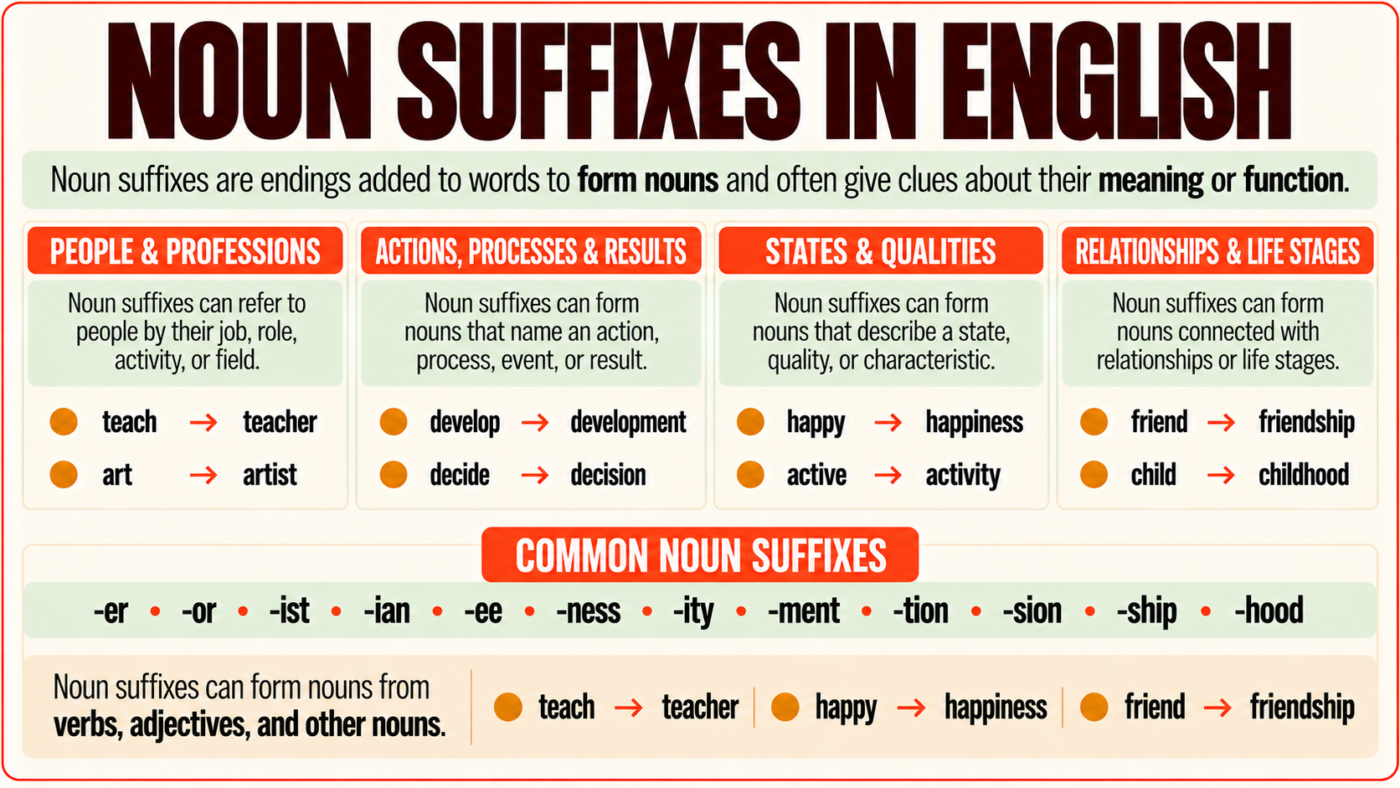
A noun suffix is a group of letters added to the end of a word to form a noun. Noun suffixes can also give clues about what a noun means or what it refers to.
For example:
- teach + -er → teacher
- happy + -ness → happiness
- develop + -ment → development
- active + -ity → activity
- friend + -ship → friendship
Learning common noun suffixes can help you recognize nouns, understand unfamiliar words, and form nouns correctly from verbs, adjectives, and other nouns.
What Are Noun Suffixes?
A noun suffix is an ending added to a word to form a noun.
For example:
- teach → teacher
- act → action
- happy → happiness
- kind → kindness
- friend → friendship
The original word is called the base or root word, while the letters added at the end form the suffix.
In:
teach + -er → teacher
- teach is the base word.
- -er is the suffix.
- teacher is the noun formed from it.
Noun suffixes can be added to different word classes:
- verb → noun: develop → development
- adjective → noun: happy → happiness
- noun → noun: friend → friendship
The suffix often gives a clue about the meaning of the new noun. For example, -er often refers to a person who performs an action, while -ness commonly refers to a state or quality.
Common Noun Suffixes in English
English has many noun-forming suffixes. Some of the most common are:
| Suffix | Common Meaning or Function | Examples |
|---|---|---|
| -er | person who does something | teacher, writer |
| -or | person who does something | actor, director |
| -ist | person associated with an activity, profession, or belief | artist, scientist |
| -ian | person associated with a profession or field | musician, historian |
| -ee | person receiving or affected by an action | employee, trainee |
| -ness | state or quality | happiness, kindness |
| -ity | state or quality | activity, ability |
| -ment | action, process, or result | development, achievement |
| -tion | action, process, or result | creation, education |
| -sion | action, process, or result | decision, revision |
| -ance / -ence | state, quality, or action | importance, existence |
| -ship | state, relationship, position, or skill | friendship, leadership |
| -hood | state, condition, or period of life | childhood, adulthood |
| -dom | state, condition, or domain | freedom, kingdom |
| -ism | belief, system, practice, or movement | capitalism, tourism |
These meanings are useful guides, but they are not absolute rules. The exact meaning of a word depends on the word itself and how it is used.
Forming Nouns with Suffixes
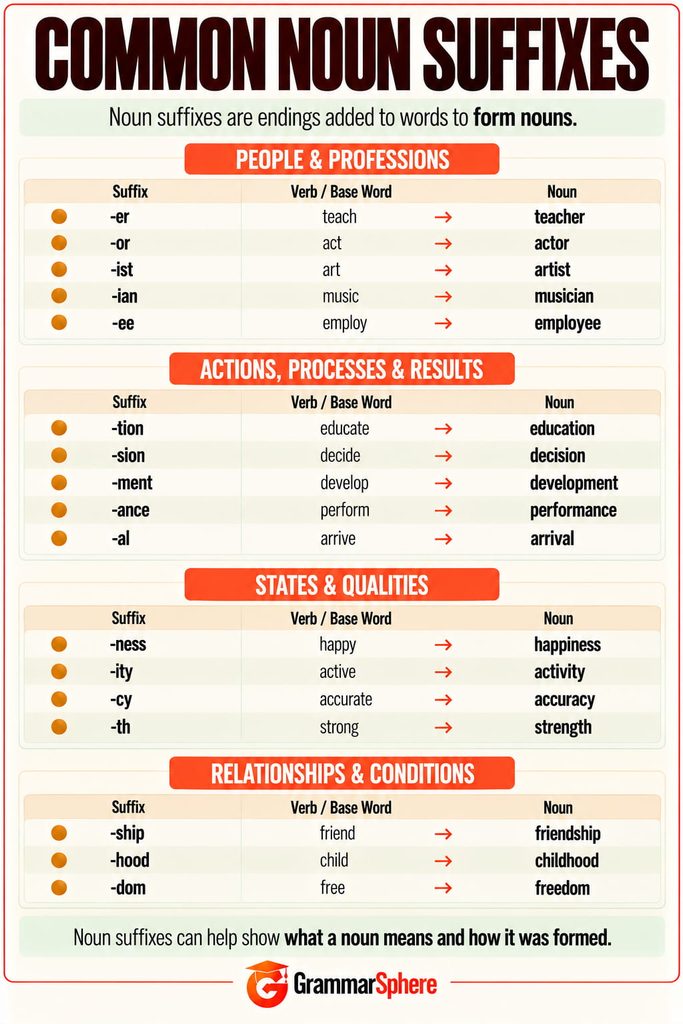
Noun suffixes can form nouns from verbs, adjectives, and other nouns.
Forming Nouns from Verbs
Many verbs become nouns when a noun-forming suffix is added.
| Verb | Suffix | Noun |
|---|---|---|
| teach | -er | teacher |
| employ | -ee | employee |
| develop | -ment | development |
| achieve | -ment | achievement |
| educate | -tion | education |
| decide | -sion | decision |
| perform | -ance | performance |
| exist | -ence | existence |
Compare:
- They developed the project.
- The development took several months.
- She decided to leave.
- Her decision surprised us.
The first word in each pair is a verb; the suffixed form is a noun.
Forming Nouns from Adjectives
Adjectives can also become nouns through suffixation.
| Adjective | Suffix | Noun |
|---|---|---|
| happy | -ness | happiness |
| kind | -ness | kindness |
| weak | -ness | weakness |
| active | -ity | activity |
| equal | -ity | equality |
| possible | -ity | possibility |
| free | -dom | freedom |
Compare:
- She is kind.
- Her kindness impressed everyone.
- This is possible.
- There is a possibility of rain.
The adjective describes a quality, while the noun names the quality, state, or condition.
Forming Nouns from Other Nouns
A suffix can also be added to an existing noun to create another noun.
| Base Noun | Suffix | New Noun |
|---|---|---|
| friend | -ship | friendship |
| member | -ship | membership |
| child | -hood | childhood |
| art | -ist | artist |
| music | -ian | musician |
| kingdom? |
Common examples include:
- friend → friendship
- child → childhood
- art → artist
- music → musician
- history → historian
The new noun usually has a related but more specific meaning.
Spelling Changes When Adding Noun Suffixes
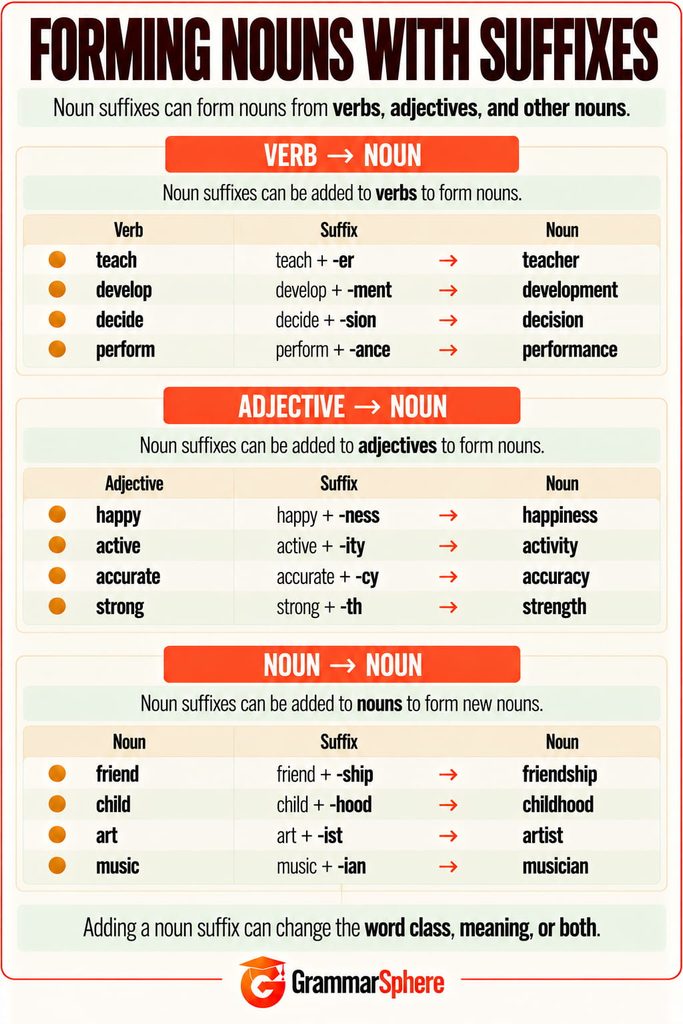
Adding a noun suffix does not always mean attaching the suffix without changing the base word. Some words undergo spelling changes.
Final -y
A final -y may change to -i before certain suffixes:
- happy → happiness
- able? → ability
- possible → possibility
However, the spelling change depends on the word and suffix, so it should not be treated as a universal rule for every noun suffix.
Dropping Final -e
Some words lose a final -e before a suffix:
- revise → revision
- combine → combination
But other words keep it:
- achieve → achievement
- manage → management
Changes with -tion, -sion and related endings
The base word may change considerably when these noun endings are added:
- decide → decision
- permit → permission
- expand → expansion
- explain → explanation
Because the spelling relationship is not always predictable, learners should pay attention to common word families rather than assume that one spelling rule works in every case.
Commonly Confused Noun Suffixes
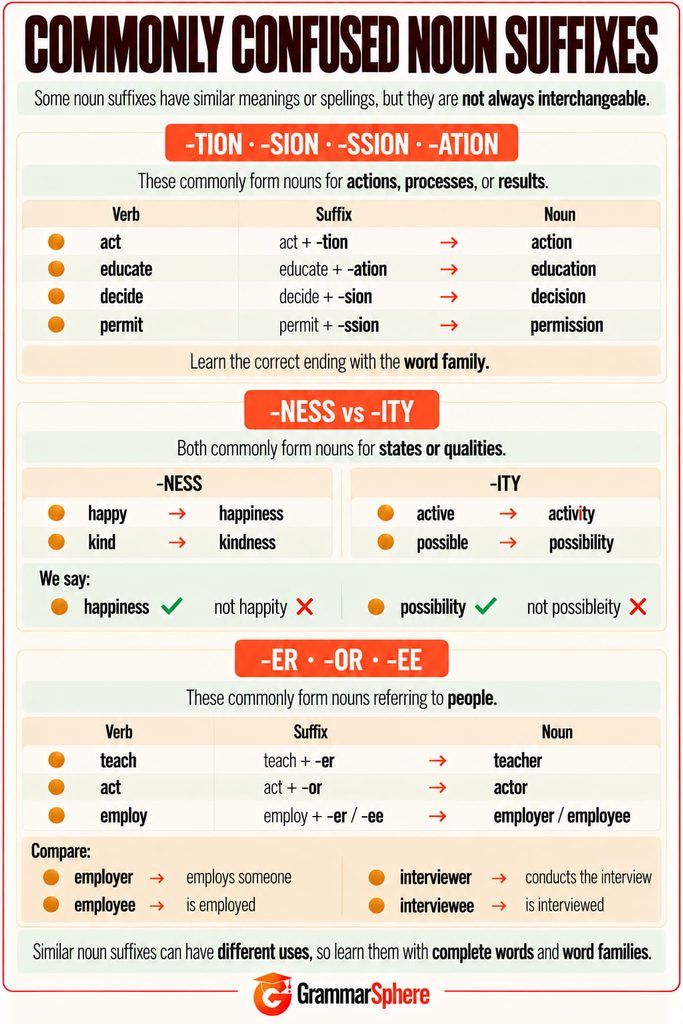
Some noun suffixes have similar meanings, but they cannot usually be substituted for one another.
-tion, -sion, -ssion and -ation
These endings commonly form nouns from verbs:
- act → action
- decide → decision
- permit → permission
- inform → information
The choice of ending depends largely on the particular word and its established spelling.
Incorrect:
- ✗ decide → decidetion
- ✗ permit → permittion
Correct:
- ✓ decide → decision
- ✓ permit → permission
It is more useful to learn these as word families than to choose the ending only by sound.
-ness and -ity
Both suffixes can form nouns expressing states or qualities:
- kind → kindness
- happy → happiness
- active → activity
- possible → possibility
They are not freely interchangeable:
- ✓ happiness
- ✗ happity
- ✓ possibility
- ✗ possibleness in ordinary usage
Learn the established noun form together with the adjective.
-er, -or and -ee
These suffixes can all refer to people, but their uses differ.
- teach → teacher
- act → actor
- employ → employee
-er and -or commonly refer to someone who performs an action or has a role. -ee often refers to someone who receives or experiences an action, although this is not true of every word.
Compare:
- employer — a person or organization that employs
- employee — a person who is employed
The suffix provides a useful meaning clue, but individual words still need to be learned.
How to Identify Nouns by Their Suffixes
A noun suffix can help you recognize that a word is functioning as a noun.
Consider:
Her kindness made everyone feel welcome.
The ending -ness in kindness is a common noun-forming suffix.
Another example:
The development of the city was rapid.
The ending -ment helps identify development as a noun.
Common noun-forming endings include:
- -er
- -or
- -ist
- -ian
- -ee
- -ness
- -ity
- -ment
- -tion
- -sion
- -ance
- -ence
- -ship
- -hood
- -dom
- -ism
However, a word ending alone should not be treated as absolute proof of its word class. Some endings occur in words with different structures or functions. Meaning and sentence context should also be considered.
For example, ask:
- Does the word name a person, thing, place, state, quality, action, or idea?
- Is it functioning as a noun in the sentence?
- Does it contain a recognizable noun-forming suffix?
Using all three clues is more reliable than looking only at the final letters.
How to Choose the Correct Noun Suffix
There is no single rule that tells you which noun suffix to add to every word.
Meaning can sometimes help:
- a person who teaches → teacher
- the state of being happy → happiness
- the process of developing → development
However, you cannot normally choose between similar suffixes simply because their meanings overlap.
For example:
- happy → happiness
- active → activity
- decide → decision
- develop → development
- act → actor
- teach → teacher
Forms such as happity, actment, or teachor are not correct simply because the suffix itself can form nouns elsewhere.
The safest approach is to learn related words as a word family:
- decide → decision
- develop → development
- happy → happiness
- active → activity
- teach → teacher
A dictionary can help when you are unsure which noun form is standard.
Common Mistakes with Noun Suffixes
Using the wrong suffix
- ✗ happity → ✓ happiness
- ✗ teachor → ✓ teacher
- ✗ decidement → ✓ decision
Using the wrong spelling
- ✗ happyness → ✓ happiness
- ✗ possiblity → ✓ possibility
- ✗ developement → ✓ development
Adding a suffix to a form that is already a noun
Avoid creating unnecessary forms when the required noun already exists.
For example:
- decide → decision
- happy → happiness
The correct noun should be learned as part of its word family rather than formed by repeatedly adding suffixes.
Assuming similar suffixes are interchangeable
- happy → happiness, not happity
- active → activity, not normally activeness when the intended noun is activity
- decide → decision, not decidement
Identifying a noun only from its ending
Suffixes are useful clues, but meaning and grammatical function also matter. Do not classify a word only because its final letters resemble a familiar noun suffix.
Noun Suffixes Quick Reference Chart
| Suffix | Common Function | Example |
|---|---|---|
| -er | person who performs an action | teach → teacher |
| -or | person who performs an action or has a role | act → actor |
| -ist | person associated with a field or activity | art → artist |
| -ian | person associated with a profession or field | music → musician |
| -ee | person receiving or affected by an action | employ → employee |
| -ness | state or quality | happy → happiness |
| -ity | state or quality | active → activity |
| -ment | action, process, or result | develop → development |
| -tion | action, process, or result | educate → education |
| -sion | action, process, or result | decide → decision |
| -ance | state, action, or quality | perform → performance |
| -ence | state, action, or quality | exist → existence |
| -ship | relationship, state, position, or skill | friend → friendship |
| -hood | state, condition, or period | child → childhood |
| -dom | state, condition, or domain | free → freedom |
| -ism | belief, system, practice, or movement | real → realism |
Practice: Noun Suffixes
Form the Correct Noun
Add or use the appropriate noun suffix to form a noun.
- teach → ______
- happy → ______
- develop → ______
- decide → ______
- active → ______
- friend → ______
- child → ______
- employ → ______
- music → ______
- perform → ______
Choose the Correct Noun
- Her kindness / kindity impressed everyone.
- The company hired a new employer / employee to work in the office.
- The development / developness of the project took several months.
- We finally made a decision / decidement.
- His greatest achievement / achieveness was winning the competition.
- She is a talented musician / musicist.
- Regular physical activity / activeness is important for health.
- Their friendship / friendness lasted for years.
Identify the Noun Suffix
Identify the noun-forming suffix in each word.
- teacher
- happiness
- development
- activity
- friendship
- childhood
- employee
- musician
- decision
- existence
Answers
Form the Correct Noun
- teacher
- happiness
- development
- decision
- activity
- friendship
- childhood
- employee
- musician
- performance
Choose the Correct Noun
- kindness
- employee
- development
- decision
- achievement
- musician
- activity
- friendship
Identify the Noun Suffix
- -er
- -ness
- -ment
- -ity
- -ship
- -hood
- -ee
- -ian
- -sion
- -ence
FAQs
What is a noun suffix?
A noun suffix is an ending added to a word to form a noun, such as teach → teacher and happy → happiness.
What are the most common noun suffixes?
Common noun suffixes include -er, -or, -ist, -ian, -ee, -ness, -ity, -ment, -tion, -sion, -ship, and -hood.
Which suffixes form nouns from verbs?
Common suffixes include -er, -or, -ment, -tion, -sion, -ance, and -ence, as in teach → teacher and decide → decision.
Which suffixes form nouns from adjectives?
Common suffixes include -ness and -ity, as in happy → happiness and active → activity.
Which noun suffixes refer to people?
Common suffixes include -er, -or, -ist, -ian, and -ee, as in teacher, actor, artist, musician, and employee.
What is the difference between -tion, -sion and -ssion?
They are noun endings used in words such as creation, decision, and permission. The correct ending depends on the individual word.
Can you identify a noun only by its suffix?
Not always. A noun suffix can be a useful clue, but you should also check the word’s meaning and its use in the sentence.
Final Takeaway
Noun suffixes are endings that help form nouns from verbs, adjectives, and other nouns.
Common examples include:
- teach → teacher
- develop → development
- happy → happiness
- active → activity
- friend → friendship
- child → childhood
Suffixes can provide useful clues about a noun’s meaning and function, but similar suffixes are not always interchangeable. The most reliable approach is to learn common suffix patterns together with the words and word families in which they occur.
You May Also Like

Leave a Comment