

Table of Contents
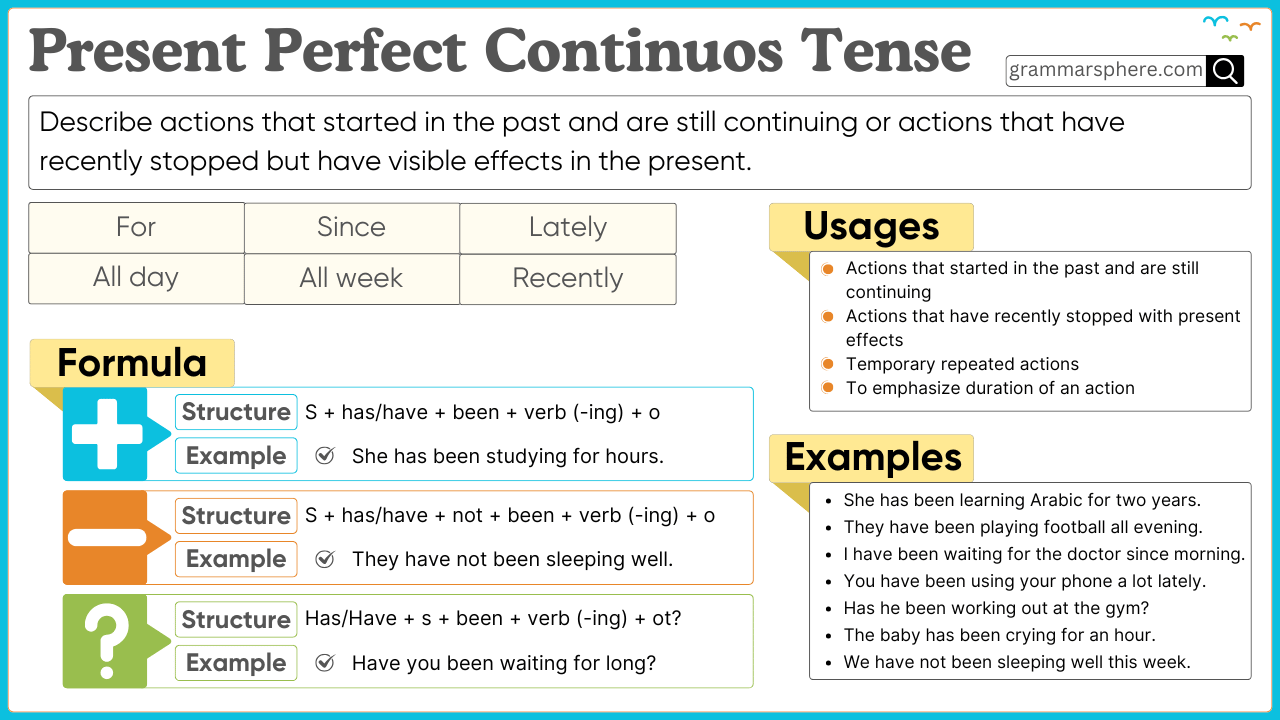
The Present Perfect Continuous Tense is used to describe actions or activities that started in the past and continue into the present, as well as recent activities that have a connection to the present. It is commonly used to emphasize the duration or ongoing nature of an activity.
In this lesson, you will learn how the Present Perfect Continuous Tense is formed and used, with clear examples, common mistakes, and its difference from the Present Perfect Tense.
What Is the Present Perfect Continuous Tense?
The Present Perfect Continuous Tense describes an action or activity that started in the past and is still continuing, or one that recently stopped but has a connection to the present. It often emphasizes the duration or continuity of the activity.
- I have been studying for two hours.
- She has been working here since 2022.
- It has been raining, so the ground is wet.
In the first two examples, the activities continue into the present. In the third, the activity may have recently stopped, but its present result is still visible.
Structure of the Present Perfect Continuous Tense
The Present Perfect Continuous Tense is formed with has/have + been + the -ing form of the verb.
Basic Structure:
Subject + has/have + been + verb-ing
Use has with he, she, and it, and have with I, you, we, and they.
Affirmative Sentences
Structure:
Subject + has/have + been + verb-ing + rest of the sentence
- Aisha has been reading for two hours.
- They have been playing football since this morning.
- I have been working on this project all day.
Negative Sentences
Structure:
Subject + has/have + not + been + verb-ing + rest of the sentence
- Aisha has not been sleeping well recently.
- They have not been attending classes regularly.
- I have not been working here for very long.
The contractions hasn’t been and haven’t been are also common:
- She hasn’t been feeling well lately.
- We haven’t been waiting for long.
Interrogative Sentences
Structure:
Has/Have + subject + been + verb-ing + rest of the sentence?
- Has Aisha been reading for two hours?
- Have they been playing football since this morning?
- Have you been waiting long?
Wh-Questions
Structure:
Wh-word + has/have + subject + been + verb-ing + rest of the sentence?
- How long has Aisha been reading?
- Why have they been waiting outside?
- What have you been doing all morning?
- Where has he been working recently?
Time Expressions in the Present Perfect Continuous Tense
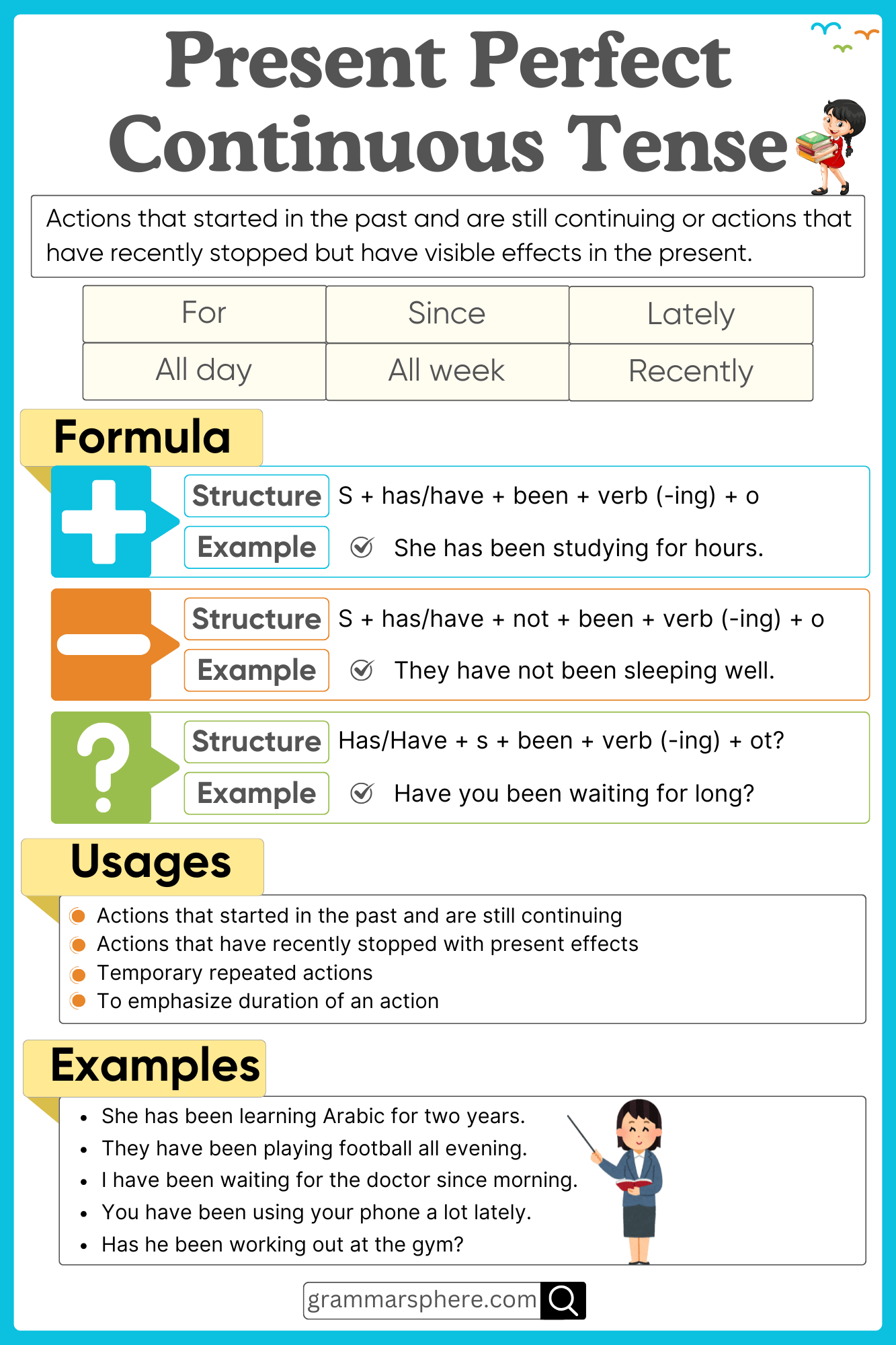
Time expressions are commonly used with the Present Perfect Continuous Tense to show how long an activity has continued, when it started, or that it has been happening during a recent period.
For — Duration
Use for to show the length of time an activity has continued.
- I have been studying for three hours.
- They have been waiting for twenty minutes.
Since — Starting Point
Use since to show when an activity started.
- She has been working here since 2020.
- He has been studying since 8 o’clock.
How Long — Asking About Duration
Use how long with the Present Perfect Continuous to ask about the duration of an activity that started in the past and continues into the present.
- How long have you been waiting?
- How long has she been working here?
- How long have they been studying English?
Answers often use for or since:
- I have been waiting for thirty minutes.
- She has been working here since 2022.
- They have been studying English for three years.
Lately and Recently — Recent Period
Use lately and recently for activities or situations happening during a recent period.
- They have been feeling tired lately.
- I have been working hard recently.
- She has been exercising regularly lately.
All Day, All Morning, All Week
These expressions can emphasize that an activity has continued throughout a period of time.
- It has been raining all day.
- She has been studying all morning.
- We have been working on the project all week.
Adverb Placement
Adverbs such as recently, lately, regularly, frequently, and constantly are often used with the Present Perfect Continuous Tense to give more information about an ongoing or recent activity.
Some adverbs can appear between has/have and been:
- He has constantly been complaining about the noise.
- She has frequently been working late.
Others commonly appear after the main verb or toward the end of the sentence:
- They have been exercising regularly.
- I have been working hard lately.
- She has been studying a lot recently.
How Long — Asking About Duration
Use how long with the Present Perfect Continuous to ask about the duration of an activity that started in the past and continues into the present.
- How long have you been waiting?
- How long has she been working here?
- How long have they been studying English?
Answers often use for or since:
- I have been waiting for thirty minutes.
- She has been working here since 2022.
- They have been studying English for three years.
Uses of the Present Perfect Continuous Tense
The Present Perfect Continuous Tense connects a past activity with the present. It is mainly used in the following situations.
Actions That Started in the Past and Continue in the Present
Use the Present Perfect Continuous for an activity that started in the past and is still continuing now. It often emphasizes how long the activity has continued.
- Ahmed has been living in Dubai for five years.
- They have been working on this project since Monday.
- I have been studying all day.
Recently Stopped Actions with Present Results
Use this tense for an activity that recently stopped but has a visible or noticeable result in the present.
- She has been crying, so her eyes are red.
- Ali has been running, and now he is out of breath.
- It has been raining, so the streets are wet.
Repeated Activities Up to the Present
The Present Perfect Continuous can also describe activities that have happened repeatedly over a period of time up to the present.
- She has been calling me every day.
- I have been going to the gym regularly this month.
- They have been visiting us frequently lately.
Stative Verbs and the Present Perfect Continuous
The Present Perfect Continuous is not normally used with stative verbs. Stative verbs describe states, thoughts, feelings, possession, or relationships rather than ongoing activities.
Common stative verbs include know, believe, understand, own, belong, like, love, and need.
With these verbs, we normally use the Present Perfect instead of the Present Perfect Continuous.
- ❌ I have been knowing him for five years.
- ✓ I have known him for five years.
- ❌ She has been owning this house since 2020.
- ✓ She has owned this house since 2020.
- ❌ We have been believing this for a long time.
- ✓ We have believed this for a long time.
Note: Some verbs can describe either a state or an activity depending on their meaning. When they describe an activity, a continuous form may be possible.
Present Perfect Continuous vs. Present Perfect
Both tenses connect the past with the present, but they often focus on different aspects of an action.
| Present Perfect Continuous | Present Perfect |
|---|---|
| has/have + been + verb-ing | has/have + past participle |
| Often focuses on an ongoing or recent activity | Often focuses on the result or achievement |
| Often emphasizes duration | Can emphasize how much or how many |
| I have been reading for two hours. | I have read three chapters. |
| She has been painting the room. | She has painted the room. |
Compare:
- She has been painting the room. → The focus is on the activity; it may or may not be finished.
- She has painted the room. → The focus is on the result of the activity.
Present Perfect Continuous vs. Present Continuous
Both the Present Perfect Continuous and Present Continuous can describe ongoing activities, but they have different time references.
The Present Continuous usually describes an activity happening now or around the present time.
- I am studying now.
- She is working from home this week.
The Present Perfect Continuous describes an activity that started in the past and has continued up to the present or has recently stopped with a present connection.
- I have been studying for two hours.
- She has been working from home since Monday.
Compare:
- I am reading a book. → The activity is happening around the present time.
- I have been reading this book for three hours. → The activity started in the past and has continued for three hours.
Present Perfect Continuous Tense Examples
Here are some examples of the Present Perfect Continuous Tense in positive, negative, and question forms.
Positive Sentences
- Maria has been learning French for six months.
- I have been working from home this week.
- The children have been watching television for an hour.
- He has been exercising regularly lately.
Negative Sentences
- I have not been sleeping well recently.
- She has not been attending classes this week.
- They have not been using the car lately.
- He has not been exercising regularly.
Question Sentences
- Have you been studying for the test?
- Has she been working here for long?
- Have they been waiting since morning?
- Has it been raining all day?
Common Mistakes with the Present Perfect Continuous Tense
Incorrect Verb Form
❌ He has been play football for two hours.
✅ He has been playing football for two hours.
Incorrect Use of Has and Have
❌ They has been waiting since morning.
✅ They have been waiting since morning.
Leaving Out “Been”
❌ She has working here for three years.
✅ She has been working here for three years.
Using the Continuous Form with Stative Verbs
Stative verbs such as know, believe, and own are not normally used in the continuous form.
❌ I have been knowing him for five years.
✅ I have known him for five years.
Practice: Present Perfect Continuous Tense
Complete the sentences using the Present Perfect Continuous form of the verbs in brackets.
- She __________ for the exam for three hours. (study)
- They __________ for the bus since 8 o’clock. (wait)
- I __________ on this project all week. (work)
- He __________ well recently. (not sleep)
- __________ you __________ English for a long time? (learn)
- How long __________ she __________ here? (work)
Answers:
- She has been studying for the exam for three hours.
- They have been waiting for the bus since 8 o’clock.
- I have been working on this project all week.
- He has not been sleeping well recently.
- Have you been learning English for a long time?
- How long has she been working here?
FAQs
When do we use the Present Perfect Continuous Tense?
We use the Present Perfect Continuous for activities that started in the past and continue in the present, recently stopped activities with present results, and repeated activities continuing over a period of time.
What is the difference between Present Perfect and Present Perfect Continuous?
The Present Perfect often focuses on the result or amount completed, while the Present Perfect Continuous often focuses on the activity or its duration.
- I have read three chapters.
- I have been reading for two hours.
Can we use stative verbs in the Present Perfect Continuous Tense?
Stative verbs such as know, believe, own, and understand are not normally used in continuous forms. We usually use the Present Perfect instead.
- ❌ I have been knowing her for years.
- ✅ I have known her for years.
What is the difference between “for” and “since” in the Present Perfect Continuous?
Use for with a period of time and since with a starting point.
- We have been waiting for two hours.
- We have been waiting since 9 a.m.
Can the Present Perfect Continuous describe an action that has already stopped?
Yes. It can describe a recent activity that has stopped when its result or evidence is still connected to the present.
- She has been crying, so her eyes are red.
- It has been raining, so the ground is wet.
Read More
Leave a Comment