

Table of Contents
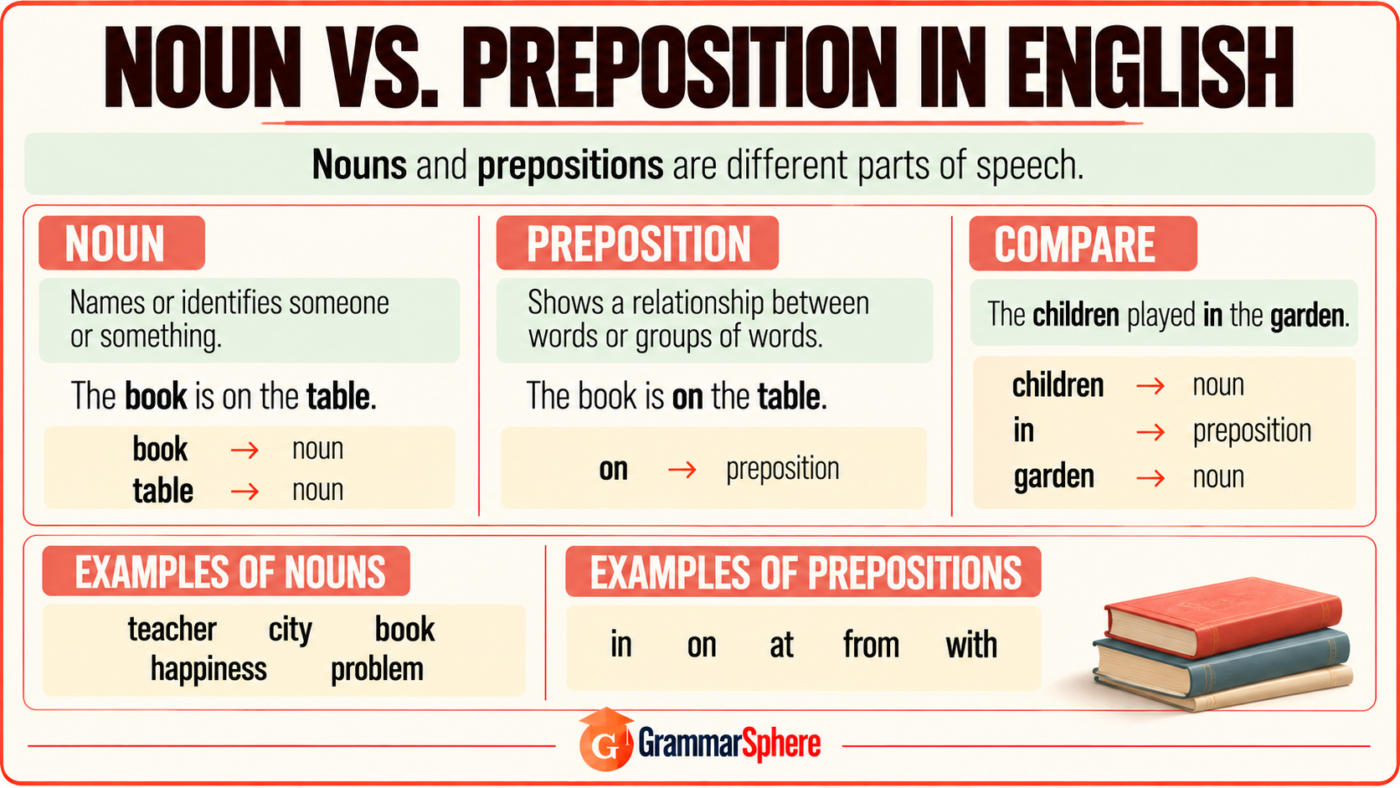
A noun and a preposition are different parts of speech in English. A noun names or identifies a person, place, thing, idea, quality, or event, while a preposition introduces an expression and shows how it relates to another part of the sentence.
Consider:
The book is on the table.
Here:
- book = noun
- on = preposition
- table = noun
The nouns book and table name things, while the preposition on shows the relationship between them. This difference in grammatical role is the main distinction between nouns and prepositions.
What Is a Noun?
A noun is a word used to name or identify a person, place, thing, idea, quality, or event.
Examples include:
- teacher — person
- city — place
- book — thing
- happiness — idea or feeling
- success — quality or state
- meeting — event
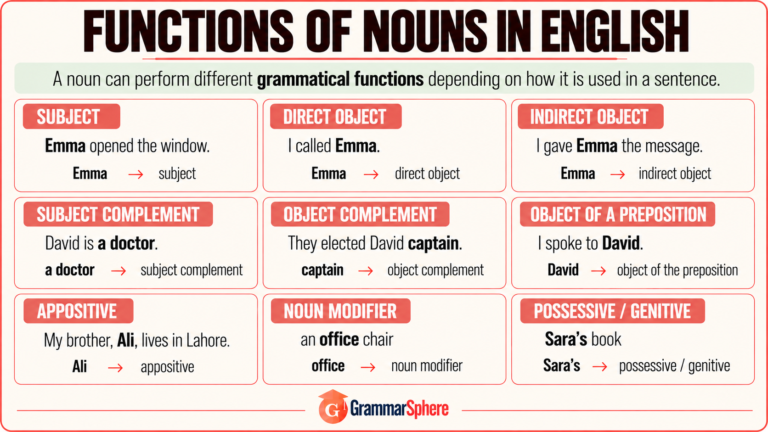
Nouns can perform different functions in sentences.
For example:
- Sara arrived early.
- I bought a book.
- We talked about the problem.
In each sentence, the bold word is a noun, but its grammatical function depends on how it is used.
What Is a Preposition?
A preposition is a word that introduces an expression and shows how it relates to another part of the sentence.
Common prepositions include:
- in
- on
- at
- of
- for
- from
- with
- about
- under
- after
- before
- between
Prepositions can show different kinds of relationships:
- Place: The keys are on the table.
- Time: We met after lunch.
- Direction: She walked into the room.
- Source: He received a letter from his friend.
- Topic: We talked about the problem.
A preposition does not name a person, place, thing, or idea. It connects the expression that follows it to another part of the sentence.
Difference Between a Noun and a Preposition
The main difference between a noun and a preposition is the grammatical job each one performs.
| Noun | Preposition |
|---|---|
| Names or identifies someone or something | Shows a relationship |
| Can function as a subject, object, or complement | Introduces a prepositional phrase |
| Can follow a determiner or preposition | Commonly comes before a noun phrase, pronoun, or similar expression |
| Examples: student, house, idea, problem | Examples: in, on, at, from, with |
Consider:
The children played in the garden.
Here:
- children = noun
- in = preposition
- garden = noun
The nouns children and garden name people or things, while the preposition in shows the relationship between the action and the place.
Nouns After Prepositions: Object of a Preposition
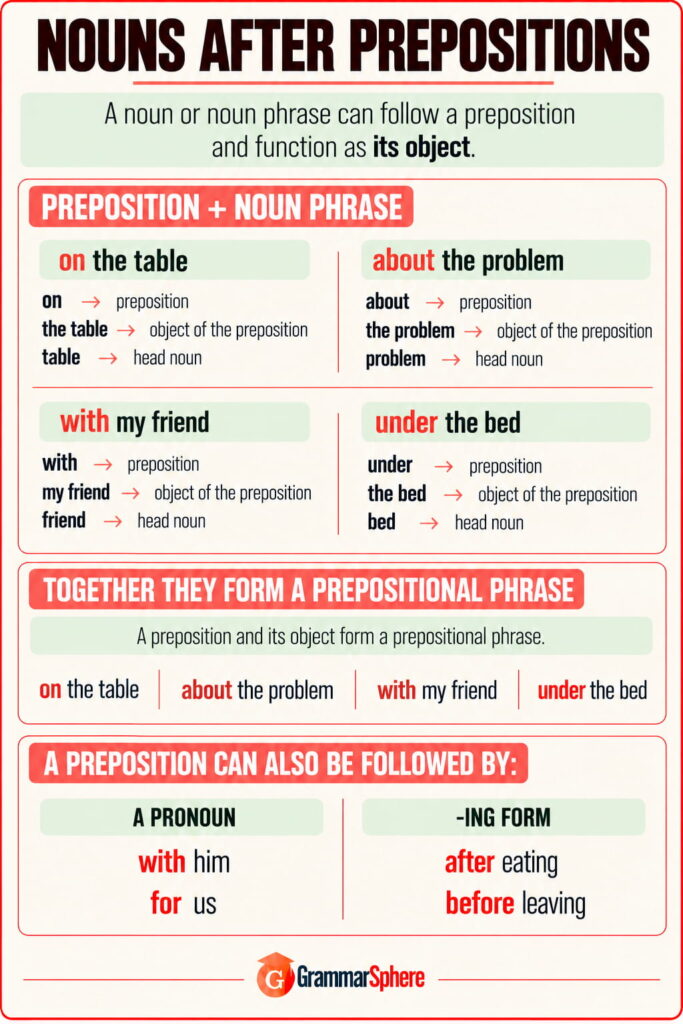
A noun or noun phrase can follow a preposition. The noun phrase that follows the preposition is commonly called the object of the preposition.
Consider:
The keys are on the table.
Here:
- on = preposition
- the table = object of the preposition
- table = head noun
Together, on the table forms a prepositional phrase.
More examples:
- in the room
- after school
- with my friend
- about the problem
- under the bed
- during the meeting
In each example, the bold expression follows the preposition and completes the prepositional phrase.
A noun does not become a preposition simply because it follows one. The noun and the preposition remain different word classes.
Can something other than a noun follow a preposition?
Yes. A preposition can also be followed by a pronoun:
- with him
- for us
- about them
It can also be followed by an -ing form:
- after eating
- before leaving
- without speaking
So, when identifying a preposition, look at the whole expression that follows it rather than expecting a single noun.
How to Identify a Noun and a Preposition
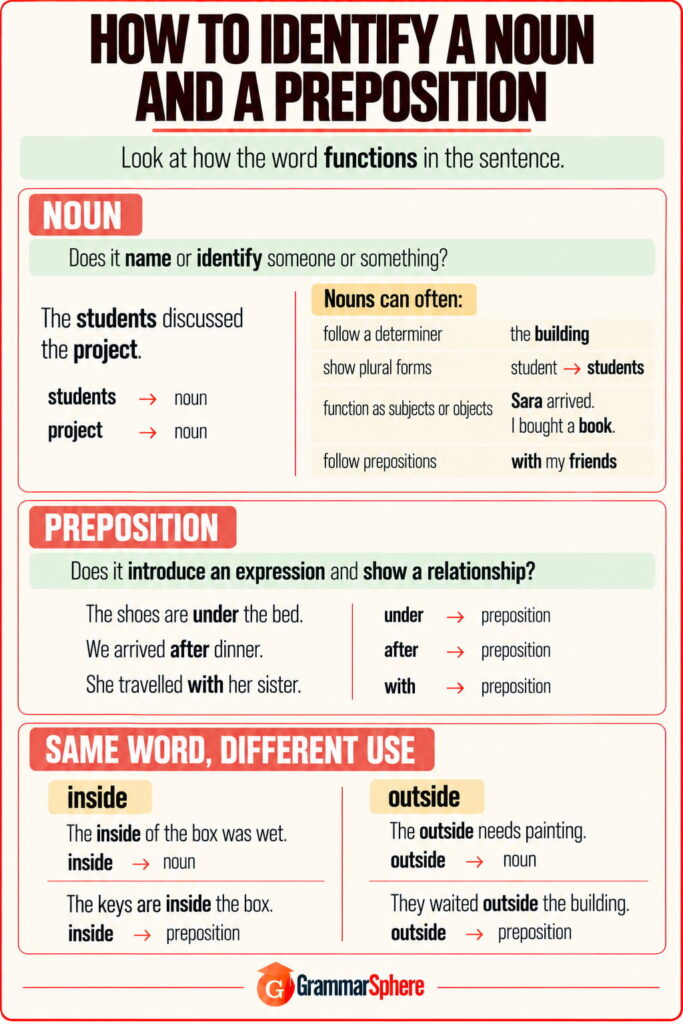
When you are not sure whether a word is a noun or a preposition, look at what the word is doing in the whole sentence.
How to Identify a Noun
A noun names or identifies a person, place, thing, idea, quality, or event.
Consider:
The students discussed the project.
Both students and project are nouns.
Useful clues include:
- nouns can often follow articles or determiners: a teacher, the building
- many countable nouns have singular and plural forms: student → students
- nouns can take possessive forms: the student’s bag
- nouns or noun phrases can function as subjects or objects
- nouns can follow prepositions: with my friends
These clues can help, but no single clue is enough by itself. Always consider how the word is used in the sentence.
How to Identify a Preposition
A preposition introduces an expression and shows how it relates to another part of the sentence.
Consider:
The shoes are under the bed.
Under is a preposition because it introduces the bed and shows where the shoes are.
A common pattern is:
preposition + noun phrase
Examples:
- in the house
- on Monday
- with my brother
- after the lesson
- about the problem
When identifying a preposition, look at both the word and the relationship it expresses in the sentence.
Words That Can Be Nouns or Prepositions
Some English words can be nouns in one sentence and prepositions in another, depending on how they are used.
Consider inside:
The inside of the box was wet.
Here, inside is a noun. It refers to the inner part of the box.
The keys are inside the box.
Here, inside is a preposition. It introduces the box and shows a relationship of place.
The same is true of outside:
- The outside of the building needs painting. → outside = noun
- They waited outside the building. → outside = preposition
This shows why a word should not be identified only by its meaning. Its grammatical use in the sentence determines its word class.
Common Mistakes with Nouns and Prepositions
1. Using a subject pronoun after a preposition
Incorrect:
between you and I ✗
Correct:
between you and me ✓
A personal pronoun after a preposition normally takes the object form, such as me, him, her, us, or them.
2. Confusing prepositional to with infinitive to
Compare:
She went to school.
Here, to is a preposition followed by the noun school.
She wants to study.
Here, to is part of the infinitive to study, not a preposition.
Noun vs. Preposition Exercises with Answers
A. Identify the nouns and prepositions.
- The book is on the desk.
- Sara walked into the room.
- We met after class.
- The children played in the garden.
- David travelled with his brother.
B. Decide whether the bold word is a noun or a preposition.
- The inside of the car was clean.
- The children stayed inside the house.
- The outside needs painting.
- They waited outside the building.
- We talked about the problem.
C. Identify the object of the preposition.
- She sat beside the window.
- We talked about the exam.
- The keys are under the chair.
- He travelled with his family.
- They arrived after lunch.
D. Choose the correct answer.
- The word under in under the bed is:
a. noun
b. preposition
- The word bed in under the bed is:
a. noun
b. preposition
- Which is correct?
a. between you and I
b. between you and me
- In She wants to leave, to is:
a. a preposition
b. part of an infinitive
- In She went to London, to is:
a. a preposition
b. part of an infinitive
Answers
A. Identify the nouns and prepositions
- book, desk = nouns; on = preposition
- Sara, room = nouns; into = preposition
- class = noun; after = preposition
- children, garden = nouns; in = preposition
- David, brother = nouns; with = preposition
B. Noun or preposition
- noun
- preposition
- noun
- preposition
- preposition
C. Object of the preposition
- the window
- the exam
- the chair
- his family
- lunch
D. Choose the correct answer
- b. preposition
- a. noun
- b. between you and me
- b. part of an infinitive
- a. preposition
FAQs About Nouns and Prepositions
What is the main difference between a noun and a preposition?
A noun names or identifies a person, place, thing, idea, quality, or event. A preposition introduces an expression and shows how it relates to another part of the sentence.
Can a noun come after a preposition?
Yes. A noun or noun phrase commonly follows a preposition, as in on the table, with my friend, and about the problem.
Can the same word be both a noun and a preposition?
Yes. Some words can belong to different word classes depending on how they are used. For example, inside is a noun in the inside of the box but a preposition in inside the box.
How can I identify a preposition in a sentence?
Look for a word that introduces an expression and connects it to another part of the sentence. Common examples include in, on, at, from, with, about, under, and after.
Is to always a preposition?
No. In She went to school, to is a preposition. In She wants to study, to is part of the infinitive to study.
You May Also Like
Leave a Comment