

Table of Contents
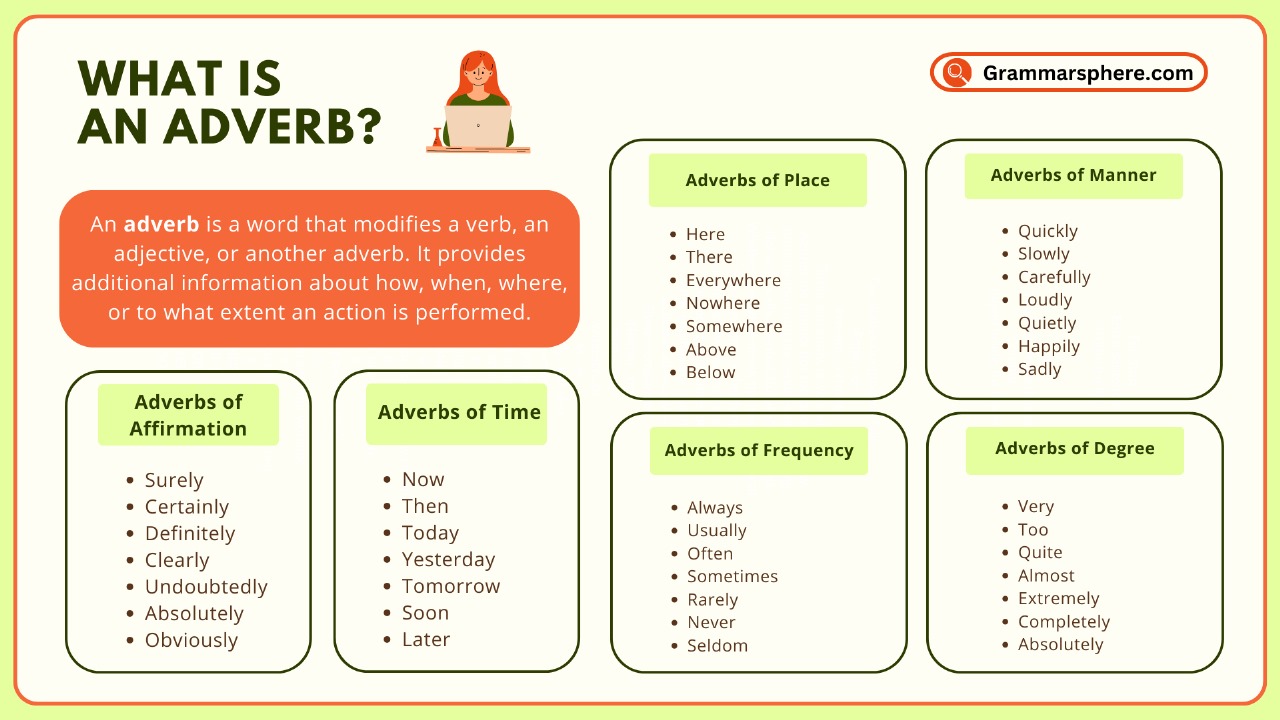
Adverbs are an essential part of English grammar. They describe or modify verbs, adjectives, or other adverbs, providing more information about how, when, where, or to what degree something happens.
Understanding adverbs and their usage is crucial to improving both written and spoken English. This guide will help you learn about adverbs, their types, and how to use them correctly in everyday sentences.
Adverb Definition
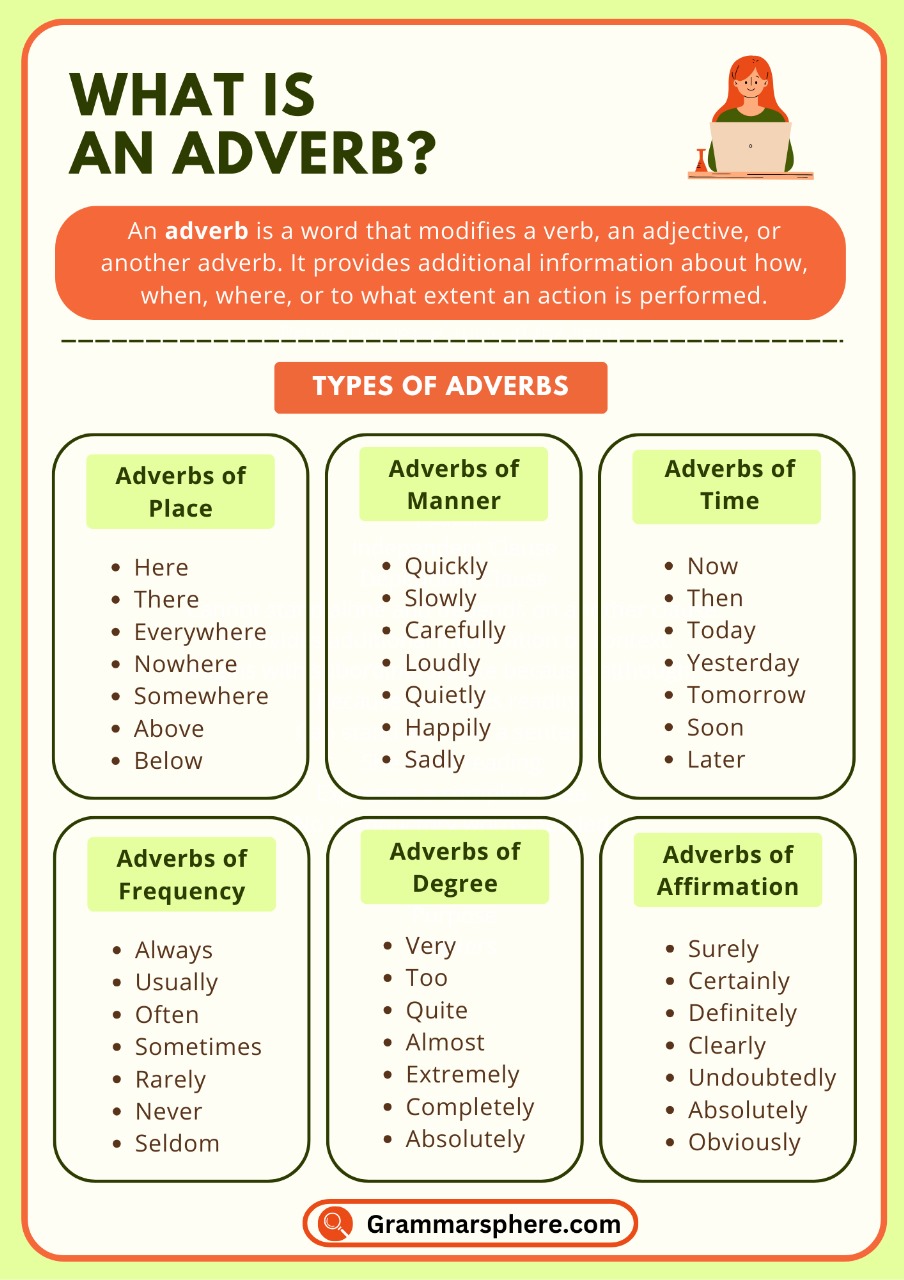
An adverb modifies a verb, adjective, or another adverb to show how, when, where, or how much something happens, making sentences more clear and detailed.
For example:
- She runs quickly. (How does she run? She runs quickly.)
- He is very tall. (How tall is he? He is very tall.)
How to Identify an Adverb
To identify an adverb in a sentence, first find the word it modifies. An adverb usually gives more information about a verb, adjective, or another adverb.
Ask questions such as:
- How? → She spoke softly.
- When? → We arrived yesterday.
- Where? → Please wait outside.
- How often? → He always arrives early.
- To what degree? → The water is very cold.
Many adverbs end in -ly, such as quickly, carefully, and slowly, but not all adverbs have this ending. Words such as often, very, here, fast, and well can also function as adverbs.
Also, not every word ending in -ly is an adverb. Words such as friendly, lovely, and lonely are commonly used as adjectives.
How Adverbs Are Formed
Many adverbs of manner are formed from adjectives by adding -ly.
| Adjective | Adverb |
|---|---|
| quick | quickly |
| careful | carefully |
| slow | slowly |
| quiet | quietly |
| beautiful | beautifully |
However, some words require spelling changes when -ly is added.
Adjectives ending in -y: Change -y to -i and add -ly.
- easy → easily
- happy → happily
- angry → angrily
Adjectives ending in -le: The final -e is usually removed and -y is added.
- simple → simply
- gentle → gently
- possible → possibly
Some adverbs have irregular forms.
- good → well
Some words have the same form as both an adjective and an adverb.
- fast → fast
- hard → hard
- early → early
Examples:
- He is a fast runner. (adjective)
- He runs fast. (adverb)
- She is a good singer. (adjective)
- She sings well. (adverb)
Remember that not all adverbs are formed from adjectives, and not every adverb ends in -ly. Words such as very, often, never, here, there, and yesterday are also adverbs.
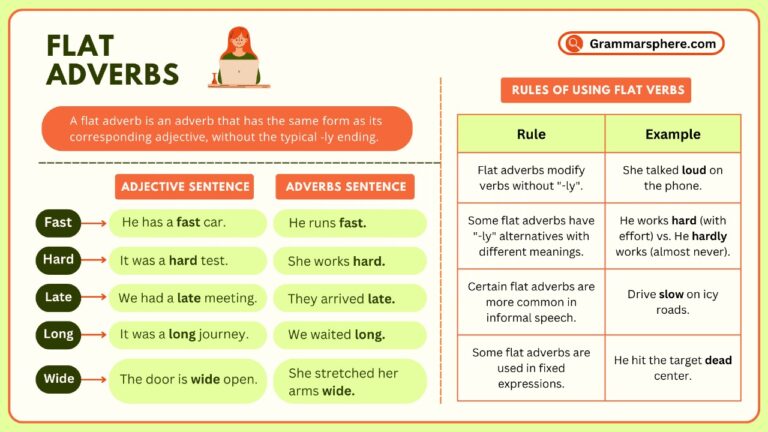
Flat Adverbs
Flat adverbs are adverbs that do not end in -ly and have the same form as their corresponding adjectives. They are commonly used to modify verbs.
Examples of flat adverbs:
- She sings fast.
Here, fast modifies the verb sings and describes how she sings. - He works hard every day.
Here, hard modifies the verb works and describes how he works.
Adverbs Modifying Verbs
Adverbs modify verbs by providing information about how, when, where, how often, or to what extent an action occurs.
For example:
- She sings beautifully.
- He studied hard.
- She always arrives on time.
Manner
Adverbs of manner describe how an action is performed. They answer the question How?
Examples of adverbs of manner:
- Huan sings loudly in the shower.
- My cat waits impatiently for his food.
- I will seriously consider your suggestion.
Time
Adverbs of time tell us when an action occurs or how long it lasts.
Examples of adverbs of time:
- We arrived at the theater and got in line early.
- Mara is confident that, eventually, her training will pay off.
- The weather will be cold and windy indefinitely.
Place
Adverbs of place describe where an action takes place. They answer the question Where?
Examples of adverbs of place:
- Turn in there, at the next left.
- Let’s go inside and ask how much they want for that guitar.
- The others hiked to the peak while she waited below.
Frequency
Adverbs of frequency describe how often an action occurs. They answer the question How often?
Examples of adverbs of frequency:
- I used to go dancing regularly, but now I go only occasionally.
- Farid prefers to be paid monthly rather than weekly.
- Jun always eats lunch at the same time.
Degree
Adverbs of degree describe to what extent an action occurs or is performed. They answer the question To what extent?
Examples of adverbs of degree:
- Have you fully read the instruction manual?
- It seems we’ve barely scratched the surface of this subject.
- The company is owned entirely by its workers.
Adverbs Modifying Adjectives
Adverbs can also modify adjectives. When they do this, they provide more information about the quality or degree of the adjective they modify. These adverbs tell us how much, to what extent, or how intense something is.
For example:
- She is extremely talented.
Here, extremely is an adverb modifying the adjective talented, explaining the degree of her talent. - He is quite tall.
In this example, quite modifies the adjective tall to indicate the degree of height.
Common adverbs that modify adjectives include very, extremely, quite, really, so, and too.
Adverbs Modifying Other Adverbs
Adverbs can also modify other adverbs, intensifying or altering their meaning. These adverbs answer questions about the degree or manner in which something happens.
For example:
- She sings incredibly well.
In this sentence, incredibly modifies the adverb well, showing to what degree she sings well. - He runs quite fast.
Here, quite modifies the adverb fast, giving more information about the speed at which he runs.
Adverbs and Degrees of Comparison
Adverbs, like adjectives, can also express degrees of comparison. They can show different degrees when comparing actions or the way something happens.
There are three degrees of comparison for adverbs:
| Degree of Comparison | Explanation | Example |
|---|---|---|
| Positive Degree | The adverb describes an action without making a comparison. | She dances gracefully. |
| Comparative Degree | The adverb compares two actions, often by adding -er or using more. | He runs faster than his friend. |
| Superlative Degree | The adverb shows the highest degree among three or more, often by adding -est or using most. | She sings most beautifully of all. |
Placement of Adverbs
Adverbs can appear in different positions within a sentence. Their placement often depends on the type of adverb and the meaning or emphasis intended.
At the beginning of the sentence: Adverbs of time and some other adverbs can appear at the beginning, particularly for emphasis.
- Never have I seen such beauty.
- Tomorrow, we will meet at the park.
In the middle of the sentence: Many adverbs of frequency commonly appear between the subject and the main verb or after an auxiliary verb.
- She always arrives early.
- He has never visited that place.
At the end of the sentence: Adverbs of manner, time, and place commonly appear at or near the end of a sentence.
- He completed the task carefully.
- She went to the store yesterday.
- They are waiting outside.
Common Adverb Mistakes to Avoid
Confusing Adverbs and Adjectives
Adjectives modify nouns, while adverbs modify verbs, adjectives, or other adverbs.
❌ She runs quick.
✔️ She runs quickly.
Misplacing Adverbs
The position of an adverb can affect the meaning or make a sentence sound unnatural.
❌ She speaks fluently Spanish.
✔️ She speaks Spanish fluently.
Overusing Adverbs
Using too many unnecessary adverbs can make writing less effective.
❌ She really wanted to go, but she really didn’t have time.
✔️ She was eager to go, but she didn’t have time.
Using Incorrect Adverbs for Comparison
When comparing actions, use the correct comparative or superlative form of the adverb.
❌ She runs more faster than him.
✔️ She runs faster than him.
Conclusion
Adverbs are an important part of English grammar because they add information about how, when, where, how often, or to what degree something happens. They can modify verbs, adjectives, and other adverbs and can appear in different positions within a sentence.
Understanding the types, uses, placement, and comparison of adverbs can help you use them more accurately in both written and spoken English.
FAQs
1. What is an adverb in English grammar?
An adverb is a word that gives more information about a verb, adjective, another adverb, or sometimes a whole sentence. It can tell us how, when, where, how often, or to what degree something happens.
2. What are the main types of adverbs?
The main types of adverbs include adverbs of manner, time, place, frequency, and degree. For example, quickly shows manner, yesterday shows time, here shows place, often shows frequency, and very shows degree.
3. How do you identify an adverb in a sentence?
Look for a word that gives more information about a verb, adjective, or another adverb. Adverbs commonly answer questions such as how? when? where? how often? and to what degree?
Many adverbs end in -ly, but not all do. Words such as fast, well, often, and here can also be adverbs.
4. What is the difference between an adjective and an adverb?
An adjective modifies a noun or pronoun, while an adverb commonly modifies a verb, adjective, or another adverb.
- She is a careful driver. (adjective)
- She drives carefully. (adverb)
5. Where do adverbs go in a sentence?
The position of an adverb depends on its type and what it modifies. Adverbs can appear at the beginning, middle, or end of a sentence.
- Yesterday, we stayed home.
- She always arrives early.
- He spoke quietly.
You May Also Like


Leave a Comment