

Table of Contents
Verbs are one of the main parts of speech in English grammar. They tell us what someone or something does, is, has, or experiences. Verbs can be divided into different types based on their meaning and function in a sentence.
In this lesson, you will learn the main types of verbs in English, how each type is used, and how to tell them apart. Clear examples and simple comparisons will help you understand and use each type correctly.
What Is a Verb?
A verb is a word that expresses an action, occurrence, or state of being. It is an essential part of a sentence because it tells us what the subject does, what happens, or what state the subject is in.
Examples:
- She writes stories every weekend. (action)
- The meeting starts at 10 a.m. (occurrence)
- He feels happy today. (state)
Types of Verbs in English
Verbs can be classified into different types based on their meaning, function, use with objects, and form. Because these classifications describe different features of verbs, the same verb can belong to more than one type.
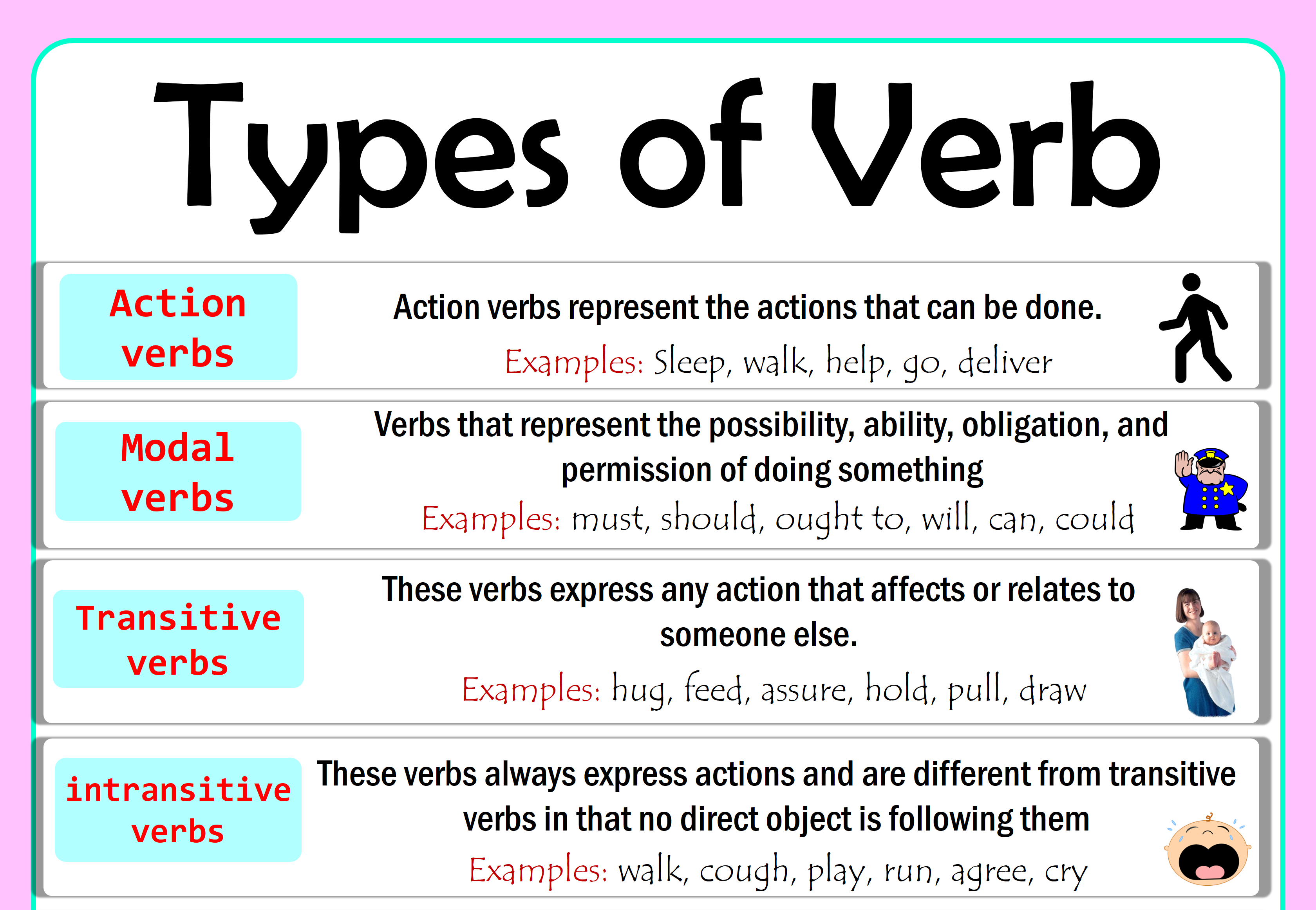
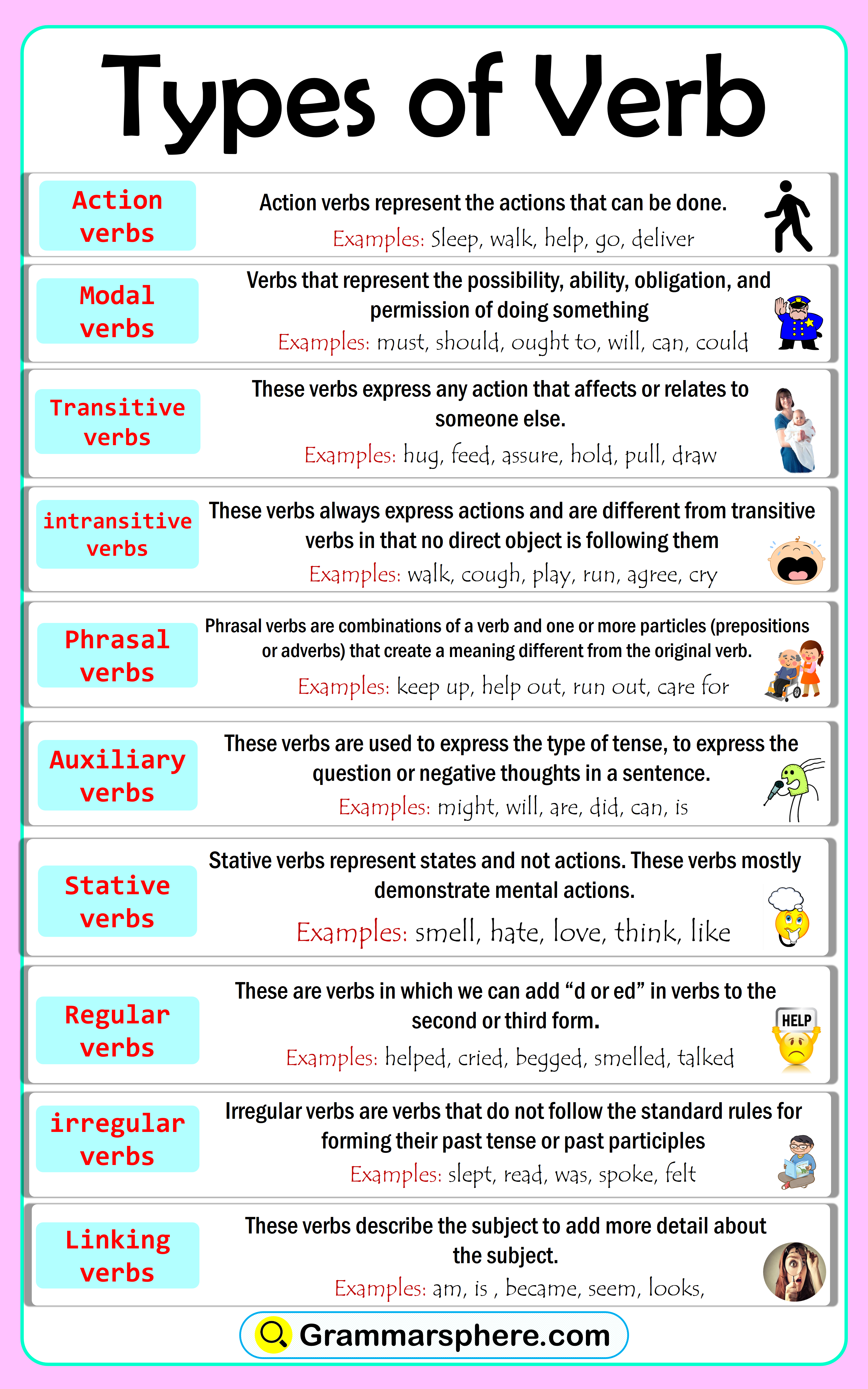
- Action Verbs
- Stative Verbs
- Linking Verbs
- Helping Verbs (Auxiliary Verbs)
- Modal Verbs
- Transitive Verbs
- Intransitive Verbs
- Regular Verbs
- Irregular Verbs
- Phrasal Verbs
1. Action Verbs
Action verbs tell us what the subject does. They can describe physical actions, such as run, jump, and swim, or mental actions, such as think, decide, and consider.
How to Identify an Action Verb
Ask, “What does the subject do?” The verb that shows the action is the action verb.
- He runs every morning. (physical action)
- She thinks about her future. (mental action)
2. Stative Verbs
Stative verbs describe a state, condition, feeling, thought, or possession rather than an action. They commonly express thoughts, emotions, possession, perception, and relationships.
Common stative verbs include know, believe, love, own, and belong.
How to Identify a Stative Verb
Ask whether the verb describes what someone or something is, feels, thinks, has, or experiences rather than an action they perform.
- I know the answer. (thought)
- She owns a car. (possession)
- They love music. (feeling)
3. Linking Verbs
Linking verbs connect the subject to a word or phrase that describes or identifies it. They do not express an action. Instead, they link the subject to more information about it.
Forms of be, such as am, is, are, was, and were, are the most common linking verbs. Other linking verbs include seem, become, appear, look, and feel when they are used as linking verbs.
How to Identify a Linking Verb
Check whether the verb connects the subject to an adjective or noun that describes or identifies it rather than showing an action.
- She is a doctor. (doctor identifies the subject)
- The sky looks clear. (clear describes the subject)
4. Helping Verbs (Auxiliary Verbs)
Helping verbs, also called auxiliary verbs, work with a main verb to add meaning or help form different grammatical structures. The primary helping verbs are be, have, and do. They are used to form tenses, questions, negatives, and the passive voice.
How to Identify a Helping Verb
Look for a verb that works with a main verb rather than expressing the main action or state by itself.
- She is running a marathon. (is helps form the present continuous)
- They have finished their homework. (have helps form the present perfect)
- Do you understand the question? (do helps form a question)
5. Modal Verbs
Modal verbs are a special type of auxiliary verb. They express meanings such as ability, possibility, permission, necessity, obligation, or advice.
Common modal verbs include can, could, may, might, will, would, shall, should, and must.
How to identify a modal verb:
A modal verb normally comes before the base form of the main verb.
- She can sing beautifully.
- You should follow the rules.
6. Transitive Verbs
A transitive verb takes a direct object—a person or thing that receives or is affected by the action.
How to identify a transitive verb:
Ask what? or whom? after the verb. If the question has a direct answer, the verb is being used transitively.
- She threw the ball.
Threw what? — the ball. - He reads books.
Reads what? — books.
7. Intransitive Verbs
An intransitive verb does not take a direct object. Its meaning does not pass directly to a person or thing.
How to identify an intransitive verb:
If there is no direct object answering what? or whom? after the verb, the verb is being used intransitively.
- She laughed loudly.
- The baby cried for hours.
Some verbs can be transitive in one sentence and intransitive in another, depending on how they are used.
8. Regular Verbs
Regular verbs form their simple past and past participle in a predictable way, usually by adding -ed or -d to the base form.
- talk → talked → talked
- dance → danced → danced
How to identify a regular verb:
Check whether its past and past participle forms follow the regular -ed/-d pattern.
9. Irregular Verbs
Irregular verbs do not form their simple past and past participle by following the regular -ed/-d pattern. Their forms may change in different ways.
- go → went → gone
- bring → brought → brought
- cut → cut → cut
Because irregular verbs follow different patterns, their forms need to be learned individually.
10. Phrasal Verbs
A phrasal verb is formed by a verb combined with one or more particles. Together, the words function as a unit and often have a meaning that cannot be understood from the verb alone.
- give up = stop trying or quit
- run into = meet someone unexpectedly
How to identify a phrasal verb:
Look for a verb followed by a particle that works with the verb to create a particular meaning.
Important Differences Between Types of Verbs
Some types of verbs can look similar but perform different functions in a sentence. Understanding these differences can help you identify and use them correctly.
Action (Dynamic) Verbs vs. Stative Verbs
Action or dynamic verbs describe actions, activities, or processes, while stative verbs describe states such as thoughts, feelings, possession, relationships, or perception.
Dynamic verbs can normally be used in continuous forms, while stative verbs are generally not used in continuous forms when they describe a state.
- She is running in the park. (dynamic)
- I know the answer. (stative)
Same Verb, Different Meaning
Some verbs can be stative or dynamic depending on their meaning.
- I think this is a good idea. (stative: opinion)
- I am thinking about the problem. (dynamic: mental activity)
- He has a car. (stative: possession)
- He is having lunch. (dynamic: activity)
Linking Verbs vs. Helping Verbs
A linking verb connects the subject to a word or phrase that describes or identifies it. A helping verb works with a main verb to form a verb phrase.
- She is happy. (linking verb: connects “she” with “happy”)
- She is working. (helping verb: works with “working”)
The same verb can therefore perform different functions depending on how it is used in a sentence.
Transitive Verbs vs. Intransitive Verbs
A transitive verb takes a direct object, while an intransitive verb does not.
- She opened the door. (transitive: “the door” is the direct object)
- The door opened. (intransitive: no direct object)
Some verbs can be transitive or intransitive depending on how they are used.
Regular Verbs vs. Irregular Verbs
Regular verbs usually form their simple past and past participle by adding -ed or -d. Irregular verbs do not follow this regular pattern.
- walk → walked → walked (regular)
- go → went → gone (irregular)
The main difference is how the verbs form their simple past and past participle.
Can a Verb Belong to More Than One Type?
Yes. A verb can belong to more than one type because verbs can be classified by their meaning, function, use with objects, and form.
For example, in “The children played,” the verb played is an action verb, an intransitive verb, and a regular verb.
Therefore, the type of a verb depends on which feature of the verb you are examining and how it is used in the sentence.
Verb Conjugation
Verb conjugation is the way a verb changes its form to express grammatical information such as tense, person, and number. In English, the form of a verb can change depending on when something happens and who or what the subject is.
For example, the verb write has the following forms:
- Base form: write
- Third-person singular: writes
- Past simple: wrote
- Past participle: written
- Present participle: writing
These verb forms are used to build different tenses and grammatical structures in English.
Common Mistakes with Types of Verbs
Learners often confuse different types of verbs because the same verb can perform different functions depending on how it is used in a sentence. Here are some common mistakes to avoid:
- Confusing linking verbs with helping verbs: A form of be is not always a helping verb.
- She is happy. (linking verb)
- She is working. (helping verb)
- Confusing transitive and intransitive verbs: A verb may take a direct object in one sentence but not in another.
- She opened the door. (transitive)
- The door opened. (intransitive)
- Using stative verbs incorrectly in continuous forms: Stative verbs are generally not used in continuous forms when they describe a state.
- I know the answer. ✓
- I am knowing the answer. ✗
- Assuming a verb belongs to only one type: A verb can belong to more than one category because verbs can be classified by meaning, function, use with objects, and form.
- In “The children played,” played is an action verb, an intransitive verb, and a regular verb.
- Confusing regular and irregular verbs: Regular verbs normally form the simple past and past participle with -ed or -d, while irregular verbs follow different patterns.
- walk → walked → walked (regular)
- go → went → gone (irregular)
Practice: Identify the Types of Verbs
Identify the bold verb or verb phrase in each sentence. Decide which type of verb it represents based on the concept being tested.
- Sarah runs every morning.
- I believe your story.
- The soup tastes delicious.
- They have finished their work.
- You should study carefully.
- She opened the window.
- The baby cried loudly.
- We walked home.
- He went to school early.
- Please turn off the light.
Answers:
- runs — Action verb
- believe — Stative verb
- tastes — Linking verb
- have — Helping verb
- should — Modal verb
- opened — Transitive verb
- cried — Intransitive verb
- walked — Regular verb
- went — Irregular verb
- turn off — Phrasal verb
FAQs About Types of Verbs
1. How many types of verbs are there in English?
There is no single fixed number because verbs can be classified in different ways. Common types include action, stative, linking, helping, modal, transitive, intransitive, regular, irregular, and phrasal verbs.
2. What are the most important types of verbs to learn?
Learners should understand action, stative, linking, helping, modal, transitive, intransitive, regular, irregular, and phrasal verbs. Each classification explains a different feature of how verbs work in English.
3. What are the five forms of a verb in English?
The five commonly taught verb forms are the base form, third-person singular form, simple past, past participle, and present participle (-ing form). For example: write, writes, wrote, written, and writing.
4. Can the same verb be different types in different sentences?
Yes. The type of a verb can depend on how it is used. For example, in “She is happy,” is is a linking verb, while in “She is working,” is is a helping verb.
5. What is the difference between a main verb and a helping verb?
A main verb carries the main meaning of the verb phrase, while a helping verb works with the main verb to add grammatical information. In “She has finished her work,” finished is the main verb and has is the helping verb.
You May Also Like
Leave a Comment