

Table of Contents
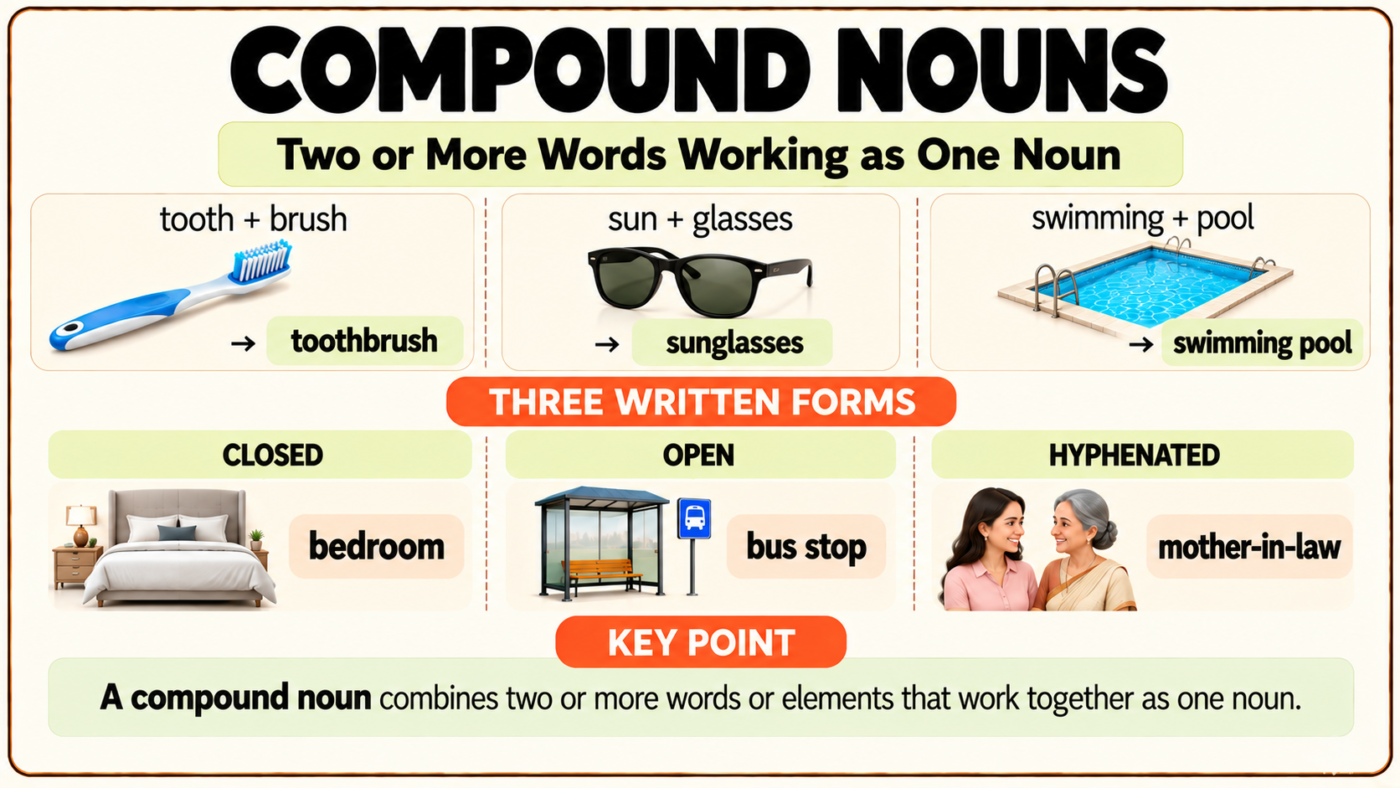
Compound nouns are nouns made from two or more words that work together as one noun. We use them every day for people, places, objects, activities, and ideas.
Look at these examples:
- toothbrush
- bus stop
- coffee shop
- swimming pool
- mother-in-law
Some compound nouns are written as one word, some as separate words, and some with hyphens. They can also be formed from different combinations of nouns, adjectives, verbs, and verb forms.
In this lesson, you will learn what compound nouns are, how they are formed, how they are written, how to make them plural, and how they are normally stressed in spoken English.
Compound Noun Definition
A compound noun is a noun made from two or more words or elements that work together as a single noun.
For example:
tooth + brush → toothbrush
bus + stop → bus stop
green + house → greenhouse
swimming + pool → swimming pool
Although a compound noun may contain two or more words, the complete expression functions as one noun.
We waited at the bus stop.
Here, bus stop contains two words, but together they name one place.
A compound noun often contains a main noun and another element that gives more information about it.
For example:
coffee shop
Shop is the main noun.
Coffee tells us what kind of shop it is.
Formation of Compound Nouns
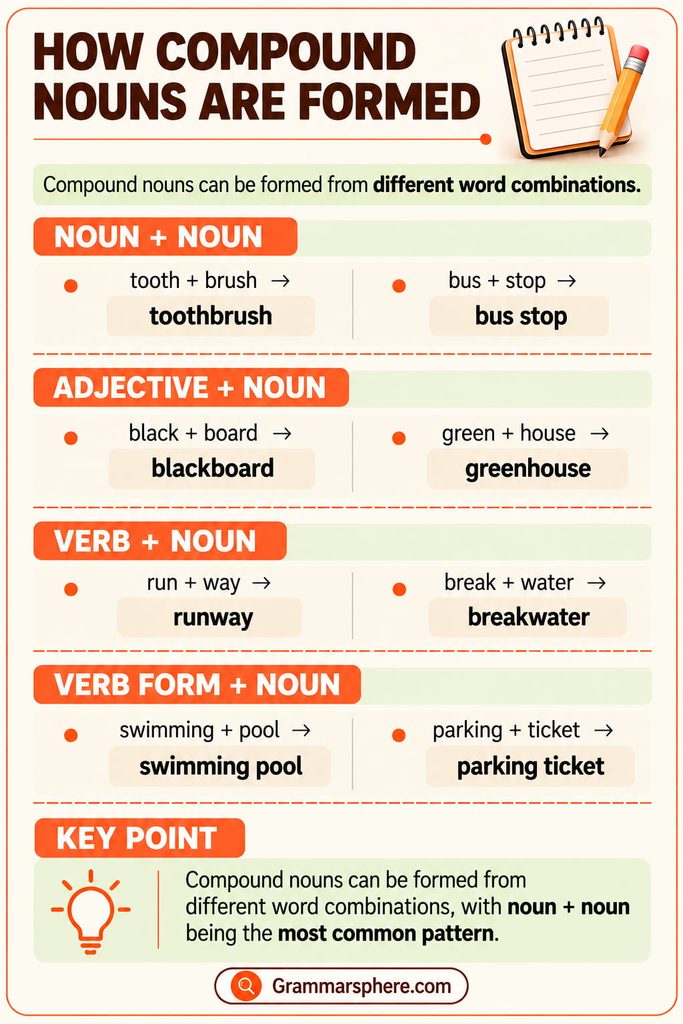
Compound nouns can be formed from different combinations of words. Noun + noun is the most common pattern, but English also uses several other combinations.
Noun + Noun
Two nouns can combine to form a compound noun.
tooth + brush → toothbrush
bus + stop → bus stop
coffee + shop → coffee shop
door + bell → doorbell
school + bus → school bus
In many noun + noun compounds, the first noun gives more information about the second.
For example:
school bus
Bus is the main noun.
School tells us the purpose or association of the bus.
Adjective + Noun
An adjective and a noun can combine to form a compound noun.
black + board → blackboard
green + house → greenhouse
full + moon → full moon
For example:
The teacher wrote on the blackboard.
Blackboard functions as one noun.
Verb + Noun
A verb can combine with a noun to form a compound noun.
run + way → runway
break + water → breakwater
For example:
The plane moved onto the runway.
Runway functions as the noun in the sentence.
Verb Form + Noun
A form related to a verb, including an -ing form, can combine with a noun.
swimming pool
washing machine
parking ticket
cleaning products
For example:
The children are in the swimming pool.
The complete expression swimming pool functions as one noun.
These are common formation patterns, but they are not the only possible combinations in English.
Types of Compound Nouns by Spelling
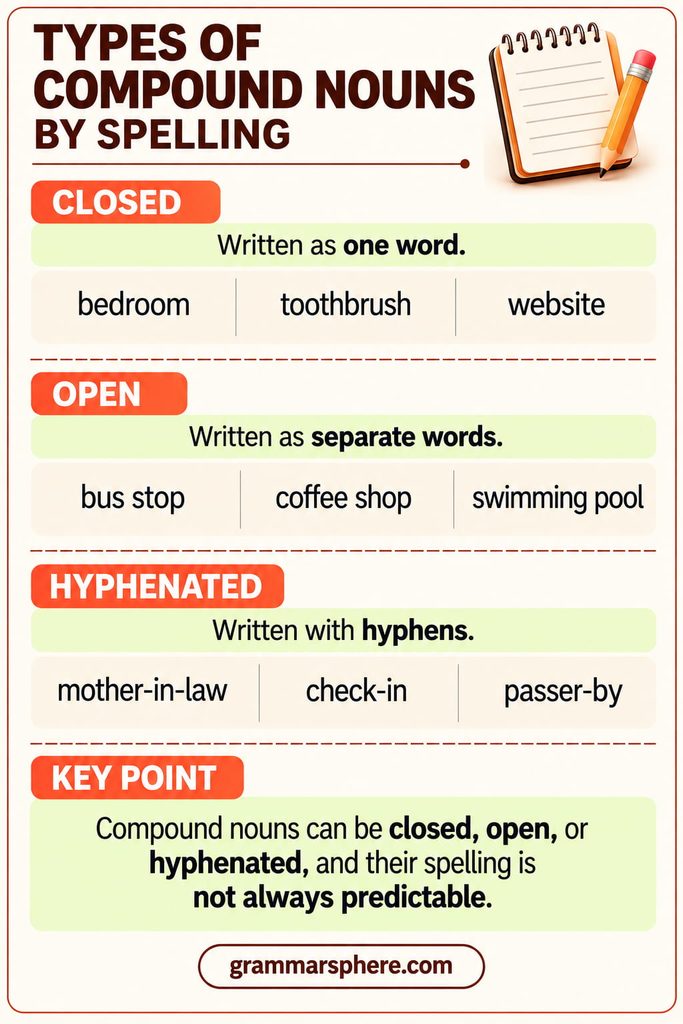
Compound nouns are commonly written in three different ways:
- closed
- open
- hyphenated
There is no single rule that can reliably tell you how every compound noun should be written. When you are unsure, check a current learner’s dictionary.
Closed Compound Nouns
A closed compound noun is written as one word, without a space or hyphen.
Examples:
- bedroom
- toothbrush
- website
- doorbell
- bathroom
- football
Her bedroom is upstairs.
Bedroom combines bed and room, but the compound is written as one word.
Open Compound Nouns
An open compound noun is written as two or more separate words.
Examples:
- bus stop
- coffee shop
- car park
- swimming pool
- bottle opener
- full moon
We waited at the bus stop.
There is a space between bus and stop, but the two words work together as one noun.
Hyphenated Compound Nouns
A hyphenated compound noun has a hyphen between its elements.
Examples:
- mother-in-law
- son-in-law
- check-in
- passer-by
My mother-in-law is visiting us.
The hyphens are part of the conventional spelling of the compound.
Compound spelling is not completely fixed. Some compounds may be written differently in different varieties of English, and spellings can change over time. A reliable dictionary is therefore the safest guide when you are uncertain.
Meaning of Compound Nouns
The words in a compound noun combine to express one particular meaning.
In many compounds, the final element is the main noun, while the first element identifies an important feature, purpose, type, or association.
Consider:
coffee shop
Shop is the main noun.
Coffee identifies the kind of shop.
school bus
Bus is the main noun.
School tells us what the bus is associated with.
tennis shoe
Shoe is the main noun.
Tennis tells us the activity associated with the shoe.
However, the meaning of a compound noun is not always simply the literal meanings of its individual words.
Compare:
green house
This can mean a house that is green.
greenhouse
This is a compound noun that normally means a structure used for growing plants.
So, meaning is important when identifying compound nouns.
Plural Forms of Compound Nouns
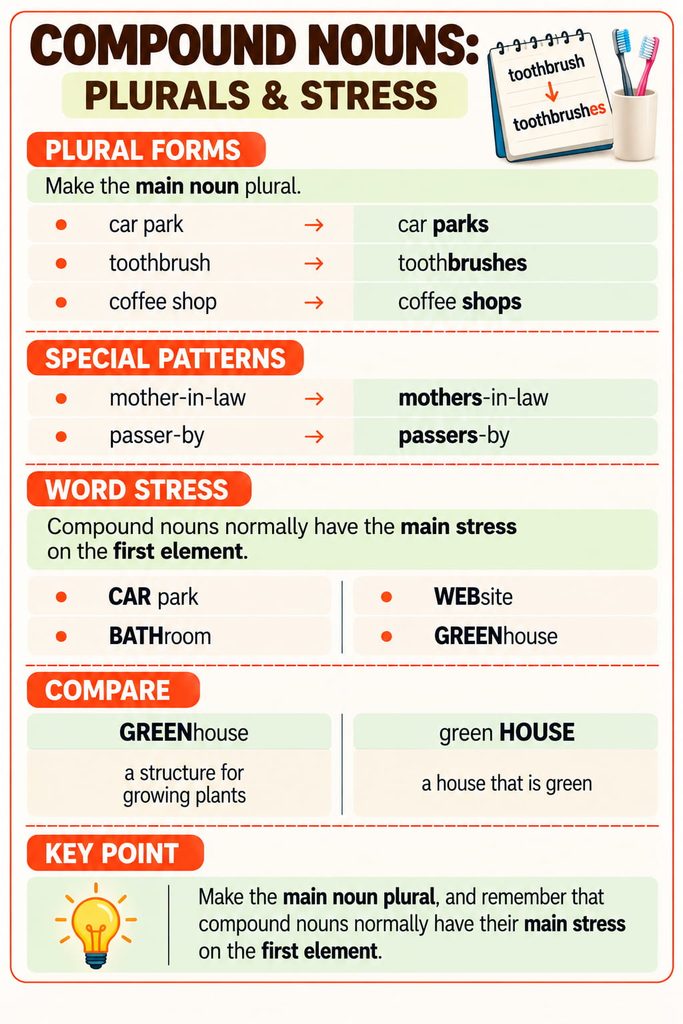
Most compound nouns form their plural by making the main noun plural.
For many compounds, the main noun comes at the end.
bedroom → bedrooms
toothbrush → toothbrushes
bus stop → bus stops
car park → car parks
coffee shop → coffee shops
However, in some compound nouns, the main noun appears earlier.
mother-in-law → mothers-in-law
sister-in-law → sisters-in-law
passer-by → passers-by
Therefore:
❌ mother-in-laws
✓ mothers-in-law
The useful general principle is:
Make the main noun plural.
In many noun + noun compounds, the first noun works as a modifier and normally remains singular.
apple tree → apple trees
bus stop → bus stops
shoe shop → shoe shops
Not:
❌ apples trees
❌ buses stops
Because some compounds have unusual structures, check a reliable dictionary if you are unsure about the plural.
Stress in Compound Nouns
Compound nouns normally have their main spoken stress on the first element.
For example:
CAR park
BATHroom
WEBsite
DOORbell
GREENhouse
Stress can sometimes help us distinguish a compound noun from an ordinary adjective + noun phrase.
Compare:
GREENhouse
This normally refers to a structure used for growing plants.
green HOUSE
This can simply mean a house that is green.
The difference in stress helps communicate the difference in meaning.
However, first-element stress is a general pattern, not an absolute rule. Some compound nouns, especially certain names and titles, have different stress patterns.
Common Compound Nouns with Examples
Here are some common compound nouns used in everyday English:
| Compound Noun | Type | Example |
|---|---|---|
| toothbrush | Closed | I bought a new toothbrush. |
| bedroom | Closed | Her bedroom is upstairs. |
| website | Closed | I found the information on their website. |
| doorbell | Closed | Someone rang the doorbell. |
| bus stop | Open | We waited at the bus stop. |
| coffee shop | Open | They met at a coffee shop. |
| car park | Open | The car park is full. |
| swimming pool | Open | The hotel has a swimming pool. |
| mother-in-law | Hyphenated | My mother-in-law called me. |
| check-in | Hyphenated | Check-in begins at noon. |
Whether a compound noun is written as one word, separate words, or with a hyphen, the complete expression functions as a noun.
Compound Nouns in Sentences
Compound nouns behave like other nouns in sentences.
They can be the subject:
The swimming pool opens at nine.
They can be an object:
I bought a new toothbrush.
They can follow a preposition:
We met at the coffee shop.
They can also be modified by an adjective:
We found a small coffee shop near the station.
Here, small describes the complete compound noun coffee shop.
Common Mistakes with Compound Nouns
Incorrect Spelling
Do not assume that every compound noun is written as one word.
❌ busstop
✓ bus stop
Similarly:
❌ bed room
✓ bedroom
Because the spelling of compound nouns is not completely predictable, check a dictionary when you are unsure.
Pluralizing the Wrong Element
Some compound nouns have their main noun before another element.
❌ mother-in-laws
✓ mothers-in-law
The main noun mother takes the plural form.
Compare:
car park → car parks
Here, park is the main noun, so it becomes plural.
Making Both Nouns Plural
In many noun + noun compounds, the first noun normally remains singular.
❌ apples trees
✓ apple trees
❌ buses stops
✓ bus stops
The first noun functions as a modifier in these compounds.
Confusing a Compound Noun with an Ordinary Phrase
Not every adjective + noun combination is a compound noun.
Compare:
greenhouse
→ a structure used for growing plants
green house
→ a house that is green
Meaning, established usage, spelling, and sometimes stress help distinguish a compound noun from an ordinary phrase.
Treating First-Element Stress as an Absolute Rule
Compound nouns normally have their main stress on the first element, but exceptions exist.
Therefore, first-element stress should be treated as a useful general pattern rather than a rule with no exceptions.
Compound Nouns Practice Exercise
Choose or identify the correct compound noun.
- Find the compound noun:
We waited at the bus stop. - Find the compound noun:
Her bedroom is very small. - Find the compound noun:
The children are playing near the swimming pool. - Choose the correct spelling:
a. tooth brush
b. toothbrush - Choose the correct spelling:
a. busstop
b. bus stop - Choose the correct plural:
a. car parks
b. cars park - Choose the correct plural:
a. mother-in-laws
b. mothers-in-law - Which is a closed compound noun?
a. bedroom
b. coffee shop - Which is an open compound noun?
a. website
b. coffee shop - Which is a hyphenated compound noun?
a. mother-in-law
b. toothbrush
Answers
- bus stop
- bedroom
- swimming pool
- toothbrush
- bus stop
- car parks
- mothers-in-law
- bedroom
- coffee shop
- mother-in-law
FAQs
What is a compound noun?
A compound noun is a noun made from two or more words or elements that work together as one noun. Examples include toothbrush, bus stop, and mother-in-law.
What are the three types of compound nouns?
Based on how they are written, compound nouns are commonly grouped into closed compounds such as bedroom, open compounds such as bus stop, and hyphenated compounds such as mother-in-law.
What are 10 examples of compound nouns?
Ten common examples are toothbrush, bedroom, website, doorbell, bus stop, coffee shop, car park, swimming pool, mother-in-law, and check-in.
How are compound nouns formed?
Compound nouns can be formed from different word combinations. Common patterns include noun + noun (bus stop), adjective + noun (blackboard), verb + noun (runway), and combinations involving verb forms such as swimming pool.
How can you identify a compound noun?
Look for two or more words or elements that work together as a single noun with one established meaning. For example, coffee shop contains two words, but together they name one type of place.
Are compound nouns one word or two words?
They can be either. Some are written as one word (bedroom), some as separate words (bus stop), and some with a hyphen (mother-in-law). There is no completely reliable spelling rule for every compound noun.
How do you make compound nouns plural?
Usually, the main noun becomes plural. For example, car park becomes car parks, while mother-in-law becomes mothers-in-law.
Where does the stress fall in a compound noun?
The main stress normally falls on the first element, as in CAR park and GREENhouse. However, there are exceptions.
Final Takeaway
Compound nouns are made from two or more words or elements that function together as one noun.
They can be formed from different word combinations and can be written as closed, open, or hyphenated compounds.
Most compound nouns form their plurals by making the main noun plural, and their main spoken stress normally falls on the first element.
Because compound spelling and some plural and stress patterns are not completely predictable, check a reliable learner’s dictionary when you are unsure.
You May Also Like

Leave a Comment