

Table of Contents
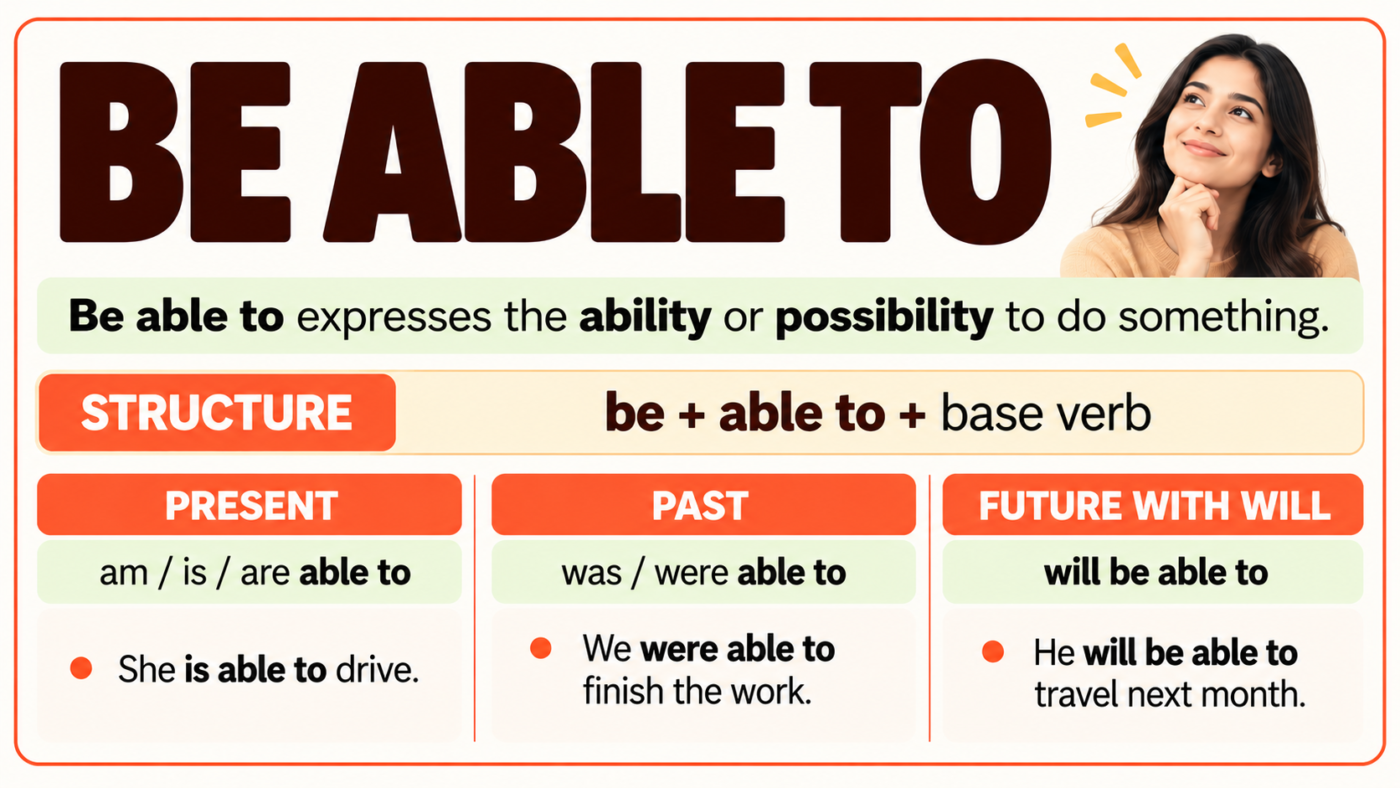
Be able to is used to talk about someone’s ability or possibility to do something. It has a similar meaning to can, but it can be used in grammatical structures where can does not have the form we need.
Compare:
I can swim.
I am able to swim.
Both sentences express present ability.
However, be able to becomes especially useful in structures such as:
She will be able to drive soon.
I haven’t been able to sleep well.
You might be able to help us.
I’d like to be able to speak Spanish.
In this lesson, you will learn the structure of be able to, how it changes in different grammatical forms, when to use it instead of can or could, and how to avoid common mistakes.
Meaning of Be Able To
Be able to means to have the ability, skill, opportunity, or necessary conditions to do something.
She is able to speak three languages.
This means that she has the ability to speak three languages.
We were able to solve the problem.
This means that we succeeded in solving it.
The expression follows this basic pattern:
be + able to + base verb
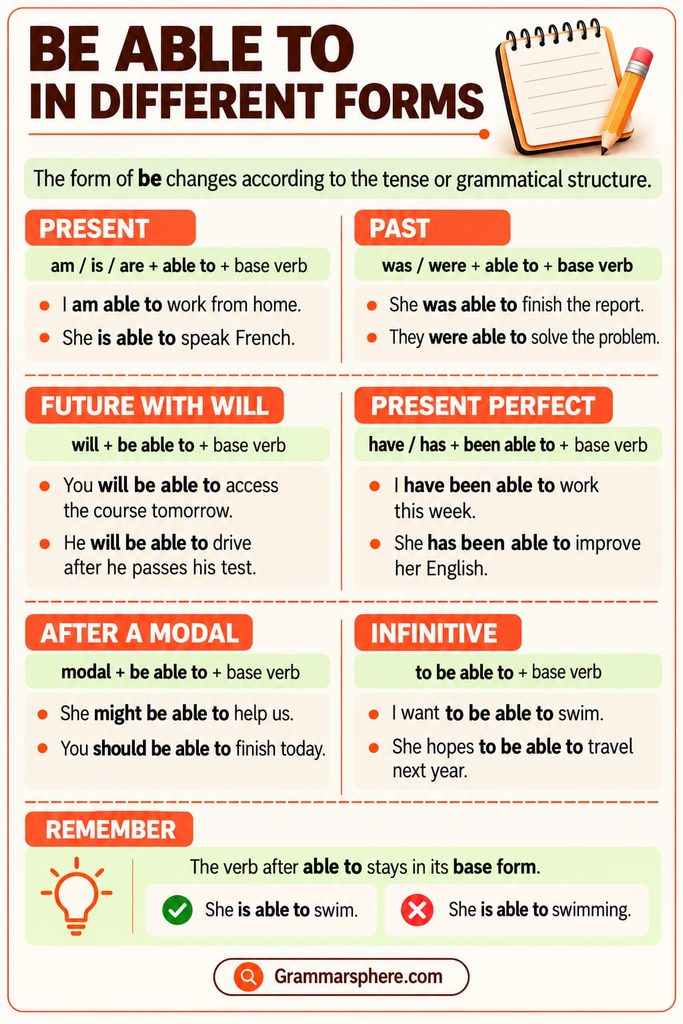
The form of be changes according to the subject and grammatical structure.
Structure of Be Able To
The basic structure is:
Subject + be + able to + base verb
Examples:
I am able to drive.
She is able to work independently.
They are able to understand the instructions.
The main verb after able to stays in its base form.
✓ She is able to swim.
Not:
✗ She is able to swims.
✗ She is able to swimming.
The form of be changes according to the grammatical structure:
| Form | Structure | Example |
|---|---|---|
| Present | am/is/are able to | She is able to drive. |
| Past | was/were able to | We were able to finish. |
| Future with will | will be able to | He will be able to come. |
| Present perfect | have/has been able to | I have been able to work. |
| Past perfect | had been able to | She had been able to save enough money. |
| After a modal | modal + be able to | You might be able to help. |
| Infinitive | to be able to | I want to be able to swim. |
This flexibility is one of the main reasons be able to is useful in English.
Be Able To in the Present
For present ability, we use:
am/is/are + able to + base verb
I am able to work from home.
She is able to speak French.
They are able to solve the problem.
In ordinary conversation, can is usually more natural and concise for simple present ability.
She can swim.
is normally more natural than:
She is able to swim.
However, be able to is grammatically correct and can be useful in more formal contexts or when the speaker wants to emphasize ability.
Be Able To in the Past
For past ability or achievement, we use:
was/were + able to + base verb
She was able to finish the report.
We were able to find the address.
They were able to escape safely.
An important distinction appears between could and was/were able to.
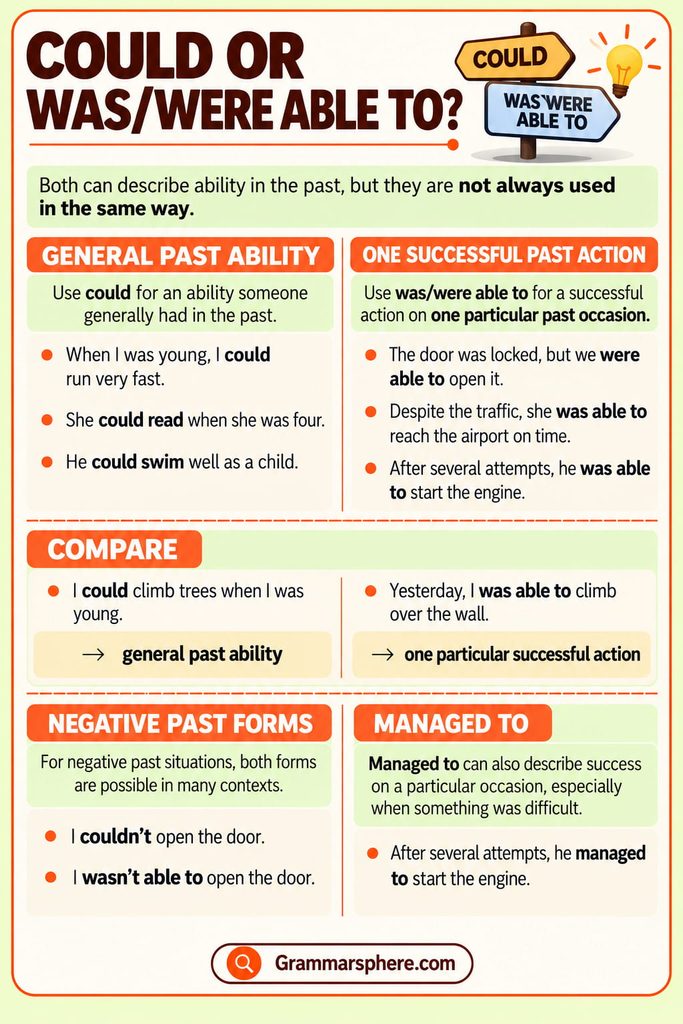
General Past Ability
We normally use could to describe a general ability that someone had over a period of time.
When I was young, I could run very fast.
She could read when she was four.
Was/were able to can also describe past ability, but could is often more natural when talking about a general ability.
Successful Action on One Past Occasion
For a particular successful action or achievement in the past, we normally use was/were able to, rather than could in an affirmative sentence.
The door was locked, but we were able to open it.
Despite the traffic, she was able to reach the airport on time.
After several attempts, he was able to start the engine.
Compare:
When I was younger, I could climb trees easily.
→ general past ability
Yesterday, I was able to climb over the wall and get the ball.
→ successful action on one particular occasion
Managed to can also describe success on a particular occasion, especially when the action was difficult.
After several attempts, he managed to start the engine.
The focus of managed to is often on difficulty and eventual success, whereas was/were able to focuses on having or using the ability or opportunity successfully.
For negative past situations, couldn’t and wasn’t/weren’t able to are both possible in many contexts:
I couldn’t open the door.
I wasn’t able to open the door.
Be Able To in the Future
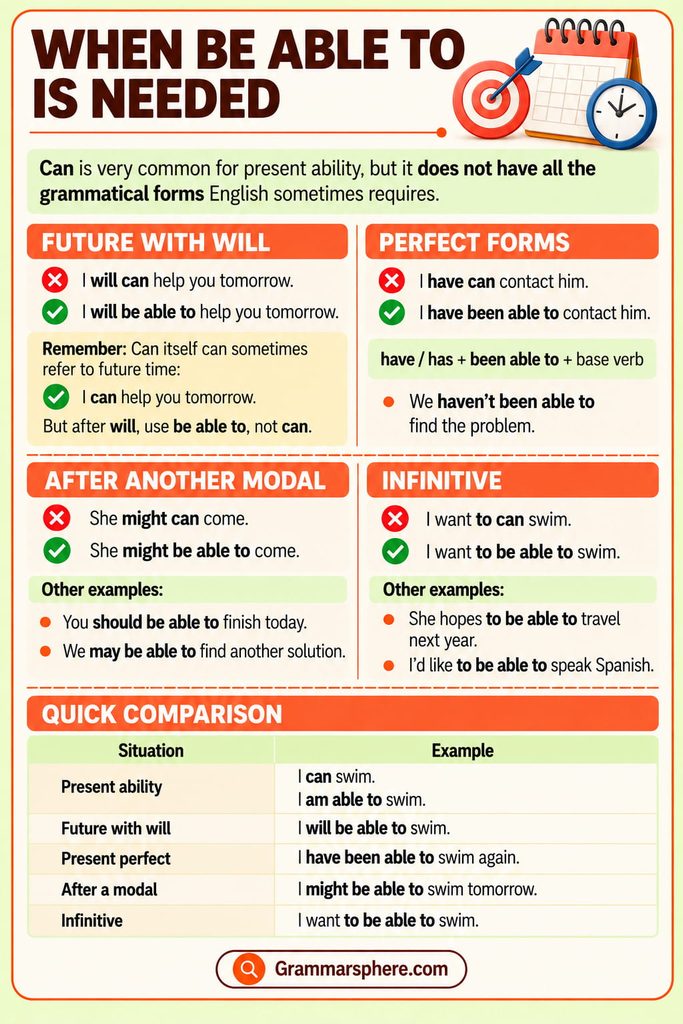
We can use will be able to + base verb to talk about future ability or circumstances that make something possible.
She will be able to drive after she passes her test.
You will be able to access the course tomorrow.
They will be able to join us next week.
The important grammatical rule is that we cannot use will can.
✗ I will can help you tomorrow.
✓ I will be able to help you tomorrow.
However, this does not mean that can can never refer to future time.
For example:
I can meet you tomorrow.
Here, can refers naturally to future availability.
The key distinction is that when the structure requires will + future ability, English uses:
will be able to
not:
will can
Be Able To in Perfect Forms
Unlike can, be able to can be used in perfect constructions.
Present Perfect
Use:
have/has been able to + base verb
I have been able to work from home this week.
She has been able to improve her English.
We haven’t been able to contact him yet.
The negative form is especially common:
I haven’t been able to sleep well recently.
Not:
✗ I haven’t can sleep well.
✗ I have could sleep well.
Past Perfect
Use:
had been able to + base verb
She had been able to save enough money before she moved.
They had been able to solve the earlier problems themselves.
The perfect forms are another important reason English needs be able to: can and could do not have participle forms that can be used in these structures.
Be Able To After Modal Verbs
Be able to can follow modal verbs such as:
- might
- may
- should
- would
- must
The structure is:
modal + be able to + base verb
Examples:
I might be able to help you tomorrow.
She should be able to finish by Friday.
We may be able to find another solution.
He must be able to work under pressure.
Do not place can directly after another central modal.
✗ She might can come.
✓ She might be able to come.
✗ You should can finish it.
✓ You should be able to finish it.
In standard English, modal verbs such as might and should do not normally combine directly with can, so be able to provides the required structure.
To Be Able To After Other Verbs
Be able to also has an infinitive form:
to be able to
This form is useful after verbs and expressions that require an infinitive.
I want to be able to speak English confidently.
She hopes to be able to travel next year.
I’d like to be able to play the piano.
He needs to be able to work independently.
We cannot use to can.
✗ I want to can speak English.
✓ I want to be able to speak English.
This is another important difference between can and be able to: can does not have an infinitive form.
Negative and Question Forms of Be Able To
The negative and question forms change according to the form of be or the auxiliary used in the construction.
Negative forms
Present:
I am not able to come.
She isn’t able to attend the meeting.
Past:
He wasn’t able to finish the work.
They weren’t able to find the house.
Future:
I won’t be able to come tomorrow.
She won’t be able to drive for a few weeks.
Present perfect:
We haven’t been able to contact him.
He hasn’t been able to find a job yet.
Question forms
Present:
Are you able to work on weekends?
Is she able to drive?
Past:
Were you able to find the address?
Was he able to finish the report?
Future:
Will you be able to come tomorrow?
Will they be able to finish on time?
Present perfect:
Have you been able to contact her?
Has she been able to solve the problem?
In everyday conversation, Can you come tomorrow? may be more natural when simply asking about someone’s availability. Will you be able to come tomorrow? more explicitly asks whether the person’s circumstances will allow it.
Can vs Be Able To
Can and be able to overlap when expressing ability, but they are not interchangeable in every grammatical structure.
| Situation | Can / Could | Be Able To |
|---|---|---|
| Present ability | I can swim. | I am able to swim. |
| General past ability | I could swim at five. | I was able to swim at five. |
| Specific past success | Could is not normally used in affirmative statements | I was able to escape. |
| Future with will | ✗ will can | I will be able to drive. |
| Present perfect | — | I have been able to work. |
| After another modal | — | I might be able to help. |
| Infinitive | — | I want to be able to swim. |
For ordinary present ability, can is usually the more natural choice:
I can drive.
Use be able to when the grammatical structure requires a form that can does not have, or when be able to better expresses the intended meaning.
Remember that can can also refer to future time in suitable contexts:
I can help you tomorrow.
The restriction applies to constructions such as will can, not to every future reference with can.
Common Mistakes with Be Able To
Using Will Can
✗ I will can drive soon.
✓ I will be able to drive soon.
Use will be able to when expressing future ability with will.
Leaving Out Be
✗ She able to speak French.
✓ She is able to speak French.
The expression requires the appropriate form of be.
Leaving Out To
✗ He is able swim.
✓ He is able to swim.
Use:
able to + base verb
Using an -ing Form After Able To
✗ She is able to swimming.
✓ She is able to swim.
The verb after able to is in the base form.
Using To Can
✗ I want to can drive.
✓ I want to be able to drive.
Can has no infinitive form.
Using Could for a Specific Past Achievement
For a single successful past action, affirmative was/were able to is normally preferred.
✗ After several attempts, we could open the door.
✓ After several attempts, we were able to open the door.
For general past ability, however, could is natural:
When I was ten, I could swim very well.
Using Can After Another Modal
✗ She might can help us.
✓ She might be able to help us.
Use be able to after another modal in standard English.
Be Able To Practice Exercise
Choose the correct answer.
- She ___ speak three languages.
a. can
b. can to - I ___ help you tomorrow.
a. will can
b. will be able to - When he was young, he ___ run very fast.
a. could
b. will be able to - The door was difficult to open, but we ___ open it in the end.
a. were able to
b. can - I haven’t ___ contact her yet.
a. been able to
b. could - She might ___ join us later.
a. can
b. be able to - I’d like ___ speak Japanese.
a. to can
b. to be able to - They ___ finish the work yesterday.
a. weren’t able to
b. aren’t able to - ___ you be able to come tomorrow?
a. Will
b. Did - He should ___ solve the problem himself.
a. be able to
b. can
Answers
- can
- will be able to
- could
- were able to
- been able to
- be able to
- to be able to
- weren’t able to
- Will
- be able to
FAQs
What does be able to mean?
Be able to means to have the ability, skill, opportunity, or necessary conditions to do something. For example, She is able to drive means that she has the ability to drive.
What is the difference between can and be able to?
Both can express ability. Can is normally more natural for simple present ability, while be able to is useful in grammatical structures such as will be able to, have been able to, might be able to, and to be able to.
Can I use be able to instead of can?
In many statements about present ability, both are possible: I can swim and I am able to swim. However, can is generally more natural in everyday conversation. They are not interchangeable in every grammatical structure.
What is the past form of be able to?
The past form is was/were able to. For example: She was able to finish the work and They were able to find the address.
What is the difference between could and was able to?
Could normally describes general past ability: I could swim when I was five. Was/were able to is normally preferred for a successful action on one particular past occasion: I was able to catch the last train.
What is the future form of be able to?
Use will be able to + base verb when expressing future ability with will: She will be able to drive next year. Do not use will can. However, can itself can refer to future time in appropriate contexts, as in I can meet you tomorrow.
How do you use have been able to and has been able to?
Use have/has been able to + base verb for the present perfect: I have been able to work from home and She has been able to improve her English.
Can be able to come after another modal verb?
Yes. Structures such as might be able to, should be able to, and may be able to are correct: She might be able to help us.
Final Takeaway
Be able to expresses ability and provides grammatical forms that can and could cannot provide.
Use:
am/is/are able to for present ability
was/were able to for past ability or a particular past achievement
will be able to for future ability with will
have/has been able to in the present perfect
modal + be able to after another modal
to be able to when an infinitive is required
For simple present ability, can is normally more natural. For general past ability, could is common. For a successful action on one particular past occasion, was/were able to is normally preferred.
And remember: can itself can sometimes refer to future time. The incorrect construction is will can; in that structure, use will be able to.
You May Also Like
Leave a Comment