

Table of Contents
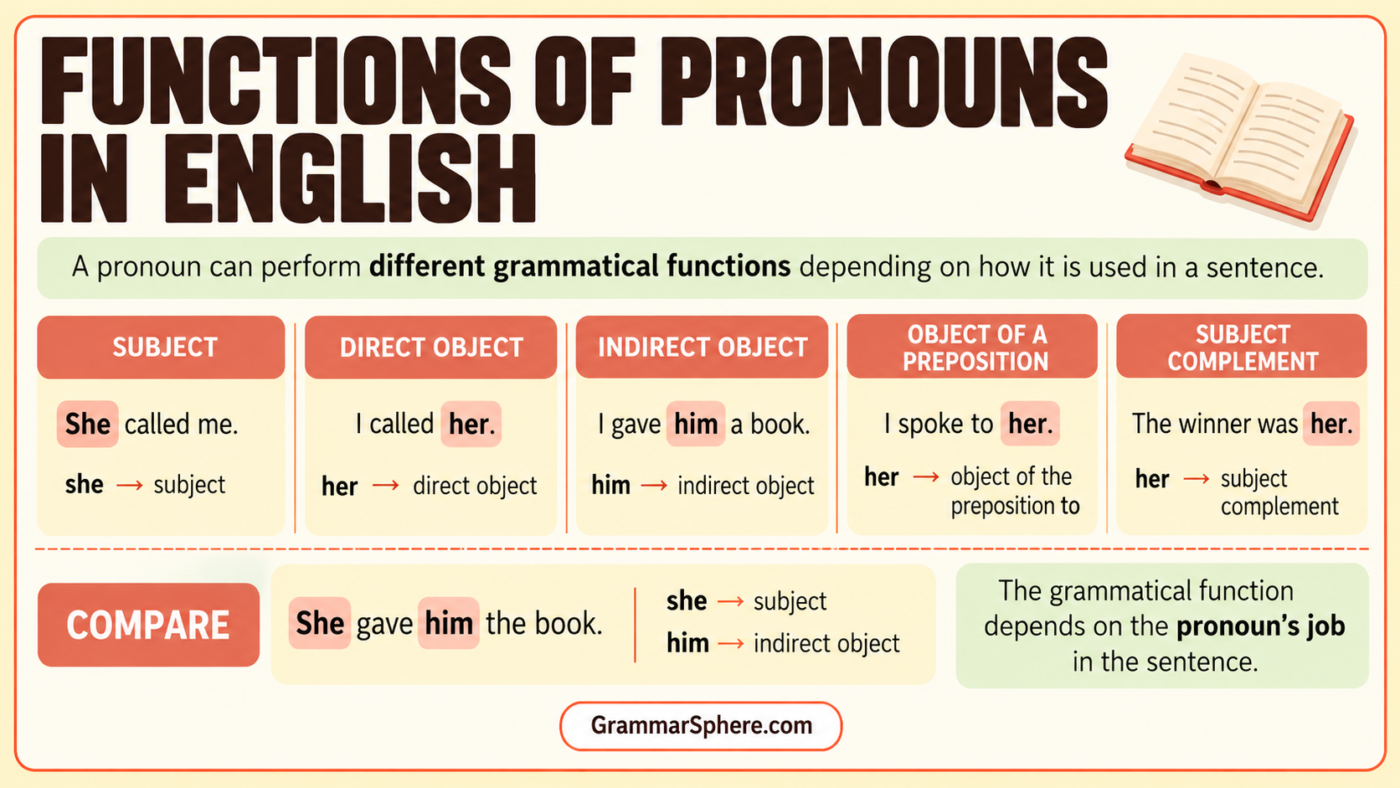
Pronouns help us talk about people, things, and ideas without repeating the same nouns again and again. A pronoun can do different jobs in a sentence. In She called me, for example, she is the subject and me is the direct object.
These different jobs are called the functions of pronouns in English. In this lesson, you will learn how pronouns act as subjects, direct objects, indirect objects, objects of prepositions, and subject complements. You will also see how different types of pronouns can have different jobs in sentences.
What Are the Functions of Pronouns?
The function of a pronoun is the grammatical job it performs in a sentence. A pronoun may act as a subject, an object, or a complement depending on how it is used.
Consider:
She gave him the book.
Here:
- she → subject
- him → indirect object
Now consider:
The teacher called her.
Here:
- her → direct object
The main grammatical functions of pronouns include:
- subject
- direct object
- indirect object
- object of a preposition
- subject complement
These functions describe what a pronoun is doing in the sentence.
For example:
- She called me. → she is the subject.
- I called her. → her is the direct object.
- I spoke to her. → her is the object of the preposition to.
- The winner was her. → her identifies the subject after be.
Different types of pronouns can do different jobs in a sentence. For example, personal pronouns can be subjects or objects, while possessive pronouns can be subjects, objects, or subject complements.
Some pronouns also have special uses. They may:
- express possession
- refer to the same person or thing as the subject
- add emphasis
- ask questions
- introduce relative clauses
- point to people or things
- express a shared action between people
These uses are explained separately in the lesson so that each function is clear before moving to the next one.
Pronoun Function and Pronoun Form
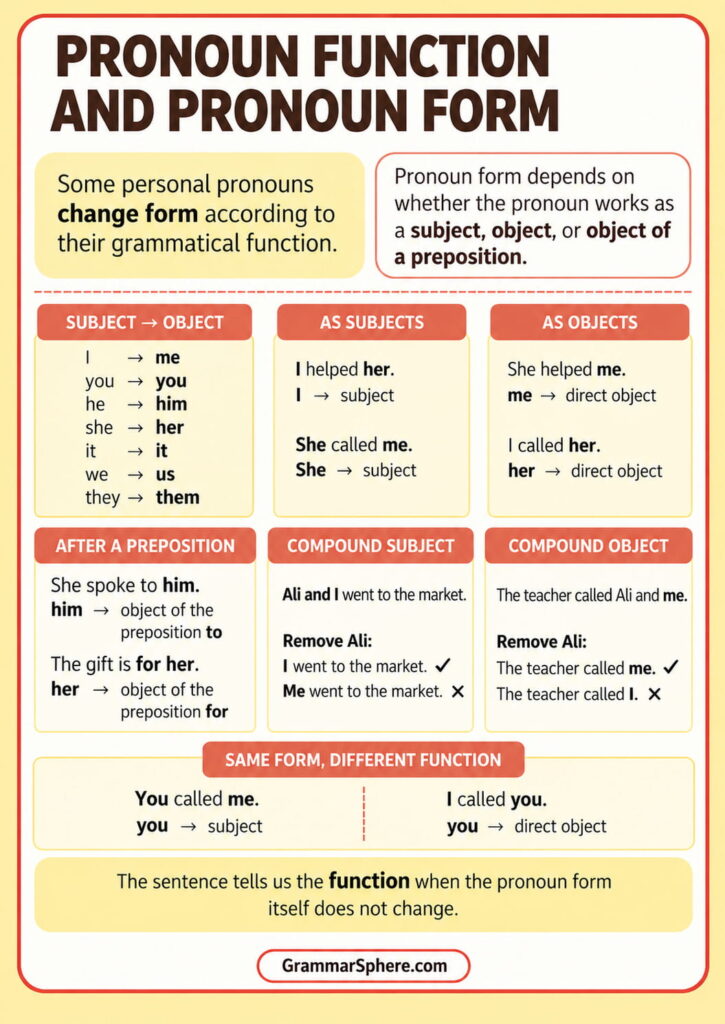
Some pronouns change form according to their grammatical function.
Subject forms:
- I
- you
- he
- she
- it
- we
- they
Object forms:
- me
- you
- him
- her
- it
- us
- them
Compare:
She helped me.
Here:
- she → subject
- me → direct object
Now compare:
I helped her.
Here:
- I → subject
- her → direct object
Some pronouns keep the same form in both positions:
- You called me.
- I called you.
- It surprised us.
- We noticed it.
The forms you and it do not change, so their function is identified from the sentence.
Pronouns as Subjects
A pronoun is the subject when it tells us who or what the sentence is about. The subject may do an action, experience something, or be described.
For example:
- She teaches English.
- They arrived early.
- We are tired.
- It looks expensive.
Here, she, they, we, and it are subjects.
In statements, the subject normally comes before the main verb:
- He works in Lahore.
- They study together.
In questions, an auxiliary verb may come before the subject:
- Is she ready?
- Have they arrived?
The word order changes, but she and they are still the subjects.
Pronouns as Direct Objects
A pronoun functions as a direct object when the action of the verb is directed toward that person or thing.
For example:
- Sara called him.
- The teacher praised us.
- I invited them.
- She opened it.
Here, him, us, them, and it are direct objects.
Personal pronouns normally take their object forms in this position.
Compare:
- She invited me. ✓
- She invited I. ✗
Because the pronoun is the direct object of invited, the correct form is me.
Pronouns as Indirect Objects
A pronoun functions as an indirect object when it identifies the person or group that receives something or benefits from an action.
Consider:
Sara gave me a book.
Here:
- a book → direct object
- me → indirect object
The book is the thing being given, while me identifies the person receiving it.
Other examples include:
- The teacher showed us the answer.
- She sent him a message.
- I bought her a gift.
Compare:
She sent him a message.
She sent a message to him.
In the first sentence, him is the indirect object.
In the second, him follows the preposition to, so it is the object of a preposition.
The meaning is similar, but the grammatical function is different.
Pronouns as Objects of Prepositions
A pronoun can function as the object of a preposition.
Personal pronouns normally take object forms after prepositions.
For example:
- She spoke to me.
- This gift is for her.
- They sat beside us.
- I went with them.
- The secret is between you and me.
Compare:
- between you and me ✓
- between you and I ✗
Because me follows the preposition between, the object form is required.
Some grammar books call the word after a preposition the complement of the preposition.
Pronouns as Subject Complements
A pronoun can appear after be and identify the subject. In this position, it functions as a subject complement.
Everyday English normally uses object forms:
- It’s me.
- That’s him.
- That was her.
- The winners were them.
More formal English can sometimes use subject forms:
- It is I.
- The person responsible was she.
For learners, the main point is that forms such as It’s me and That’s him are normal in modern everyday English. Forms such as It is I are much more formal.
The Pronoun It as a Dummy Subject
Sometimes it is used as the subject even though it does not refer to a particular person or thing.
For example:
- It is raining.
- It is getting late.
- It is five o’clock.
- It is cold outside.
- It is ten kilometres from here.
Here, it is the grammatical subject, but it does not replace a noun.
The same structure appears when the main idea comes later:
- It is important to practise regularly.
- It was difficult to answer the question.
- It is nice to see you again.
This use is commonly called dummy it or introductory it.
Possessive Pronouns and Their Functions
Possessive pronouns express possession or belonging and stand without a noun after them.
The main possessive pronouns are:
- mine
- yours
- his
- hers
- ours
- theirs
They can perform different grammatical functions.
As a subject:
Mine is on the table.
Here, mine is the subject.
As a direct object:
I prefer yours.
Here, yours is the direct object.
As a subject complement:
This book is hers.
Here, hers is the subject complement.
Forms such as my, your, her, our, and their normally come before nouns:
- my book
- your car
- their house
These forms are commonly called possessive determiners.
Compare:
This is my book.
This book is mine.
My comes before the noun book, while mine stands on its own.
Reflexive Pronouns Used for Emphasis
Reflexive pronouns can also be used to add emphasis.
For example:
- The manager herself signed the letter.
- I completed the work myself.
- The students themselves decorated the room.
This is called the emphatic or intensive use of reflexive pronouns.
Compare:
Sara hurt herself.
Here, herself is the direct object and refers back to Sara.
Sara herself opened the door.
Here, herself adds emphasis to Sara.
If we remove it, the sentence is still complete:
Sara opened the door.
Relative Pronouns as Subjects and Objects
Relative pronouns introduce relative clauses and can also act as subjects or objects inside those clauses.
Common relative pronouns include who, whom, which, and that.
A relative pronoun can be the subject:
- The student who called me is absent.
- The book that fell is mine.
Here:
- who → subject of called
- that → subject of fell
A relative pronoun can also be an object:
The student whom I called was absent.
Here, whom is the object of called.
In everyday English, who is often used instead of whom:
The student who I called was absent.
Another example is:
The book that I bought was expensive.
Here, that is the object of bought.
The relative word whose expresses possession:
The student whose bag was missing spoke to the teacher.
So, a relative pronoun introduces a relative clause and also has a grammatical job inside that clause.
Interrogative Pronouns as Subjects and Objects
Interrogative pronouns are used to ask questions.
Common interrogative pronouns include:
- who
- whom
- what
- which
- whose
They can act as subjects:
- Who called you?
- What happened?
They can also act as objects:
- Whom did you call?
- Which do you prefer?
In everyday English, who is more common than whom:
Who did you call?
Whose asks about possession:
Whose is this?
The function of an interrogative pronoun depends on the job it has in the question.
Demonstrative Pronouns and Their Functions
The demonstrative pronouns this, that, these, and those point to particular people, things, or ideas.
When they stand on their own, they are pronouns.
As subjects:
- This is expensive.
- Those are mine.
- These look better.
As direct objects:
- I prefer that.
- She bought these.
- We need those.
The same words can also come before nouns:
- this book
- that idea
- these shoes
- those students
When they come before a noun, they are determiners, not pronouns.
Compare:
This is interesting.
→ this = pronoun
This book is interesting.
→ this = determiner
The word stays the same, but its grammatical job changes.
Indefinite Pronouns and Their Functions
Indefinite pronouns refer to people or things without saying exactly who or what they are.
Examples include:
- someone
- anyone
- everyone
- nobody
- something
- nothing
- each
- many
- few
- several
They can act as subjects:
- Someone is waiting outside.
- Nobody answered.
- Several were absent.
They can also act as objects:
- I saw nobody.
- She invited everyone.
- We need something.
An indefinite pronoun can also come after a preposition:
I spoke to everyone.
Here, everyone is the object of to.
The word is still an indefinite pronoun, but its grammatical function depends on how it is used in the sentence.
Reciprocal Pronouns and Their Functions
The reciprocal pronouns each other and one another express an action or relationship shared between people.
They often act as objects.
For example:
- Sara and Ayesha helped each other.
- The players congratulated one another.
They can also come after prepositions:
- The students spoke to one another.
- They looked at each other.
Reciprocal pronouns are different from reflexive pronouns.
Compare:
They looked at themselves.
→ each person looked at himself, herself, or themselves
They looked at each other.
→ each person looked at another person
The first sentence has reflexive meaning, while the second has reciprocal meaning.
Pronouns in Compound Subjects and Objects
Pronouns often appear with nouns or other pronouns in compound subjects and objects.
To choose the correct pronoun form, remove the other noun and check which form is correct on its own.
For example:
Ali and I went to the market.
Remove Ali and:
I went to the market. ✓
not:
Me went to the market. ✗
So:
Ali and I went to the market. ✓
Now consider a compound object:
The teacher called Ali and me.
Remove Ali and:
The teacher called me. ✓
not:
The teacher called I. ✗
The same rule applies after a preposition:
The teacher spoke to Sara and me.
Because me comes after the preposition to, the object form me is required.
Pronoun Type vs. Pronoun Function
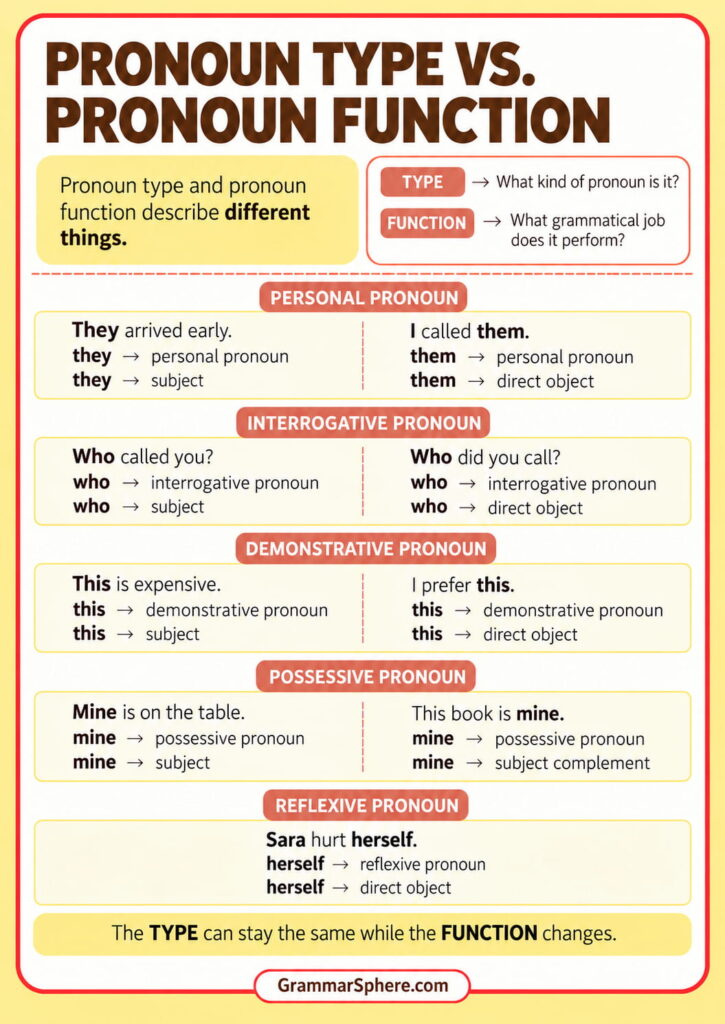
A pronoun type and a pronoun function tell us different things.
The type tells us what kind of pronoun it is, such as:
- personal pronoun
- possessive pronoun
- reflexive pronoun
- relative pronoun
- interrogative pronoun
- demonstrative pronoun
- indefinite pronoun
- reciprocal pronoun
The function tells us what job the pronoun has in a sentence.
Consider:
They arrived early.
Here, they is a personal pronoun and acts as the subject.
Now compare:
I called them.
Here, them is also a personal pronoun, but it acts as the direct object.
The same pronoun type can therefore have different functions.
For example:
Who called?
Here, who is an interrogative pronoun and acts as the subject.
Who did you call?
Here, who is still an interrogative pronoun, but it acts as the direct object.
The same idea applies to demonstrative pronouns:
This is expensive.
Here, this is a demonstrative pronoun and acts as the subject.
I prefer this.
Here, this is still a demonstrative pronoun, but it acts as the direct object.
So, the type tells us what kind of pronoun it is, while the function tells us what job it has in the sentence.
How to Identify the Function of a Pronoun
To identify a pronoun’s function, first find the pronoun and then check what job it has in the sentence.
A useful method is:
- Find the pronoun.
- Find the verb or preposition connected with it.
- Check whether the pronoun is the subject.
- If it comes after an action verb, check whether it is a direct or indirect object.
- If it comes after a preposition, it is usually the object of that preposition.
- If it comes after a linking verb such as be, check whether it identifies the subject.
- Check whether it expresses possession, reflexive meaning, emphasis, or another special use.
Consider:
She gave him the book.
Here:
- she → subject
- him → indirect object
Now consider:
The teacher spoke to her.
Here:
- her → object of the preposition to
And:
This bag is mine.
Here:
- mine → subject complement
The easiest way to identify a pronoun’s function is to ask: What job is this pronoun doing in this sentence?
Common Mistakes with Pronoun Functions
1. Using an Object Pronoun as the Subject
- Me went to the shop. ✗
- I went to the shop. ✓
The sentence needs a subject, so the subject form I is required.
2. Using a Subject Pronoun as the Object
- She called I. ✗
- She called me. ✓
The pronoun is the direct object, so the object form me is required.
3. Using the Wrong Pronoun After a Preposition
- The gift is for she. ✗
- The gift is for her. ✓
A personal pronoun after a preposition normally takes the object form.
4. Choosing the Wrong Form in Compound Subjects and Objects
- Me and Ali are friends. ✗
- Ali and I are friends. ✓
Here, I is part of the subject.
Compare:
- The teacher called Ali and I. ✗
- The teacher called Ali and me. ✓
Here, me is part of the direct object.
5. Confusing Possessive Determiners and Possessive Pronouns
- This book is my. ✗
- This book is mine. ✓
A possessive determiner comes before a noun:
my book
A possessive pronoun stands on its own:
This book is mine.
6. Using a Reflexive Pronoun Instead of an Object Pronoun
- Please contact myself tomorrow. ✗
- Please contact me tomorrow. ✓
Use a reflexive pronoun when it refers back to the subject:
I introduced myself.
Use an ordinary object pronoun when there is no reflexive meaning:
Please contact me.
FAQs About the Functions of Pronouns
What are the main functions of pronouns?
Pronouns commonly act as subjects, direct objects, indirect objects, objects of prepositions, and subject complements.
Can the same pronoun have different functions?
Yes. A pronoun’s function depends on how it is used in the sentence.
You called me.
Here, you is the subject.
I called you.
Here, you is the direct object.
Do all types of pronouns have the same function?
No. Different types of pronouns can have different functions. For example, personal pronouns often act as subjects or objects, while possessive pronouns can act as subjects, objects, or subject complements.
How can I tell what function a pronoun has?
Look at the pronoun’s position and its connection with the verb or preposition. Ask whether it is the subject, an object, the object of a preposition, or a complement.
You May Also Like
Leave a Comment