

Table of Contents
Pronouns allow us to refer to people, things, and ideas without repeating the same nouns again and again. However, choosing the correct pronoun involves more than simply replacing a noun. The pronoun needs the right form, must fit its grammatical job, and should refer clearly to the intended person, thing, or idea.
These choices are part of pronoun usage in English. In this lesson, you will learn how to choose subject and object pronouns, express possession, use reflexive and reciprocal pronouns, maintain agreement and clear reference, and avoid common pronoun errors.
What Does Pronoun Usage Mean?
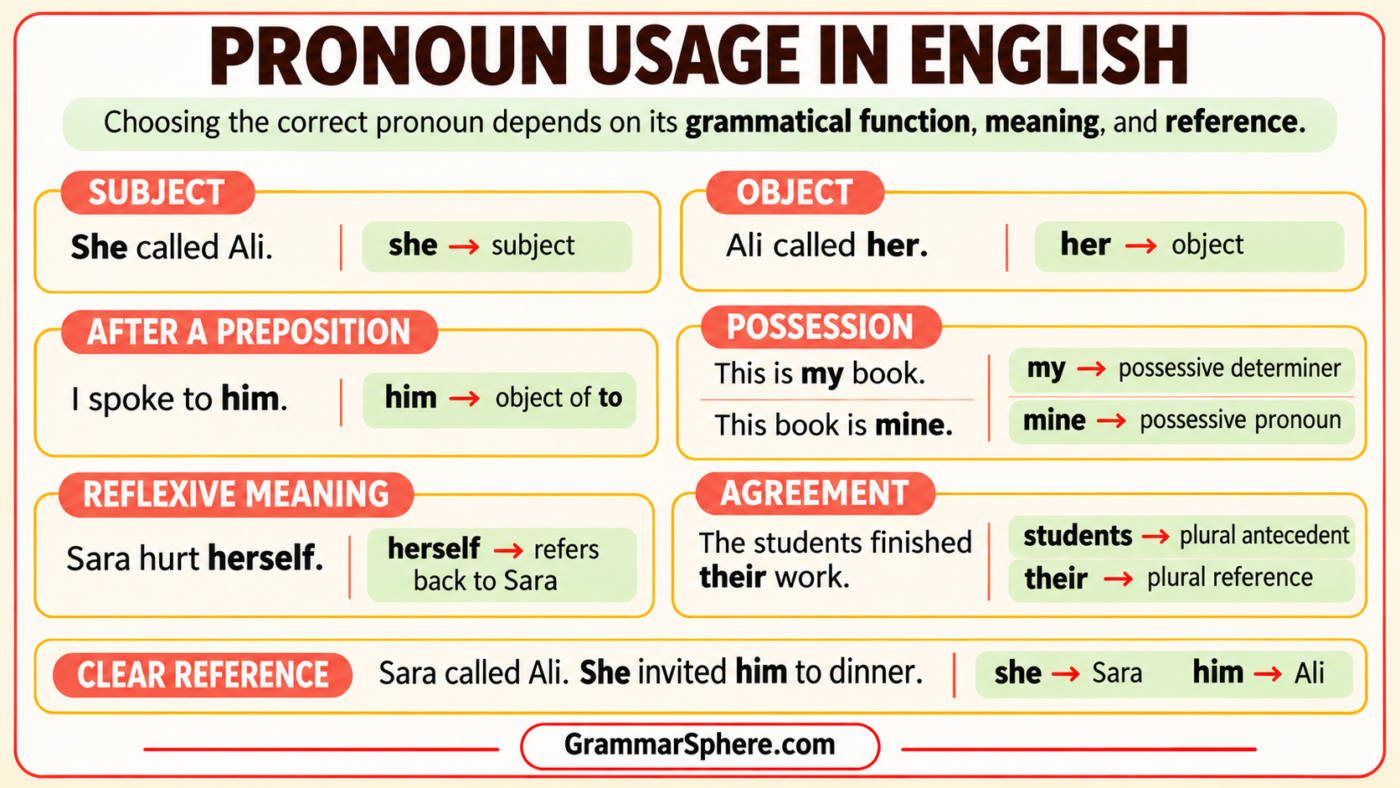
Pronoun usage refers to the way pronouns are chosen and used correctly in sentences.
Consider:
Sara called Ali. She invited him to dinner.
Here:
- she refers to Sara and is the subject of invited
- him refers to Ali and is the object of invited
The pronouns have different forms because they perform different grammatical jobs.
Correct pronoun usage depends on several things:
- the pronoun’s grammatical function
- who or what the pronoun refers to
- whether the reference is singular or plural
- whether possession, reflexive meaning, or another relationship is intended
- whether the reference remains clear and consistent
Subject Pronouns in Subject Position
A subject pronoun appears as the subject of a clause.
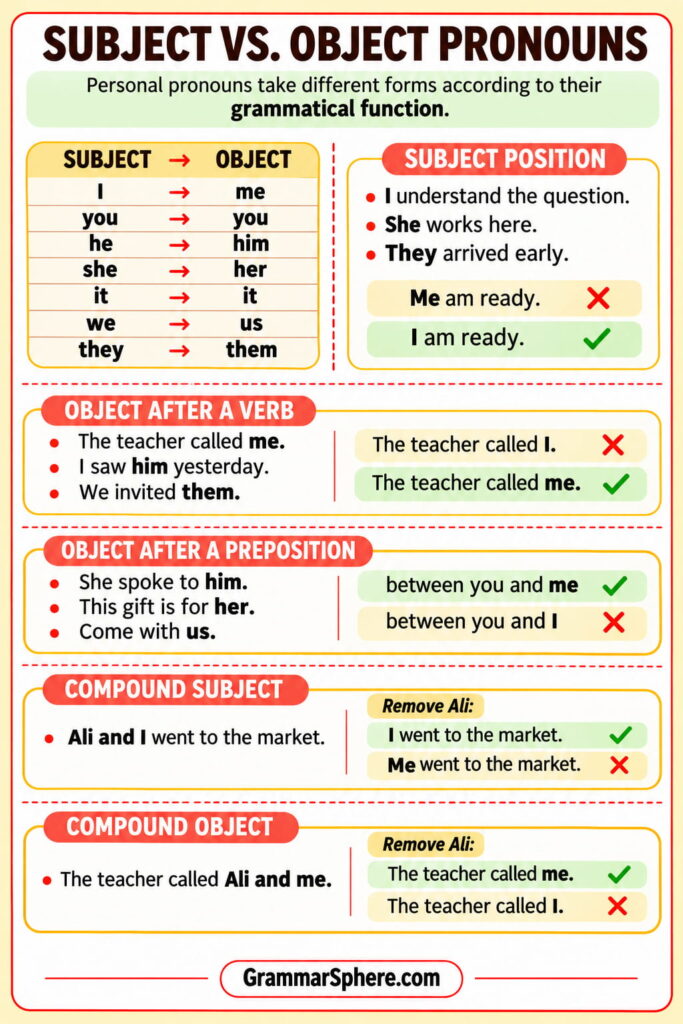
The subject pronouns are:
- I
- you
- he
- she
- it
- we
- they
For example:
- I understand the question.
- She works at a school.
- They arrived early.
- We are ready.
Do not normally place an object pronoun in subject position.
Me am ready. ✗
I am ready. ✓
Her works here. ✗
She works here. ✓
The subject form is required because the pronoun occupies the subject position in the sentence.
Object Pronouns After Verbs
An object pronoun appears as the object of a verb.
The object pronouns are:
- me
- you
- him
- her
- it
- us
- them
For example:
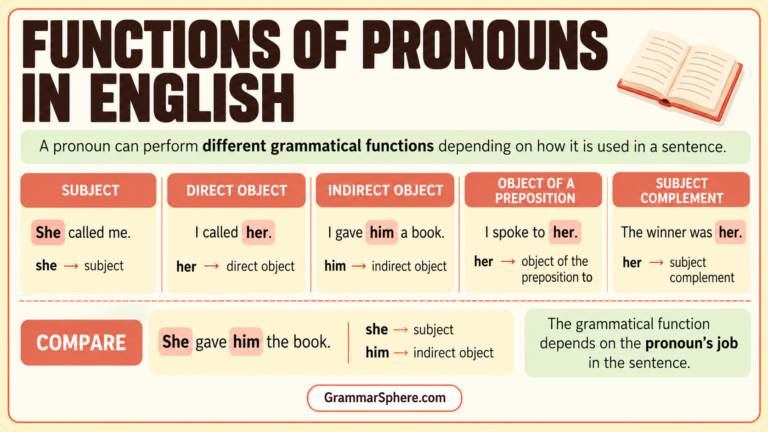
- Sara called me.
- I saw him yesterday.
- The teacher helped us.
- We invited them.
Compare:
She called me.
Here:
- she → subject
- me → object
A common mistake is to place a subject form where the sentence requires an object form.
The teacher called I. ✗
The teacher called me. ✓
Object Pronouns After Prepositions
Personal pronouns normally take their object forms after prepositions such as to, for, with, from, about, between, and without.
For example:
- She spoke to him.
- This gift is for her.
- Come with us.
- They were talking about them.
- The secret is between you and me.
Because me follows the preposition between, the object form is required:
between you and me ✓
not:
between you and I ✗
Pronouns in Compound Subjects and Objects
Pronouns often appear with a noun or another pronoun in a compound subject or object.
In a compound subject, choose the subject form:
Ali and I went to the market.
A simple way to check the form is to remove the other name:
I went to the market. ✓
not:
Me went to the market. ✗
In a compound object, choose the object form:
The teacher called Ali and me.
Remove Ali and:
The teacher called me. ✓
not:
The teacher called I. ✗
The same principle applies after a preposition:
The teacher spoke to Sara and me.
Because me is part of the object of to, the object form is correct.
Possessive Determiners and Possessive Pronouns
English has two related sets of possessive forms.
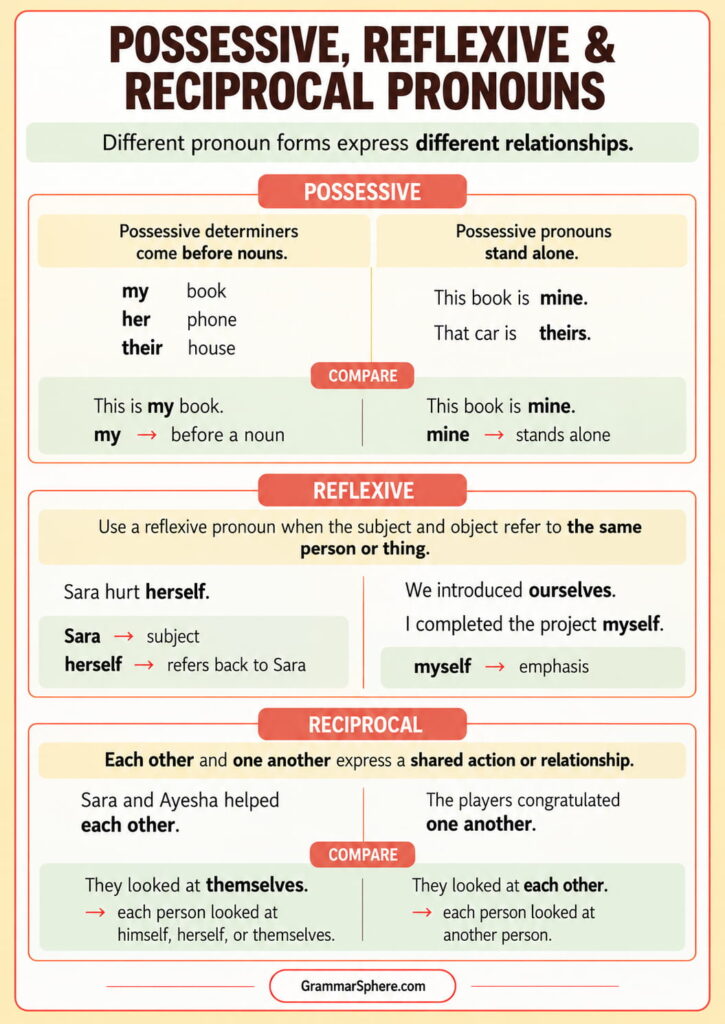
Forms such as my, your, his, her, its, our, and their come before nouns:
- my book
- her phone
- its tail
- their house
These forms are called possessive determiners. They are also often called possessive adjectives in school grammar.
Possessive pronouns stand without a noun after them:
- mine
- yours
- his
- hers
- ours
- theirs
Compare:
This is my book.
This book is mine.
And:
That is their car.
That car is theirs.
Do not use a possessive determiner by itself when a possessive pronoun is needed.
This book is my. ✗
This book is mine. ✓
There is no independent possessive pronoun its corresponding to mine or hers.
Also distinguish its from it’s:
The dog wagged its tail.
→ its expresses possession
It’s raining.
→ it’s means it is
Reflexive Pronouns: When the Subject and Object Are the Same
Reflexive pronouns include:
- myself
- yourself
- himself
- herself
- itself
- ourselves
- yourselves
- themselves
A reflexive pronoun refers back to the subject when the subject and object are the same person or thing.
For example:
- Sara hurt herself.
- He blamed himself.
- We introduced ourselves.
In each sentence, the reflexive pronoun refers to the same person or people as the subject.
Reflexive pronouns can also add emphasis:
I completed the project myself.
The manager herself answered the call.
Do not choose a reflexive pronoun simply because it sounds more formal.
Please contact myself tomorrow. ✗
Please contact me tomorrow. ✓
Here, me is the ordinary object of contact.
Reciprocal Pronouns: Each Other and One Another
Each other and one another express an action or relationship shared between people.
For example:
- Sara and Ayesha helped each other.
- The players congratulated one another.
- The students spoke to each other.
These forms are called reciprocal pronouns.
They express a different relationship from reflexive pronouns.
Compare:
They looked at themselves.
This means each person looked at himself, herself, or themselves.
They looked at each other.
This means each person looked at another person.
Traditional grammar sometimes uses each other for two people and one another for more than two. In modern English, however, both are commonly used for two or more people.
“It Is I” or “It’s Me”? Pronouns After Be
Pronouns after forms of be can cause confusion.
Traditional formal grammar may place a subject form after be:
It is I.
The winner was she.
In everyday modern English, object forms are much more natural:
It’s me.
The winner was her.
Expressions such as It’s me, That’s him, and It was them are normal in everyday English. Subject forms in this position are mainly associated with very formal usage.
Using It for Weather, Time, Temperature, and Distance
The pronoun it does not always refer to a particular noun.
English commonly places it in subject position when talking about weather, time, temperature, and distance.
For example:
- It is raining.
- It is cold today.
- It is five o’clock.
- It is ten kilometres from here.
In these sentences, it does not replace a particular noun.
This use is sometimes called dummy it, but the main point for learners is that English requires it as the grammatical subject in these expressions.
Pronoun–Antecedent Agreement
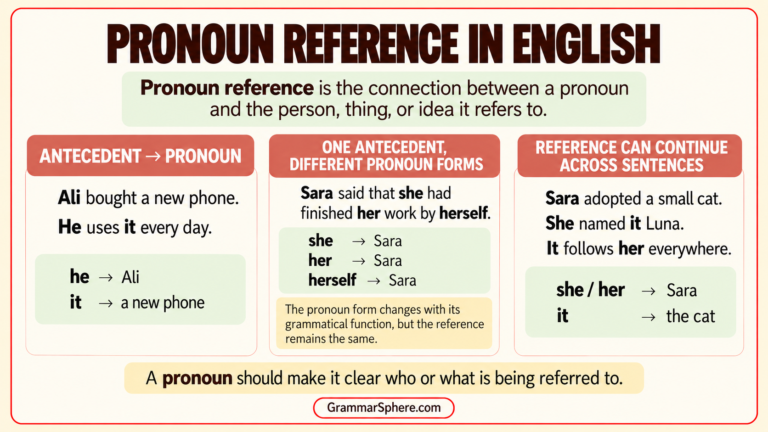
When a pronoun refers to a noun or noun phrase, that noun or noun phrase is called its antecedent.
For example:
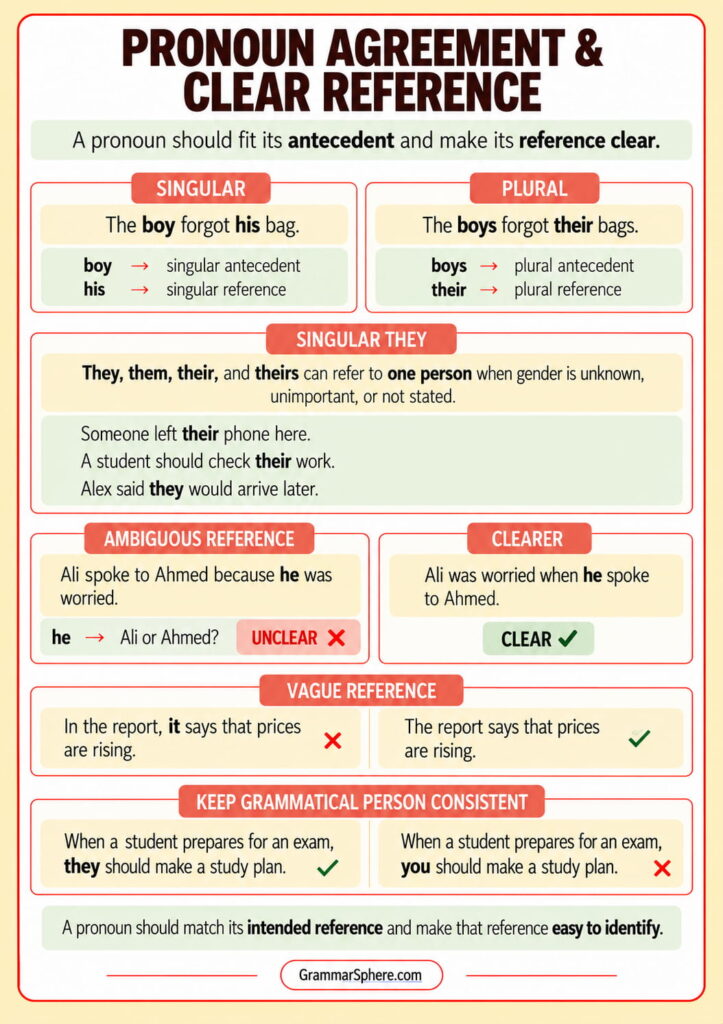
The boy forgot his bag.
Here, the boy is the antecedent of his.
A pronoun should agree appropriately with its antecedent.
Compare:
The boy forgot his bag.
The boys forgot their bags.
The first antecedent is singular, while the second is plural.
Agreement also involves grammatical person:
- I finished my work.
- You finished your work.
- They finished their work.
Pronoun agreement and pronoun reference are closely related, but they describe different things. Agreement concerns whether the pronoun has an appropriate form for its antecedent, while reference tells us who or what the pronoun refers to.
Singular They
They, them, their, and theirs can refer to one person as well as more than one person.
For example:
Someone left their phone here.
If a student has a question, they should ask the teacher.
Here, singular they refers to one person whose gender is unknown, unimportant, or not stated.
Compare:
Every applicant should bring his or her passport.
Every applicant should bring their passport.
Both forms are possible, but singular they is common and natural in modern English.
Singular they can also refer to a particular person who uses they/them pronouns:
Alex said they would arrive later.
Clear Pronoun Reference
A pronoun should make it easy for the reader or listener to understand who or what it refers to.
Consider:
Ali spoke to Ahmed because he was worried.
The pronoun he could refer to either Ali or Ahmed, so the reference is ambiguous.
A clearer version is:
Ali was worried when he spoke to Ahmed.
A pronoun can also have a vague reference:
In the report, it says that prices are rising. ✗
Here, it has no clear antecedent.
A clearer version is:
The report says that prices are rising. ✓
The pronouns this, that, these, and those also need clear reference.
For example:
The company changed its policy. This caused confusion.
The meaning is understandable, but adding a noun makes the reference more precise:
The company changed its policy. This change caused confusion.
Similarly:
- This is mine.
- That looks expensive.
- These are ready.
- I prefer those.
Use this and that for singular reference and these and those for plural reference.
Repeating a noun or adding a clear noun after this or that is often better than leaving the reader to guess what the pronoun refers to.
Who and Whom
Who normally appears as a subject.
Who called you?
Here, who is the subject of called.
Whom traditionally appears as an object.
Whom did you call?
Here, whom is the object of call.
After a preposition, whom is common in formal English:
To whom did you speak?
In everyday English, who is much more common:
Who did you speak to?
For most learners, the practical distinction is:
- who → normally subject
- whom → object form, mainly in formal English
Keeping Grammatical Person Consistent
Pronoun usage can become confusing when a sentence switches unnecessarily from one grammatical person to another.
Consider:
When a student prepares for an exam, you should make a study plan. ✗
The sentence begins with a student but then switches to you.
A consistent version is:
When a student prepares for an exam, they should make a study plan.
Another possible version is:
When you prepare for an exam, you should make a study plan.
A similar problem occurs when a sentence switches between you and one:
If you want to improve, one should practise regularly. ✗
A clearer version is:
If you want to improve, you should practise regularly.
Pronouns should change only when the grammatical person or intended reference genuinely changes.
Common Mistakes with Pronoun Usage
1. Using an Object Pronoun as the Subject
Me and Ahmed went home. ✗
Ahmed and I went home. ✓
2. Using a Subject Pronoun as the Object
The teacher called she. ✗
The teacher called her. ✓
3. Choosing the Wrong Form After a Preposition
This is between you and I. ✗
This is between you and me. ✓
4. Confusing Possessive Forms
This bag is her. ✗
This bag is hers. ✓
5. Misusing a Reflexive Pronoun
Please send the email to myself. ✗
Please send the email to me. ✓
6. Confusing Reflexive and Reciprocal Meaning
Sara and Ayesha helped themselves.
This means each person helped herself.
If they helped one another, write:
Sara and Ayesha helped each other.
7. Using an Ambiguous Pronoun
Sara spoke to Ayesha while she was driving.
The pronoun she could refer to either person.
A clearer sentence is:
Sara was driving when she spoke to Ayesha.
8. Switching Grammatical Person Unnecessarily
If one wants to improve, you should practise. ✗
If you want to improve, you should practise. ✓
Pronoun Usage Exercises with Answers
A. Choose the Correct Pronoun
- I / Me called the teacher.
- The teacher helped we / us.
- This gift is for she / her.
- Ahmed and I / me went outside.
- The teacher spoke to Sara and I / me.
B. Complete the Sentences
- This book belongs to me. It is _____.
- Sara hurt _____ while cooking.
- Everyone should bring _____ notebook.
- The students finished _____ work.
- Ali and Ahmed helped _____ with the project.
C. Correct the Pronoun Error
- Me and Ali are classmates.
- Please contact myself tomorrow.
- This secret is between you and I.
- If one wants to learn English, you should practise daily.
- The students forgot its books.
Answers
- I
- us
- her
- I
- me
- mine
- herself
- their
- their
- each other
- Ali and I are classmates.
- Please contact me tomorrow.
- This secret is between you and me.
- If you want to learn English, you should practise daily.
- The students forgot their books.
FAQs About Pronoun Usage
How do I know whether to use I or me?
Use I when the pronoun is the subject and me when it is an object.
I called Sara.
Sara called me.
The same distinction helps with expressions such as Ali and I and Ali and me.
Is “between you and I” correct?
No. After the preposition between, use the object form me:
between you and me
When should I use myself instead of me?
Use myself when it refers back to the subject I or when it adds emphasis.
I hurt myself.
I completed the work myself.
Use me as an ordinary object:
Please call me.
Can their refer to one person?
Yes. Singular their is common in modern English when the person’s gender is unknown, unimportant, or not stated.
Someone left their phone here.
Should I say “than me” or “than I”?
Both forms occur, but the structures are slightly different.
She is taller than me is common and natural in everyday English.
She is taller than I am is also correct and makes the full comparison clear.
For most everyday situations, than me is natural and correct.
You May Also Like
Leave a Comment