


Table of Contents
The Future Perfect Tense is used to describe actions that will be completed by a specific point in the future. Many learners find it difficult to use will have + past participle correctly and distinguish this tense from other future tenses.
In this lesson, you will learn the rules, structure, uses, and examples of the Future Perfect Tense and how to use it correctly in English.
What Is the Future Perfect Tense?
The Future Perfect Tense describes an action that will be completed before a specific time or event in the future. It emphasizes that the action will already be finished by that future point.
For example:
By next year, he will have completed his degree.
She will have finished the report by Friday.
They will have arrived before the meeting starts.
Structure of the Future Perfect Tense
The Future Perfect Tense is formed using:
Subject + will have + past participle (V3) + rest of sentence
Affirmative Sentences
Structure: Subject + will have + past participle (V3) + rest of sentence
- Aisha will have completed her assignment by tomorrow.
- They will have finished their work before the deadline.
Negative Sentences
Structure: Subject + will not have + past participle (V3) + rest of sentence
- Aisha will not have completed her assignment by tomorrow.
- They will not have finished their work before the deadline.
The contraction won’t can also be used:
- Aisha won’t have completed her assignment by tomorrow.
Interrogative Sentences
Structure: Will + subject + have + past participle (V3) + rest of sentence?
- Will Aisha have completed her assignment by tomorrow?
- Will they have finished their work before the deadline?
Wh-Questions
Structure: Wh-word + will + subject + have + past participle (V3) + rest of sentence?
- When will Aisha have completed her assignment?
- Why will they have finished their work so early?
Subject Agreement
The structure will have remains the same with all subjects:
- I will have finished
- She will have finished
- They will have finished
The helping verb will does not change according to the subject.

Time Expressions in the Future Perfect Tense
Time expressions are commonly used with the Future Perfect Tense to show the future point or event by which an action will be completed.
By — Future Deadline
Use by to show the latest time by which an action will be completed.
- I will have finished my homework by 6 p.m.
- She will have completed the project by Friday.
By the Time — Future Event
Use by the time to introduce a future event before which another action will be completed.
- By the time you arrive, I will have finished dinner.
- By the time the meeting starts, they will have prepared the report.
Before — Earlier Than a Future Time or Event
Use before when an action will be completed earlier than another future time or event.
- She will have left before you arrive.
- We will have finished the work before the deadline.
By Then / By the End of
These expressions can also identify a future completion point.
- The course ends in June. By then, she will have completed all the lessons.
- By the end of the year, they will have saved enough money.
Uses of the Future Perfect Tense
1. Actions Completed Before a Specific Future Time
Use the Future Perfect to describe an action that will be completed before a particular time or event in the future.
- By next year, Bilal will have graduated from university.
- She will have written the report before the deadline.
2. Assumptions About Completed Actions
The Future Perfect can also be used to make an assumption or deduction that something has probably already happened.
- They will have left the office by now.
- Ahmed will have reached home by now.
FuFuture Perfect vs. Past Perfect Tense
The Future Perfect describes an action completed before a future point, while the Past Perfect describes an action completed before another past point or action.
| Feature | Future Perfect | Past Perfect |
|---|---|---|
| Structure | will have + past participle | had + past participle |
| Time Reference | Before a future point | Before a past point |
| Example | By next year, I will have graduated. | By the time she arrived, he had left. |
In short:
Future Perfect → completed before a future point
Past Perfect → completed before a past point
| Feature | Future Perfect Tense | Past Perfect Tense |
|---|---|---|
| Definition | Describes an action that will be completed before a specific future time. | Describes an action that was completed before another past action. |
| Structure | Subject + will have + past participle | Subject + had + past participle |
| Example Sentences | By next year, I will have graduated from college. | By the time she arrived, he had left. |
| Usage | Used to indicate an action completed before a future event. | Used to indicate an action completed before a past event. |
| Time Indicators | By tomorrow, by next year, by then, before 2025 | Before, already, by the time, until then |
Future Perfect vs. Future Perfect Continuous
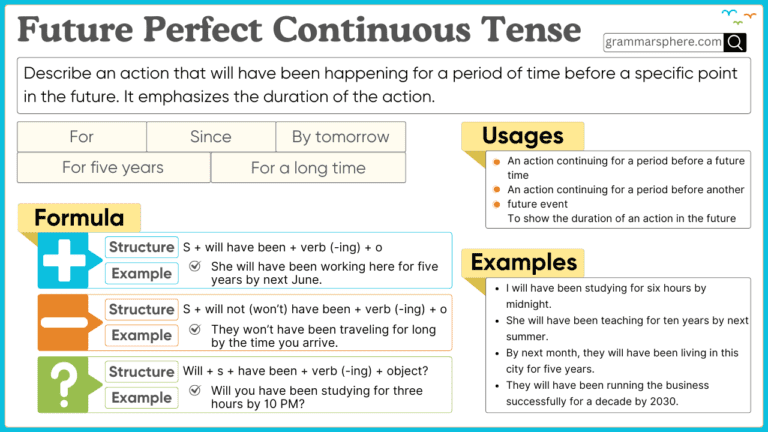
The Future Perfect focuses on an action that will be completed by a future point, while the Future Perfect Continuous focuses on how long an action will have been continuing up to that point.
| Feature | Future Perfect | Future Perfect Continuous |
|---|---|---|
| Focus | Completion or result | Duration or continuity |
| Structure | will have + past participle (V3) | will have been + verb-ing |
| Example | She will have written the report by 6 p.m. | She will have been writing for three hours by 6 p.m. |
In short:
Future Perfect → completion/result
Future Perfect Continuous → duration/continuity
Examples of the Future Perfect Tense in Use
Affirmative:
- I will have visited Mecca by next year.
- They will have completed the project before the deadline.
- She will have learned Arabic by the end of the course.
- We will have saved enough money for the trip.
- Ahmed will have finished his book by next month.
Negative:
- He will not have finished his assignment by then.
- We will not have left the house before 10 AM.
- They will not have completed the exam before the time is up.
- Fatima will not have arrived at the airport before noon.
- I will not have submitted my report by Friday.
Interrogative:
- Will she have prepared the dinner by 8 PM?
- Will they have built the bridge in six months?
- Will Ahmed have completed his degree by next year?
- Will we have reached home before sunset?
- Will the students have finished their test before the bell rings?
Common Mistakes with the Future Perfect Tense
1. Using the Wrong Verb Form
Use the past participle (V3) after will have.
❌ He will have finish his work by noon.
✅ He will have finished his work by noon.
2. Using the -ing Form Instead of the Past Participle
Do not use verb-ing after will have in the Future Perfect.
❌ They will have completing the task before the deadline.
✅ They will have completed the task before the deadline.
3. Using “Has” Instead of “Have”
Always use have after will, regardless of the subject.
❌ She will has finished the book by next week.
✅ She will have finished the book by next week.
4. Confusing the Future Perfect with the Simple Future
Use the Future Perfect when the action will be completed by a particular future point.
❌ By Friday, I will finish the report.
✅ By Friday, I will have finished the report.
5. Confusing the Future Perfect with the Future Perfect Continuous
Use the Future Perfect to emphasize completion or result and the Future Perfect Continuous to emphasize duration.
By 6 p.m., she will have been working for five hours. → duration
By 6 p.m., she will have completed the report. → completion
FAQs
1. What is the Future Perfect Tense?
The Future Perfect Tense describes an action that will be completed before a specific time or event in the future.
2. What is the formula of the Future Perfect Tense?
The basic formula is:
Subject + will have + past participle (V3)
Example: She will have finished the work by Friday.
3. When do we use the Future Perfect Tense?
We mainly use the Future Perfect to talk about actions that will be completed by or before a particular point in the future.
4. What are some examples of the Future Perfect Tense?
- I will have completed the course by June.
- She will have arrived by 8 p.m.
- They will have finished the project by Friday.
5. What is the difference between Future Perfect and Future Perfect Continuous?
The Future Perfect emphasizes completion or result, while the Future Perfect Continuous emphasizes duration or continuity.
- Future Perfect: She will have written the report.
- Future Perfect Continuous: She will have been writing for three hours.
Read More
Leave a Comment