

Table of Contents
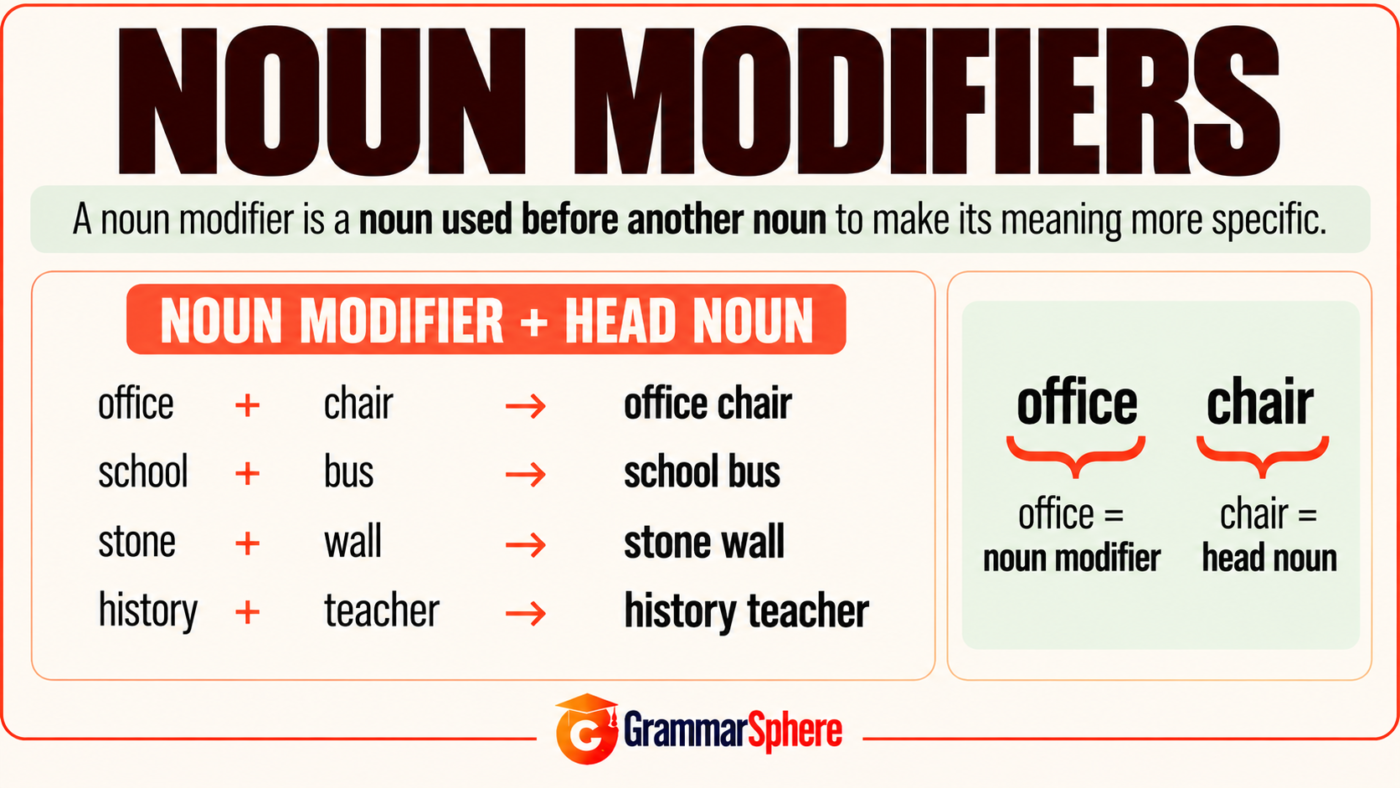
Noun modifiers are nouns used before other nouns to give more information about them. They help identify or classify a person, thing, place, or idea.
office chair
school bus
stone wall
history teacher
In office chair, office is the noun modifier and chair is the main noun, or head noun.
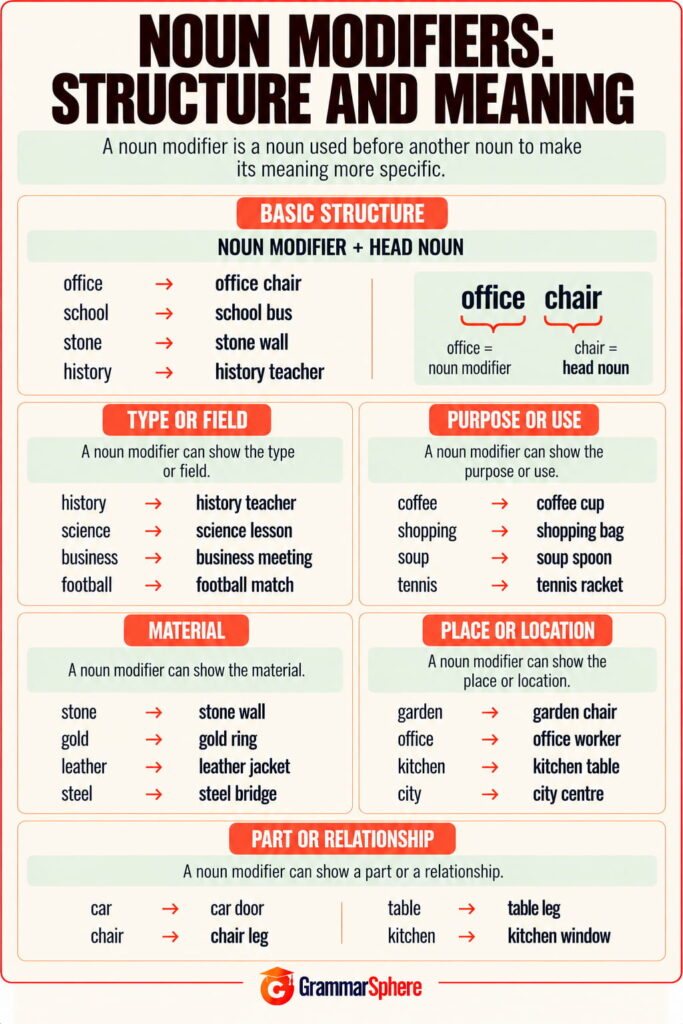
Noun modifiers are very common in English and can express relationships such as type, purpose, material, place, and part.
What Is a Noun Modifier?
A noun modifier is a noun that modifies another noun. It usually comes before the head noun and makes its meaning more specific.
Consider:
coffee cup
- coffee = noun modifier
- cup = head noun
The basic pattern is:
noun modifier + head noun
For example:
- office chair
- car door
- school bus
- computer screen
- garden chair
- history teacher
- football match
- kitchen table
- stone wall
- coffee cup
Noun modifiers are sometimes described as nouns used like adjectives because they appear before nouns and modify their meaning. However, the modifying word is still a noun.
Compare:
a chair → an office chair
a teacher → a history teacher
a wall → a stone wall
The noun modifier makes the meaning of the head noun more specific.
Types of Noun Modifiers
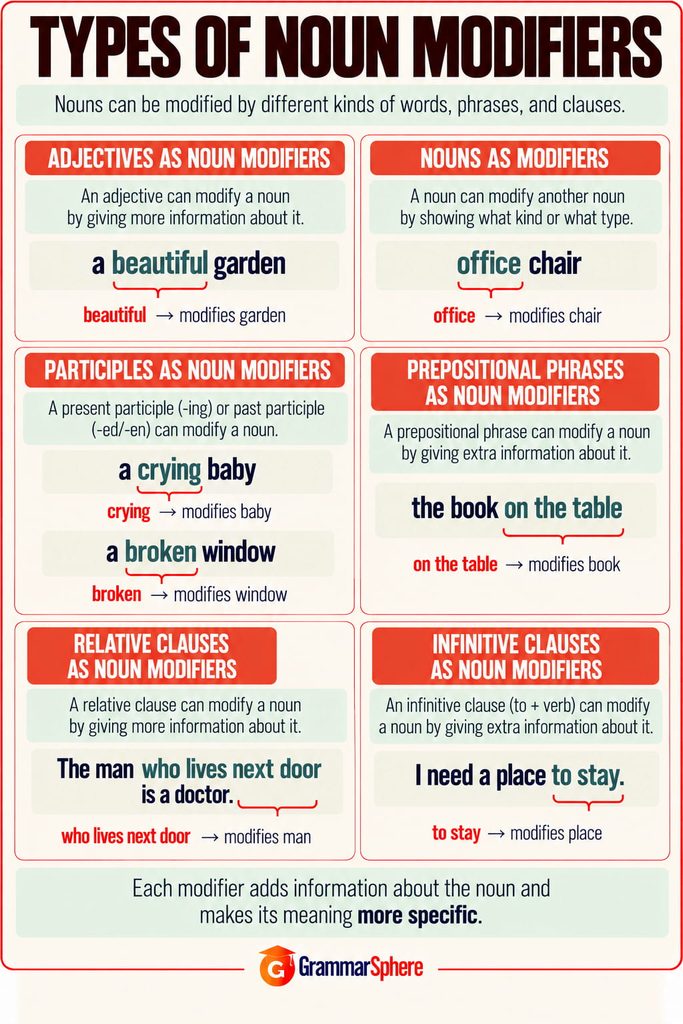
Nouns can be modified by different kinds of words, phrases, and clauses. These modifiers add information about the noun and make its meaning more specific.
1. Adjectives as Noun Modifiers
Adjectives modify nouns by describing their qualities, characteristics, or other features. They usually come before the noun.
- a beautiful garden
- an old house
- a difficult question
In a beautiful garden, beautiful modifies the noun garden.
2. Nouns as Modifiers
A noun can modify another noun to classify or specify its meaning.
- office chair
- school bus
- stone wall
- history teacher
In office chair, office modifies chair, which is the head noun.
Nouns used as modifiers can express relationships such as type, purpose, material, place, or association.
3. Participles as Noun Modifiers
Present and past participles can modify nouns.
Present participles (-ing forms):
- a crying baby
- boiling water
- a sleeping child
Past participles (-ed or other past-participle forms):
- a broken window
- boiled eggs
- a written report
Participles can occur before a noun or as part of a longer participial phrase after the noun.
4. Prepositional Phrases as Noun Modifiers
A prepositional phrase can modify a noun by providing additional information about it. It normally comes after the noun.
- the book on the table
- the girl in the red dress
- the students from our school
In the book on the table, on the table modifies the noun book.
5. Relative Clauses as Noun Modifiers
A relative clause can modify a noun by giving additional information about a person, thing, place, or idea.
- The man who lives next door is a doctor.
- The book that I bought yesterday is interesting.
- The students who passed the exam were happy.
In the first sentence, who lives next door modifies the noun man.
6. Infinitive Clauses as Noun Modifiers
An infinitive clause can come after a noun and provide more information about it. It commonly begins with to + base verb.
- I need a place to stay.
- She has a lot of work to finish.
- He was the first person to arrive.
- We need something to eat.
In a place to stay, to stay modifies the noun place by specifying what kind of place is meant.
Premodifiers and Postmodifiers
Noun modifiers can also be classified according to their position in relation to the noun.
Premodifiers come before the head noun:
- a beautiful house
- a stone wall
- a broken window
Postmodifiers come after the head noun:
- the book on the table
- the man who lives next door
- a place to stay
In simple terms:
Premodifier + Head Noun
a beautiful house
Head Noun + Postmodifier
the book on the table
Some modifiers can appear in different positions depending on their form and structure. For a detailed explanation, see our complete lesson on Premodifiers and Postmodifiers.
Noun Modifiers with Adjectives and Other Nouns
Noun modifiers can appear with adjectives and other nouns before the head noun.
Noun Modifiers with Adjectives
An adjective can come before a noun modifier to give additional information about the head noun.
- a new office chair
- a beautiful stone house
- an expensive leather jacket
In a new office chair:
- new = adjective
- office = noun modifier
- chair = head noun
The adjective normally comes before the noun modifier:
a beautiful stone house ✓
a stone beautiful house ✗
Multiple Noun Modifiers
More than one noun can appear before the head noun.
- school bus driver
- computer science teacher
- football team manager
- home office chair
In school bus driver, driver is the head noun, while the nouns before it help specify what kind of driver is meant.
Long strings of nouns can sometimes be difficult to understand. In formal writing, they may need to be rewritten with prepositions or other structures to make the relationship clearer.
Singular and Plural Noun Modifiers
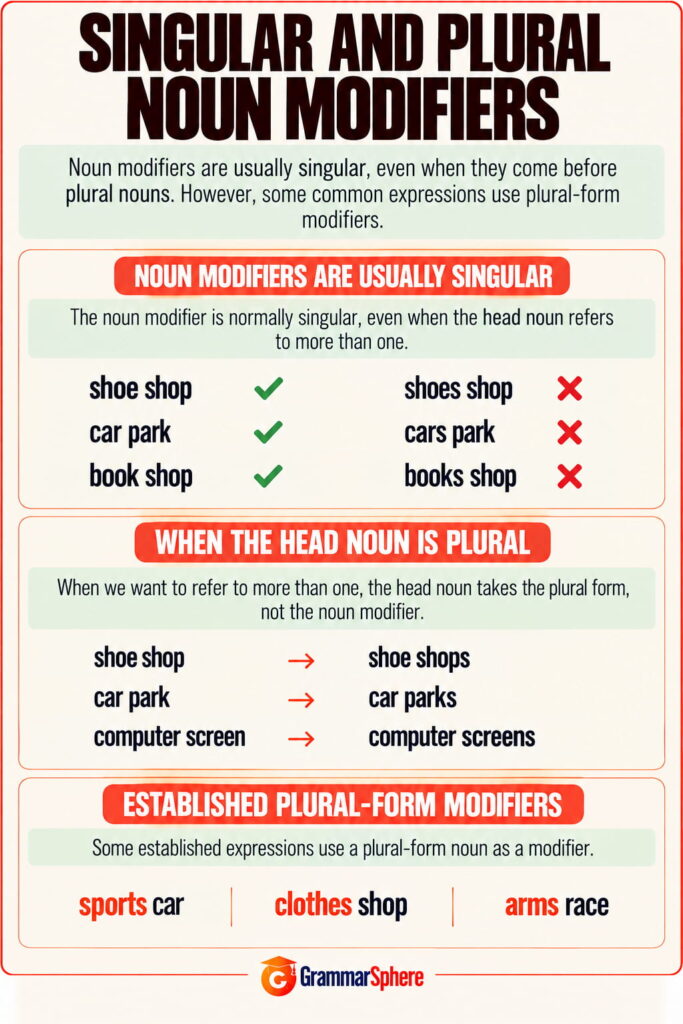
A noun used as a modifier is usually singular, even when its meaning involves more than one person or thing.
shoe shop ✓
shoes shop ✗
car park ✓
cars park ✗
book shop ✓
books shop ✗
For example, a shoe shop may contain hundreds of shoes, but shoe normally remains singular because it functions as a noun modifier.
When the head noun becomes plural, the modifier normally remains singular:
shoe shop → shoe shops
car park → car parks
computer screen → computer screens
However, this is a strong general tendency rather than an absolute rule. Some established expressions contain plural-form modifiers:
- sports car
- clothes shop
- arms race
These forms are best learned as established expressions
Compound Noun Modifiers
Sometimes, more than one word works together to modify a noun. These words form a compound modifier and together describe or classify the noun that follows.
Examples:
- a high-speed train
- a well-known author
- a part-time job
- a last-minute decision
When a compound modifier comes before a noun, its words are often joined with a hyphen, especially when the hyphen helps show that the words work together as one modifier.
Compare:
- a well-known author
- the author is well known
Not all compound modifiers require hyphens. Hyphenation depends on the structure and position of the expression.
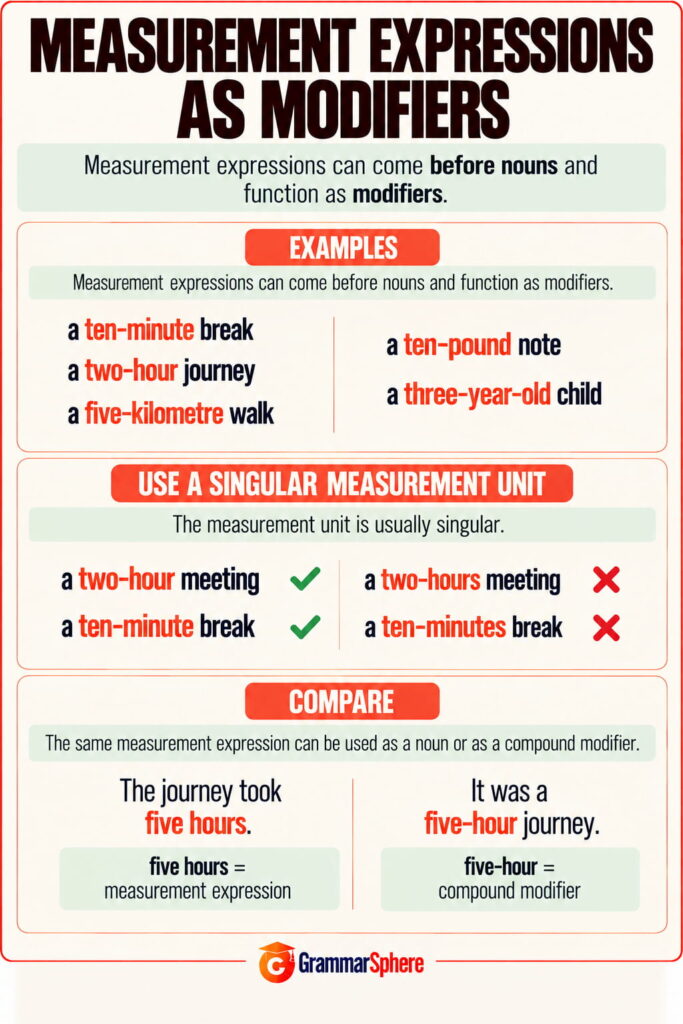
Measurement Expressions as Modifiers
Expressions of time, distance, age, value, and other measurements can modify nouns.
For example:
- a ten-minute break
- a two-hour journey
- a five-kilometre walk
- a ten-pound note
- a three-year-old child
When a number and a unit of measurement form a compound modifier before a noun, the unit is normally singular:
a two-hour meeting ✓
a two-hours meeting ✗
a ten-minute break ✓
a ten-minutes break ✗
These compound modifiers are normally hyphenated when they come before the noun.
Compare:
The journey took five hours.
It was a five-hour journey.
In the first sentence, five hours is an ordinary measurement expression. In the second, five-hour functions as a compound modifier before journey.
Noun Modifiers vs. Open Compound Nouns
Noun modifiers and open compound nouns can look very similar because both are often made up of two nouns written as separate words. The main difference is how the words work together.
| Noun Modifier | Open Compound Noun |
|---|---|
| One noun gives more information about another noun. | Two separate words work together as the name of one thing or idea. |
| The second noun is the head noun. | The words together have an established meaning. |
| stone wall — stone tells us what the wall is made of. | post office — the two words together name a particular place. |
| office chair — office tells us the type or purpose of the chair. | ice cream — the two words together name a particular food. |
The difference is not always clear-cut. Some noun + noun combinations can be understood as both noun modification and compound nouns.
Noun Modifiers and Possessive Forms
A noun modifier and a possessive noun are different structures.
Compare:
car door
Here, car functions as a noun modifier.
John’s car
Here, John’s is a possessive form.
English can express relationships between nouns in several ways:
the car door
John’s car
the door of the house
These structures are not freely interchangeable. The appropriate form depends on the relationship being expressed and established English usage.
For example, we normally say:
car door ✓
kitchen window ✓
chair leg ✓
rather than automatically changing the first noun into a possessive form.
Common Mistakes with Noun Modifiers
Using a plural noun modifier unnecessarily
Incorrect:
a shoes shop ✗
Correct:
a shoe shop ✓
Noun modifiers are usually singular.
Making the head noun singular when it should be plural
Incorrect:
two shoe shop ✗
Correct:
two shoe shops ✓
It is normally the head noun that takes the plural ending.
Using a plural measurement unit before a noun
Incorrect:
a five-hours journey ✗
Correct:
a five-hour journey ✓
The measurement unit in this type of compound modifier is singular.
Forgetting hyphens in compound measurement modifiers
Less clear:
a ten minute break
Preferred:
a ten-minute break
The hyphens show that ten-minute functions together as a modifier of break.
Confusing noun modifiers with adjectives
In:
a leather jacket
leather is a noun functioning as a modifier. It does not become an adjective simply because it modifies another noun.
Using a possessive form where a noun modifier is normally used
Incorrect in the intended compound meaning:
the car’s door
Normal form:
the car door
The possessive form may be possible in particular contexts, but the established compound expression is normally car door.
Noun Modifier Exercises with Answers
A. Identify the noun modifier and the head noun.
- office chair
- school bus
- stone wall
- history teacher
- car door
B. Choose the correct form.
- shoe shop / shoes shop
- car park / cars park
- a three-hour meeting / a three-hours meeting
- a ten-minute break / a ten-minutes break
- kitchen window / kitchen’s window
C. Complete each expression with a suitable noun modifier.
- ______ teacher
- ______ bag
- ______ table
- ______ screen
- ______ door
D. Correct the mistakes.
- We stopped for a twenty-minutes break.
- She works in a shoes shop.
- It was a four-hours journey.
- We visited three shoe shop.
- We attended a two-days training course.
Answers
- office = noun modifier; chair = head noun
- school = noun modifier; bus = head noun
- stone = noun modifier; wall = head noun
- history = noun modifier; teacher = head noun
- car = noun modifier; door = head noun
- shoe shop
- car park
- a three-hour meeting
- a ten-minute break
- kitchen window
- Answers may vary. Possible answers include history teacher, shopping bag, kitchen table, computer screen, and car door.
- We stopped for a twenty-minute break.
- She works in a shoe shop.
- It was a four-hour journey.
- We visited three shoe shops.
- We attended a two-day training course.
FAQs About Noun Modifiers
What is a noun modifier?
A noun modifier is a noun used before another noun to make its meaning more specific. In office chair, office is the noun modifier and chair is the head noun.
What are some examples of noun modifiers?
Common examples include school bus, coffee cup, car door, stone wall, history teacher, and computer screen. In each expression, the first noun modifies the noun that follows.
Are noun modifiers adjectives?
No. A noun modifier remains a noun even though it performs a modifying function. In stone wall, stone is a noun functioning as a modifier of wall.
Are noun modifiers singular or plural?
Noun modifiers are usually singular, as in shoe shop, car park, and computer screen. However, some established expressions use plural-form modifiers, such as sports car and clothes shop.
What is the difference between a noun modifier and an adjective?
An adjective typically describes a quality or characteristic, as in a red car. A noun modifier helps classify or specify another noun, as in a sports car.
You May Also Like This
Leave a Comment