

Table of Contents
Pronouns can refer to one person or thing or to more than one. For example, he refers to one male person, while we refers to a group that includes the speaker. Some pronouns, however, do not show this difference so clearly. You can refer to one person or several people, and they can also have singular or plural reference.
This difference is called pronoun number in English. In this lesson, you will learn how singular and plural pronouns work, how number affects pronoun forms and agreement, and how to understand special cases such as you, singular they, indefinite pronouns, compound antecedents, and collective nouns.
What Is Pronoun Number?
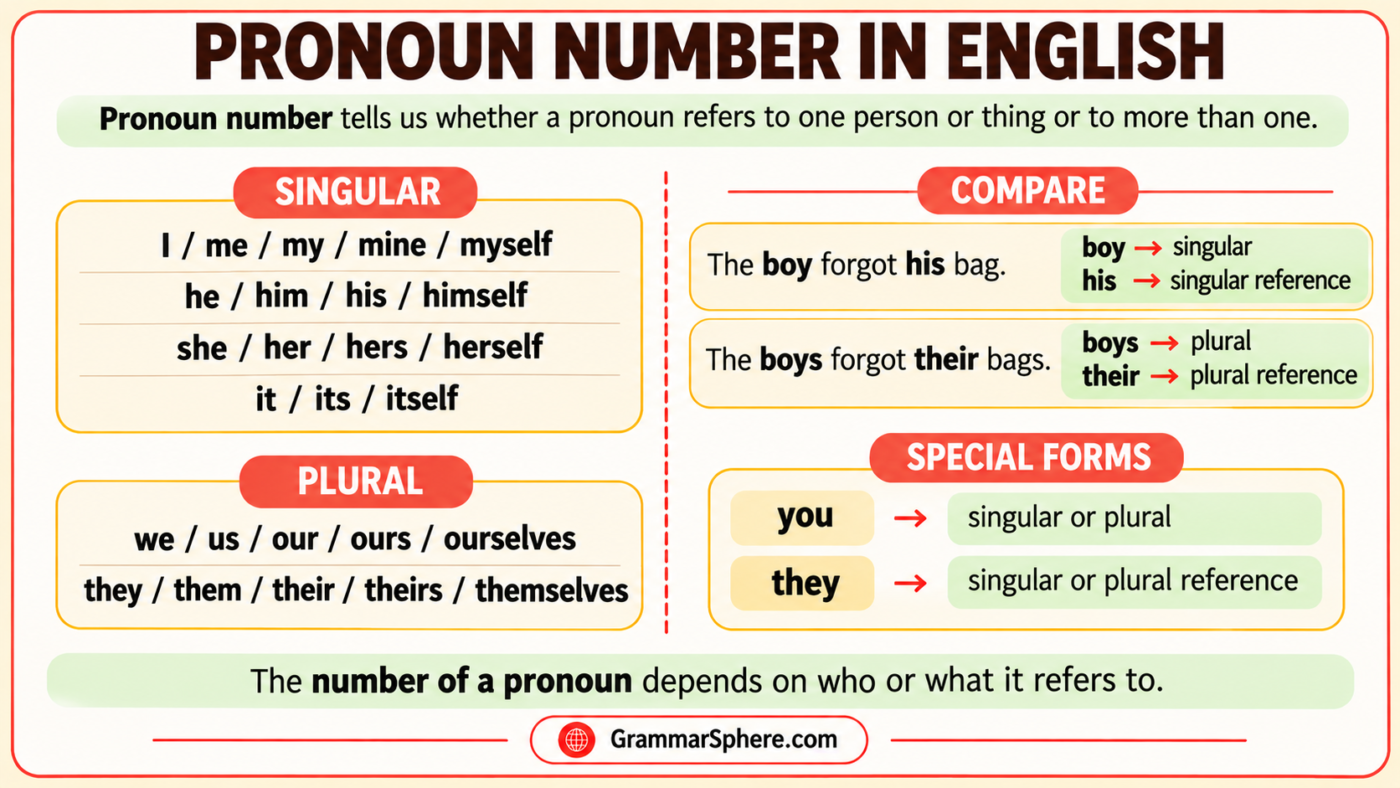
Pronoun number tells us whether a pronoun refers to one person or thing or to more than one.
English has two main numbers:
- singular → one person or thing
- plural → more than one person or thing
Compare:
The boy forgot his bag.
Here, his refers to one boy, so the reference is singular.
The boys forgot their bags.
Here, their refers to more than one boy, so the reference is plural.
Pronoun number therefore depends on who or what the pronoun refers to.
Singular and Plural Pronouns
Some pronoun forms normally have singular reference.
These include:
- I, me, my, mine, myself
- he, him, his, himself
- she, her, hers, herself
- it, its, itself
For example:
- She is my teacher.
- I called him yesterday.
- The dog wagged its tail.
- Sara introduced herself.
Other forms normally have plural reference:
- we, us, our, ours, ourselves
- they, them, their, theirs, themselves
For example:
- We are ready.
- The teacher called us.
- They live nearby.
- The students finished their work.
The main personal pronoun forms can be compared below:
| Person and Number | Subject | Object | Possessive Determiner | Possessive Pronoun | Reflexive |
|---|---|---|---|---|---|
| First person singular | I | me | my | mine | myself |
| First person plural | we | us | our | ours | ourselves |
| Second person singular | you | you | your | yours | yourself |
| Second person plural | you | you | your | yours | yourselves |
| Third person singular | he | him | his | his | himself |
| Third person singular | she | her | her | hers | herself |
| Third person singular | it | it | its | — | itself |
| Third person singular or plural | they | them | their | theirs | themselves |
An important point is that pronoun number is not always clear from the form alone. You can be singular or plural, and they can also have singular or plural reference.
Pronoun Number and Person
Number and person describe different features of a pronoun.
Number tells us whether the reference is singular or plural.
Person tells us whether the pronoun refers to the speaker, the listener, or someone or something else.
For example:
- I → first person singular
- we → first person plural
- you → second person singular or plural
- he → third person singular
- they → third person singular or plural
A pronoun can therefore be described by both its person and its number.
You as Singular and Plural
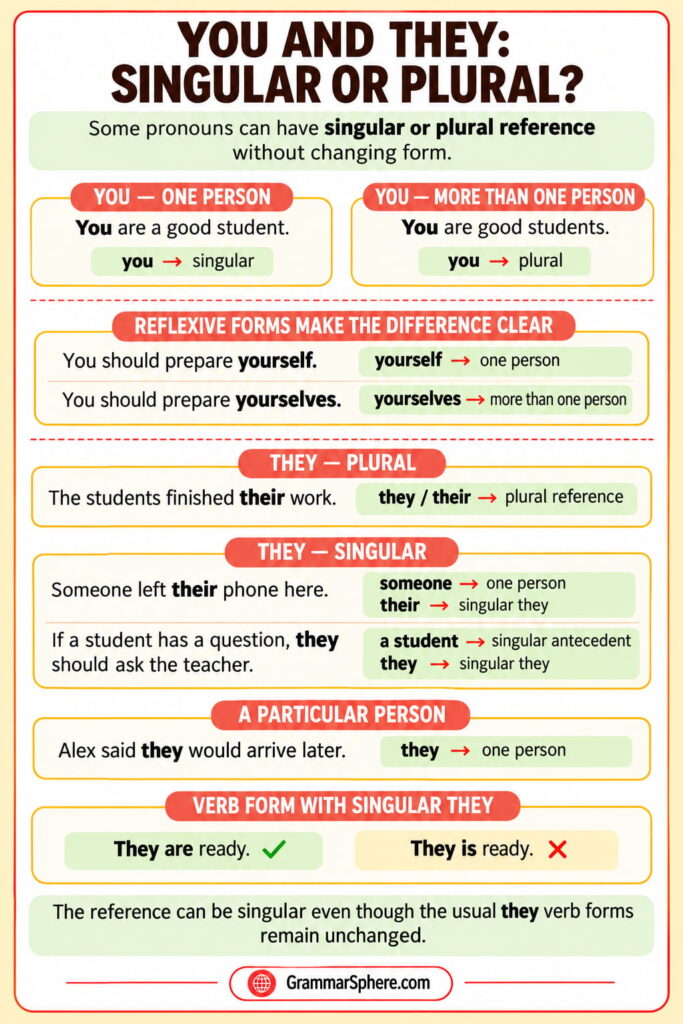
The pronoun you can refer to one person or more than one person.
For one person:
You are a good student.
For more than one person:
You are good students.
The form you does not change, so the context usually tells us whether the reference is singular or plural.
The reflexive forms make the difference clearer:
- yourself → one person
- yourselves → more than one person
Compare:
You should prepare yourself.
You should prepare yourselves.
In the first sentence, you refers to one person. In the second, it refers to more than one.
Singular They in English
Modern English commonly uses they, them, their, and theirs for one person as well as for more than one.
For example:
Someone left their phone here.
If a student has a question, they should ask the teacher.
Here, their and they refer to one person.
Singular they is commonly used when a person’s gender is unknown, unimportant, or not stated.
It can also refer to a particular person who uses they/them pronouns:
Alex said they would arrive later.
Although the reference is singular, singular they takes the same verb forms as plural they:
They are ready. ✓
not:
They is ready. ✗
So, they can have singular reference even though its form does not change.
Pronoun Number and Antecedent Agreement
When a pronoun refers to a noun or noun phrase, that noun or noun phrase is called its antecedent.
Consider:
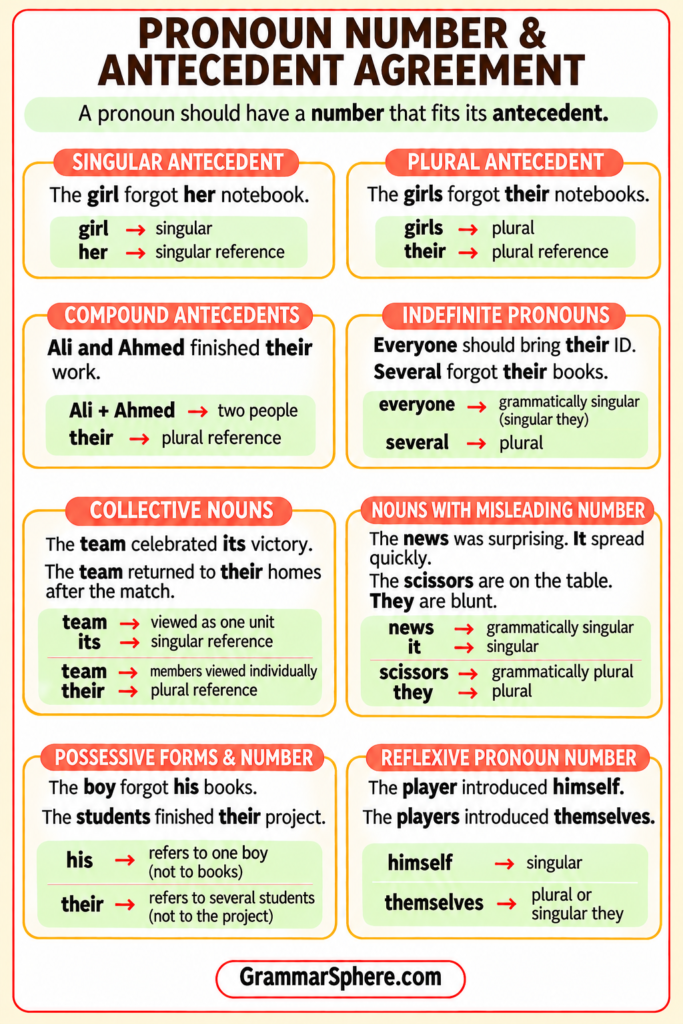
The girl forgot her notebook.
Here:
- the girl → singular antecedent
- her → singular reference
Now compare:
The girls forgot their notebooks.
Here:
- the girls → plural antecedent
- their → plural reference
A pronoun should have a number that is appropriate for its antecedent. This relationship is called pronoun–antecedent agreement.
A singular antecedent normally takes a pronoun with singular reference:
The dog hurt its leg.
Ahmed forgot his book.
Sara brought her notebook.
For singular human antecedents, modern English can also use singular they:
A student should check their work.
Every applicant should bring their ID.
A plural antecedent normally takes a pronoun with plural reference:
The students finished their work.
The dogs wagged their tails.
The pronoun should clearly fit the number of the person, thing, or group it refers to.
Pronoun Number with Compound Antecedents
A pronoun can refer to two or more antecedents together.
When antecedents are joined by and, they normally form a plural reference.
For example:
Ali and Ahmed finished their work.
Sara and Ayesha said they were ready.
In both sentences, the pronoun refers to two people.
When antecedents are joined by or or nor, they present alternatives rather than one combined group.
For example:
Either Ali or Ahmed should bring their ID.
Here, singular they naturally refers to whichever person is meant.
If the alternatives have different numbers and the sentence becomes awkward, rewriting it is often clearer than forcing an unnatural pronoun choice.
Pronoun Number with Indefinite Pronouns
Indefinite pronouns refer to people or things without identifying exactly who or what they are.
Some indefinite pronouns are grammatically singular:
- someone
- anyone
- everyone
- nobody
- each
Modern English commonly uses singular they with these pronouns:
Someone left their bag here.
Everyone should bring their ID.
Each student should check their answer.
Other indefinite pronouns are plural:
- both
- few
- many
- several
These take plural reference:
Several forgot their books.
Some indefinite pronouns, including some, all, most, and none, can have singular or plural meaning depending on what they refer to.
Compare:
Some of the milk has lost its freshness.
Some of the students have finished their work.
The noun or idea connected with the indefinite pronoun helps determine its number.
Pronoun Number with Collective Nouns
A collective noun refers to a group, such as team, family, committee, class, or staff.
When the group is treated as one unit, a singular pronoun may be used:
The team celebrated its victory.
Here, its refers to the team as one group.
When the members are being considered individually, a plural pronoun may be used:
The team returned to their homes after the match.
This plural treatment is especially common in British English.
The choice depends on whether the group is being viewed as one unit or as individual members.
When an Antecedent’s Number Is Not Obvious
Some nouns can make number less obvious.
For example, news ends in -s, but it is normally singular:
The news was surprising. It spread quickly.
Here, it refers to the news.
Other nouns, such as scissors, trousers, and glasses, are normally plural:
The scissors are on the table. They are blunt.
Here, they refers to the scissors.
When one of these nouns follows a pair of, the whole noun phrase can be singular:
This pair of scissors is new. It was expensive.
The grammatical number of the antecedent helps determine the appropriate pronoun.
Pronoun Number in Possessive Forms
Possessive forms reflect the number of the person or group they refer to.
Compare:
The boy forgot his bag.
The boys forgot their bags.
Here:
- his → refers to one boy
- their → refers to more than one boy
The number of the thing possessed does not determine the pronoun.
Compare:
The boy forgot his book.
The boy forgot his books.
The form his remains the same because it refers to the boy, not to book or books.
Similarly:
The students finished their project.
The students finished their projects.
The form their refers to the plural antecedent the students.
With singular they, their can also refer to one person:
Someone forgot their book.
So, the number of a possessive form depends on who or what it refers to, not on the number of the possessed noun.
Pronoun Number in Reflexive Forms
Reflexive pronouns often make number especially clear.
Common singular reflexive forms include:
- myself
- yourself
- himself
- herself
- itself
Common plural reflexive forms include:
- ourselves
- yourselves
- themselves
Compare:
The player introduced himself.
The players introduced themselves.
The reflexive form changes because the reference changes from one person to more than one.
The contrast is also clear with you:
- yourself → singular
- yourselves → plural
Demonstrative Pronouns and Number
The demonstrative pronouns this, that, these, and those show a clear singular–plural distinction.
Singular:
- this
- that
Plural:
- these
- those
Compare:
This is mine.
These are mine.
And:
That looks expensive.
Those look expensive.
The form changes according to number.
When these words come before nouns, they function as determiners:
- this book
- these books
- that idea
- those ideas
How to Identify Pronoun Number
To identify pronoun number, first find what the pronoun refers to.
A useful method is:
- Find the pronoun.
- Identify who or what it refers to.
- Decide whether the reference is singular or plural.
- Check the antecedent if there is one.
- Remember that you and they can have singular or plural reference.
- Check whether possessive or reflexive forms fit the intended number.
Consider:
The students brought their books.
Here:
- the students → plural antecedent
- their → plural reference
Now compare:
Someone left their book.
Here:
- someone → singular antecedent
- their → singular reference through singular they
The form their is the same in both sentences, but its number is understood from what it refers to.
Common Mistakes with Pronoun Number
1. Using a Singular Pronoun for a Plural Antecedent
The boys blamed himself. ✗
The boys blamed themselves. ✓
The pronoun refers to more than one boy, so a plural reflexive form is needed.
2. Using a Plural Pronoun for a Singular Thing
The table has lost one of their legs. ✗
The table has lost one of its legs. ✓
The pronoun refers to one table, so its is required.
3. Assuming They Is Always Plural
Someone forgot their phone. ✓
Here, their refers to one person as part of singular they.
4. Assuming You Is Always Singular
You are excellent students.
Here, you refers to more than one person. The context makes the plural meaning clear.
5. Confusing Yourself and Yourselves
Students, prepare yourself. ✗
Students, prepare yourselves. ✓
Because students refers to more than one person, yourselves is needed.
6. Using the Wrong Reflexive Number
Sara and Ayesha introduced herself. ✗
Sara and Ayesha introduced themselves. ✓
The reflexive pronoun refers to two people.
7. Using a Singular Pronoun for a Clearly Plural Antecedent
The students forgot its notebooks. ✗
The students forgot their notebooks. ✓
The antecedent the students is plural, so their is the appropriate form.
Pronoun Number Exercises with Answers
A. Identify the Pronoun Number
- She is waiting outside.
- They are my friends.
- The dog hurt itself.
- We completed our work.
- Someone forgot their phone.
B. Choose the Correct Pronoun
- The boy forgot his / their bag.
- The boys forgot his / their bags.
- The table has lost one of its / their legs.
- The students introduced himself / themselves.
- Everyone should bring their / its ID.
C. Correct the Pronoun Number Error
- The boys blamed himself.
- The students prepared himself for the test.
- The table has lost one of their legs.
- The students forgot its notebooks.
- Students, please introduce yourself.
Answers
- she → singular
- they → plural
- itself → singular
- our → plural reference
- their → singular reference
- his
- their
- its
- themselves
- their
- The boys blamed themselves.
- The students prepared themselves for the test.
- The table has lost one of its legs.
- The students forgot their notebooks.
- Students, please introduce yourselves.
FAQs About Pronoun Number
Can you be both singular and plural?
Yes. You can refer to one person or more than one person. The context usually tells us which meaning is intended.
Why can everyone take their if everyone is singular?
Everyone is grammatically singular, but modern English commonly uses singular they/their with singular human antecedents.
Everyone should bring their ID.
Here, their refers to each person.
Does the number of a possessive form depend on the thing possessed?
No. It depends on who or what the possessive form refers to.
The boy forgot his books.
His is singular because it refers to the boy, even though books is plural.
Why is themselves used with singular they?
Singular they commonly uses themselves as its reflexive form:
Someone should introduce themselves.
The reference is singular, while the form follows the usual they system.
How can I tell whether a pronoun is singular or plural when the form is the same?
Look at who or what the pronoun refers to. The surrounding sentence usually makes the number clear.
You are a good student.
Here, you is singular.
You are good students.
Here, you is plural.
You May Also Like
Leave a Comment