

Table of Contents
A noun complement is a phrase or clause that follows a noun and helps complete or make its meaning more specific.
For example:
- the need for change
- the belief that he is innocent
- her decision to leave
In each example, the bold part gives information that is closely connected to the meaning of the noun.
Noun complements are especially common after abstract nouns such as idea, belief, fact, possibility, decision, need, hope, and reason.
What Is a Noun Complement?
A noun complement is a phrase or clause that follows a noun and gives information needed to complete or specify its meaning.
Consider:
the possibility of rain
Here:
- possibility = head noun
- of rain = noun complement
Of rain tells us what the possibility concerns.
Another example:
the belief that everyone is equal
Here:
- belief = head noun
- that everyone is equal = noun complement
The clause tells us what the belief is.
Noun complements normally come after the nouns they complement.
Noun + Complement
Examples:
- the need for change
- her knowledge of English
- the fact that he apologized
- their decision to leave
Forms of Noun Complements
Noun complements commonly take the form of prepositional phrases, that-clauses, and to-infinitive clauses.
Prepositional Phrases as Noun Complements
Many nouns can be followed by prepositional phrases that provide information closely connected to their meaning.
For example:
- the need for change
- her knowledge of English
- his interest in science
- their objection to the proposal
- the reason for the delay
- the possibility of rain
Different nouns occur naturally with different prepositions.
Common patterns include:
noun + of
- knowledge of
- fear of
- possibility of
- importance of
noun + for
- need for
- reason for
- demand for
- request for
noun + in
- interest in
- increase in
- difficulty in
noun + to
- objection to
- solution to
- response to
The complement can also contain an -ing form after a preposition:
the possibility of winning
her fear of flying
the importance of practising regularly
Because different nouns are used with different prepositions, it is useful to learn these combinations together.
That-Clauses as Noun Complements
A that-clause can give the content of a noun.
For example:
- the belief that everyone is equal
- the fact that the door was open
- the idea that we should leave early
- the possibility that the plan may fail
- the claim that the product is safe
Compare:
She believes that he is innocent.
her belief that he is innocent
In the first example, that he is innocent follows the verb believes. In the second, it follows the noun belief and functions as its complement.
Other nouns that commonly occur with that-clauses include assumption, hope, news, and suggestion.
To-Infinitive Clauses as Noun Complements
Some nouns can be followed by a to-infinitive clause that gives more information about the noun.
For example:
- her decision to resign
- his attempt to escape
- their plan to expand the business
- our ability to solve the problem
- the opportunity to study abroad
Compare:
They decided to leave.
their decision to leave
In the first example, to leave follows the verb decided. In the second, to leave follows the noun decision and tells us what the decision was.
Common noun + to-infinitive patterns include:
- ability to
- attempt to
- decision to
- desire to
- opportunity to
- plan to
- promise to
- refusal to
- willingness to
Not every noun can be followed naturally by a to-infinitive, so it is useful to learn these patterns together.
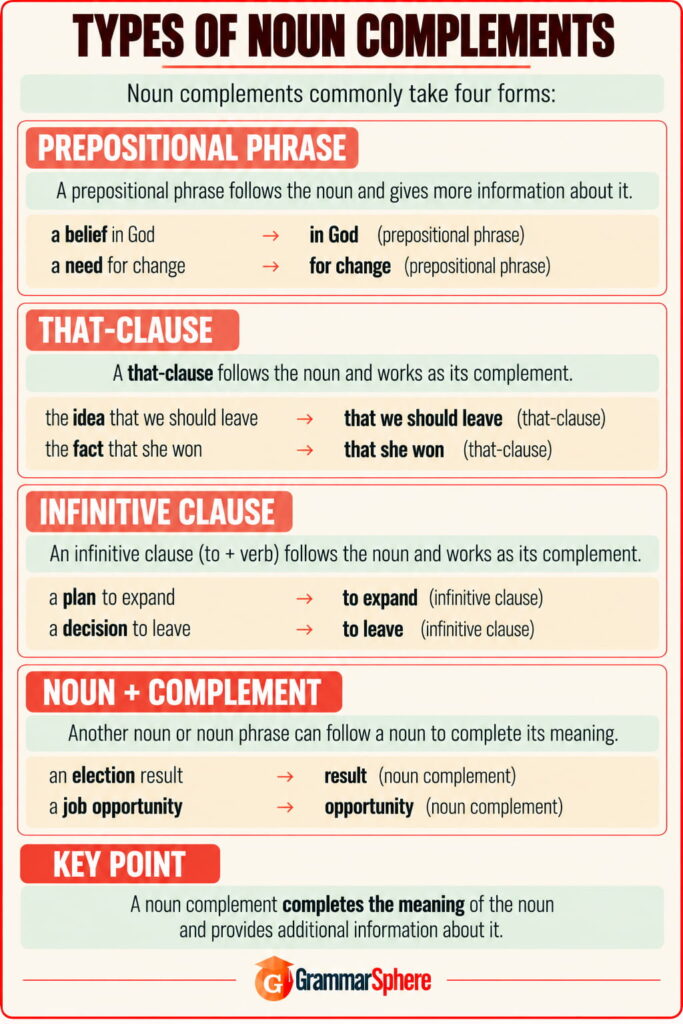
To-Infinitive Clauses as Noun Complements
Some nouns can be followed by a to-infinitive clause that gives more information about the noun.
For example:
- her decision to resign
- his attempt to escape
- their plan to expand the business
- our ability to solve the problem
- the opportunity to study abroad
Compare:
They decided to leave.
their decision to leave
In the first example, to leave follows the verb decided. In the second, to leave follows the noun decision and tells us what the decision was.
Common noun + to-infinitive patterns include:
- ability to
- attempt to
- decision to
- desire to
- opportunity to
- plan to
- promise to
- refusal to
- willingness to
Not every noun can be followed naturally by a to-infinitive, so it is useful to learn these patterns together.re specific information about the head noun.
How to Identify a Noun Complement
To identify a noun complement, first find the head noun and then look at the phrase or clause that follows it.
Consider:
Her decision to study abroad surprised us.
The head noun is decision. The words to study abroad tell us what she decided to do.
Therefore:
- decision = head noun
- to study abroad = noun complement
Another example:
The fact that he lied shocked everyone.
Here:
- fact = head noun
- that he lied = noun complement
The clause tells us what the fact is.
Now consider:
There is a need for more teachers.
Here:
- need = head noun
- for more teachers = noun complement
The prepositional phrase tells us what the need is for.
Noun complements are especially common after abstract nouns and often appear as prepositional phrases, that-clauses, or to-infinitive clauses.
However, do not assume that every phrase or clause after a noun is a complement. Some phrases and clauses simply describe or identify the noun. What matters is the relationship between the head noun and the words that follow it, not simply their position after the noun.
Noun Complement Clauses vs. Relative Clauses
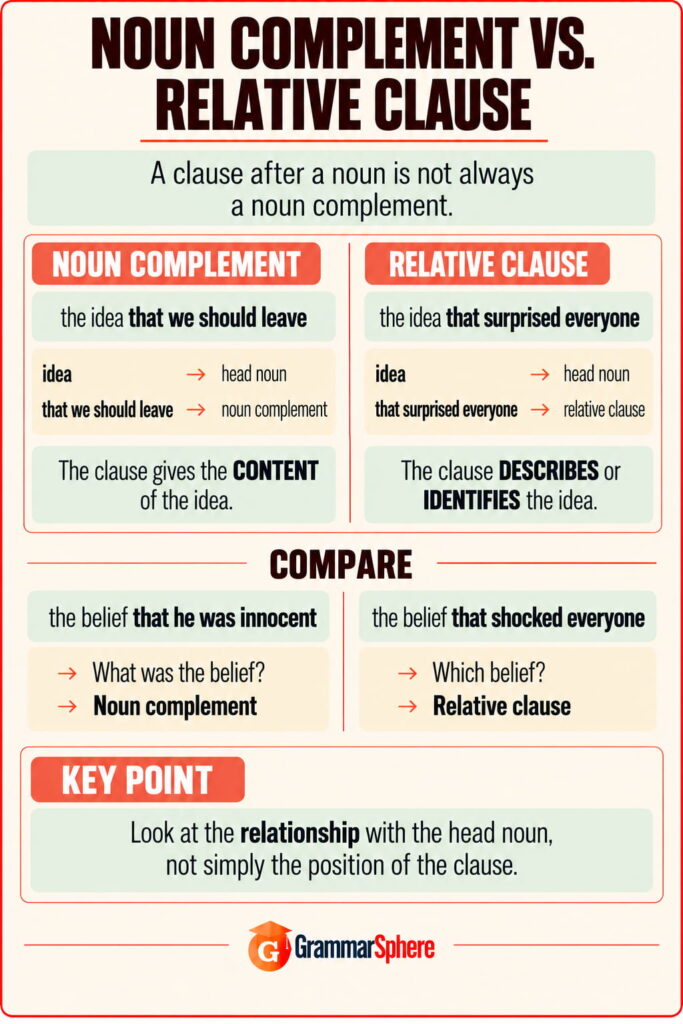
Noun complement clauses and relative clauses can look similar because both can come after a noun. However, they do different jobs.
A noun complement clause gives the content or meaning of a noun. A relative clause describes or identifies a noun.
Compare:
the fact that he lied
Here, that he lied is a noun complement clause. It tells us what the fact is.
the book that he bought
Here, that he bought is a relative clause. It tells us which book we mean.
| Noun Complement Clause | Relative Clause |
|---|---|
| Gives the content or meaning of a noun | Describes or identifies a noun |
| the fact that he left | the man who left |
| the idea that we should wait | the idea that she suggested |
| the news that they had won | the news that surprised everyone |
A useful way to recognize the difference is to look at what the clause does.
In a noun complement clause, the clause gives the content of the noun:
- the belief that everyone is equal
- the possibility that prices will rise
- the news that she had won
In a relative clause, the clause describes or identifies the noun:
- the belief that changed his life
- the possibility that we discussed
- the news that surprised everyone
In a relative clause, the relative word has a role inside the clause.
the book that I bought
Here, that refers back to the book: I bought the book.
Compare:
the fact that he lied
Here, that does not stand for fact inside the clause. He lied is already complete. The clause tells us what the fact is.
Common Mistakes with Noun Complements
Here are some common mistakes learners make when using noun complements.
1. Using the Wrong Preposition
Incorrect:
the reason of the delay ✗
Correct:
the reason for the delay ✓
Different nouns are used with different prepositions, so these combinations often need to be learned together.
2. Adding an Unnecessary Preposition Before a That-Clause
Incorrect:
the belief about that he was innocent ✗
Correct:
the belief that he was innocent ✓
A noun such as belief can be followed directly by a that-clause expressing its content.
3. Using the Wrong Form After a Preposition
Incorrect:
the possibility of win ✗
Correct:
the possibility of winning ✓
When a verb follows a preposition, the -ing form is normally used.
4. Using the Wrong Complement Pattern
Incorrect:
her decision of leaving ✗
Correct:
her decision to leave ✓
The noun decision normally takes a to-infinitive when we say what someone decided to do.
5. Confusing a Noun Complement Clause with a Relative Clause
Compare:
the idea that we should leave
Here, that we should leave gives the content of idea, so it is a noun complement clause.
the idea that surprised everyone
Here, that surprised everyone describes or identifies idea, so it is a relative clause.
Noun Complement Exercises with Answers
A. Identify the head noun and its complement.
- the possibility of rain
- the need for change
- the belief that he was innocent
- her decision to resign
- his interest in science
B. Choose the correct form.
- the reason for the delay / of the delay
- her decision to leave / of leave
- the possibility of winning / of win
- his interest in music / on music
- the belief that she was right / about that she was right
C. Complete each noun phrase with the correct word.
- the need ______ more information
- her decision ______ apply for the job
- the possibility ______ losing the match
- the belief ______ everyone deserves respect
- his interest ______ English grammar
D. Decide whether the bold clause is a noun complement clause or a relative clause.
- the idea that we should wait
- the idea that surprised everyone
- the claim that the product was safe
- the claim that appeared in the newspaper
- the fact that nobody complained
Answers
A. Identify the head noun and its complement
- possibility = head noun; of rain = noun complement
- need = head noun; for change = noun complement
- belief = head noun; that he was innocent = noun complement
- decision = head noun; to resign = noun complement
FAQs About Noun Complements
What is a noun complement?
A noun complement is a phrase or clause that follows a noun and helps complete or make its meaning more specific. For example, in the possibility of rain, of rain is the complement of possibility.
What are some examples of noun complements?
Examples include the need for change, the possibility of rain, the belief that he is innocent, and her decision to leave.
What forms can noun complements take?
Noun complements commonly take the form of prepositional phrases, that-clauses, and to-infinitive clauses, as in the need for help, the fact that she won, and the decision to leave.
Which nouns commonly take complements?
Noun complements are especially common with abstract nouns such as idea, fact, belief, possibility, decision, need, reason, hope, and claim.
What is the difference between a noun complement clause and a relative clause?
A noun complement clause gives the content of a noun, as in the idea that we should leave. A relative clause describes or identifies a noun, as in the idea that surprised everyone.
You May Also Like
Leave a Comment