

Table of Contents
Pronouns help us write clearly by referring to people and things without repeating their names. We use words such as he, she, it, and they every day. However, choosing a pronoun is not enough. It must also suit the noun or noun phrase it refers to. Otherwise, readers may misunderstand who or what we mean.
Compare “Sara is absent. She is ill” with “The students are absent. They are ill.” The pronoun changes because the first sentence refers to one person and the second to several. The noun or noun phrase a pronoun refers to is its antecedent. This relationship is called pronoun–antecedent agreement. In this lesson, you will learn its essential rules, recognize common errors, and practise choosing pronouns that make sentences clear and grammatically correct.
What Is Pronoun–Antecedent Agreement?
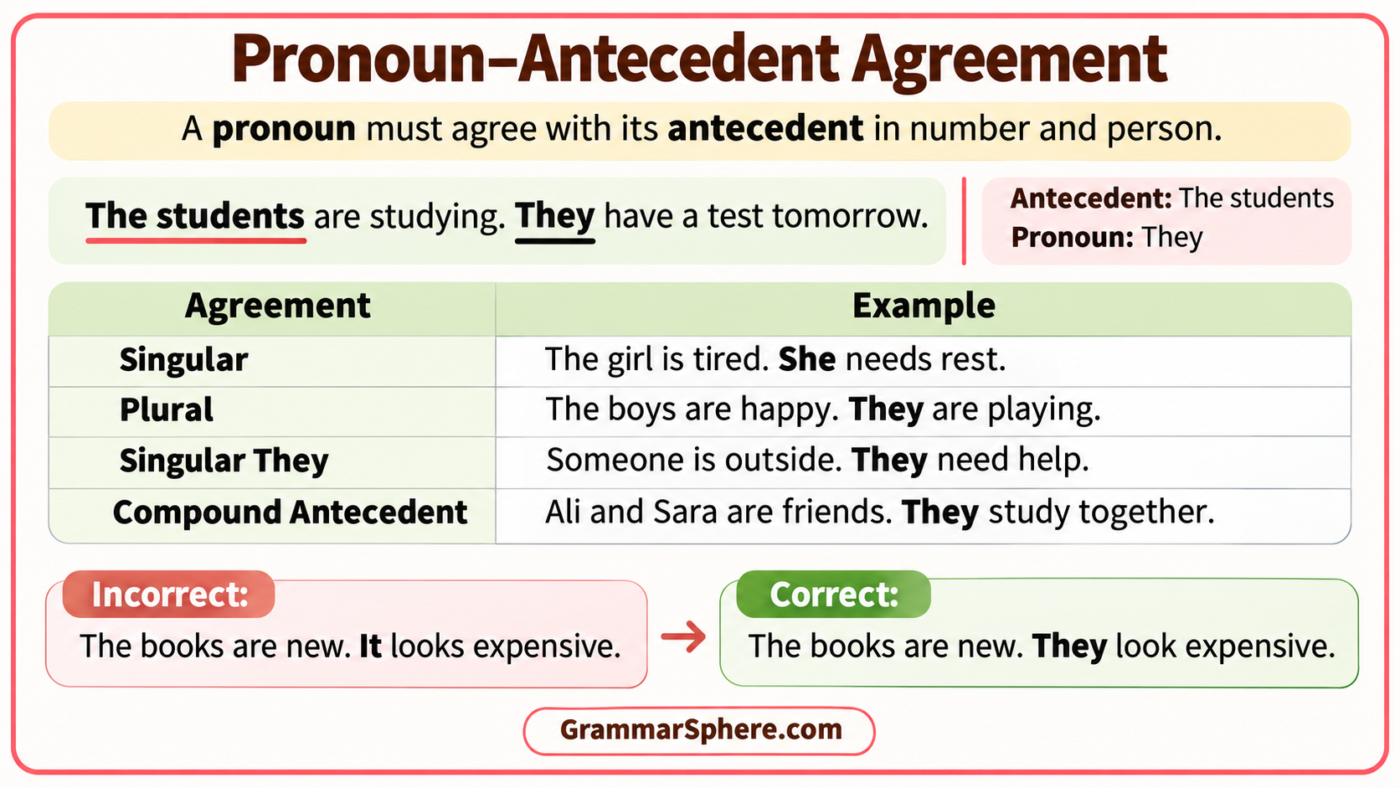
Pronoun–antecedent agreement is a grammar rule that requires a pronoun to agree with the noun or noun phrase it refers to.
In English grammar, a pronoun is a word used to refer to someone or something, often instead of repeating a noun. An antecedent is the noun or noun phrase to which that pronoun refers.
Example:
Ali bought a bicycle. He rides it every day.
In these sentences:
- Ali is the antecedent of he.
- Bicycle is the antecedent of it.
Both pronouns clearly refer to the person or thing mentioned earlier.
Pronoun agreement mainly involves number and person. Number tells us whether the reference is singular or plural. Person tells us whether we are referring to the speaker, the person being addressed, or someone else. The pronoun should also be appropriate for the person or thing being discussed.
Rules of Pronoun–Antecedent Agreement
The following five rules explain the most important patterns of pronoun agreement in English.
1. Singular Antecedents Take Singular Pronouns
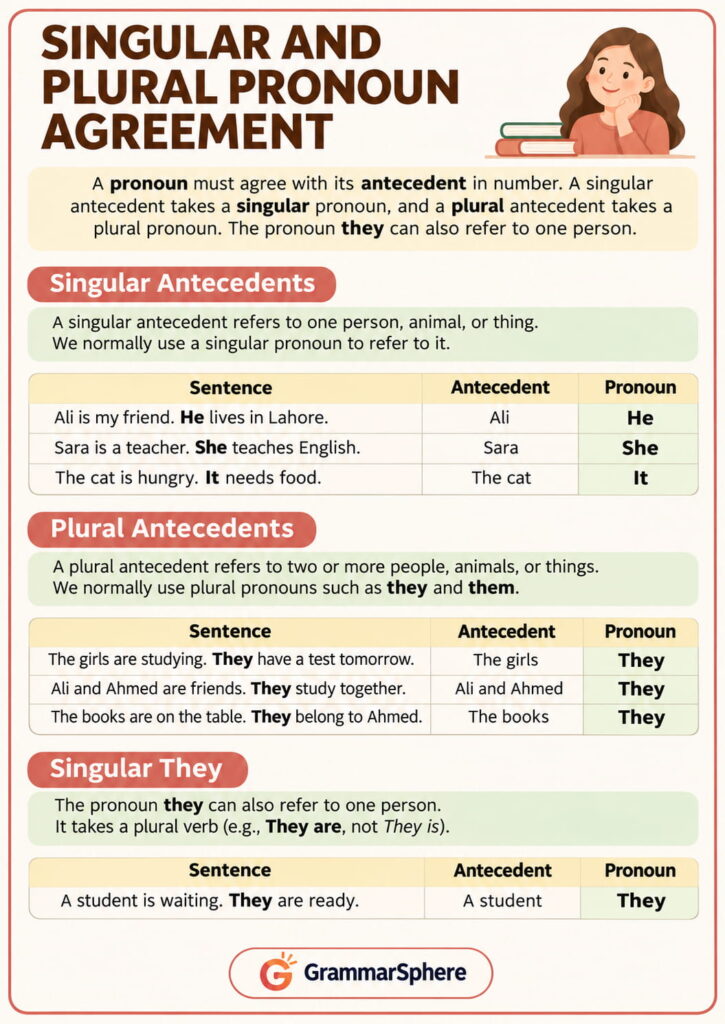
A singular antecedent refers to one person, animal, or thing. We normally use a singular pronoun to refer to it.
Examples:
- Ali is my friend. He lives in Lahore.
- Sara is a teacher. She teaches English.
- The dog is hungry. It needs food.
In these examples, he, she, and it refer to singular antecedents.
A singular antecedent can also take singular they when referring to a person in suitable contexts.
Example:
A student has left their notebook in the classroom.
Here, their refers to one student. This use is accepted in modern English.
2. Plural Antecedents Take Plural Pronouns
A plural antecedent refers to two or more people, animals, or things. We generally use plural pronouns such as they and them to refer to them.
Examples:
- The girls are studying. They have an examination tomorrow.
- My friends are here. They want to meet you.
- The books are on the table. They belong to Ahmed.
Incorrect: The boys are tired. He needs rest. (If all the boys need rest.)
Correct: The boys are tired. They need rest.
The antecedent boys refers to more than one person. Therefore, they is appropriate when referring to the entire group.
3. Agreement with Indefinite Pronouns
Indefinite pronouns refer to people or things without naming them specifically.
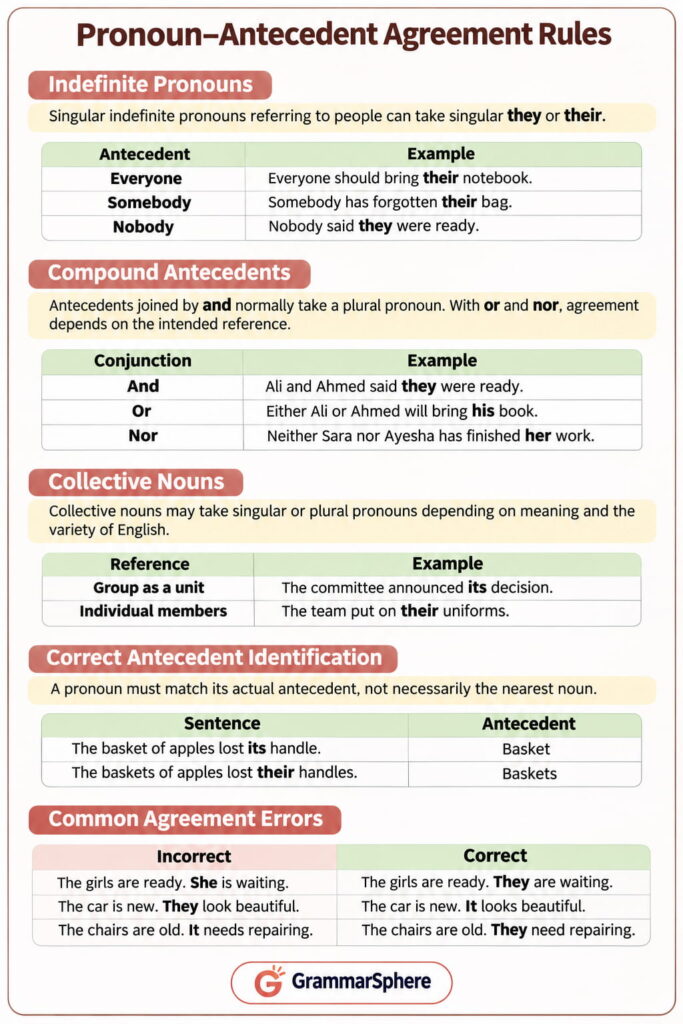
Words such as everyone, somebody, anyone, nobody, each, either, and neither are grammatically singular.
Examples:
- Everyone is ready.
- Somebody has forgotten their bag.
- Each of the students should complete their work.
When an indefinite pronoun refers to one person, singular they or their is often appropriate.
Although singular they refers to one person, it takes the usual verb forms used with they.
Correct: They are ready.
Incorrect: They is ready.
Some indefinite pronouns, including both, few, many, and several, are plural.
Examples:
- Both students said they were ready.
- Several players said they were tired.
Other indefinite pronouns, such as some, all, and none, can have singular or plural reference depending on the context.
Examples:
- Some of the milk was spilled. It was wasted.
- Some of the books were damaged. They were replaced.
The correct pronoun depends on the person or thing being discussed.
4. Agreement with Compound Antecedents
A compound antecedent contains two or more nouns or noun phrases joined by a conjunction such as and, or, or nor.
Antecedents Joined by “And”
When two different people or things are joined by and, they normally form a plural antecedent.
Examples:
- Ali and Ahmed are friends. They study together.
- Sara and Ayesha are sisters. They live in Karachi.
- The teacher and the principal are here. They are discussing the examination.
The pronoun they refers to both people in each sentence.
Antecedents Joined by “Or” or “Nor”
When two antecedents are joined by or or nor, only one of the alternatives may be intended.
Examples:
- Either Ali or Ahmed will bring his notebook.
- Either Sara or Ayesha will present her project.
- Neither Ali nor Ahmed has submitted his assignment.
The pronouns in these examples refer to whichever individual is intended.
If the antecedents differ in number or the pronoun reference becomes unclear, rewriting the sentence is often the simplest solution.
Example:
Either the teacher or the students will lead the activity.
Whoever leads the activity will explain the instructions.
This wording makes the meaning clear without creating confusion about the pronoun.
5. Agreement with Collective Nouns
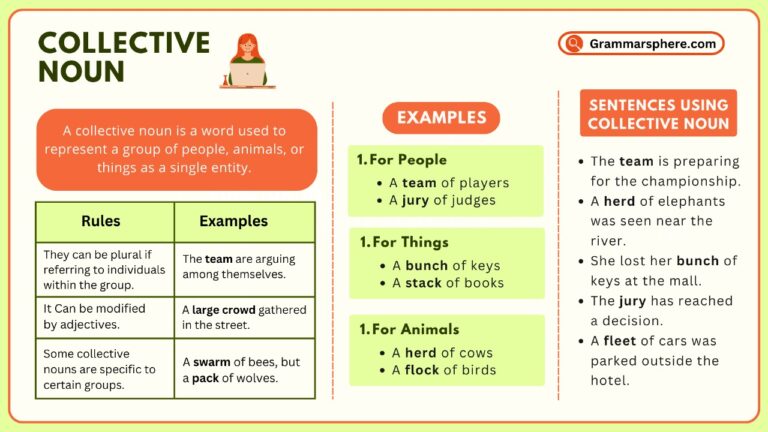
A collective noun names a group of people, animals, or things.
Common collective nouns include team, family, class, committee, and audience.
In American English, collective nouns are generally treated as singular when the group acts as one unit.
Examples:
- The team won its first match.
- The committee announced its decision.
- The company changed its policy.
In British English, plural agreement is also common when referring to the members of a group.
Example:
The team celebrated their victory.
Both forms are used in standard English. The choice depends on the intended meaning and the variety of English being used.
Common Pronoun–Antecedent Agreement Mistakes
Pronoun agreement errors often occur when a writer chooses a pronoun without checking the antecedent.
The following examples show common mistakes and their corrections.
| Incorrect Sentence | Correct Sentence |
|---|---|
| The chairs are broken. It needs repairing. | The chairs are broken. They need repairing. |
| The car is expensive. They look beautiful. | The car is expensive. It looks beautiful. |
| Ali and Ahmed are absent. He is ill. (Both are ill.) | Ali and Ahmed are absent. They are ill. |
| The documents are ready. It can be collected. | The documents are ready. They can be collected. |
In each correction, the pronoun matches the intended singular or plural antecedent.
Choosing the Wrong Antecedent
Sometimes another noun appears between an antecedent and its pronoun. This can make it difficult to identify the correct reference.
Example:
The basket of apples has lost its handle.
Here, its refers to basket, not apples.
Now compare:
The baskets of apples have lost their handles.
The possessive determiner their refers to the plural noun baskets.
The correct choice depends on which noun the sentence is discussing.
Pronoun–Antecedent Agreement vs. Pronoun Reference
Pronoun–antecedent agreement and pronoun reference are closely related, but they are not identical.
Pronoun–antecedent agreement concerns whether a pronoun appropriately matches its antecedent.
Example:
The children are playing. They are happy.
Here, they agrees with the plural antecedent children.
Pronoun reference concerns whether readers can identify the person or thing a pronoun refers to.
Unclear: Sara met Ayesha when she arrived.
The pronoun she could refer to Sara or Ayesha.
Clear: Sara arrived and met Ayesha.
The revised sentence removes the uncertainty.
A pronoun can be grammatically appropriate in number and person but still have an unclear reference. Good writing requires both correct agreement and clear reference.
How to Check Pronoun–Antecedent Agreement
You can check pronoun agreement by following three simple steps.
1. Identify the Pronoun
Find the pronoun used in the sentence.
Example:
The students are preparing for their examination. They are studying together.
Pronoun: They
2. Find the Antecedent
Identify the noun or noun phrase the pronoun refers to.
Antecedent: The students
3. Check the Agreement
Determine whether the pronoun appropriately matches the antecedent.
The antecedent students is plural, and the pronoun they refers to the same group.
Therefore, the agreement is correct.
Pronoun–Antecedent Agreement Exercises
Complete the following exercises to practise choosing pronouns and identifying their antecedents.
Exercise A: Choose the Correct Pronoun
- The boys are playing cricket. _____ are enjoying the game. (He / They)
- The book is new. _____ is on the table. (It / They)
- Ali and Ahmed are here. _____ are waiting outside. (He / They)
- The girls are studying. _____ have an examination tomorrow. (She / They)
- Everyone should bring _____ own notebook. (their / our)
- The committee announced _____ decision. (its / his)
Exercise B: Identify the Antecedent
Find the antecedent of the indicated pronoun.
- The children are hungry. They want lunch.
- Ahmed bought a bicycle. He rides it every day.
- The birds are flying. They are going south.
Exercise C: Correct the Sentences
- The chairs are old. It needs repairing. (Refer to all the chairs.)
- The boys are tired. He wants to rest. (Refer to all the boys.)
- The baskets of fruit are ready. It can be delivered today. (Refer to all the baskets.)
Answers to the Exercises
Exercise A
- They
- It
- They
- They
- their
- its
Exercise B
- They refers to the children.
- He refers to Ahmed, and it refers to the bicycle.
- They refers to the birds.
Exercise C
- The chairs are old. They need repairing.
- The boys are tired. They want to rest.
- The baskets of fruit are ready. They can be delivered today.
FAQs About Pronoun–Antecedent Agreement
What is pronoun–antecedent agreement in English grammar?
Pronoun–antecedent agreement means that a pronoun must appropriately match the noun or noun phrase it refers to in number and person.
Example: The students are happy. They have passed their examination.
What is an antecedent in English grammar?
An antecedent is the noun or noun phrase that a pronoun refers to.
Example: Sara is reading. She is busy.
Here, Sara is the antecedent of she.
What are the main rules of pronoun–antecedent agreement?
The main rules involve agreement with singular and plural antecedents, indefinite pronouns, compound antecedents, and collective nouns. The use of singular they is also important in modern English.
Can a singular antecedent take the pronoun “they”?
Yes. Singular they is accepted in modern English when referring to one person.
Example: Someone is calling. They want to speak to you.
How does pronoun agreement work with two antecedents joined by “and”?
Two different antecedents joined by and normally require a plural pronoun when referring to both.
Example: Ali and Ahmed are friends. They study together.
Do collective nouns take singular or plural pronouns?
Collective nouns can take singular or plural pronouns depending on the meaning and variety of English.
Examples:
- The team won its match.
- The team celebrated their victory.
The first pattern is especially common in American English, while the second is common in British English.
How can students avoid pronoun–antecedent agreement errors?
Students should identify the antecedent, determine whether it refers to one person or thing or more than one, and choose a pronoun that correctly matches the intended reference.
You May Also Like
Leave a Comment