

Table of Contents
Some English words can have different grammatical jobs depending on how they are used in a sentence. For example, we say This book is interesting, but we can also say This is interesting. In the first sentence, this helps identify the noun book. In the second, it stands on its own and refers to something understood from the context.
This change in how a word is used helps explain the difference between pronouns and determiners in English. Some words, such as this and some, can function as both, while others have different forms, such as my and mine. In this lesson, you will learn how to distinguish pronouns from determiners, understand their different uses, and choose the correct forms in sentences.
What Is the Difference Between a Pronoun and a Determiner?
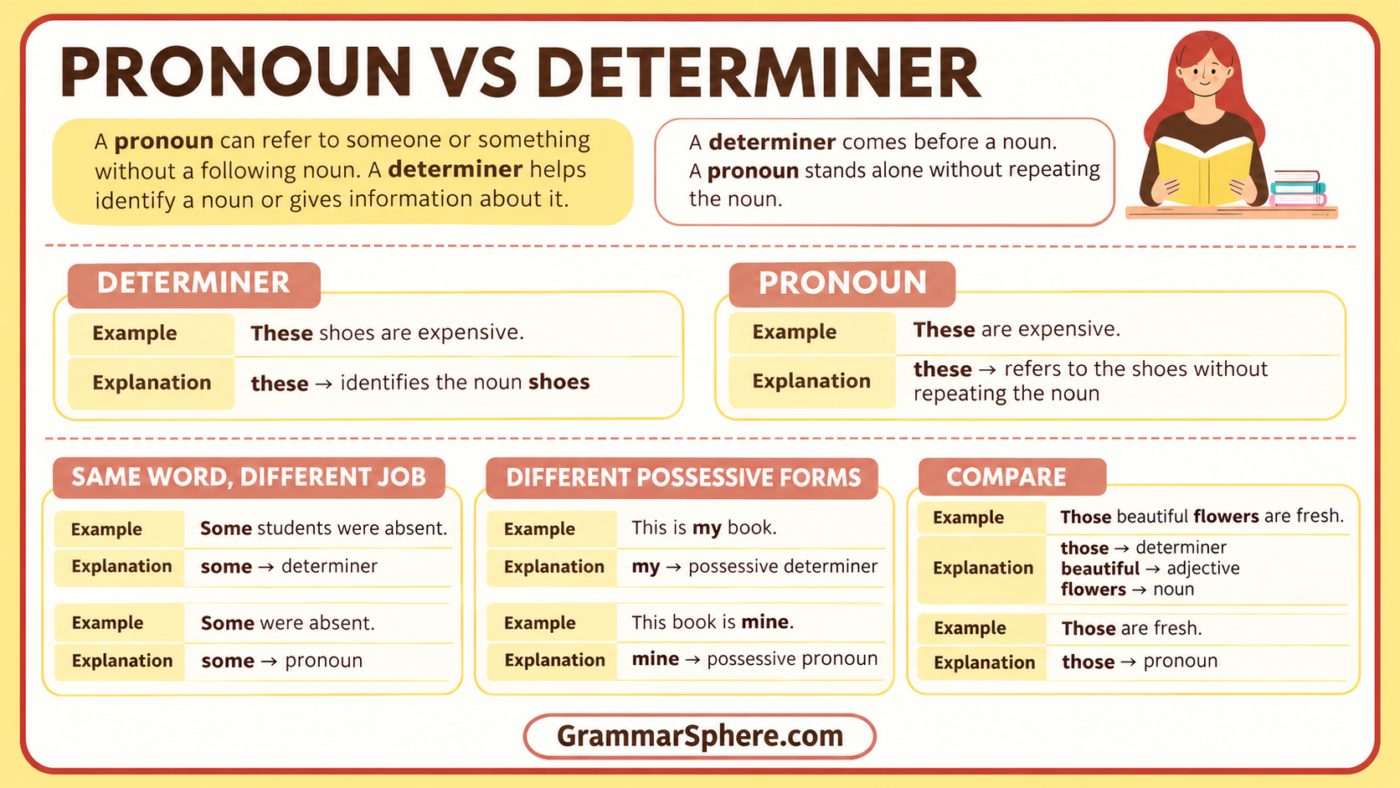
A pronoun is a word that refers to a person, thing, or idea without naming it directly. Pronouns often replace nouns to avoid repetition, but they can also refer to someone or something without a noun being mentioned earlier.
For example:
Sara bought a new phone. She uses it every day.
Here, she refers to Sara, while it refers to the new phone.
A determiner is a word used with a noun to help identify it or give information about it, such as which one, whose, or how many.
Examples include this book, my bag, some students, and the teacher.
Compare:
- Those shoes are expensive. — Determiner
- Those are expensive. — Pronoun
In the first sentence, those helps identify the noun shoes. In the second, it refers to the shoes without repeating the noun.
The main difference is that a pronoun can stand on its own, while a determiner is used with a noun.
A determiner forms part of a noun phrase, which is a noun together with the words that belong with it. For example, those beautiful flowers is a noun phrase. Here, those is a determiner, even though beautiful comes between it and the noun flowers.
Demonstrative Pronouns vs Demonstrative Determiners
The words this, that, these, and those are called demonstratives. They help us point to or identify people and things. These words can be used as both pronouns and determiners.
As determiners, they are used before nouns:
- This book is interesting.
- That house is beautiful.
- These students are ready.
- Those flowers are fresh.
As pronouns, they refer to people or things without a following noun:
- This is interesting.
- That is beautiful.
- These are ready.
- Those are fresh.
Compare:
- These books are expensive. — Determiner
- These are expensive. — Pronoun
In the first sentence, these comes before the noun books, so it is a determiner. In the second, these refers to the books without repeating the noun, so it is a pronoun.
Demonstratives also have singular and plural forms. This and that are singular, while these and those are plural. We generally use this and these for things nearer to us and that and those for things farther away.
These distinctions remain the same whether the demonstrative is used as a pronoun or a determiner.
Words That Can Be Pronouns or Determiners
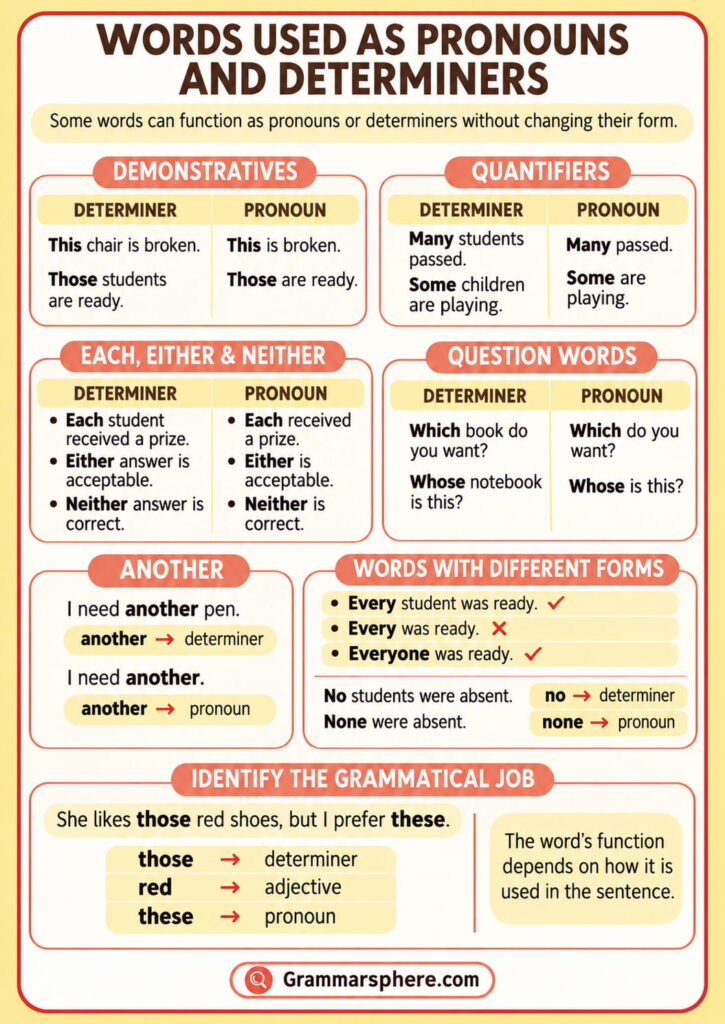
Some English words can function as both pronouns and determiners without changing their form. The difference depends on how they are used in a sentence.
| Word | As a Determiner | As a Pronoun |
|---|---|---|
| this | This chair is broken. | This is broken. |
| that | That house is old. | That is old. |
| these | These books are mine. | These are mine. |
| those | Those students are ready. | Those are ready. |
| some | Some children are playing. | Some are playing. |
| many | Many students passed. | Many passed. |
| each | Each student received a prize. | Each received a prize. |
| which | Which book is yours? | Which is yours? |
In the determiner examples, the words come before nouns and help identify them or give information about them. In the pronoun examples, the same words stand on their own and refer to people or things understood from the context.
This means that the grammatical function of a word depends on how it is used, not simply on the word itself.
Demonstrative Pronouns vs Demonstrative Determiners
The words this, that, these, and those are called demonstratives. They help us point to or identify people and things. Each of these words can be used as a pronoun or a determiner.
A demonstrative determiner is used with a noun, while a demonstrative pronoun refers to someone or something without a following noun.
Compare:
- These flowers are beautiful. — Determiner
- These are beautiful. — Pronoun
In the first sentence, these comes before the noun flowers. In the second, it refers to the flowers without repeating the noun.
Demonstratives also indicate number and distance. This and that are singular, while these and those are plural. We generally use this and these for things that are near and that and those for things that are farther away.
The words keep the same forms in both uses. Only their grammatical function changes.
Possessive Determiners vs Possessive Pronouns
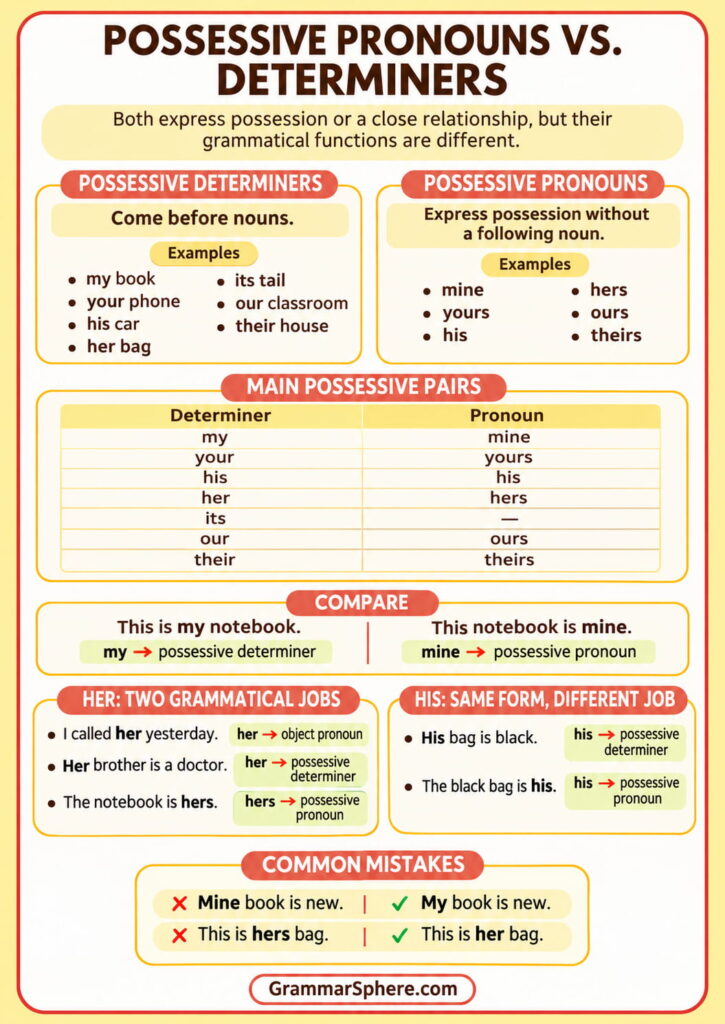
Possessive determiners and possessive pronouns express ownership or a relationship between people and things. They have similar meanings, but they are used differently in sentences.
A possessive determiner is used with a noun, while a possessive pronoun expresses possession without a following noun.
The main possessive forms are:
| Possessive Determiner | Possessive Pronoun |
|---|---|
| my | mine |
| your | yours |
| his | his |
| her | hers |
| its | — |
| our | ours |
| their | theirs |
Compare:
- This is my notebook.
- This notebook is mine.
In the first sentence, my is a possessive determiner because it comes before the noun notebook. In the second, mine is a possessive pronoun because it expresses possession without repeating the noun.
Notice that his has the same form in both uses:
- His bag is black. — Determiner
- The black bag is his. — Pronoun
Unlike the other possessive determiners, its has no corresponding independent possessive pronoun in standard English.
Some school grammar books call words such as my, your, her, and their possessive adjectives. However, possessive determiner is the more precise term because these words are used with nouns to indicate possession or relationships.
Her as a Pronoun and a Determiner
The word her can function as both a pronoun and a determiner, depending on how it is used in a sentence.
As an object pronoun, her refers to a female person who receives an action or follows a preposition.
For example:
- I called her yesterday.
- The teacher spoke to her.
As a possessive determiner, her comes before a noun to indicate possession or a relationship.
For example:
- Her brother is a doctor.
- I borrowed her book.
Compare:
- I gave her a pen. — Pronoun
- I returned her pen. — Determiner
In the first sentence, her is an object pronoun because it identifies the person receiving the pen. In the second, her is a possessive determiner because it comes before the noun pen.
The possessive pronoun hers is different from both uses of her. It expresses possession without a following noun.
For example:
This pen is hers.
Quantifiers as Pronouns and Determiners
Quantifiers are words that express quantity or amount. Common examples include some, any, many, much, few, several, all, both, most, and enough. Many quantifiers can be used as both pronouns and determiners.
As determiners, quantifiers are used with nouns to tell us how many people or things there are, or how much of something there is.
For example:
- Some students are absent.
- Many people attended the meeting.
- Both brothers are doctors.
As pronouns, quantifiers stand without a following noun. Their meaning is usually clear from the context.
For example:
- Some are absent.
- Many attended the meeting.
- Both are doctors.
Compare:
- Most students passed the test. — Determiner
- Most passed the test. — Pronoun
In the first sentence, most is a determiner because it comes before the noun students. In the second, it is a pronoun because it refers to the students without repeating the noun.
Quantifiers can also be followed by of when referring to a particular group:
- Some of the students were absent.
- Many of them passed the test.
- Both of us agreed.
The important difference is whether the quantifier is used with a following noun or stands in place of a noun phrase.
EEach, Every, Either, and Neither
The words each, every, either, and neither are used when referring to people or things in a group. However, they do not all have the same grammatical function.
Each can be used as both a determiner and a pronoun. It refers to members of a group individually.
- Each student received a prize. — Determiner
- Each received a prize. — Pronoun
Every is used as a determiner, not as a pronoun. It refers to all the members of a group considered individually.
- Every student must attend the class. — Correct
- Every must attend the class. — Incorrect
To refer to people without a following noun, we can use everyone or everybody, which are pronouns.
Either and neither can also function as both pronouns and determiners. Either refers to one or the other of two choices, while neither means not one and not the other.
- Either answer is correct. — Determiner
- Either is correct. — Pronoun
- Neither student was absent. — Determiner
- Neither was absent. — Pronoun
The main distinction is that each, either, and neither can stand without a following noun, while every must be used with a noun.
Interrogative Pronouns vs Interrogative Determiners
Interrogative means related to asking questions. The words which, what, and whose can function as interrogative pronouns or interrogative determiners.
Which
As a determiner:
Which book do you want?
Here, which comes before the noun book.
As a pronoun:
Which do you want?
Here, which asks about a choice without a following noun.
What
As a determiner:
What time does the class start?
Here, what comes before time.
As a pronoun:
What happened?
Here, what asks about something without introducing a noun.
Whose
As a determiner:
Whose notebook is this?
As a pronoun:
Whose is this?
These examples show that the same question word can perform different grammatical jobs without changing its form.
Another, Other, and Others
The words another, other, and others are also useful when distinguishing pronouns from determiners.
Another can function as a determiner or pronoun:
I need another pen. — Determiner
I need another. — Pronoun
Here, another means one more or a different one.
Other commonly comes before a noun:
Other students joined the class.
Here, other helps identify the students being discussed.
The related form others can stand without a following noun:
Some students left early, but others stayed.
Here, others is a pronoun because it refers to the remaining students without repeating the noun.
The expression the other can also stand without a following noun:
I have two books. One is red, and the other is blue.
Here, the other refers to the second book.
These forms help us refer to additional or different people and things.
Words Used Only as Pronouns or Determiners
Not every pronoun can function as a determiner, and not every determiner can function as a pronoun.
Some common words are used as pronouns rather than determiners:
- I, he, she, we, they
- me, him, them
- someone, everyone, nobody
- myself, herself, themselves
For example:
She is my friend.
Everyone is ready.
These words do not normally introduce nouns as determiners.
Other words are used as determiners rather than independent pronouns:
- a, an, the
- my, your, our, their
- every
- no
For example:
The students are here.
Every student has a notebook.
No seats are available.
The words a, an, and the are called articles. Articles are a type of determiner.
Notice the difference between no and none:
No students were absent. — Determiner
None were absent. — Pronoun
The meaning is related, but the grammatical form changes.
Pronouns, Determiners, and Adjectives
Pronouns and determiners can also be confused with adjectives because all three are connected with nouns.
However, their grammatical jobs are different.
- A pronoun can refer to someone or something without a following noun.
- A determiner helps identify a noun or gives information about it.
- An adjective describes a noun by expressing a quality, such as size, colour, or appearance.
Consider:
Those beautiful flowers are fresh.
Here:
- those → determiner
- beautiful → adjective
- flowers → noun
The determiner those identifies the flowers, while the adjective beautiful describes them.
Now compare:
Those are beautiful.
Here, those is a pronoun because it refers to the flowers without repeating the noun.
A determiner does not always come immediately before its noun. An adjective can appear between them, as in those beautiful flowers.
How to Identify a Pronoun or Determiner
To identify a pronoun or determiner, look at the grammatical job it performs in the sentence.
Follow these steps:
- Find the word you want to identify.
- Check whether it helps identify a noun. If it does, the word may be functioning as a determiner.
- Check whether it refers to someone or something without introducing a noun. If so, it may be functioning as a pronoun.
- Look at the whole noun phrase. An adjective may appear between a determiner and its noun.
- Check related forms, such as my/mine, her/hers, and no/none.
Consider:
She likes those red shoes, but I prefer these.
Here:
- She → pronoun
- those → determiner
- I → pronoun
- these → pronoun
The word those helps identify shoes, while these refers to another group of shoes without repeating the noun.
Another useful comparison is:
I gave her a book.
Here, her is an object pronoun.
I returned her book.
Here, her is a possessive determiner because it belongs with book.
The important point is to identify the word’s grammatical function, not simply look for a noun somewhere in the sentence.
Common Mistakes with Pronouns and Determiners
1. Using a Possessive Pronoun Before a Noun
Mine book is on the table. ✗
My book is on the table. ✓
Use my before a noun and mine without a following noun.
2. Confusing Her and Hers
This is hers notebook. ✗
This is her notebook. ✓
Use her before a noun. Use hers independently to express possession.
3. Using Every as a Pronoun
Every was invited. ✗
Everyone was invited. ✓
Every needs a following noun, while everyone can stand alone.
4. Confusing No and None
None students were absent. ✗
No students were absent. ✓
Use no before a noun. Use none without a following noun.
5. Using the Wrong Demonstrative Form
This books are mine. ✗
These books are mine. ✓
Use this with a singular noun and these with a plural noun.
6. Assuming a Word Always Has the Same Grammatical Job
Compare:
That car is new. — Determiner
That is new. — Pronoun
The word that has the same spelling in both sentences, but its grammatical job changes.
Pronoun vs Determiner Exercises with Answers
A. Identify the Bold Word as a Pronoun or Determiner
- These chairs are comfortable.
- These belong to our classroom.
- I called her yesterday.
- Her brother works in Lahore.
- Which answer is correct?
B. Choose the Correct Word
- This umbrella belongs to me. It is my / mine.
- She brought her / hers notebook.
- Every / Everyone finished the work.
- There are no / none seats left.
- Is that your / yours jacket?
C. Correct the Sentences
- Mine shoes are new.
- This is hers bag.
- Every arrived on time.
- None books were returned.
- This pencils are broken.
Answers
A. Identify the Word
- These → determiner
- These → pronoun
- her → object pronoun
- Her → possessive determiner
- Which → interrogative determiner
B. Correct Choices
- mine
- her
- Everyone
- no
- your
C. Corrected Sentences
- My shoes are new.
- This is her bag.
- Everyone arrived on time.
- No books were returned.
- These pencils are broken.
FAQs About Pronouns and Determiners
Does a pronoun always replace a noun mentioned earlier?
No. Some pronouns refer to people or things without needing a previously mentioned noun.
For example, I refers to the speaker, you refers to the listener, and someone can refer to an unidentified person.
Can more than one determiner appear before a noun?
Yes. Certain determiners can be used together.
For example:
- All my books are on the shelf.
- Both the teachers were present.
However, not every combination is correct. We say my book or the book, not the my book.
Can a pronoun refer to a whole idea?
Yes. Pronouns such as this and that can refer to an entire statement or situation.
The train was delayed. This caused problems for the passengers.
Here, this refers to the delay.
Can numbers function as both pronouns and determiners?
Yes. A number can come before a noun or stand without one when the noun is understood.
Two students were absent. — Determiner
Two were absent. — Pronoun use
You May Also Like

Leave a Comment