

Table of Contents
Pronouns help us refer to people and things without repeating their names. Words such as I, you, he, she, we, and they are familiar to most English learners. However, using pronouns correctly also means keeping the person or group we are discussing clear. A sentence can become confusing when we change that reference without a reason.
Imagine a student describing their own routine: “I revise my notes because you want better marks.” The student begins with I but switches to you, even though they are describing their own goals. A clearer sentence is “I revise my notes because I want better marks.” This unnecessary change is called a pronoun shift. In this lesson, you will learn how shifts in person and number occur, when pronoun changes are acceptable, and how to correct common errors.
What Is a Pronoun Shift?
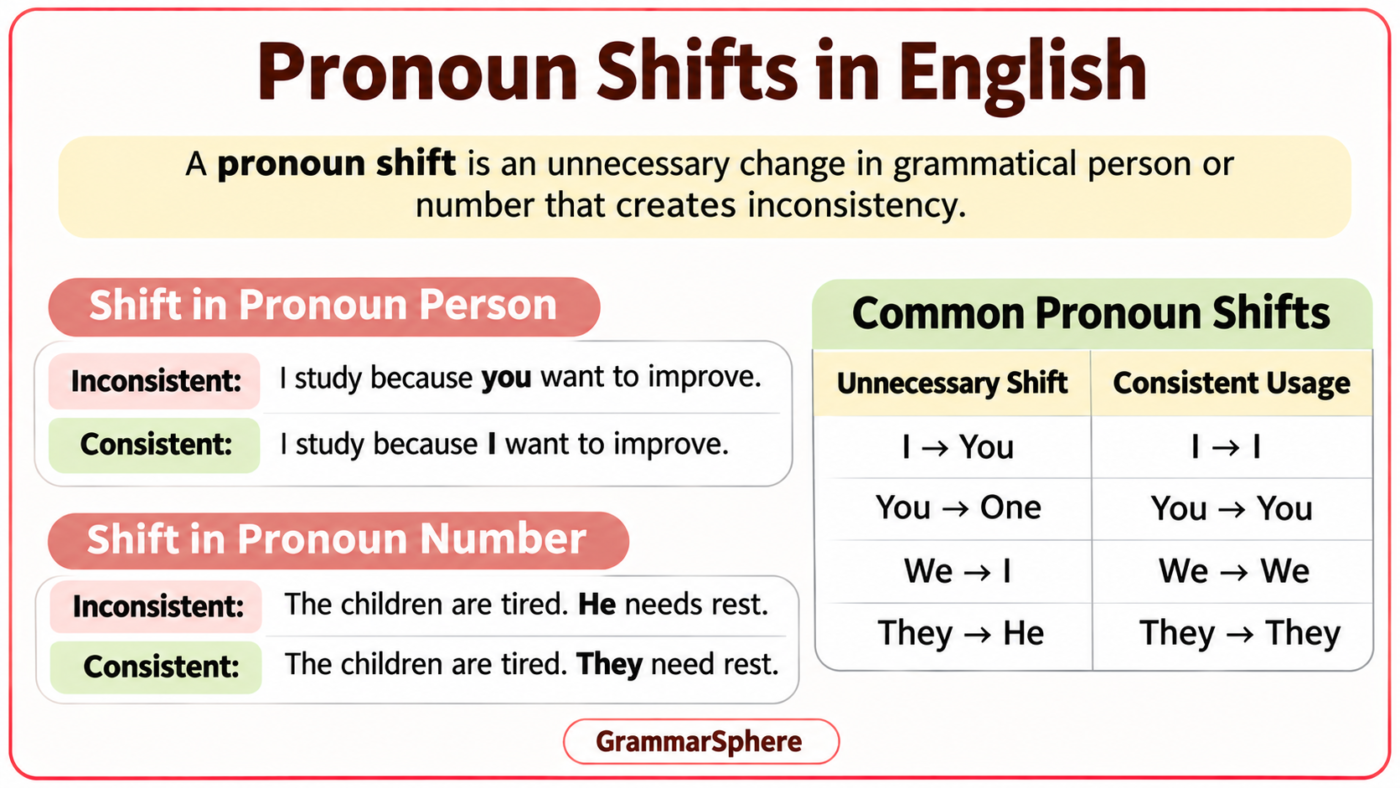
A pronoun shift is an unnecessary change in grammatical person or number that makes a sentence or paragraph inconsistent or confusing.
In simple words, a pronoun shift occurs when we change pronouns without a clear reason while referring to the same person or group.
Example:
Inconsistent: When I prepare for an examination, you need to revise carefully.
Consistent: When I prepare for an examination, I need to revise carefully.
The first sentence changes from I to you. If the speaker is describing their own examination preparation, this change is unnecessary.
The corrected sentence maintains the first-person point of view and makes the intended meaning clear.
However, using different pronouns in the same sentence is not always incorrect. The important point is whether the change has a clear purpose.
Types of Pronoun Shifts in English
Pronoun shifts are commonly discussed in two main forms: shifts in pronoun person and shifts in pronoun number.
1. Shift in Pronoun Person
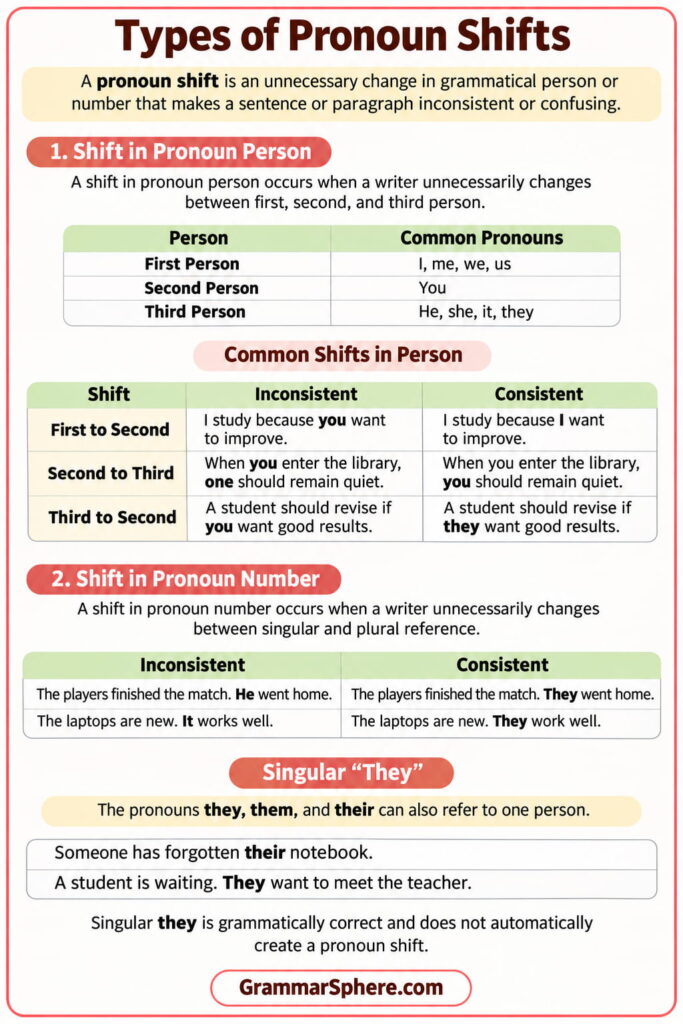
A shift in pronoun person occurs when a sentence or paragraph unnecessarily changes between first, second, and third person.
In English grammar, there are three grammatical persons.
| Person | Common Pronouns | Example |
|---|---|---|
| First person | I, me, we, us | I enjoy reading. |
| Second person | you | You enjoy reading. |
| Third person | he, she, it, they | They enjoy reading. |
First-person pronouns refer to the speaker or writer. Second-person pronouns refer to the person being addressed, while third-person pronouns refer to other people or things.
When discussing the same person or group, we should avoid unnecessary changes between these grammatical persons.
First Person to Second Person
Inconsistent: I study English every evening because you want to improve.
Consistent: I study English every evening because I want to improve.
If the speaker is describing their own learning goals, the change from I to you is unnecessary.
Second Person to Third Person
Inconsistent: When you enter the library, one should remain quiet.
Consistent: When you enter the library, you should remain quiet.
The sentence begins by addressing the reader with you but changes to the general pronoun one. Using you throughout makes the instruction more natural and consistent.
Third Person to Second Person
Inconsistent: A student should revise regularly if you want good results.
Consistent: A student should revise regularly if they want good results.
The sentence begins by discussing a student but then changes to you, which addresses the reader. The corrected sentence uses singular they to maintain the intended reference.
2. Shift in Pronoun Number
A shift in pronoun number occurs when a writer unnecessarily changes between singular and plural reference.
A singular pronoun generally refers to one person or thing, while a plural pronoun refers to more than one.
For example, he, she, and it usually have singular reference. The pronouns we and us refer to a group that includes the speaker. The pronouns they and them can have either singular or plural reference.
Consider this example:
Inconsistent: The players finished the match. He went home. (If all the players went home.)
Consistent: The players finished the match. They went home.
The word players refers to more than one person. If the writer means that all the players went home, they is appropriate. Using he would refer to only one male player.
Another example:
Inconsistent: The laptops are new. It works very well. (If all the laptops work well.)
Consistent: The laptops are new. They work very well.
The plural noun laptops requires an appropriate plural reference when discussing all the laptops.
These examples also involve pronoun–antecedent agreement. A pronoun number error can overlap with an agreement error, but the two concepts are not identical.
Singular “They”
In modern English, they, them, and their can also refer to one person.
Examples:
- Someone has forgotten their notebook.
- A student is waiting outside. They want to meet the teacher.
These sentences are grammatically correct.
Although singular they refers to one person, it takes the usual verb forms used with they.
Correct: They are ready.
Incorrect: They is ready.
Therefore, using singular they is not automatically an incorrect pronoun shift.
Rules for Avoiding Pronoun Shifts
Pronoun consistency helps readers understand who or what a sentence refers to. The following rules explain how to maintain a clear point of view in English writing.
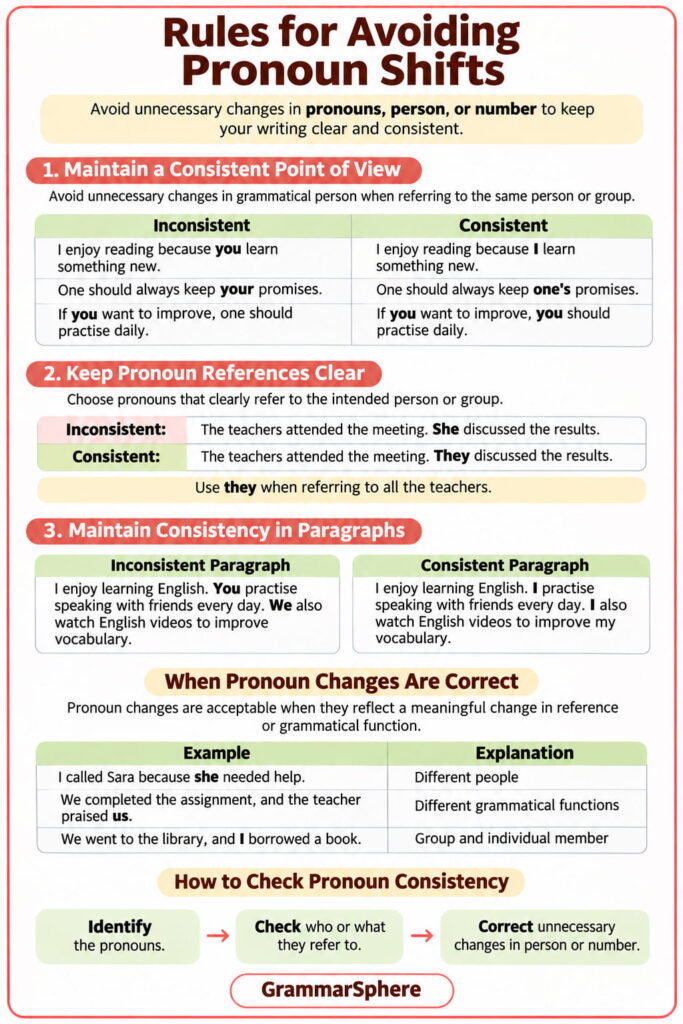
1. Maintain a Consistent Point of View
Point of view refers to the position from which we speak or write.
When describing your own actions or experiences, use first-person pronouns unless the meaning requires a change.
Inconsistent: I enjoy reading books because you learn something new.
Consistent: I enjoy reading books because I learn something new.
If the speaker is describing their own experience, I should be used consistently.
Similarly, when giving advice directly to a reader, maintain the second-person point of view.
Example:
If you want to improve your writing, you should read regularly.
The same principle applies to the general pronoun one, which is more common in formal English.
Inconsistent: One should always keep your promises.
Consistent: One should always keep one’s promises.
A more natural everyday alternative is:
You should always keep your promises.
Both corrected sentences are grammatically acceptable.
2. Keep Pronoun References Clear
Before choosing a pronoun, identify the person or group it refers to.
Inconsistent: The teachers attended the meeting. She discussed the examination results. (If all the teachers discussed them.)
Consistent: The teachers attended the meeting. They discussed the examination results.
Here, they refers to all the teachers.
However, if only one female teacher discussed the results, she could be correct. The writer would need to make that meaning clear.
Pronoun consistency does not mean using the same pronoun in every sentence.
Example:
I called Sara because she needed help.
Here, I refers to the speaker, while she refers to Sara. The change is correct because the pronouns refer to different people.
Similarly:
We completed the assignment, and the teacher praised us.
The pronouns we and us refer to the same group, but they have different grammatical functions. We is a subject pronoun, while us is an object pronoun.
This is not an incorrect pronoun shift.
3. Maintain Pronoun Consistency in Paragraphs
Pronoun shifts can occur across sentences in a paragraph, especially when a writer changes point of view without a clear reason.
Inconsistent Paragraph
I enjoy learning English. You practise speaking with friends every day. We also watch English videos to improve vocabulary.
If the writer intends to describe only their own learning routine, the changes from I to you and we are unnecessary.
Consistent Paragraph
I enjoy learning English. I practise speaking with friends every day. I also watch English videos to improve my vocabulary.
The corrected paragraph maintains the first-person point of view, making it easier to follow the writer’s experience.
Common Pronoun Shift Errors and Corrections
Pronoun shift errors often occur when a writer changes grammatical person or number without considering the intended meaning.
The following examples show common mistakes and their corrections.
| Inconsistent Sentence | Consistent Sentence |
|---|---|
| When I finish my homework, you feel relaxed. | When I finish my homework, I feel relaxed. |
| If you join the library, one must follow its rules. | If you join the library, you must follow its rules. |
| Every driver should check your mirrors. | Every driver should check their mirrors. |
| The children finished lunch. He went outside. (All went outside.) | The children finished lunch. They went outside. |
| We study together because I want to improve our results. (The whole group wants to improve.) | We study together because we want to improve our results. |
In each example, the corrected sentence maintains the intended person or group.
How to Identify and Correct Pronoun Shifts
You can check sentences for unnecessary pronoun changes by following three simple steps.
- Identify the pronouns. Find words such as I, you, we, and they.
- Check their reference. Determine who or what each pronoun refers to.
- Correct unnecessary changes. Keep the intended person or group consistent without changing the meaning.
Example:
Inconsistent: If you want to become a better reader, one should practise daily.
The sentence begins with you but changes to one, although the writer is addressing the same reader.
Corrected: If you want to become a better reader, you should practise daily.
The corrected sentence maintains a consistent point of view.
Pronoun Shift Exercises
Complete the following exercises to test your understanding.
Exercise A: Correct the Pronoun Shifts
Rewrite each sentence so that it refers consistently to the intended person or group.
- When you prepare for a test, one should revise carefully.
- When I wake up early, you have more time to study. (The speaker means themself.)
- A visitor should show your ticket before entering the building.
- The children finished lunch. He went outside to play. (All the children went outside.)
- One should always follow your dreams.
- We share our notes because I want to help each other. (The whole group wants to help one another.)
Exercise B: Identify Correct and Incorrect Pronoun Usage
Decide whether each sentence contains an unnecessary pronoun shift.
- I told Ali that he had forgotten his bag.
- A visitor should keep their ticket until the event ends.
- We went to the library, and I borrowed a book.
- I enjoy playing cricket because you get regular exercise. (The speaker means their own exercise.)
Answers to the Exercises
Exercise A
- When you prepare for a test, you should revise carefully.
- When I wake up early, I have more time to study.
- A visitor should show their ticket before entering the building.
- The children finished lunch. They went outside to play.
- One should always follow one’s dreams.
- We share our notes because we want to help each other.
Exercise B
- Correct. I and he refer to different people.
- Correct. Singular their refers to one visitor.
- Correct. We refers to the group, while I refers to one member of that group. The change is meaningful.
- Inconsistent. If the speaker is describing their own experience, the sentence should read: “I enjoy playing cricket because I get regular exercise.”
FAQs about Pronoun Shifts
What is a pronoun shift in English grammar?
A pronoun shift is an unnecessary change in grammatical person or number that makes a sentence or paragraph inconsistent or confusing.
What are the two main types of pronoun shifts?
The two main types commonly taught are shifts in pronoun person and shifts in pronoun number.
A shift in person changes the point of view, while a shift in number changes between singular and plural reference.
Can “I” and “you” appear in the same sentence?
Yes. These pronouns can appear together when they refer to different people.
Example: I will help you with your homework.
This sentence is grammatically correct.
Is singular “they” an incorrect pronoun shift?
No. Singular they is accepted in modern English when referring to one person.
Example: Someone is calling. They want to speak to you.
What is the difference between a pronoun shift and pronoun–antecedent agreement?
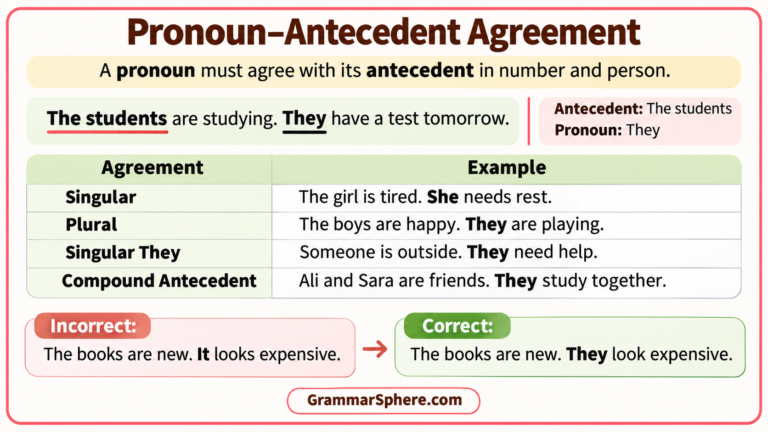
A pronoun shift involves an unnecessary change in grammatical person or number. Pronoun–antecedent agreement concerns whether a pronoun appropriately matches the noun or noun phrase it refers to.
The two problems can overlap, particularly when a writer changes between singular and plural reference.
How can students avoid pronoun shift errors?
Students should identify the person or group being discussed, check the pronouns, and avoid unnecessary changes in point of view or number.
Leave a Comment