

Table of Contents
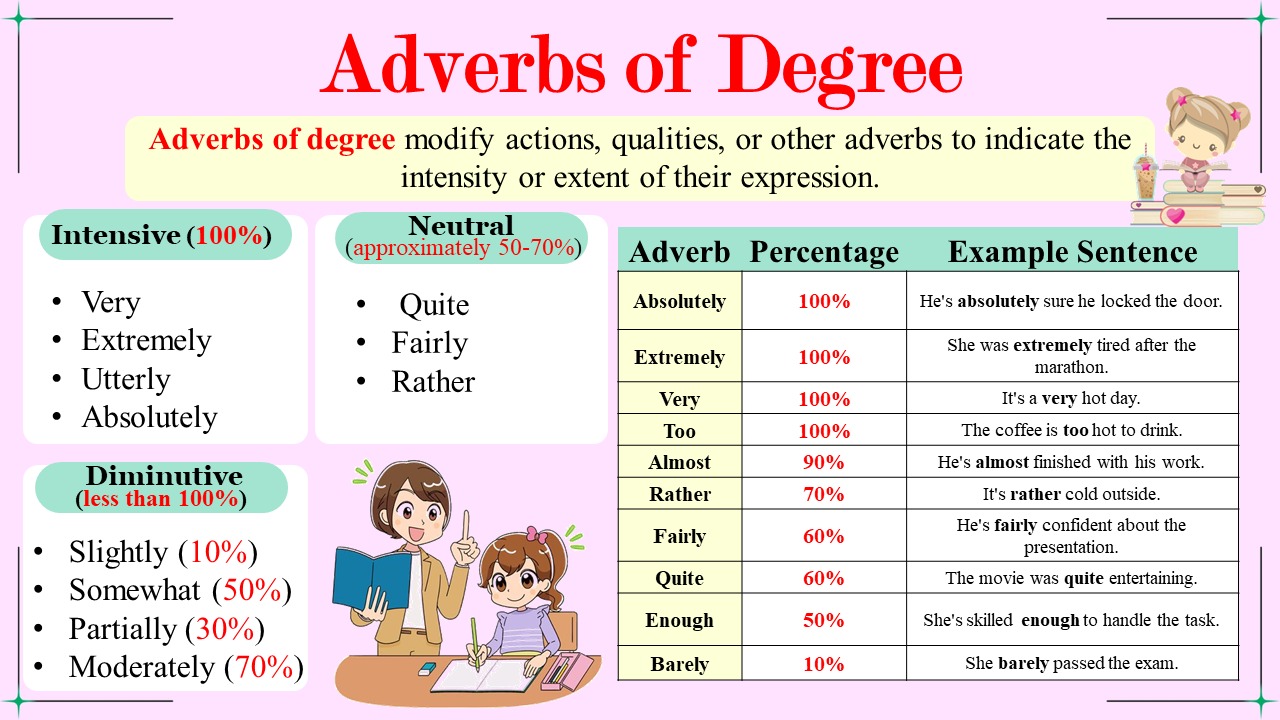
Adverbs of degree tell us how much or to what extent something happens or is true. They are commonly used with verbs, adjectives, and other adverbs to show the degree or intensity of an action, quality, or description.
For example, in She is very happy, the adverb of degree very tells us how happy she is. Common adverbs of degree include very, too, quite, almost, extremely, enough, and completely.
Learning how to use adverbs of degree helps you express different levels of intensity and make your English more precise and natural.
What Is an Adverb of Degree?
An adverb of degree is a word that shows the degree or intensity of an action, quality, or another description. It answers questions such as “how much?” or “to what extent?” and can modify a verb, adjective, or another adverb.
Examples:
- She is very happy. → very modifies the adjective happy.
- I completely agree. → completely modifies the verb agree.
- He walked quite slowly. → quite modifies the adverb slowly.
Common adverbs of degree include very, too, quite, almost, extremely, completely, nearly, and enough.
How to Identify an Adverb of Degree
To identify an adverb of degree, look for a word that shows the degree, intensity, or extent of something.
Ask:
- How much?
- To what extent?
- To what degree?
Then check what the adverb modifies:
- Before an adjective: She was extremely tired.
Extremely shows the degree of tiredness. - Before another adverb: He ran quite quickly.
Quite shows the degree to which he ran quickly. - With a verb: I completely agree with you.
Completely shows the degree of agreement.
Quick Tip: If an adverb tells you the degree or intensity of a verb, adjective, or another adverb, it is likely an adverb of degree.ee. Its position in the sentence can change depending on the adverb it modifies.
Common Adverbs of Degree List
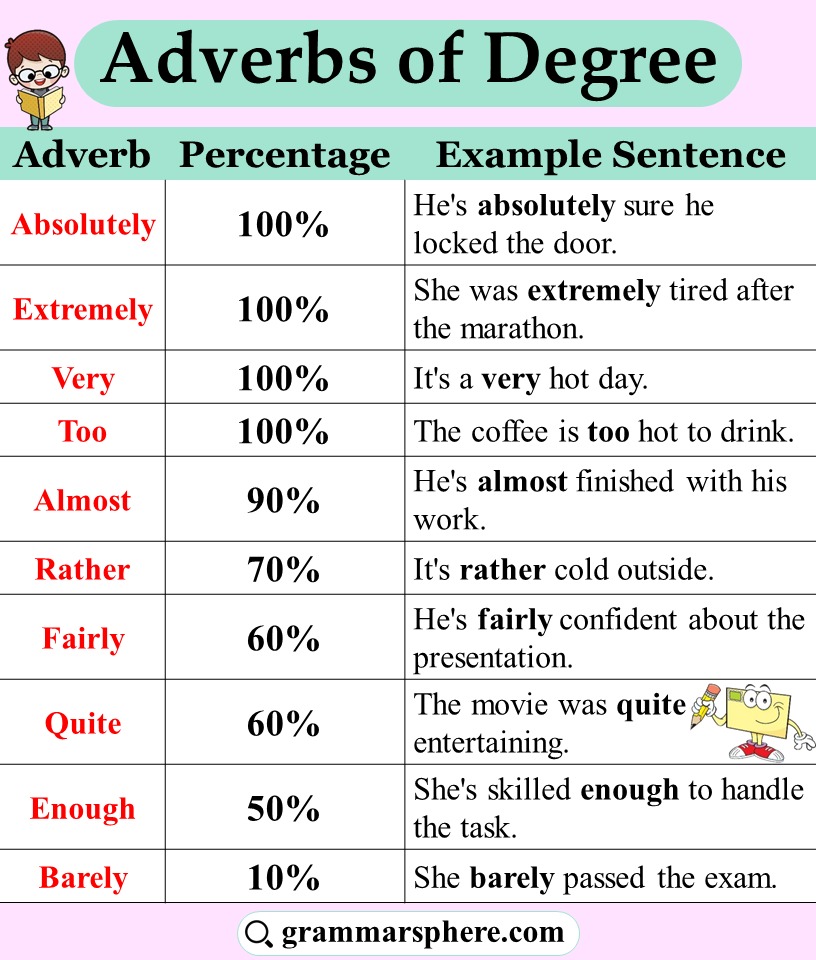
There are many adverbs of degree in English. They can express different levels of intensity, extent, completeness, approximation, or excess. The table below shows some common adverbs of degree, their meanings, and examples.
| Adverb of Degree | Meaning | Example |
|---|---|---|
| Very | High degree | The movie was very interesting. |
| Extremely | Very high degree | It is extremely cold today. |
| Too | More than necessary or desirable | The coffee is too hot. |
| Quite | Fairly or considerably, depending on context | The test was quite difficult. |
| Fairly | Moderate degree | The room is fairly large. |
| Rather | Fairly high degree, often with emphasis | The journey was rather long. |
| Slightly | Small degree | The water is slightly warm. |
| Somewhat | Moderate or limited degree | The instructions were somewhat confusing. |
| Almost | Nearly, but not completely | The bottle is almost empty. |
| Nearly | Close to a point, amount, or state | We are nearly ready. |
| Completely | Total or full degree | The road was completely blocked. |
| Totally | Complete degree | I totally agree with you. |
| Absolutely | Complete or very strong degree | The answer is absolutely correct. |
| Highly | To a high degree | She is highly respected. |
| Partially | Partly; not completely | The building was partially damaged. |
| Perfectly | Completely or exactly | I perfectly understand your concern. |
| Incredibly | Extremely high degree | The view was incredibly beautiful. |
| Just | Exactly or by a small amount, depending on context | The water is just warm enough. |
Position of Adverbs of Degree
The position of an adverb of degree depends on what it modifies and which adverb is being used. Most come before an adjective, adverb, or main verb, but some follow different patterns.
Before an Adjective
Adverbs such as very, extremely, quite, and rather usually come before an adjective.
- She is very kind.
- The water is extremely cold.
Before Another Adverb
An adverb of degree can come before another adverb to change its intensity.
- He walked very slowly.
- She answered quite confidently.
Before a Main Verb
Adverbs such as almost, nearly, and completely can come before a main verb.
- She almost fell.
- They nearly finished the work.
- I completely agree.
After an Adjective or Adverb: Enough
Unlike many adverbs of degree, enough normally comes after an adjective or adverb.
- The water is warm enough.
- He worked quickly enough.
Here, enough means that the required or necessary degree has been reached.
Important: The exact position can depend on the particular adverb and sentence structure, so not every adverb of degree follows the same placement rule.
Different Levels of Degree
Adverbs of degree can express different levels of intensity or completeness. Some indicate a low or moderate degree, while others express a high or complete degree.
| Level of Degree | Common Adverbs | Example |
|---|---|---|
| Low | slightly, somewhat | The water is slightly cold. |
| Moderate | fairly, quite, rather | The test was quite difficult. |
| High | very, extremely, highly | She was extremely tired. |
| Complete | completely, totally, absolutely | The room was completely empty. |
Understanding these levels helps you choose an adverb that expresses the strength or degree of meaning you want.
Adverbs of Degree with Gradable and Non-Gradable Adjectives
Not every adverb of degree can be used naturally with every adjective. The choice often depends on whether an adjective is gradable or non-gradable.
Gradable adjectives can have different levels or degrees. They commonly occur with adverbs such as very, quite, fairly, and extremely.
- very tired
- quite cold
- extremely difficult
Non-gradable adjectives already express an extreme or complete meaning. They are commonly intensified with adverbs such as absolutely, completely, and totally.
- absolutely exhausted
- completely impossible
- totally unacceptable
For example, very tired is natural because tired can have different degrees, while absolutely exhausted is more natural because exhausted already expresses an extreme degree of tiredness.
Rules for Using Adverbs of Degree
Different adverbs of degree do not always have the same meaning or follow the same usage patterns. Keep these important rules in mind:
1. “Very” and “too” have different meanings.
Very shows a high degree, while too means more than is necessary, suitable, or wanted.
- The coffee is very hot. (high degree)
- The coffee is too hot to drink. (more than is suitable)
2. Use “too + adjective/adverb + to” to show excess.
This structure shows that something is excessive and prevents or limits an action.
- The box is too heavy to lift.
- He spoke too quickly to understand.
3. “Enough” comes after an adjective or adverb.
When enough modifies an adjective or adverb, place it after the word it modifies.
- The water is warm enough.
- She spoke clearly enough.
4. Use “adjective/adverb + enough + to” to show sufficient degree.
This structure means that the necessary degree has been reached.
- She is old enough to drive.
- He ran fast enough to win.
5. “Almost” and “nearly” show that something is close to happening or being complete.
- I almost fell.
- We are nearly ready.
- The bottle is almost empty.
They generally mean that something is close to a particular point or state but has not completely reached it.
Common Mistakes with Adverbs of Degree
Learners sometimes confuse the meaning, position, and usage of adverbs of degree. Here are some common mistakes to avoid:
1. Placing “enough” before an adjective
❌ The room is enough warm.
✓ The room is warm enough.
When enough modifies an adjective or adverb, it normally comes after it.
2. Confusing “very” and “too”
❌ The coffee is very hot to drink.
✓ The coffee is too hot to drink.
Use very for a high degree and too when the degree is excessive.
3. Combining “too” and “very” incorrectly
❌ She is too very tired.
✓ She is very tired.
✓ She is too tired to work.
Choose the adverb that expresses the meaning you need rather than combining them unnaturally.
4. Using “too” and “enough” incorrectly together
❌ He didn’t run too fast enough.
✓ He didn’t run fast enough.
✓ He ran too fast.
Too expresses excess, while enough expresses sufficiency.
FAQs
1. What is an adverb of degree?
An adverb of degree shows how much, how strongly, or to what extent something happens or is true. It can modify a verb, adjective, or another adverb.
2. What are some common adverbs of degree?
Common adverbs of degree include very, too, quite, extremely, fairly, rather, slightly, almost, nearly, completely, absolutely, and enough.
3. Where do adverbs of degree go in a sentence?
Many adverbs of degree come before the word they modify, as in very cold, quite slowly, and completely agree. However, some follow different patterns. For example, enough normally comes after an adjective or adverb: warm enough and quickly enough.
4. What is the difference between “very,” “too,” and “enough”?
Very expresses a high degree, too expresses more than is necessary or suitable, and enough expresses the required or sufficient degree.
- very hot = a high degree of heat
- too hot = more heat than is suitable
- hot enough = the required degree of heat
5. Is “enough” always an adverb of degree?
No. Enough can function differently depending on what it modifies. It functions as an adverb when it modifies an adjective or adverb, as in warm enough or quickly enough. Before a noun, as in enough time, it functions differently.
You May Also Like

Leave a Comment