

Table of Contents
Noun gender refers to distinctions associated with male and female people or animals and, in traditional grammar, to the classification of nouns as masculine, feminine, common, or neuter.
Unlike languages with a grammatical gender system, modern English does not normally assign gender to every noun. Most English nouns have the same form regardless of gender.
For example:
- teacher can refer to a man, a woman, or a person of another gender.
- doctor does not change its form according to the gender of the person.
- book and table have no male or female meaning.
However, English can express gender through the meaning of particular nouns, different male and female words, some traditional masculine–feminine forms, and pronoun reference.
father → mother
king → queen
prince → princess
teacher → he, she, or they
Understanding noun gender therefore involves both the traditional classification of nouns and the way gender is actually expressed in modern English.
What Is Noun Gender in English?
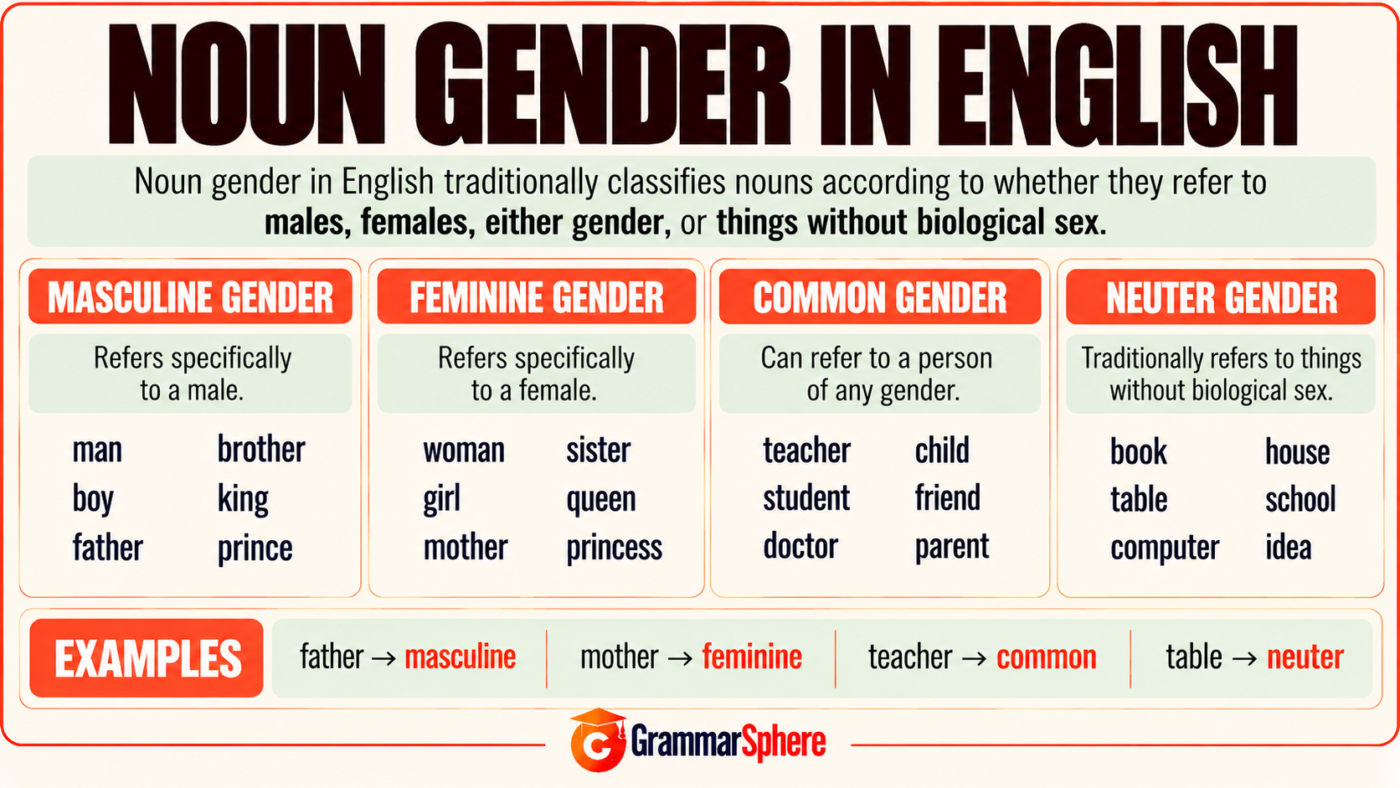
Noun gender tells us whether a noun refers to a male, female, either male or female, or a thing with no gender.
In traditional English grammar, nouns are divided into four gender categories:
- Masculine gender – refers to males
- Feminine gender – refers to females
- Common gender – can refer to either males or females
- Neuter gender – refers to things with no gender
Examples:
table → neuter
man → masculine
woman → feminine
teacher → common
Types of Noun Gender
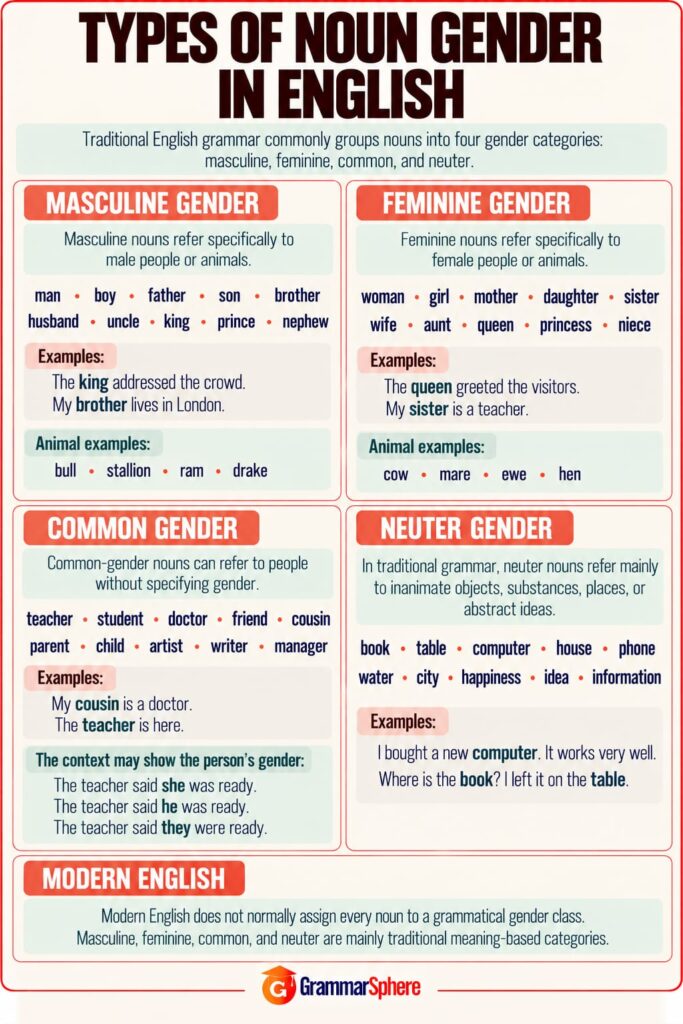
There are four main types of noun gender in English: masculine, feminine, common, and neuter. Learning these types helps you understand whether a noun refers to a male, a female, either one, or something that has no gender.
Masculine Nouns
A masculine noun refers specifically to a male person or animal.
Examples include:
- man
- boy
- father
- son
- brother
- husband
- uncle
- king
- prince
- nephew
For example:
The king addressed the crowd.
My brother lives in London.
In these examples, king and brother have male reference as part of their meaning.
Some animal terms also specifically refer to males:
bull
stallion
ram
drake
These are discussed further in the section on animal nouns.
Feminine Nouns
A feminine noun refers specifically to a female person or animal.
Examples include:
- woman
- girl
- mother
- daughter
- sister
- wife
- aunt
- queen
- princess
- niece
For example:
The queen greeted the visitors.
My sister is a teacher.
Here, queen and sister have female reference as part of their meaning.
Some animal terms also specifically refer to females:
cow
mare
ewe
hen
English also has some traditional feminine forms such as actress, hostess, and heroine. However, modern usage increasingly prefers a gender-neutral form in many occupations and roles when gender is not relevant.
Common-Gender Nouns
In traditional English grammar, a common-gender noun can refer to either a male or a female.
Examples include:
- teacher
- student
- doctor
- friend
- cousin
- parent
- child
- artist
- writer
- lawyer
- manager
- neighbour
For example:
My cousin is a doctor.
Neither cousin nor doctor tells us whether the person is male or female.
The context may provide that information:
My cousin is a doctor. She works at a hospital.
My cousin is a doctor. He works at a hospital.
Or the gender may remain unspecified:
Ask the doctor if they can see you today.
The term common gender is useful in traditional grammar lessons, although in modern descriptions such nouns are often simply described as gender-neutral or as nouns that do not specify sex or gender.
Neuter Nouns
In traditional grammar, a neuter noun refers to something that is not considered male or female, especially an inanimate object, substance, place, or abstract idea.
Examples include:
- book
- table
- computer
- house
- phone
- water
- city
- happiness
- idea
- information
For example:
I bought a new computer. It works very well.
Where is the book? I left it on the table.
These nouns normally take it when a singular pronoun is needed.
However, neuter should be used carefully when describing English. A noun such as table is not assigned to a formal grammatical neuter class in the way nouns may be in languages with grammatical gender. Calling such nouns neuter is mainly part of the traditional English teaching classification.
How Gender Is Expressed in English Nouns
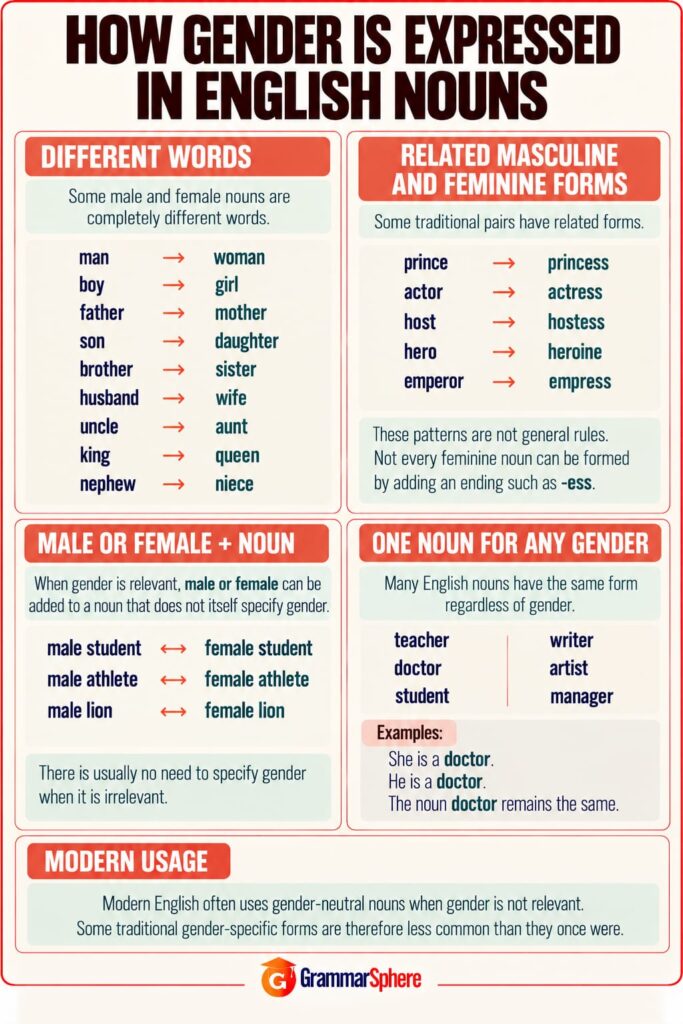
Because English does not normally mark every noun for grammatical gender, male and female distinctions are expressed in several lexical ways.
Different words can express male and female reference.
Some masculine and feminine nouns are completely different words:
| Male | Female |
|---|---|
| man | woman |
| boy | girl |
| father | mother |
| son | daughter |
| brother | sister |
| husband | wife |
| uncle | aunt |
| king | queen |
| nephew | niece |
There is no regular ending that changes father into mother or king into queen. Learners therefore learn these as separate vocabulary items.
Some traditional pairs have related forms.
Examples include:
| Traditionally masculine | Traditionally feminine |
|---|---|
| prince | princess |
| actor | actress |
| host | hostess |
| hero | heroine |
| emperor | empress |
These patterns are not fully productive rules. Learners should not assume that a feminine noun can always be formed by adding -ess or another ending.
In modern English, some traditionally masculine forms are also used neutrally. For example, actor is widely used for people of any gender.
Gender can be specified by adding another word.
When a noun itself does not indicate sex, male or female can be added when that information is genuinely relevant:
a male student
a female student
a male athlete
a female athlete
The same pattern can be used with animals:
a male lion
a female lion
However, there is normally no reason to specify male or female when the distinction is irrelevant.
One noun can be used regardless of gender.
Many English nouns have a single form:
teacher
doctor
student
writer
artist
manager
This is one of the most important characteristics of gender in modern English.
Gender in Animal Nouns
Animal nouns show gender in several different ways.
Some animals have separate terms for males and females:
| Animal | Male | Female |
|---|---|---|
| cattle | bull | cow |
| horse | stallion | mare |
| sheep | ram | ewe |
| chicken | rooster/cock | hen |
| deer | buck/stag | doe |
| duck | drake | duck |
In other cases, the ordinary animal name does not necessarily tell us the sex of the animal:
dog
cat
horse
rabbit
lion
When the sex is unknown or unimportant, the general animal term is normally enough:
There is a dog outside.
We saw three horses in the field.
If necessary, gender can be specified:
a male cat
a female cat
Pronoun choice also depends on context. It is common when the sex of an animal is unknown or unimportant:
A bird flew into the room. It quickly flew out again.
For pets and other animals whose sex is known, he or she is common:
My dog is called Max. He loves playing outside.
Our cat has just eaten. She is sleeping now.
Therefore, animal gender depends both on the vocabulary available for the species and on whether the animal’s sex is relevant in the context.
Gender-Neutral Nouns in Modern English
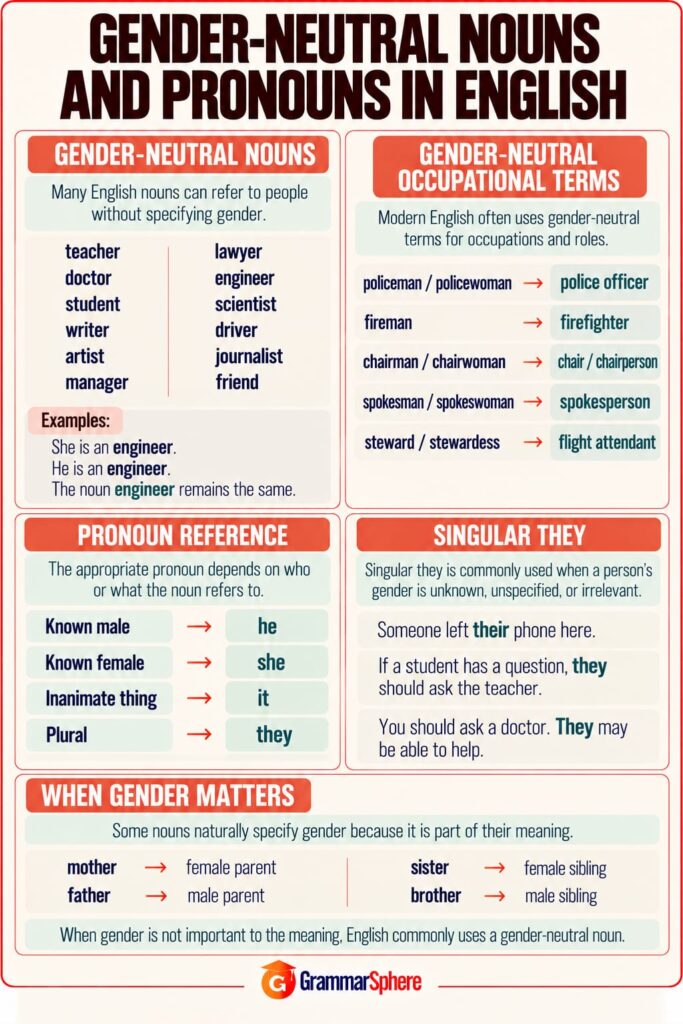
Modern English commonly uses gender-neutral nouns, particularly for occupations, roles, and positions.
Many nouns are already neutral:
- teacher
- doctor
- lawyer
- writer
- manager
- engineer
- scientist
- artist
- driver
- journalist
For example:
She is an engineer.
He is an engineer.
The noun engineer remains the same.
Other occupational terms have developed or shifted toward gender-neutral alternatives:
| Gender-specific or traditional term | Gender-neutral alternative |
|---|---|
| policeman / policewoman | police officer |
| fireman | firefighter |
| chairman / chairwoman | chair / chairperson |
| spokesman / spokeswoman | spokesperson |
| steward / stewardess | flight attendant |
| headmaster / headmistress | headteacher / head |
Gender-neutral forms are especially useful when the person’s gender is unknown, irrelevant, or unnecessary.
However, this does not mean that every gender-specific noun should be replaced. Words such as mother, father, sister, brother, aunt, and uncle remain normal because male or female reference is part of their meaning.
The important question is whether gender is inherent and relevant to the meaning.
Compare:
mother — specifically refers to a female parent
parent — does not specify gender
sister — specifically refers to a female sibling
sibling — does not specify gender
doctor — does not specify gender
Modern English therefore often avoids marking gender when there is no communicative need to do so.
Gender and Pronoun Reference
Gender distinctions in English are often clearer in pronouns than in nouns themselves.
Compare:
David is my brother. He lives in Manchester.
Anna is my sister. She lives in Manchester.
The computer is new. It works perfectly.
The pronouns he and she refer to people according to gender, while it is normally used for inanimate things and may also be used for animals when their sex is unknown or unimportant.
Many human nouns do not specify gender:
teacher
doctor
student
friend
The appropriate pronoun therefore depends on the person being referred to rather than on the grammatical form of the noun.
The doctor said she would call tomorrow.
The doctor said he would call tomorrow.
When a person’s gender is unknown, unspecified, or irrelevant, singular they is commonly used:
If a student has a question, they should ask the teacher.
Someone has left their phone here.
You should ask a doctor. They may be able to help.
This is an important feature of modern English because a gender-neutral noun does not require a masculine or feminine pronoun unless the referent calls for one.
In literary, traditional, or affectionate language, an inanimate thing may occasionally be personified and referred to as he or she. Ships, countries, cars, or other valued objects have sometimes been referred to in this way. In ordinary modern usage, however, it is normally used for inanimate things.
How to Identify the Gender of a Noun
Gender in English is usually identified from the meaning of the noun and its context, not from its grammatical form alone.
Consider these questions:
1. Does the noun specifically refer to a male?
Examples:
father, brother, son, king
These have masculine meaning.
2. Does the noun specifically refer to a female?
Examples:
mother, sister, daughter, queen
These have feminine meaning.
3. Can the noun refer to a person regardless of gender?
Examples:
teacher, doctor, student, friend
These do not inherently specify gender and are traditionally described as common-gender nouns.
4. Does the noun refer to an inanimate thing or abstract idea?
Examples:
book, table, computer, happiness
These are traditionally classified as neuter and normally take it.
5. Does the noun itself actually mark gender?
Do not infer gender simply from a person’s occupation or role.
For example:
nurse
does not mean “female nurse,” and:
engineer
does not mean “male engineer.”
The safest principle is to look at what the noun actually means rather than relying on stereotypes or assuming that every English noun must have a masculine or feminine form.
Common Mistakes with Noun Gender
Treating English as if every noun had grammatical gender
English does not normally divide all nouns into formal grammatical gender classes. The traditional masculine, feminine, common, and neuter categories are primarily useful for describing meaning and reference.
Assuming every occupation needs separate male and female forms
Unnecessary when gender is irrelevant:
female doctor
male teacher
Normally:
doctor
teacher
Add male or female only when the distinction matters.
Automatically forming feminine nouns with -ess
Not every noun has or needs a feminine -ess form.
Some traditional pairs exist:
prince → princess
host → hostess
But -ess is not a general rule for creating feminine nouns, and some traditional forms are less common in modern usage.
Assuming a person’s gender from an occupation
Incorrect assumption:
The nurse said she would come.
if the nurse’s gender is not known.
Better:
The nurse said they would come.
Gender-neutral occupational nouns do not tell us the gender of the person.
Using he automatically when gender is unknown
Instead of:
Every student should bring his book.
modern English commonly allows:
Every student should bring their book.
Using it for a person in ordinary personal reference
Normally incorrect:
My teacher is very helpful. It always explains things clearly. ✗
Use the appropriate personal pronoun:
My teacher is very helpful. She always explains things clearly.
or:
My teacher is very helpful. They always explain things clearly.
when gender is unspecified.
Confusing common-gender nouns with traditional neuter nouns
teacher refers to a person but does not itself specify gender.
table refers to an inanimate thing.
Traditional grammar may classify teacher as common gender and table as neuter, but these categories describe different kinds of reference.
Noun Gender Exercises with Answers
A. Identify the traditional gender category of each noun.
- father
- queen
- teacher
- computer
- brother
- doctor
- daughter
- table
- student
- mother
B. Write the corresponding male or female noun.
- brother → ______
- aunt → ______
- king → ______
- daughter → ______
- nephew → ______
- husband → ______
- mother → ______
- prince → ______
C. Choose the most appropriate pronoun.
- Maria is my sister. ___ lives in London.
- My computer is old, but ___ still works well.
- Someone has forgotten ___ umbrella.
- My dog Max is hungry. ___ hasn’t eaten yet.
- You should ask a doctor. ___ may be able to help.
D. Replace the traditional gender-specific occupational term with a gender-neutral alternative.
- policeman
- fireman
- chairman
- spokesman
- stewardess (on an aircraft)
Answers
- masculine
- feminine
- common gender / gender-neutral
- neuter in the traditional classification
- masculine
- common gender / gender-neutral
- feminine
- neuter in the traditional classification
- common gender / gender-neutral
- feminine
- sister
- uncle
- queen
- son
- niece
- wife
- father
- princess
- She
- it
- their
- He
- They
- police officer
- firefighter
- chair / chairperson
- spokesperson
- flight attendant
Frequently Asked Questions About Noun Gender
What are the traditional genders of nouns in English?
Traditional English grammar commonly describes four categories: masculine, feminine, common, and neuter. These are useful meaning-based categories for learners, but modern English does not generally have a grammatical gender system in which every noun belongs to one of these classes.
Does English have grammatical gender?
Most English nouns do not have grammatical gender. Gender distinctions are mainly expressed through the meanings of particular nouns, lexical choices, and pronoun reference.
What is a common-gender noun?
In traditional grammar, a common-gender noun can refer to a person without specifying whether that person is male or female. Examples include teacher, doctor, student, friend, and cousin.
What is a neuter noun?
In traditional English grammar, nouns referring to inanimate things, substances, places, or abstract ideas are often described as neuter. Examples include book, table, water, and happiness. They normally take it when a singular pronoun is needed.
Can singular “they” be used when a person’s gender is unknown?
Yes. Singular they is commonly used when a person’s gender is unknown, unspecified, or irrelevant: Someone has left their phone here.
You May Also Like
Leave a Comment