

Table of Contents
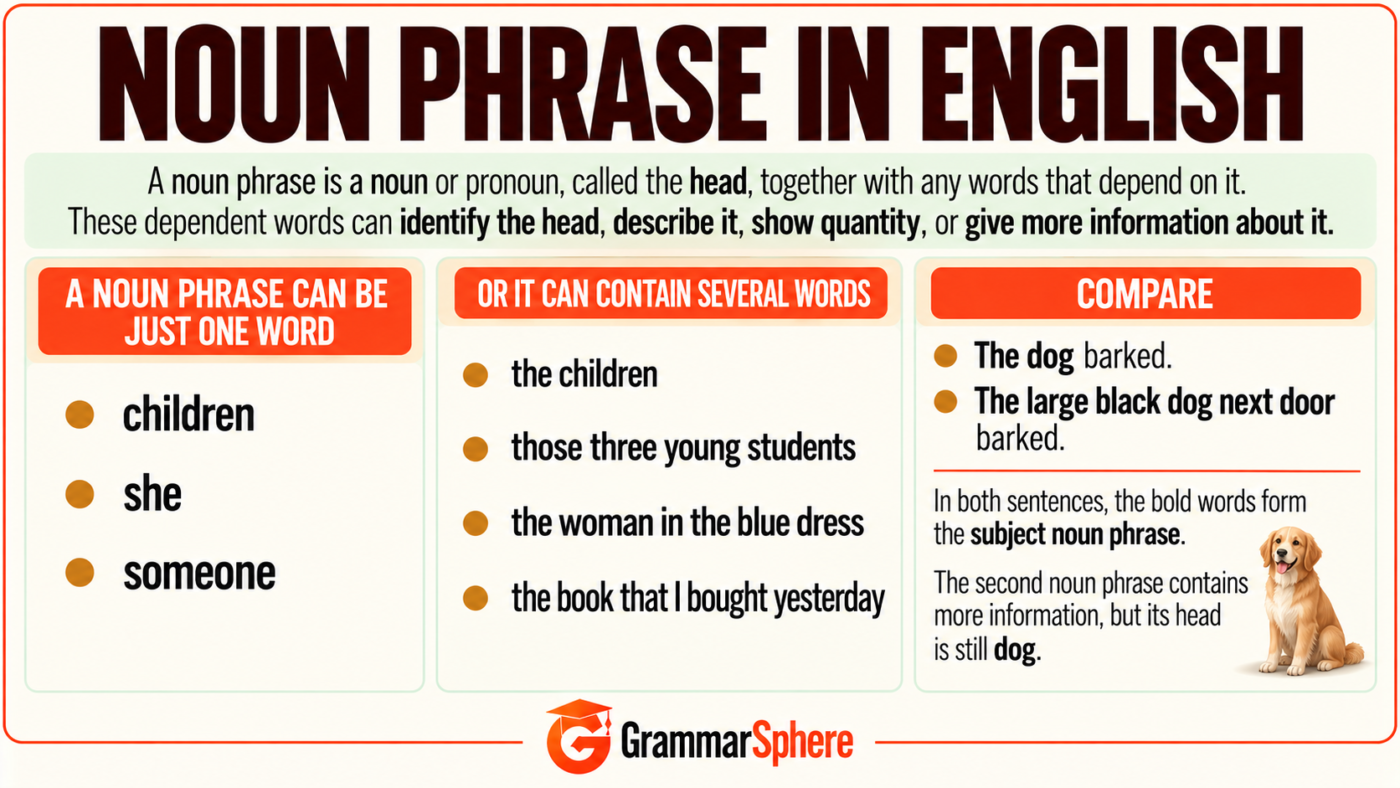
A noun phrase is a noun or pronoun, called the head, together with any words that depend on it. These dependent words can identify the head, describe it, show quantity, or give more information about it.
A noun phrase can be just one word:
- children
- she
- someone
Or it can contain several words:
- the children
- those three young students
- the woman in the blue dress
- the book that I bought yesterday
Noun phrases are an important part of English sentence structure. They commonly function as subjects and objects, but they can also have other functions.
Compare:
- The dog barked.
- The large black dog next door barked.
In both sentences, the bold words form the subject noun phrase. The second noun phrase contains more information, but its head is still dog.
What Is a Noun Phrase?
A noun phrase is a phrase built around a noun or pronoun that functions as its head. Other elements can appear before or after the head.
For example:
the three old houses on the hill
| Element | Example |
|---|---|
| Determiner | the |
| Number | three |
| Premodifier | old |
| Head | houses |
| Postmodifier | on the hill |
The head houses is the central element. The other words help identify, quantify, or describe the houses.
Not every noun phrase contains all these elements.
- books
- the books
- interesting books
- those interesting books
- those interesting books on the shelf
A noun phrase can therefore consist of the head alone or of the head with words before it, after it, or both.
The Head of a Noun Phrase
The head is the central element of a noun phrase. It tells us what the phrase is mainly about.
In:
the expensive new phone
the head is phone.
The other words give us information about the phone, but phone remains the central noun.
More examples:
- the little girl
- several interesting books
- my old school friend
- those beautiful flowers
Finding the head is one of the most useful steps when identifying or analyzing a noun phrase.
Nouns as Heads
A noun commonly functions as the head of a noun phrase.
- the red car
- an interesting story
- those beautiful flowers
- my new computer
The noun determines the central meaning of the phrase.
Pronouns as Heads
A pronoun can also function as the head.
- she
- him
- someone
- nothing
Some pronouns can occur with words that add more information:
- someone helpful
- nothing unusual
- something to eat
- somebody from my class
In each case, the pronoun is the head.
Structure of a Noun Phrase
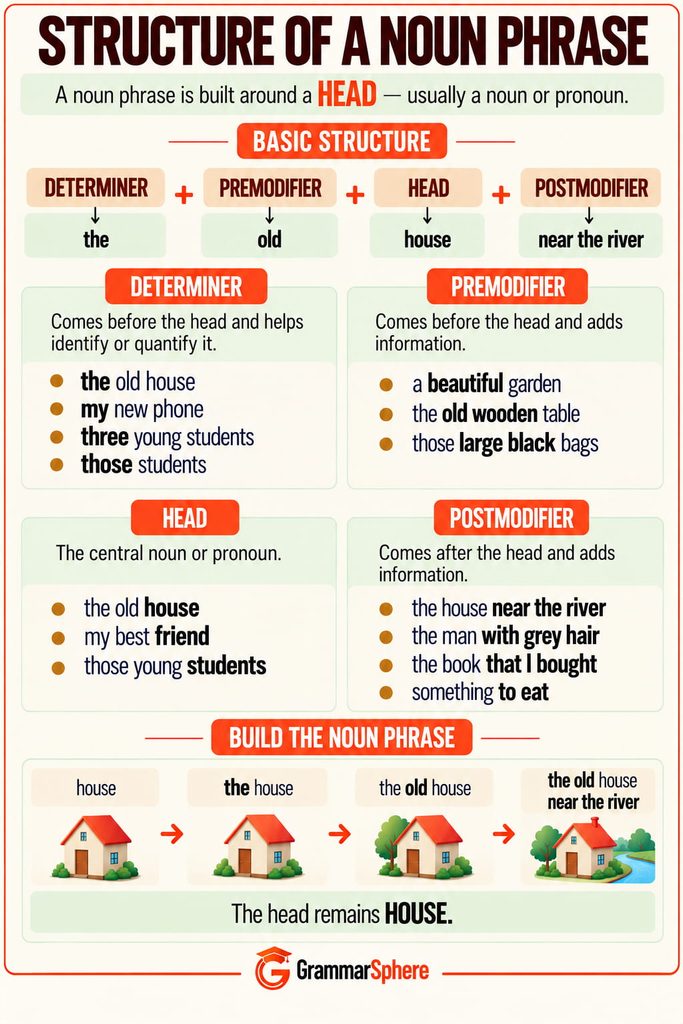
Noun phrases can contain elements before and after the head.
A useful general pattern is:
Determiner(s) + Premodifier(s) + HEAD + Complement/Postmodifier(s)
For example:
the beautiful house near the river
- the → determiner
- beautiful → premodifier
- house → head
- near the river → postmodifier
Another example:
my two favourite books about history
- my two → determiners
- favourite → premodifier
- books → head
- about history → element after the head
This is a general pattern, not a rule that every noun phrase must contain every part.
Compare:
children
→ the children
→ the young children
→ the young children in the garden
The head remains children, while other elements are added around it.
Determiners in Noun Phrases
Determiners come before the head and normally before adjective or noun premodifiers. They help identify the noun or express ideas such as reference, possession, number, or quantity.
Common determiners include:
Articles
- a
- an
- the
Demonstratives
- this
- that
- these
- those
Possessive determiners
- my
- your
- his
- her
- our
- their
Quantifiers
- some
- any
- many
- enough
- every
- all
Numbers
- one
- two
- three
Examples:
- a house
- the old house
- my new phone
- those beautiful flowers
- three students
- some interesting books
- our two children
Not every noun phrase needs an expressed determiner.
Compare:
- Dogs need exercise.
- Water is essential.
- The dogs are outside.
- Some water is in the bottle.
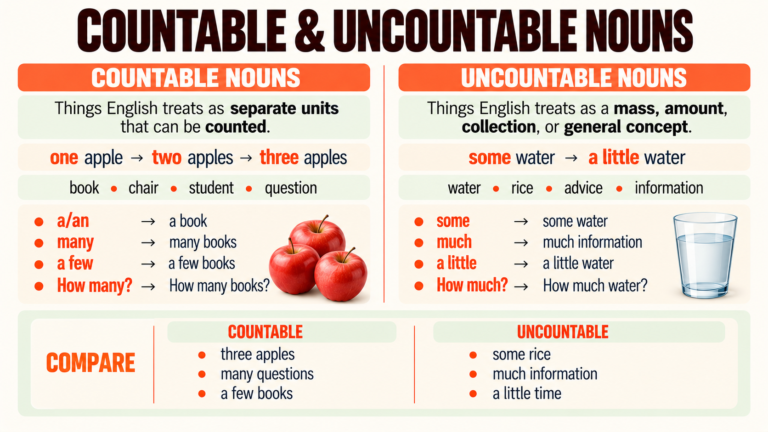
The choice of determiner also depends on factors such as whether the noun is countable or uncountable and singular or plural.
Premodifiers in Noun Phrases
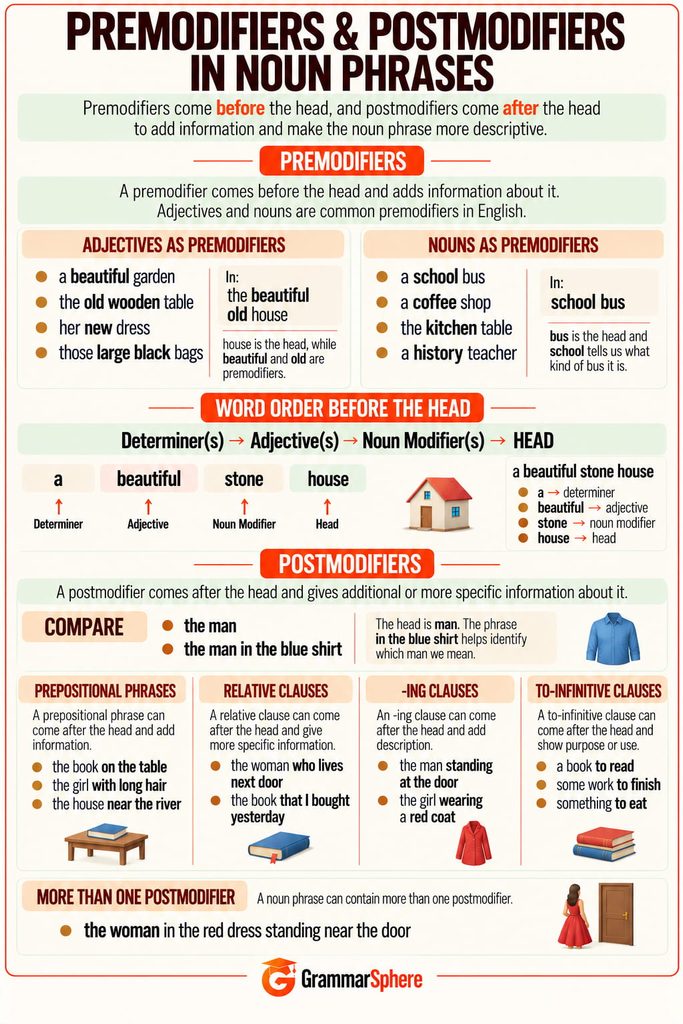
A premodifier comes before the head and adds information about it. Adjectives and nouns are common premodifiers in English.
Adjectives as Premodifiers
Adjectives can describe the qualities or characteristics of the head.
- a beautiful garden
- the old wooden table
- her new dress
- those large black bags
In:
the beautiful old house
house is the head, while beautiful and old are premodifiers.
An adjective phrase can also function as a premodifier:
- a very expensive car
- an extremely difficult question
Nouns as Premodifiers
A noun can come before another noun and modify it.
- a school bus
- a coffee shop
- the kitchen table
- a government report
- a history teacher
In school bus, bus is the head and school tells us what kind of bus it is.
Nouns used as premodifiers are normally singular in form:
- a shoe shop
- a car park
- four metal boxes
Not normally:
- a shoes shop
- a cars park
- four metals boxes
Measurement expressions used before nouns also normally have a singular form:
- a ten-minute break
- a two-hour meeting
- a five-day trip
Word Order Before the Head
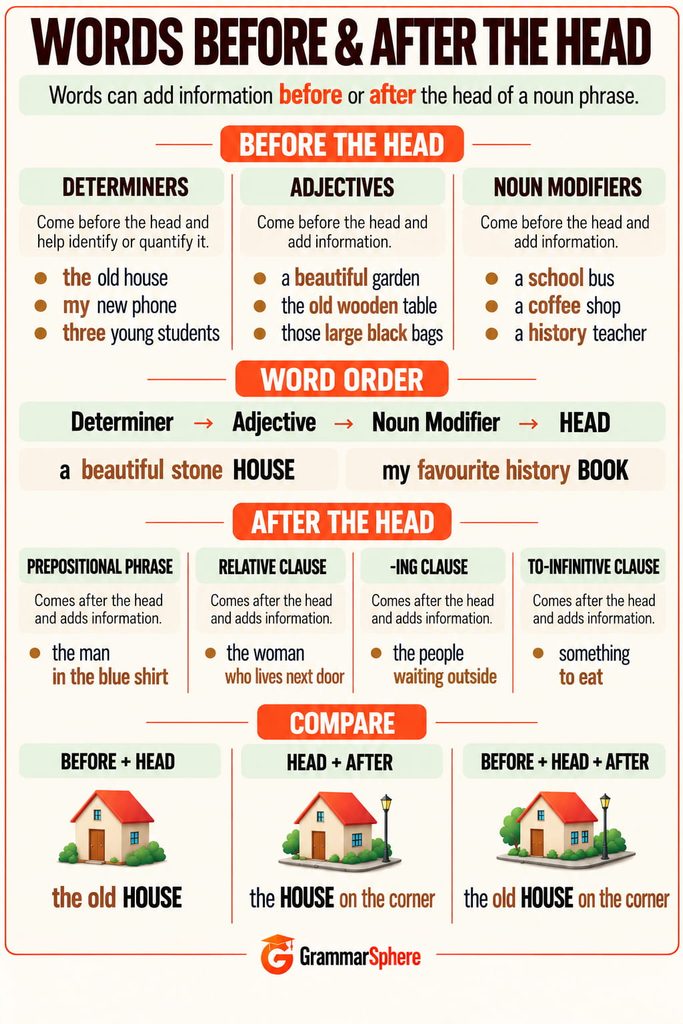
Elements before the head generally follow an established order.
A useful basic pattern is:
Determiner(s) → Adjective(s) → Noun Modifier(s) → HEAD
For example:
a beautiful stone house
- a → determiner
- beautiful → adjective
- stone → noun modifier
- house → head
More examples:
- a heavy iron gate
- my favourite history book
- those large kitchen windows
- my two best friends
This is why a beautiful leather bag sounds natural, while a leather beautiful bag does not follow normal English adjective and noun-modifier order.
Postmodifiers in Noun Phrases
A postmodifier comes after the head and gives additional or more specific information about it.
Compare:
the man
and:
the man in the blue shirt
The head is man. The phrase in the blue shirt helps identify which man we mean.
Several structures can function as postmodifiers.
Prepositional Phrases
Prepositional phrases are very common after nouns.
- the book on the table
- the girl with long hair
- the house near the river
- the students in my class
Relative Clauses
A relative clause can modify the head.
- the woman who lives next door
- the book that I bought yesterday
- the students who passed the exam
- the house which stands on the corner
-ing Clauses
An -ing clause can give information about the head.
- the man standing at the door
- the girl wearing a red coat
- the people waiting outside
To-Infinitive Clauses
A to-infinitive clause can also occur after a noun or pronoun.
- a book to read
- some work to finish
- something to eat
- a place to stay
A noun phrase can contain more than one postmodifier:
the woman in the red dress standing near the door
Here, in the red dress and standing near the door both add information about woman.
Complements in Noun Phrases
Some elements after the head are closely connected to the meaning of the noun and are needed to complete that meaning. These are called complements.
Examples include:
- a feeling of fear
- a rise in prices
- the fact that he was absent
- the idea that we should leave early
Compare:
a feeling of fear
The phrase of fear completes what is meant by feeling.
the woman in the red dress
The phrase in the red dress adds information that helps identify woman, but the noun woman does not require it to complete its meaning.
This gives us an important distinction:
Complement → completes the meaning of the head.
Postmodifier → adds extra or identifying information about the head.
For many everyday noun phrases, learners do not need to label every element as a complement or postmodifier. The important first step is to recognize the head and understand how the words after it relate to that head.
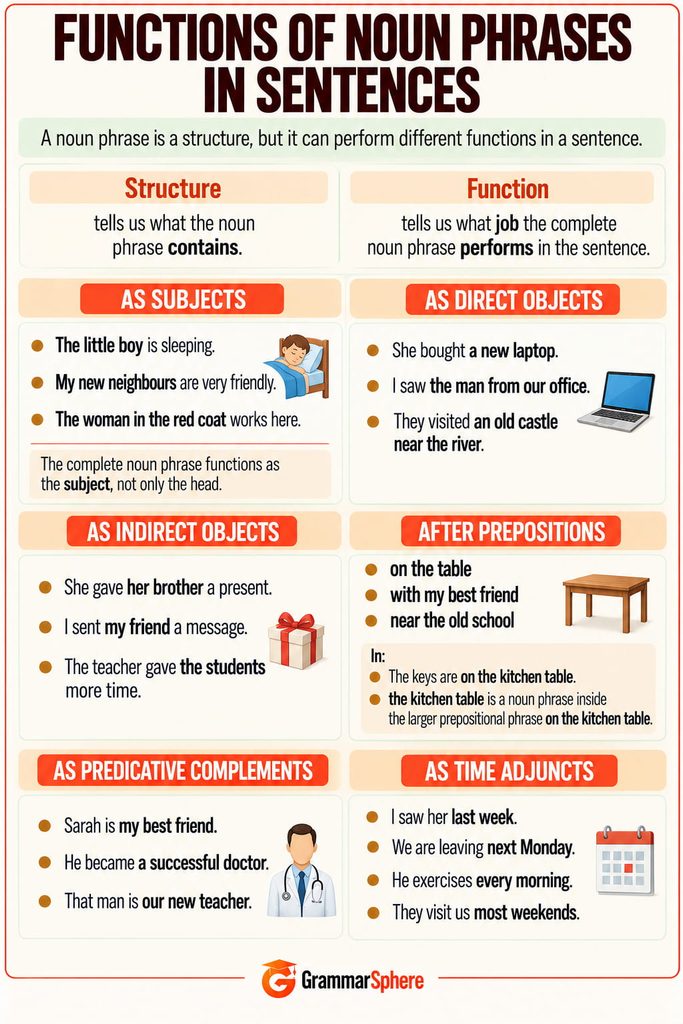
Functions of Noun Phrases in Sentences
A noun phrase is a structure, but it can perform different functions in a sentence.
This distinction is important:
Structure tells us what the noun phrase contains.
Function tells us what job the complete noun phrase performs in the sentence.
Noun Phrases as Subjects
Noun phrases commonly function as subjects.
- The little boy is sleeping.
- My new neighbours are very friendly.
- The woman in the red coat works here.
- Those three students near the window are talking.
The complete noun phrase functions as the subject, not only the head.
In:
The tall man with grey hair is my teacher.
the complete subject is the tall man with grey hair.
Noun Phrases as Direct Objects
A noun phrase can function as a direct object.
- She bought a new laptop.
- I saw the man from our office.
- They visited an old castle near the river.
- We watched the new film.
Noun Phrases as Indirect Objects
A noun phrase can function as an indirect object.
- She gave her brother a present.
- I sent my friend a message.
- The teacher gave the students more time.
Noun Phrases After Prepositions
A noun phrase can function as the complement of a preposition.
- on the table
- with my best friend
- near the old school
- for her birthday
In:
The keys are on the kitchen table.
the kitchen table is a noun phrase inside the larger prepositional phrase on the kitchen table.
Noun Phrases as Predicative Complements
A noun phrase can identify or classify the subject after a linking verb such as be or become.
- Sarah is my best friend.
- He became a successful doctor.
- That man is our new teacher.
The noun phrase refers to or identifies the subject.
Noun Phrases as Time Adjuncts
Some noun phrases can function as time adjuncts.
- I saw her last week.
- We are leaving next Monday.
- He exercises every morning.
- They visit us most weekends.
These noun phrases tell us when or how often something happens.
How to Identify a Noun Phrase
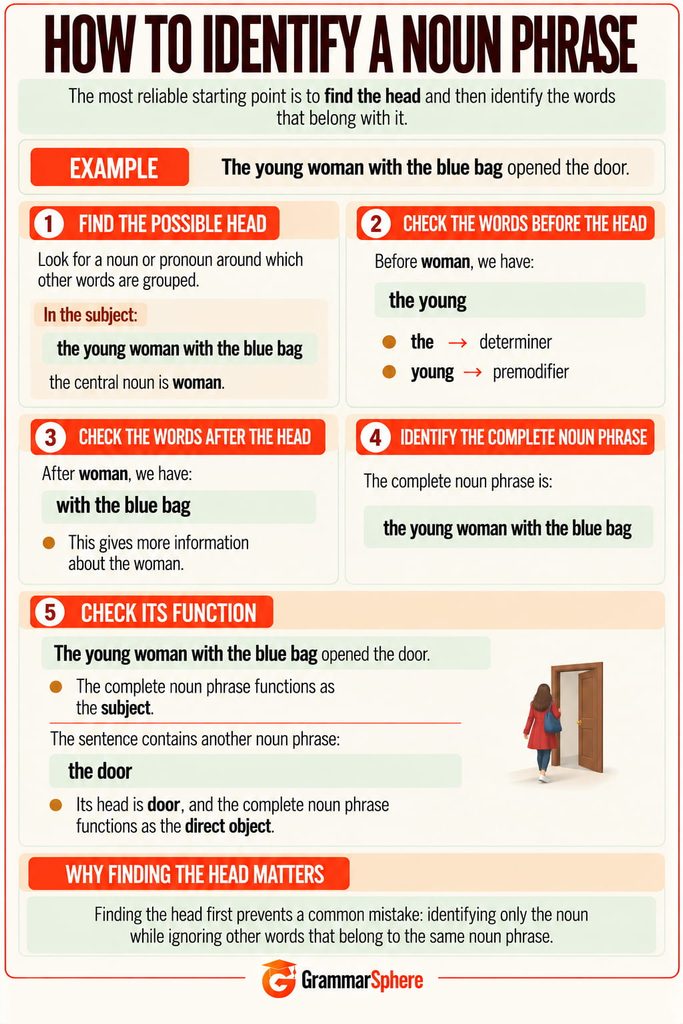
The most reliable starting point is to find the head and then identify the words that belong with it.
Consider:
The young woman with the blue bag opened the door.
1. Find the Possible Head
Look for a noun or pronoun around which other words are grouped.
In the subject:
the young woman with the blue bag
the central noun is woman.
2. Check the Words Before the Head
Before woman, we have:
the young
- the → determiner
- young → premodifier
3. Check the Words After the Head
After woman, we have:
with the blue bag
This gives more information about the woman.
4. Identify the Complete Noun Phrase
The complete noun phrase is:
the young woman with the blue bag
5. Check Its Function
The young woman with the blue bag opened the door.
The complete noun phrase functions as the subject.
The sentence contains another noun phrase:
the door
Its head is door, and the complete noun phrase functions as the direct object.
Finding the head first prevents a common mistake: identifying only the noun instead of the complete noun phrase.
Noun Phrases and Subject–Verb Agreement
When a noun phrase functions as the subject, the head normally determines whether the verb is singular or plural.
Compare:
- The student in the front row is asking a question.
- The students in the front row are asking questions.
In the first sentence, the head student is singular, so the verb is is.
In the second, students is plural, so the verb is are.
Longer noun phrases can sometimes cause confusion:
- The box of old photographs is upstairs.
- The boxes of old photographs are upstairs.
The noun photographs is close to the verb, but it is not the head of the subject noun phrase.
Compare the heads:
box → is
boxes → are
Finding the head therefore helps with both noun-phrase analysis and subject–verb agreement.
Common Mistakes with Noun Phrases
Using the wrong word order
✗ a leather beautiful bag
✓ a beautiful leather bag
Adjectives normally come before nouns used as modifiers.
Using a plural noun incorrectly as a premodifier
✗ a shoes shop
✓ a shoe shop
Nouns used as premodifiers are normally singular.
Making a measurement modifier plural
✗ a two-hours meeting
✓ a two-hour meeting
Measurement expressions used before a noun normally have a singular form.
Identifying only the head as the complete noun phrase
Sentence:
The tall boy near the window is my cousin.
Head:
boy
Complete subject noun phrase:
the tall boy near the window
The head is part of the noun phrase, but it is not always the complete phrase.
Choosing the verb according to a nearby noun
✗ The box of books are heavy.
✓ The box of books is heavy.
The head of the subject noun phrase is singular box, so the verb must be singular.
Assuming a noun phrase must contain several words
A noun phrase can consist of a single noun or pronoun:
- Children laughed.
- She smiled.
The word phrase does not mean that a noun phrase must always contain several words in this grammatical analysis.
Noun Phrase Practice
Identify the complete noun phrase in bold and give its head.
- The little girl smiled at me.
- I bought a new phone yesterday.
- The man in the black coat is waiting outside.
- We visited an old house near the river.
- Those three young students won the competition.
Identify the function of the bold noun phrase.
Choose from:
subject • direct object • indirect object • complement of a preposition • predicative complement • time adjunct
- My younger brother plays football.
- She bought a beautiful dress.
- I gave my friend a book.
- We sat beside the old tree.
- Daniel is our new manager.
- I saw her last week.
Choose the correct form.
- a two-hour / hours meeting
- a shoe / shoes shop
- The box of books is / are heavy.
- The students in my class is / are preparing for the exam.
- a leather beautiful / beautiful leather bag
Answers
- the little girl — head: girl
- a new phone — head: phone
- the man in the black coat — head: man
- an old house near the river — head: house
- those three young students — head: students
- subject
- direct object
- indirect object
- complement of a preposition
- predicative complement
- time adjunct
- hour
- shoe
- is
- are
- beautiful leather
FAQs
What is a noun phrase in English?
A noun phrase is a grammatical unit built around a noun or pronoun called the head. It may contain determiners, modifiers, complements, or other dependent elements.
What is the head of a noun phrase?
The head is the central noun or pronoun in the phrase. In the beautiful old house, the head is house.
Can a noun phrase contain only one word?
Yes. A noun or pronoun can form a noun phrase by itself. For example, children in Children are playing and she in She smiled function as noun phrases.
What comes before the head in a noun phrase?
Determiners and premodifiers can come before the head. For example, in those three beautiful houses, houses is the head and the other words occur before it.
What can come after the head in a noun phrase?
Complements and postmodifiers can occur after the head. These can include prepositional phrases and clauses, such as on the table in the book on the table.
What is the difference between a noun and a noun phrase?
A noun is a word class, such as book, teacher, or city. A noun phrase is a grammatical unit built around a noun or pronoun and may contain other elements. For example, book is a noun, while the interesting book on the table is a noun phrase headed by book.
What is the difference between a noun phrase and a clause?
A noun phrase is built around a noun or pronoun as its head. A clause is built around a verb and expresses a situation, event, or state.
Can a noun phrase be a subject or an object?
Yes. Noun phrases commonly function as subjects and objects.
- The new student arrived. → subject
- I met the new student. → direct object
Final Takeaway
A noun phrase is built around a noun or pronoun called the head. It may consist of the head alone or include determiners and modifiers before the head and complements or postmodifiers after it.
A useful way to understand noun phrases is to:
- find the head;
- identify the words that belong with it;
- identify the complete noun phrase;
- determine its function in the sentence.
Understanding the head and the structure around it makes noun phrases much easier to identify and use correctly.
You May Also Like
Leave a Comment