

Table of Contents
English sometimes places two noun expressions together to identify or give more information about the same person or thing.
In this article, you will learn how appositives work, when commas are needed, and how to identify and use them correctly.
What Is an Appositive?
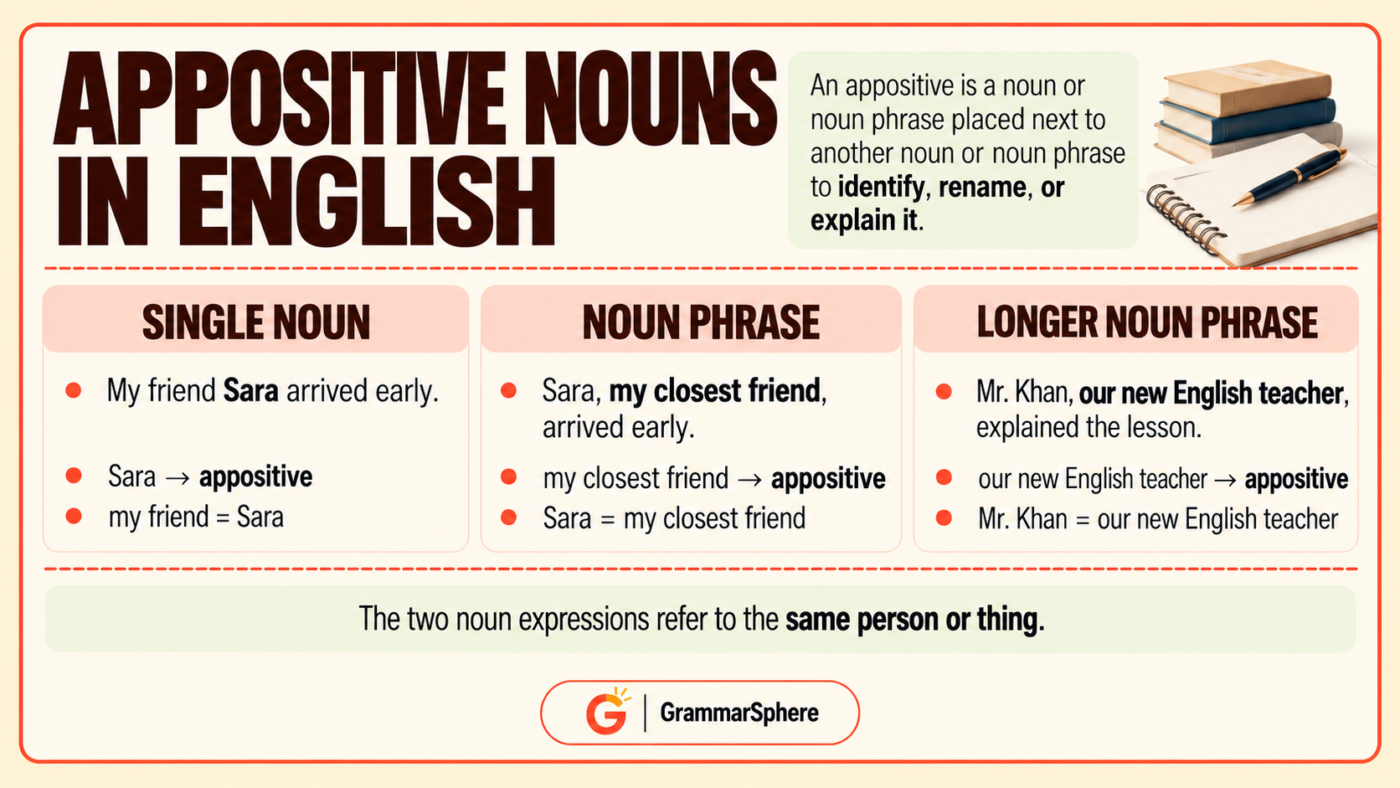
An appositive is a noun or noun phrase placed next to another noun or noun phrase to identify, rename, or explain it.
For example:
My brother Ahmed is a doctor.
Here, Ahmed identifies my brother. Both refer to the same person.
Ahmed, my older brother, is a doctor.
Here, my older brother gives more information about Ahmed.
Nouns and Noun Phrases as Appositives
An appositive can be a single noun or a noun phrase.
A single noun can be an appositive:
My friend Sara arrived early.
A noun phrase can also be an appositive:
Sara, my closest friend, arrived early.
Mr. Ahmed, our new English teacher, explained the lesson.
Lahore, a historic city in Pakistan, attracts many visitors.
Essential vs. Nonessential Appositives
An appositive can be essential or nonessential.
Essential Appositives
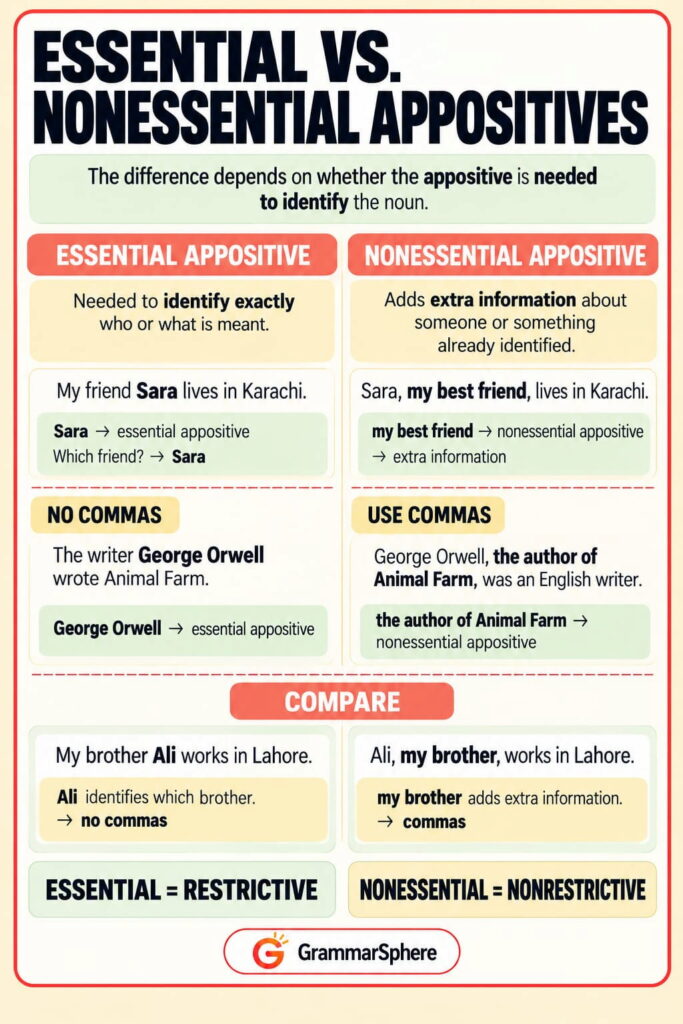
An essential appositive is needed to identify exactly who or what we mean.
For example:
My friend Sara lives in Karachi.
Sara tells us which friend.
The writer George Orwell wrote Animal Farm.
George Orwell identifies which writer is meant.
Nonessential Appositives
A nonessential appositive gives extra information about a noun that is already clearly identified.
For example:
Sara, my best friend, lives in Karachi.
My best friend adds information about Sara.
George Orwell, the author of Animal Farm, was an English writer.
The author of Animal Farm adds information about George Orwell.
Compare:
My brother Ali works in Lahore.
→ Ali identifies which brother.
Ali, my brother, works in Lahore.
→ my brother adds extra information.
Restrictive vs. Nonrestrictive Appositives
The terms restrictive and nonrestrictive are alternative terms for the same distinction:
- essential = restrictive
- nonessential = nonrestrictive
Commas and Punctuation with Appositives
Essential appositives are not normally separated by commas:
My friend Sara called me.
The poet Robert Frost wrote many famous poems.
Nonessential appositives are normally separated by commas:
Sara, my best friend, called me.
Robert Frost, an American poet, wrote many famous poems.
When a nonessential appositive appears in the middle of a sentence, use a comma before and after it:
My father, a schoolteacher, works in Multan.
When a nonessential appositive appears at the end of a sentence, a comma normally introduces it:
I spoke to Ahmed, our new manager.
Position of Appositives in Sentences
An appositive usually comes after the noun it identifies or explains:
Sara, my younger sister, studies medicine.
It can also come before the noun:
A talented musician, Sara performs at local events.
An appositive may also appear at the end of a sentence:
I finally met the new manager, Mr. Ahmed.
How to Identify an Appositive
Follow these steps.
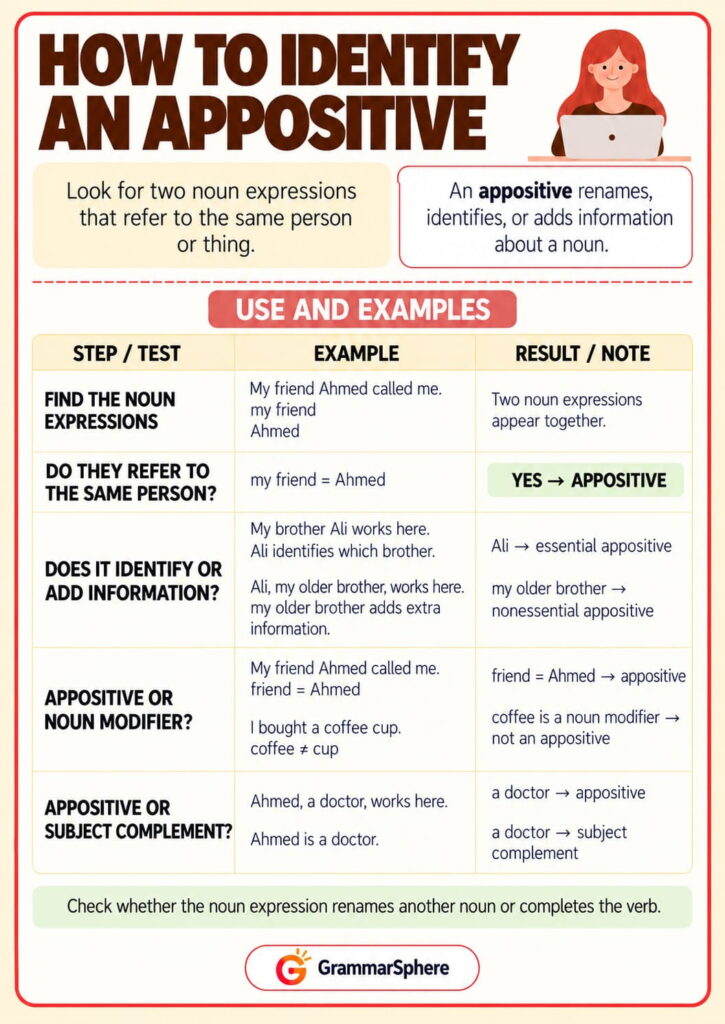
1. Find two nouns or noun phrases close together.
My friend Sara arrived early.
2. Check whether they refer to the same person or thing.
my friend = Sara
So Sara is an appositive.
3. Check whether the appositive identifies the noun or adds information about it.
My brother Ali works here.
→ Ali identifies my brother.
Ali, my older brother, works here.
→ my older brother adds information about Ali.
4. Check whether the two expressions really refer to the same person or thing.
Compare:
My friend Ahmed called me.
→ friend = Ahmed
→ appositive
I bought a coffee cup.
→ coffee ≠ cup
→ not an appositive
In coffee cup, coffee modifies cup rather than renaming it.
Common Mistakes with Appositives
1. Using commas around an essential appositive
My friend, Sara, called me. ✗
My friend Sara called me. ✓
2. Leaving out commas around a nonessential appositive
Sara my best friend called me. ✗
Sara, my best friend, called me. ✓
3. Using only one comma around a nonessential appositive
My brother, a teacher works in Lahore. ✗
My brother, a teacher, works in Lahore. ✓
4. Treating every pair of nouns as an appositive
coffee shop → not an appositive
my friend Ahmed → appositive
In coffee shop, coffee modifies shop.
5. Confusing an appositive with a subject complement
Ahmed, a doctor, works here.
→ a doctor = appositive
Ahmed is a doctor.
→ a doctor = subject complement
Appositive Nouns Exercises with Answers
A. Identify the Appositive
- My friend Sara studies medicine.
- Ahmed, our class monitor, collected the notebooks.
- We visited Islamabad, the capital of Pakistan.
- The writer George Orwell wrote Animal Farm.
- My uncle, a successful businessman, lives abroad.
B. Essential or Nonessential?
- My brother Ali works in Lahore.
- Ali, my older brother, works in Lahore.
- The poet Robert Frost wrote many famous poems.
- Robert Frost, an American poet, wrote many famous poems.
- My friend Sara studies medicine.
C. Add Commas Where Needed
- Sara my best friend lives next door.
- My friend Ahmed lives next door.
- Mr. Khan our English teacher explained the lesson.
- The writer George Orwell wrote Animal Farm.
- Lahore a historic city attracts many visitors.
D. Appositive or Not?
- My friend Ahmed called me.
- She works at a language school.
- The writer George Orwell became famous worldwide.
- I bought a coffee cup.
- Our teacher, Mrs. Khan, entered the room.
Answers
A
- Sara
- our class monitor
- the capital of Pakistan
- George Orwell
- a successful businessman
B
- essential
- nonessential
- essential
- nonessential
- essential
C
- Sara, my best friend, lives next door.
- My friend Ahmed lives next door.
- Mr. Khan, our English teacher, explained the lesson.
- The writer George Orwell wrote Animal Farm.
- Lahore, a historic city, attracts many visitors.
D
- appositive
- not an appositive
- appositive
- not an appositive
- appositive
FAQs About Appositive Nouns
Do appositives always need commas?
No. Nonessential appositives are normally separated by commas, while essential appositives are not.
My friend Sara called me.
→ essential; no commas
Sara, my best friend, called me.
→ nonessential; commas
How can I tell if an appositive is essential or nonessential?
Ask whether the appositive is needed to identify the person or thing.
My brother Ali lives in Lahore.
→ Ali identifies which brother, so it is essential.
Ali, my brother, lives in Lahore.
→ my brother adds extra information, so it is nonessential.
How do I identify an appositive in a sentence?
Look for two noun expressions that refer to the same person or thing.
My friend Ahmed arrived early.
Here:
my friend = Ahmed
So Ahmed is an appositive.
What is the difference between an appositive and an appositive phrase?
An appositive can be a single noun:
My friend Sara arrived.
An appositive phrase contains more than one word:
Sara, my closest friend, arrived.
Both perform the same basic function.
What is the difference between an appositive and a noun modifier?
You May Also Like
Leave a Comment