

Table of Contents
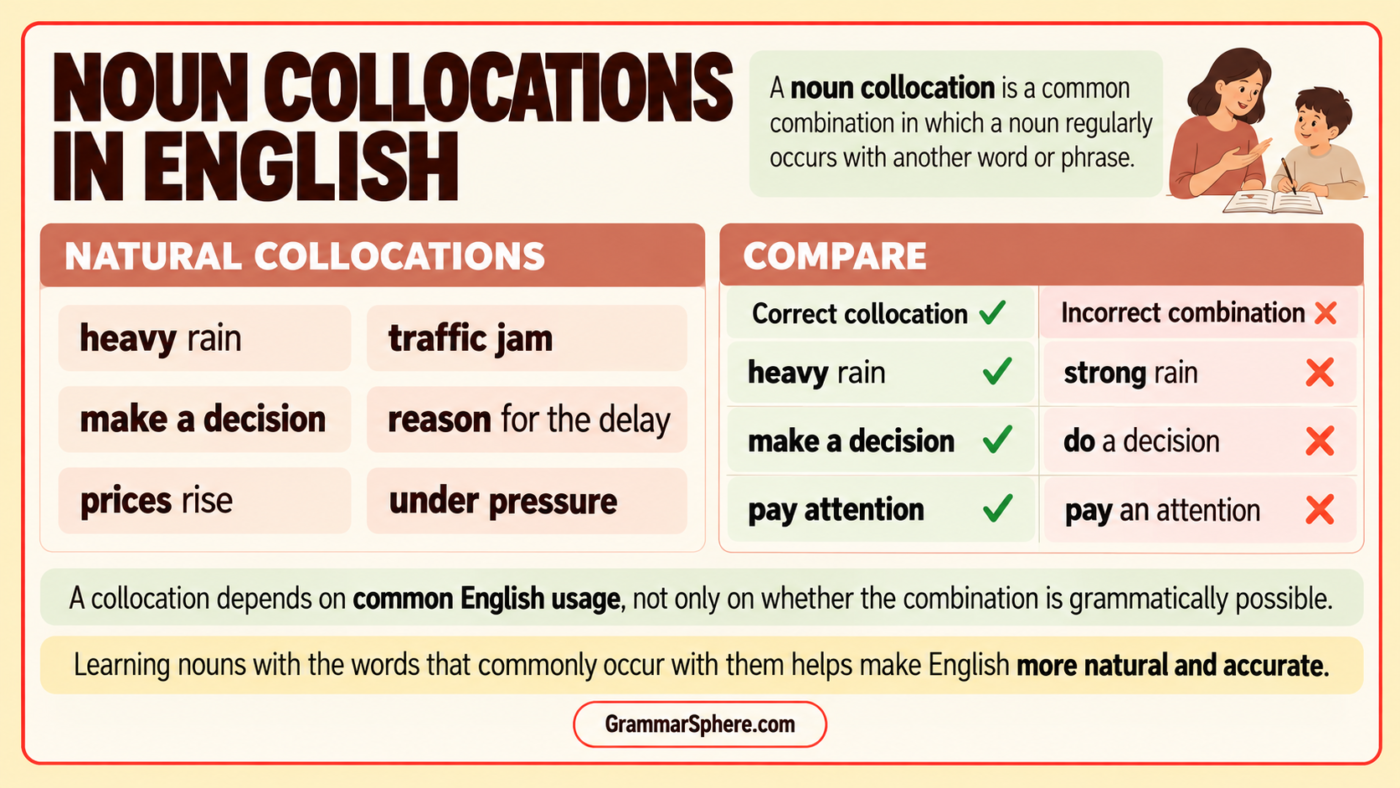
English words often occur together in familiar combinations. We normally say heavy rain, make a decision, and pay attention because these combinations are common and natural in English. Other words with similar meanings may be grammatically possible but sound unusual together.
These familiar combinations are called noun collocations in English when a noun regularly occurs with another word or phrase. Learning them helps learners choose more natural word combinations and use nouns more accurately in speaking and writing.
What Are Noun Collocations?
A noun collocation is a common word combination in which a noun regularly occurs with another word or phrase.
For example:
- heavy rain
- make a decision
- prices rise
- traffic jam
- reason for the delay
- under pressure
A collocation depends on normal English usage, not simply on whether a combination is grammatically possible.
Compare:
- heavy rain ✓
- strong rain ✗
Both heavy and strong can express intensity, but English normally uses heavy rain.
Similarly:
- make a decision ✓
- do a decision ✗
The noun decision normally occurs with make, not do.
Some noun collocations allow very little variation, while others combine naturally with several words. For example, we normally say pay attention, but problem can occur with several adjectives:
- serious problem
- major problem
- big problem
- difficult problem
Learning nouns together with the words that commonly occur with them helps learners develop more accurate and natural English.
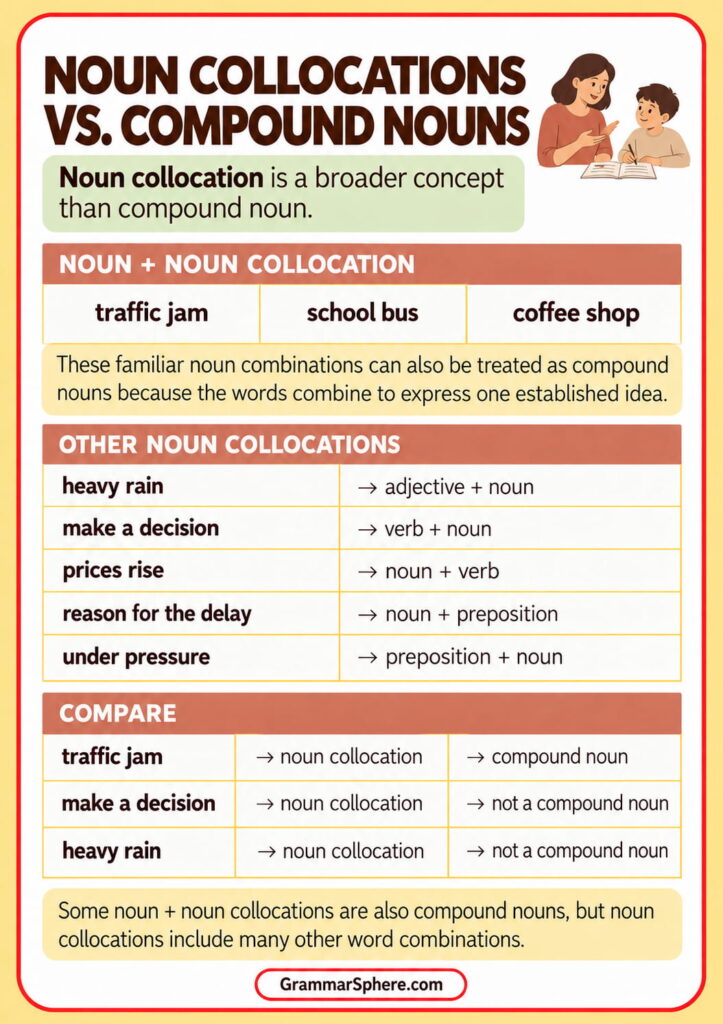
Adjective + Noun Collocations
In an adjective + noun collocation, an adjective regularly occurs with a particular noun.
Examples include:
- heavy rain
- strong coffee
- deep sleep
- close friend
- serious problem
- high price
- major decision
- clear explanation
For example:
We had heavy rain last night.
Here, heavy describes a large amount of rain.
Another example is:
She gave a clear explanation of the rule.
The adjective clear describes an explanation that is easy to understand.
Words with similar meanings do not always occur naturally with the same nouns.
Compare:
- strong coffee ✓
- powerful coffee ✗
Although strong and powerful can have similar meanings in some contexts, strong coffee is the usual English collocation.
Verb + Noun Collocations
In a verb + noun collocation, a particular verb regularly occurs with a noun.
Examples include:
- make a decision
- take a break
- pay attention
- give advice
- reach an agreement
- catch a bus
- make progress
- take responsibility
For example:
We need to make a decision today.
The noun decision commonly occurs with the verb make.
Another common combination is:
Please pay attention to the instructions.
One verb can occur with several nouns:
- make a decision
- make an effort
- make a mistake
- make progress
The same noun can also occur with different verbs:
- give advice
- ask for advice
- follow advice
- ignore advice
Each verb creates a different meaning with the noun advice.
Noun + Verb Collocations
In a noun + verb collocation, a noun commonly appears as the subject of a particular verb.
Examples include:
- rain falls
- prices rise
- an opportunity arises
- a problem occurs
- an alarm rings
- a disease spreads
For example:
Prices rose sharply last month.
The verb rise commonly describes prices becoming higher.
Another example is:
An opportunity arose to work abroad.
The verb arise commonly occurs with opportunity when an opportunity becomes available.
These collocations help learners choose verbs that naturally occur with particular nouns.
Noun + Noun Collocations
In a noun + noun collocation, one noun comes before another and helps identify its type, purpose, or meaning.
Examples include:
- traffic jam
- school bus
- job interview
- language barrier
- coffee shop
- data analysis
- customer service
- climate change
For example:
I was late because of a traffic jam.
The noun traffic tells us what kind of jam is meant.
Another example is:
She has a job interview tomorrow.
Here, job identifies the purpose of the interview.
Many common noun + noun combinations are also treated as compound nouns. The difference between noun collocations and compound nouns is explained later in the lesson.
Quantity Expressions with Nouns
Some nouns regularly occur in expressions that describe an amount, piece, unit, or group of something.
Examples include:
- a piece of advice
- a piece of information
- a loaf of bread
- a slice of cake
- a round of applause
- a burst of laughter
- an item of clothing
These expressions are especially useful with nouns that are normally uncountable.
For example:
She gave me a piece of advice.
The noun advice is uncountable, so we do not normally say an advice. Instead, a piece of advice allows us to refer to one item of advice.
Similarly:
I need a piece of information.
The noun information is also uncountable, so a piece of information allows us to refer to one item.
Noun + Preposition Collocations
Some nouns are regularly followed by particular prepositions. These are called noun + preposition collocations.
Examples include:
- reason for
- solution to
- increase in
- interest in
- effect on
- demand for
- relationship with
- relationship between
For example:
What is the reason for the delay?
The noun reason commonly takes the preposition for.
Another example is:
We need a solution to this problem.
The noun solution normally takes to.
Compare:
- a solution to the problem ✓
- a solution of the problem ✗
The correct preposition cannot always be predicted from meaning alone, so it is useful to learn the noun together with its usual preposition.
Preposition + Noun Collocations
English also has common expressions in which a particular preposition regularly occurs before a noun.
Examples include:
- at risk
- in danger
- under pressure
- by chance
- in detail
- on purpose
For example:
The company is under pressure to reduce costs.
Under pressure is a common preposition + noun collocation.
Another example is:
I met her by chance.
Here, by chance means that the meeting was not planned.
The preposition forms part of the established expression. Changing it can make the expression sound unnatural or change its meaning.
Noun Collocations and Compound Nouns
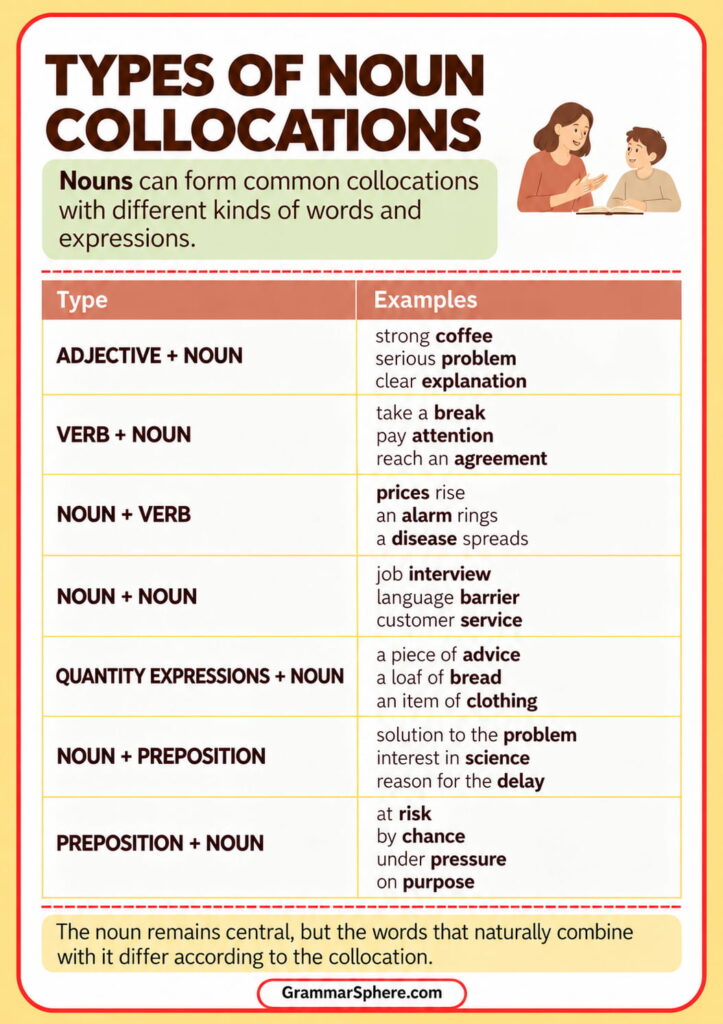
Noun collocations and compound nouns can overlap, especially when two nouns regularly occur together.
For example:
- traffic jam
- school bus
- coffee shop
These combinations are commonly treated as compound nouns because the two words combine to express one established idea.
A noun collocation, however, is a broader type of word combination. A noun can regularly occur with an adjective, verb, another
How to Identify Noun Collocations
To identify a noun collocation, first find the noun and then look at the word or phrase that regularly appears with it.
For example:
- heavy rain → rain is the noun, and heavy is the adjective that commonly occurs with it.
- make a decision → decision is the noun, and make is the verb normally used with it.
- interest in science → interest is the noun, and in is the preposition that normally follows it.
A simple way to check a possible noun collocation is to ask:
- What is the noun?
- Which word or phrase occurs with it?
- Is this combination natural and common in English?
- Would a similar word sound unusual in the same expression?
Compare:
- heavy rain ✓
- strong rain ✗
Both combinations follow the grammatical structure adjective + noun, but English normally uses heavy rain, not strong rain.
This shows that noun collocations depend not only on grammatical structure but also on the word combinations that English speakers normally use.
Common Mistakes with Noun Collocations
1. Translating a word combination directly from another language
- strong rain ✗
- heavy rain ✓
A word may have the right general meaning but still sound unnatural with a particular noun. English normally uses heavy rain.
2. Choosing the wrong verb
- do a decision ✗
- make a decision ✓
The noun decision normally occurs with the verb make.
3. Choosing the wrong preposition
- the reason of the delay ✗
- the reason for the delay ✓
Similarly:
- a solution of the problem ✗
- a solution to the problem ✓
Some nouns regularly take particular prepositions, so it is useful to learn the noun and preposition together.
4. Replacing a word with an unsuitable synonym
- powerful coffee ✗
- strong coffee ✓
Words with similar meanings do not always form the same collocations. Strong coffee is the natural English combination.
5. Forgetting the normal grammar of the noun
- make decision ✗
- make a decision ✓
The noun decision is a singular countable noun, so it normally needs an article.
Compare:
- give an advice ✗
- give advice ✓
The noun advice is uncountable, so it does not normally take a/an.
A noun keeps its usual grammatical properties when it appears in a collocation. The collocation tells us which words naturally occur together, but normal rules for articles, number, and countability still apply.
Noun Collocations Exercises with Answers
A. Choose the Natural Collocation
- heavy / strong rain
- make / do a decision
- powerful / strong coffee
- pay / give attention
- reach / arrive an agreement
B. Complete the Collocation
- a solution ______ the problem
- a piece ______ advice
- ______ pressure
- ______ an effort
- prices ______
C. Correct the Mistakes
- We had strong rain yesterday.
- She did an important decision.
- I need an advice.
- What is the reason of the delay?
- He drank a cup of powerful coffee.
Answers
- heavy rain
- make a decision
- strong coffee
- pay attention
- reach an agreement
- a solution to the problem
- a piece of advice
- under pressure
- make an effort
- prices rise
- We had heavy rain yesterday.
- She made an important decision.
- I need some advice. / I need a piece of advice.
- What is the reason for the delay?
- He drank a cup of strong coffee.
FAQs About Noun Collocations
Can one noun have several different collocations?
Yes. A noun can occur naturally with several different words.
For example, decision appears in:
- make a decision
- reach a decision
- important decision
- final decision
Each combination adds a different meaning or grammatical relationship to the noun.
Are noun collocations always fixed?
No. Some collocations allow very little variation, while others have several natural alternatives.
For example, we normally say pay attention, but problem can occur with several adjectives:
- serious problem
- major problem
- big problem
- difficult problem
The amount of variation depends on the particular collocation.
Are noun + noun collocations always compound nouns?
No. Many common noun + noun combinations, such as traffic jam and school bus, are also treated as compound nouns. However, noun collocation is a broader term because noun collocations can also include adjectives, verbs, and prepositions.
Why can we not always replace one word in a collocation with a synonym?
Words with similar meanings do not always occur naturally with the same nouns.
For examples recognizable even when the verb tense or noun number changes.
You May Also Like

Leave a Comment