

Table of Contents
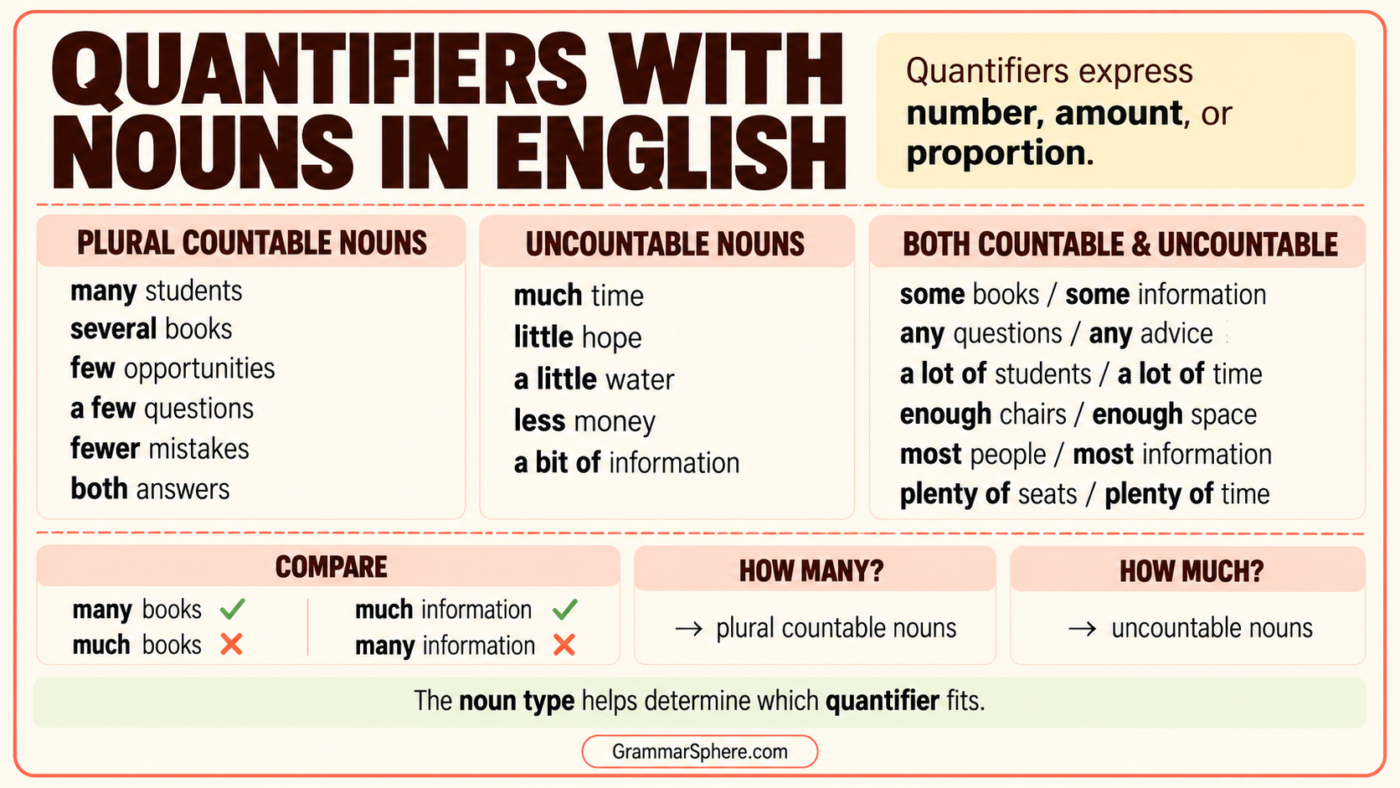
English does not always express quantity with exact numbers. We often indicate an approximate number or amount instead, and the type of noun helps determine which quantity word fits naturally.
This relationship is expressed through quantifiers with nouns. Choices such as many, much, few, little, some, any, and enough depend on whether a noun is countable or uncountable and on the quantity the speaker wants to express.
What Are Quantifiers?
A quantifier is a word or phrase that indicates the number, amount, or proportion of something.
Compare:
- many students
- much time
- some information
- a few questions
- enough chairs
The quantifier comes before the noun and adds information about quantity. Some quantifiers combine only with plural countable nouns, some with uncountable nouns, and others can occur with both.
For example:
many books ✓
much information ✓
but:
much books ✗
many information ✗
Choosing the correct quantifier therefore begins with identifying the noun type.
Countable and Uncountable Nouns
Countable nouns refer to people or things that can be counted as separate units. They have singular and plural forms:
- one book → three books
- one student → several students
- one question → many questions
Uncountable nouns refer to substances, ideas, amounts, or other meanings that are not normally counted as separate units:
- information
- water
- money
- advice
- time
This distinction determines many common quantifier choices:
many students
a few questions
much time
a little information
A quantifier that suits one noun type may be grammatically unsuitable with the other.
Quantifiers with Countable Nouns
Quantifiers that express a number of separate people or things combine with plural countable nouns.
Common examples include:
- many students
- several books
- a few questions
- few opportunities
- fewer mistakes
- both answers
These quantifiers do not all express the same quantity. Many indicates a large number, several an unspecified number greater than a few, while a few and few both refer to a small number but differ in meaning.
Many students attended the lecture.
Several questions remained unanswered.
A few students stayed after class.
The noun remains plural because the quantifier refers to more than one countable item.
Quantifiers with Uncountable Nouns
Quantifiers used with uncountable nouns express an amount rather than a number of separate items.
Common combinations include:
- much time
- a little water
- little hope
- less money
- a bit of information
For example:
We don’t have much time.
There is a little milk left.
Because time and milk are uncountable in these sentences, forms such as many time and a few milk are not grammatical.
When an uncountable noun needs to be counted, a countable unit can be introduced:
two pieces of advice
three bottles of water
The number belongs to pieces or bottles, not directly to the uncountable noun.
Quantifiers Used with Both Countable and Uncountable Nouns
Some quantifiers can modify both plural countable nouns and uncountable nouns.
These include:
- some
- any
- a lot of
- lots of
- enough
- most
- all
- no
- more
- plenty of
Compare:
some students
some information
a lot of books
a lot of time
enough chairs
enough space
The same quantifier can therefore occur with different noun types, but agreement still follows the noun:
Some students are waiting.
Some information is missing.
Many vs. Much
Many modifies plural countable nouns and expresses a large number.
- many students
- many books
- many problems
Much modifies uncountable nouns and expresses a large amount.
- much time
- much money
- much information
The same distinction appears in questions:
How many students are in the class?
How much time do we have?
Use how many when separate items can be counted and how much when the noun represents an uncountable amount.
Both many and much occur naturally in questions and negative sentences:
Are there many seats available?
We don’t have much information yet.
In everyday affirmative sentences, a lot of is often more natural than much:
She has a lot of experience.
Much remains grammatical in affirmative clauses but can sound more formal:
Much research has focused on this question.
Few and A Few vs. Little and A Little
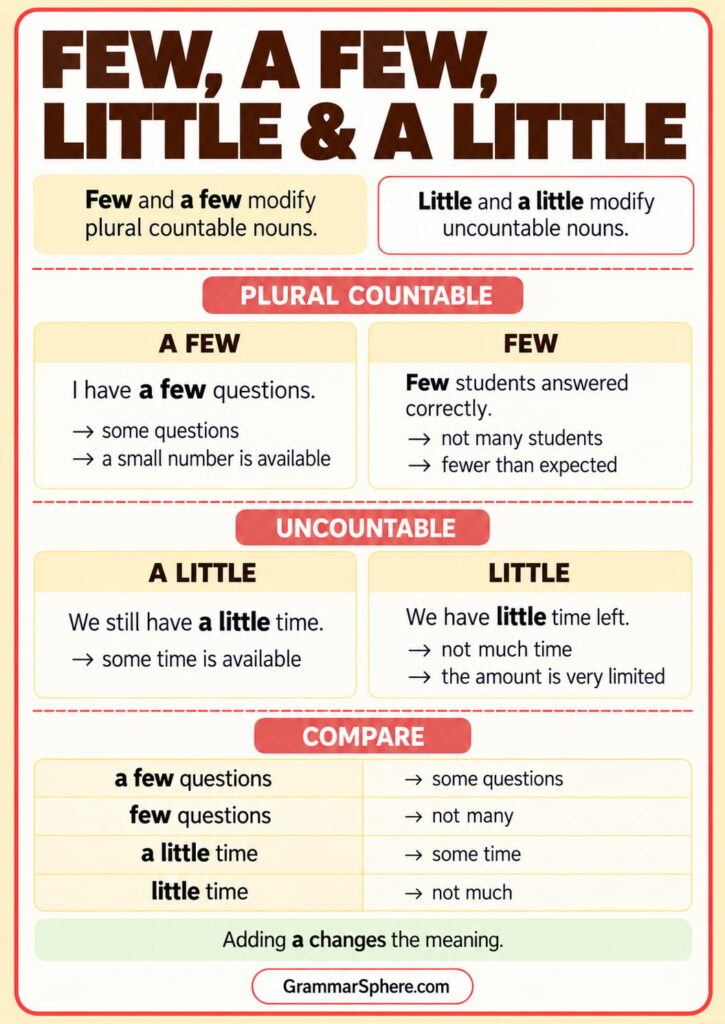
Few and a few modify plural countable nouns. Little and a little modify uncountable nouns.
The article a changes the meaning.
A few means a small number, with the sense that some are available:
I have a few questions.
The speaker has some questions.
Few also refers to a small number, but usually suggests that the number is limited or smaller than expected:
Few students answered correctly.
The meaning is close to not many students.
The same distinction appears with uncountable nouns.
A little means a small amount that is available:
We still have a little time.
Little suggests that the available amount is very limited:
We have little time left.
The contrast can be summarized as:
a few + plural countable noun → some
few + plural countable noun → not many
a little + uncountable noun → some
little + uncountable noun → not much
Some vs. Any
Some commonly expresses an unspecified quantity in affirmative sentences:
She bought some books.
We need some information.
Any commonly appears in negative sentences and neutral questions:
I don’t have any questions.
Do you have any information?
However, the distinction is not simply affirmative versus question.
Some is natural in offers and requests when a positive response is expected or invited:
Would you like some tea?
Could I have some water?
Any can also appear in affirmative sentences when it means that there is no restriction on the choice:
Any student can apply.
Here, any student means whichever student meets the condition.
A Lot of, Lots of, and Enough
A lot of and lots of express a large quantity and combine with both plural countable and uncountable nouns.
a lot of students
a lot of work
lots of ideas
lots of time
Both forms are common in everyday English, although lots of is slightly more informal.
Enough expresses a sufficient number or amount:
We have enough chairs for everyone.
There is enough food for the guests.
When enough modifies a noun, it comes before that noun:
enough money ✓
enough books ✓
not:
money enough ✗
books enough ✗
Plenty of expresses a quantity that is more than sufficient:
We have plenty of time.
There are plenty of seats available.
Fewer vs. Less
Fewer normally modifies plural countable nouns because it compares numbers of separate items.
- fewer students
- fewer mistakes
- fewer cars
Less normally modifies uncountable nouns because it compares amounts.
- less time
- less money
- less traffic
Compare:
There are fewer students in the class today.
We have less time than yesterday.
Expressions of time, distance, money, and other measurements commonly take less, even when a number follows:
less than ten minutes
less than five kilometres
less than twenty dollars
With ordinary plural countable nouns, fewer remains the standard choice in careful English:
fewer mistakes
rather than:
less mistakes
Quantifier + Of
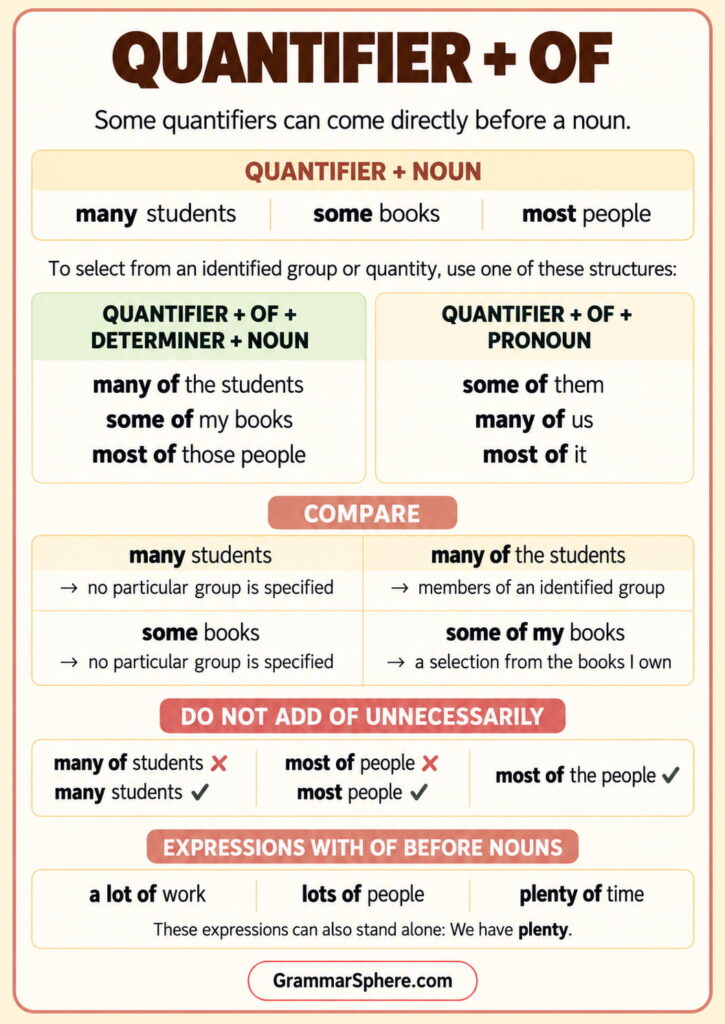
A quantifier can sometimes come directly before a noun:
many students
some books
most people
When the following noun phrase refers to a particular group through the, a possessive, or a demonstrative, of commonly connects the quantifier to that phrase.
Compare:
many students
many of the students
some books
some of my books
most people
most of those people
Pronouns also normally follow of:
some of them
many of us
most of it
Do not insert of before an ordinary noun phrase unnecessarily:
many of students ✗
many students ✓
Expressions such as a lot of, lots of, and plenty of already contain of as part of the quantifier:
a lot of work
lots of people
plenty of time
How to Choose the Right Quantifier
Begin by identifying whether the noun is countable or uncountable.
With a plural countable noun, suitable choices may include many, several, a few, few, fewer, some, any, a lot of, and enough.
With an uncountable noun, suitable choices may include much, a little, little, less, some, any, a lot of, and enough.
Then consider the quantity you want to express. A large quantity may require many, much, or a lot of; a small quantity may require a few, few, a little, or little; an unspecified quantity may be expressed by some or any.
The choice therefore depends on two questions:
Is the noun countable or uncountable?
What quantity or meaning needs to be expressed?
Common Mistakes with Quantifiers
1. Using much with a plural countable noun
much books ✗
many books ✓
2. Using many with an uncountable noun
many information ✗
much information ✓
3. Confusing a few with a little
a little students ✗
a few students ✓
a few water ✗
a little water ✓
4. Ignoring the difference between few and a few
Few students attended.
→ not many attended
A few students attended.
→ some attended
The article a changes the meaning.
5. Using less with ordinary plural countable nouns
less mistakes ✗
fewer mistakes ✓
but:
less time ✓
6. Adding of before an ordinary noun
many of people ✗
many people ✓
Use of when the following phrase identifies a particular group:
many of the people ✓
Quantifiers with Nouns Exercises with Answers
A. Choose the Correct Quantifier
- How ___ students are in the classroom?
much / many - We don’t have ___ time before the train leaves.
many / much - She has ___ close friends, so she never feels alone.
a few / a little - There is ___ milk left in the fridge.
a few / a little - ___ students answered correctly, so the teacher explained the question again.
Few / A few - We have ___ time left, so we need to hurry.
little / a little - Do you have ___ questions?
some / any - Would you like ___ coffee?
some / any - There are ___ cars on the road today than yesterday.
less / fewer - We spent ___ money this month.
less / fewer
B. Complete or Correct the Sentence
- There aren’t ___ chairs for everyone.
enough / much - ___ my classmates live near the school.
Many / Many of - Correct the sentence:
She gave me many advice. - Correct the sentence:
A little students stayed after class.
Answers
- many
- much
- a few
- a little
- Few
- little
- any
- some
- fewer
- less
- enough
- Many of
- She gave me a lot of advice.
- A few students stayed after class.
FAQs About Quantifiers with Nouns
Can a lot of be used with both countable and uncountable nouns?
Yes. A lot of can modify plural countable nouns and uncountable nouns:
a lot of books
a lot of information
It is especially common in everyday affirmative sentences.
Can some be used in questions?
Yes. Some is common in offers and requests when the speaker expects or invites a positive response:
Would you like some tea?
Could I have some help?
Neutral questions more often take any:
Do you have any questions?
Is much correct in affirmative sentences?
Yes. Much is grammatical in affirmative sentences, particularly in formal contexts:
Much research has examined this issue.
In everyday conversation, a lot of is often more natural:
We have a lot of work to do.
Should I use less or fewer with people?
Use fewer with people because it is a plural countable noun:
fewer people ✓
less people is common in informal usage, but fewer people is the standard form in careful English.
When is of needed after a quantifier?
Use of when the quantifier refers to a particular group introduced by a determiner or represented by a pronoun:
many students
but:
many of the students
some books
but:
some of my books
With pronouns:
some of them
most of us
You May also Like
Leave a Comment