

Table of Contents
Nouns and adjectives are different. A noun names a person, place, thing, or idea. An adjective describes a person or thing.
Compare:
- Her success surprised everyone.
- She was successful.
Success is a noun. Successful is an adjective.
Now compare:
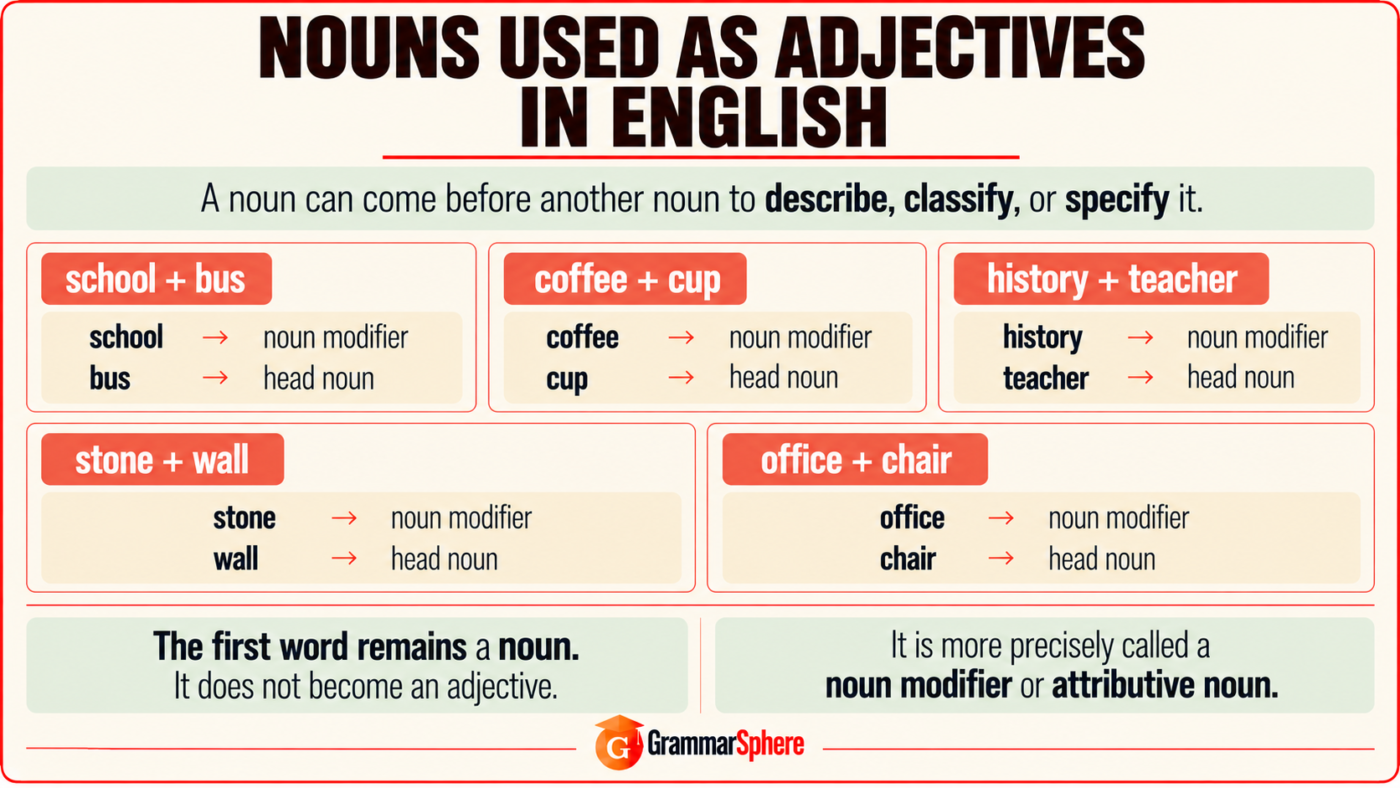
- a history teacher
- a historical event
History is a noun, even though it comes before another noun. Historical is an adjective.
To know whether a word is a noun or an adjective, look at how it is used in the sentence.
What Is a Noun?
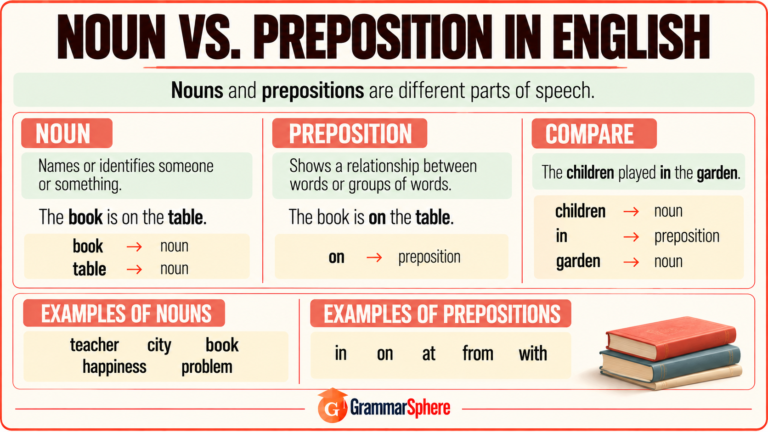
A noun is a word used to name or identify a person, place, thing, idea, quality, or event.
Examples:
- teacher
- city
- book
- happiness
- education
- success
Nouns can have different jobs in sentences:
- The teacher arrived early.
- I bought a book.
- Sara is a doctor.
- We talked about the problem.
Many countable nouns also have singular and plural forms:
- student → students
- book → books
- child → children
Nouns are also commonly used with articles and other determiners:
- a teacher
- the problem
- this book
- my car
- three students
These features become useful when we compare nouns with adjectives.
What Is an Adjective?
An adjective describes or gives more information about a noun.
Examples:
- beautiful
- large
- difficult
- helpful
- successful
- expensive
An adjective often comes before a noun:
- a beautiful dress
- a large house
- a difficult question
- a helpful teacher
It can also come after a linking verb such as be, seem, become, look, or feel:
- The dress is beautiful.
- The question seems difficult.
- She became angry.
- You look tired.
In both positions, the adjective tells us something about a person or thing.
What Is the Difference Between a Noun and an Adjective?
The basic difference is in the job each word does.
A noun usually names or identifies the person, thing, idea, quality, or event we are talking about. An adjective gives us information about a noun or about the person or thing the noun refers to.
Compare:
- Her beauty attracted attention.
- She is beautiful.
Beauty is a noun. It names a quality.
Beautiful is an adjective. It describes the person.
Compare:
- His success surprised everyone.
- He was successful.
Success is a noun. Successful is an adjective.
A noun can also be the main word in a group of words:
- a teacher
- the problem
- this idea
- three books
An adjective can be added to describe that noun:
- a helpful teacher
- the serious problem
- this interesting idea
- three useful books
In a helpful teacher, teacher is the noun and helpful is the adjective.
Nouns and Adjectives After Linking Verbs
Both nouns and adjectives can come after linking verbs. This is an important difference to understand because a word after is, are, was, or were is not automatically an adjective.
Compare:
- Ahmed is a doctor.
- Ahmed is kind.
Doctor is a noun. It tells us what Ahmed is.
Kind is an adjective. It describes Ahmed.
Compare:
- Sara became a manager.
- Sara became angry.
Manager is a noun. Angry is an adjective.
The same pattern appears in:
- My father is a teacher.
- My father is patient.
So, when a word comes after a linking verb, look at what it is doing. Is it identifying what someone or something is, or is it describing them?
Nouns and Adjectives Before Other Nouns
An adjective often comes before a noun:
- a beautiful garden
- an expensive car
- a difficult lesson
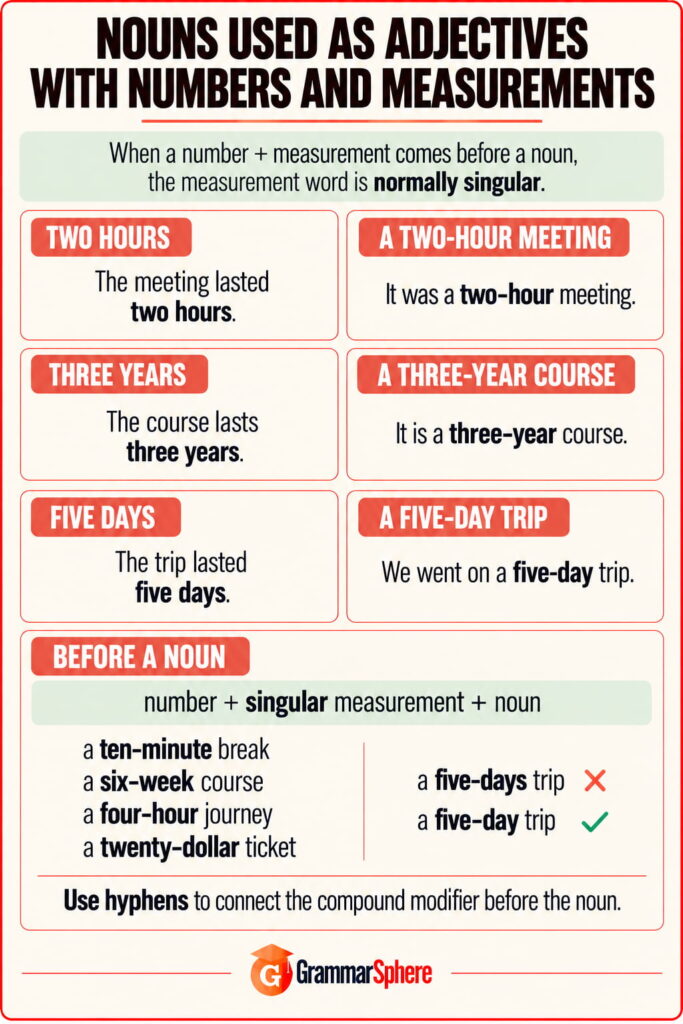
However, a noun can also come before another noun:
- a flower garden
- a company car
- a grammar lesson
- a history teacher
- a coffee cup
This means that a word before a noun is not automatically an adjective.
Compare:
- an expensive office chair
Here:
- expensive → adjective
- office → noun used before another noun
- chair → main noun
Another example:
- a beautiful stone house
Here:
- beautiful → adjective
- stone → noun used before another noun
- house → main noun
A noun used before another noun can tell us what the second noun is connected with, used for, made of, or related to. It still remains a noun.
A noun and a related adjective can also give different meanings:
- a history teacher
- a historical event
A history teacher is a teacher who teaches history. A historical event is an event connected with history or the past.
Compare:
- a child actor
- childish behaviour
A child actor is an actor who is a child. Childish behaviour means behaviour that seems immature.
So, we should not replace a noun before another noun with a related adjective unless the adjective gives the meaning we want.
Measurement Expressions Before Nouns
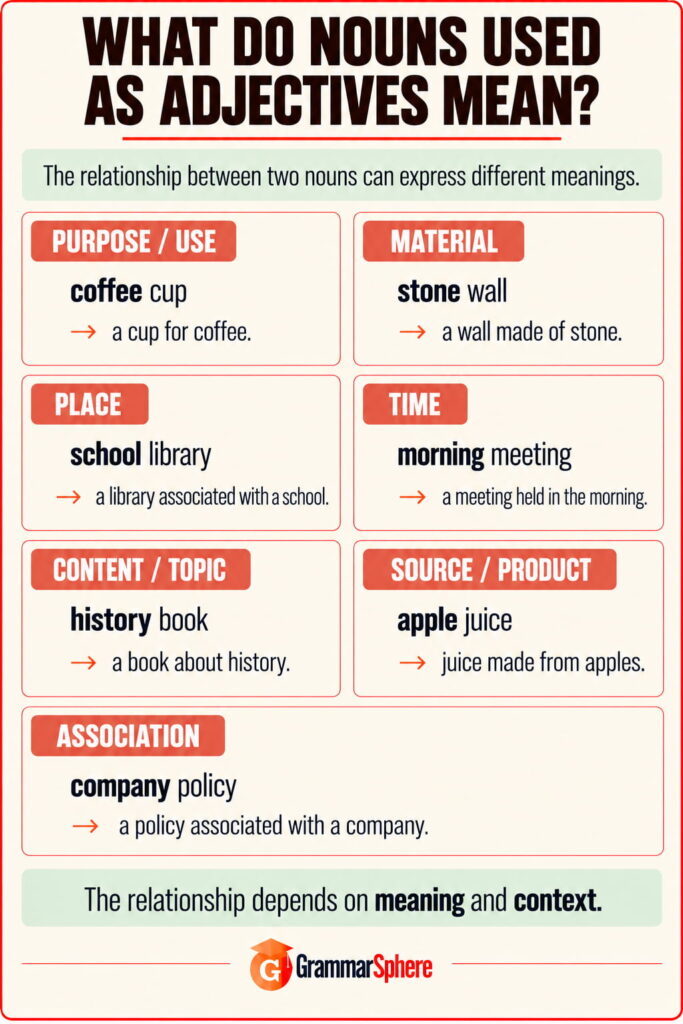
Measurement expressions can be used before nouns to give information about time, distance, age, price, size, or other measurements.
For example:
- a five-minute break
- a two-hour journey
- a three-day trip
- a ten-dollar ticket
- a six-foot wall
In these expressions, the measurement unit normally stays singular:
- a five-minute break ✓
- a five-minutes break ✗
- a two-hour journey ✓
- a two-hours journey ✗
Compare this with a measurement expression used after a verb:
- The journey took two hours.
- It was a two-hour journey.
In two hours, hours is plural because it is an ordinary measurement expression. In two-hour journey, two-hour comes before journey and works together as a modifier, so hour stays singular.
These measurement expressions are usually hyphenated when they come before a noun:
- a ten-minute walk
- a five-year plan
- a twenty-dollar meal
So, a word before a noun is not automatically an adjective. In expressions such as a five-minute break, the measurement words work together as a modifier of the noun.
Noun Forms and Adjective Forms
Many words have a noun form and a related adjective form.
Common examples include:
- beauty → beautiful
- success → successful
- danger → dangerous
- importance → important
- confidence → confident
- difference → different
- difficulty → difficult
- strength → strong
The noun and adjective are related in meaning, but they are used differently.
Compare:
- Her confidence impressed the interviewer.
- She sounded confident.
Confidence is a noun. Confident is an adjective.
Compare:
- We understand the importance of education.
- Education is important.
And:
- The difficulty of the exam surprised us.
- The exam was difficult.
Some endings can also give us a clue about whether a word is a noun or an adjective.
Common noun endings include:
- -tion / -sion: education, decision, discussion
- -ment: development, improvement, achievement
- -ness: happiness, kindness, darkness
- -ity: ability, possibility, activity
- -ance / -ence: importance, confidence, difference
Common adjective endings include:
- -ful: helpful, beautiful, successful
- -ous: dangerous, famous, nervous
- -able / -ible: comfortable, suitable, possible
- -ive: active, effective, attractive
- -al: natural, personal, cultural
- -less: careless, hopeless, useless
These endings are useful clues, but they are not rules that work for every word. We still need to look at how the word is used in the sentence.
Nouns and Adjectives with Articles and Other Determiners
Articles and other determiners can help us tell nouns and adjectives apart.
Nouns commonly appear in expressions such as:
- a teacher
- the problem
- this book
- my friend
- three students
When an adjective is added, it usually comes before the noun:
- a helpful teacher
- the serious problem
- this interesting book
- my old friend
- three successful students
Look at:
- a successful student
Student is the noun. Successful is the adjective describing the student.
We do not normally say:
- a successful ✗
when we mean a successful student.
The adjective does not normally replace the countable noun in this kind of sentence.
Singular and Plural: Nouns vs. Adjectives
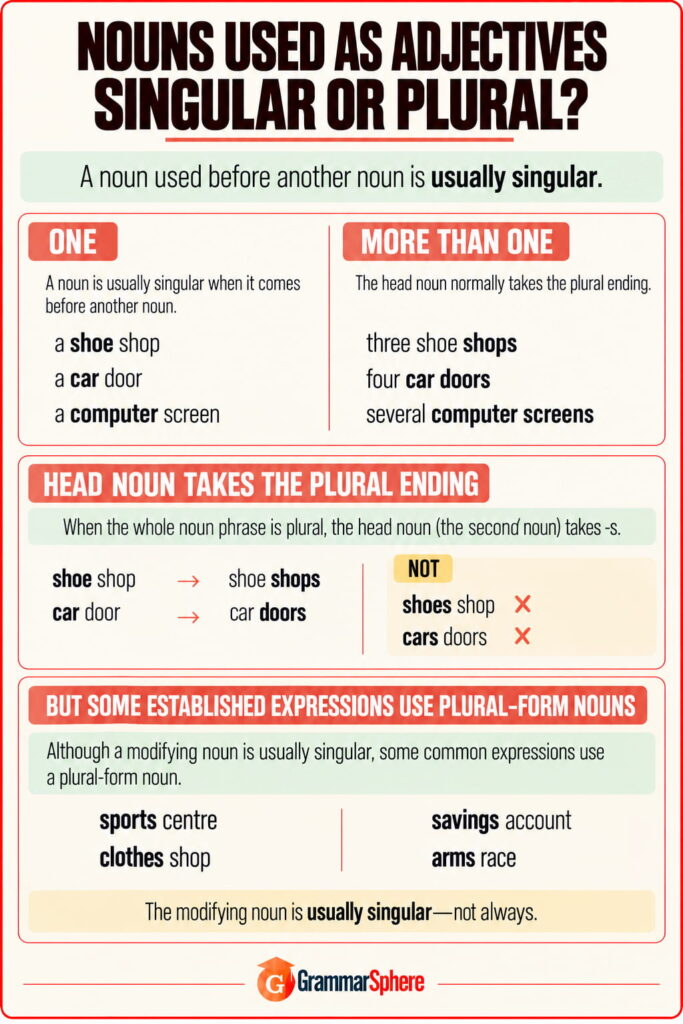
Many countable nouns change form when we talk about more than one:
- student → students
- book → books
- child → children
- person → people
English adjectives normally do not change when they describe singular or plural nouns.
Compare:
- a small house
- two small houses
Not:
- two smalls houses ✗
Similarly:
- an intelligent student
- intelligent students
The noun changes from singular to plural, but the adjective stays the same.
This is another useful clue when deciding whether a word is a noun or an adjective.
Can Adjectives Be Used Without a Noun?
Yes. An adjective does not always have to come directly before a noun.
It can come after a linking verb:
- The children are happy.
- The soup smells delicious.
- He looks tired.
- She became angry.
The words happy, delicious, tired, and angry are still adjectives even though no noun comes immediately after them.
English also has expressions such as:
- the rich
- the poor
- the elderly
- the unemployed
For example:
- The program provides support for the elderly.
Here, the elderly refers to elderly people as a group.
This does not mean that every adjective can be used like an ordinary noun. For example, we do not normally use an elderly to mean one elderly person.
Can the Same Word Be a Noun and an Adjective?
Yes. Some English words can be nouns in one sentence and adjectives in another.
Consider light:
- We need more light in this room.
- This bag is very light.
In the first sentence, light is a noun. In the second, light is an adjective meaning “not heavy.”
Another example is orange:
- She ate an orange.
- She wore an orange dress.
In the first sentence, orange is a noun referring to the fruit. In the second, orange describes the colour of the dress.
So, we cannot always identify a word as a noun or adjective by looking at the word alone. We need to see how it is being used.
How to Choose Between a Noun and an Adjective
Learners often know the meaning of a word but choose the wrong form.
Compare:
- Her success / successful surprised everyone.
The correct choice is:
- Her success surprised everyone.
We need a noun because her success is what surprised everyone.
Now compare:
- She is very success / successful.
The correct choice is:
- She is very successful.
We need an adjective because the word describes she.
Another example:
- The difficulty / difficult of the exam worried the students.
- The exam was difficulty / difficult.
Correct:
- The difficulty of the exam worried the students.
- The exam was difficult.
And:
- She has great confidence.
- She feels confident.
When choosing between a noun and an adjective, ask what the sentence needs. If you need to name or refer to something, you usually need a noun. If you need to describe someone or something, you usually need an adjective.
How to Identify a Noun or an Adjective
When you are not sure whether a word is a noun or an adjective, do not rely on just one clue. Look at how the word is used in the whole sentence.
Ask yourself:
- Is the word naming or identifying someone or something? It is likely to be a noun.
- Is it describing someone or something? It is likely to be an adjective.
- Is it used with an article, determiner, or number? This may indicate that it is a noun.
- Can it change from singular to plural? Countable nouns can usually do this, while adjectives normally do not.
- Does it come before another noun? Check carefully, because both nouns and adjectives can appear in this position.
- Does its ending give you a clue? Endings such as -ness, -tion, and -ment often occur in nouns, while -ful, -ous, and -able often occur in adjectives.
These clues are most useful when you consider them together rather than relying on only one.hen you consider them together rather than relying on just one.
Common Mistakes with Nouns and Adjectives
Using a noun where an adjective is needed
Incorrect:
- She is a very beauty girl.
Correct:
- She is a very beautiful girl.
Beautiful is the adjective describing girl.
Using an adjective where a noun is needed
Incorrect:
- His successful surprised everyone.
Correct:
- His success surprised everyone.
Success is the noun needed in this sentence.
Using the wrong form after a linking verb
Incorrect:
- The exam was difficulty.
Correct:
- The exam was difficult.
But remember that a noun can also follow a linking verb:
- The exam was a challenge.
So, the rule is not simply “use an adjective after is or was.”
Thinking every word before a noun is an adjective
In:
- a history teacher
History is a noun used before another noun.
Adding a plural ending to an adjective
Incorrect:
- two bigs houses
Correct:
- two big houses
The noun changes for plural, but the adjective normally does not.
Nouns vs. Adjectives Exercise
Choose the correct word or identify whether the bold word is a noun or an adjective.
- Her kindness made everyone feel welcome.
Is kindness a noun or an adjective? - She is always kind to everyone.
Is kind a noun or an adjective? - His success / successful surprised his family.
- He is a very success / successful businessman.
- The difficulty / difficult of the task worried us.
- The task was extremely difficulty / difficult.
- In a beautiful stone house, identify the adjective, the noun used before another noun, and the main noun.
- In a history teacher, is history a noun or an adjective?
- Correct the sentence:
She bought two expensives cars. - Correct the sentence:
Her confident impressed the interviewer. - Identify light in each sentence:a. We need more light in this room.
b. This suitcase is very light. - Choose the correct word:She spoke with great confidence / confident.
Answers
- Kindness → noun
- Kind → adjective
- His success surprised his family.
- He is a very successful businessman.
- The difficulty of the task worried us.
- The task was extremely difficult.
- Beautiful → adjective; stone → noun used before another noun; house → main noun
- History → noun
- She bought two expensive cars.
- Her confidence impressed the interviewer.
- a. light → noun; b. light → adjective
- She spoke with great confidence.
FAQs About Nouns and Adjectives
What is the main difference between a noun and an adjective?
A noun usually names or identifies someone or something, while an adjective describes or gives more information about a noun. In a beautiful garden, garden is the noun and beautiful is the adjective.
How can I tell if a word is a noun or an adjective?
Look at how the word is used in the sentence. Check whether it is naming something or describing something, whether it is used with an article or other determiner, whether it can have a plural form, and what words appear around it.
Can a noun be used like an adjective?
A noun can come before another noun and give information about it, as in school bus, history teacher, and coffee cup. The first word remains a noun.
Can the same word be both a noun and an adjective?
Yes. Some words can be used differently in different sentences. Light is a noun in We need more light, but it is an adjective in This bag is light.
How do I choose between a noun and an adjective form?
Look at what the sentence needs. Use a noun when you need to name or refer to something: Her success surprised us. Use an adjective when you need to describe someone or something: She was successful.
You May Also Like

Leave a Comment