

Table of Contents
English nouns can perform different grammatical jobs in a sentence, such as acting as the subject, the object, or showing a relationship with another noun. These roles are often made clear by word order, prepositions, and sentence structure rather than by a change in the noun itself.
This leads to noun case in English, which explains how these grammatical relationships are expressed and when a noun takes a different form. In this article, you will learn how noun case works in modern English, how the genitive case is formed and used, and how case differs from grammatical function.
What Is Noun Case?
Noun case describes how a noun is grammatically related to other elements in a sentence.
Compare:
Sarah opened the door.
Here, Sarah functions as the subject.
I called Sarah.
Here, Sarah functions as the object.
The grammatical role changes, but the noun Sarah retains the same shape.
Now compare:
Sarah’s bag is on the table.
The ending ‘s marks a genitive relationship between Sarah and bag.
Modern English therefore does not normally alter an ordinary noun when it moves between subject and object positions. The clearest case marking that remains on nouns is the genitive, often called the possessive.
Noun Case in Modern English
In modern English, a noun usually keeps the same form even when its grammatical job changes. What changes most clearly is the genitive form, which is marked with ‘s or an apostrophe.
Compare:
- student → singular noun
- students → plural noun
- student’s → singular genitive
- students’ → plural genitive
Now notice how the noun student can perform different functions without changing its form:
The student answered the question.
→ student is the subject
The teacher called the student.
→ student is the direct object
I gave the student a book.
→ student is the indirect object
I spoke to the student.
→ student is the object of the preposition to
In each sentence, student has a different grammatical function, but the noun itself remains unchanged.
English usually makes these roles clear through word order, prepositions, and sentence structure rather than by changing the noun form. The genitive is different because it is visibly marked:
the student’s book
the students’ booksre rather than through separate noun endings.
Traditional Case Terms in English
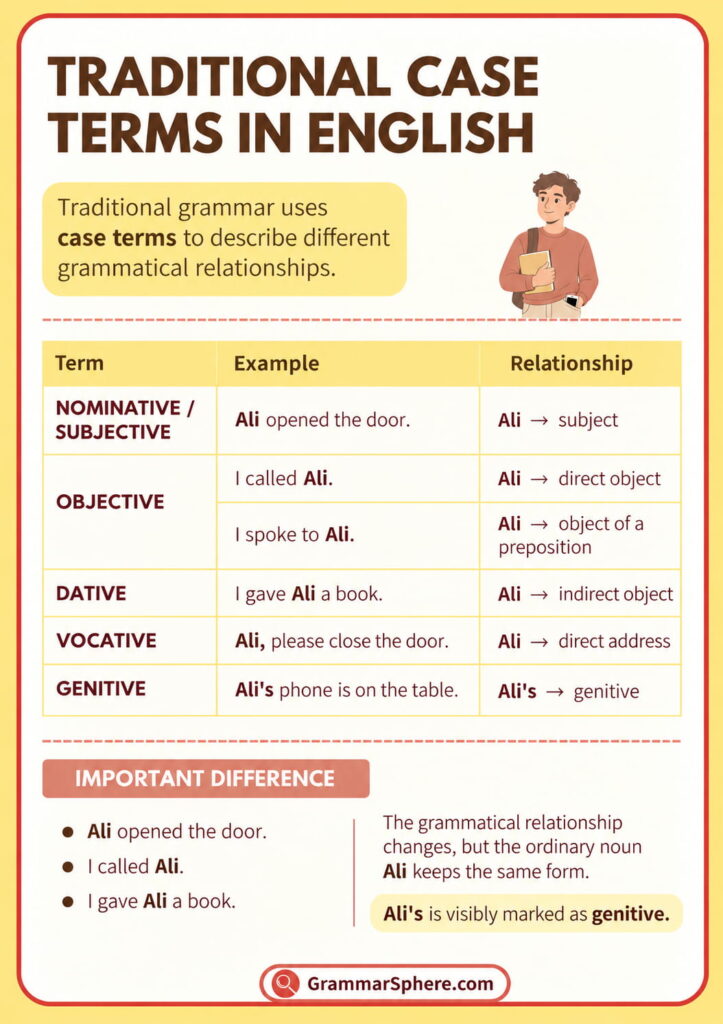
Traditional grammar uses several case terms to describe the role a noun or pronoun has in a sentence. These terms are useful for understanding older grammar descriptions, even though modern English nouns usually do not change form for each case.
The nominative, or subjective case, describes a noun used as the subject:
Ali opened the door.
Here, Ali is the subject.
The objective case is a broader term for nouns used as objects:
I called Ali.
→ Ali is the direct object
I gave Ali a book.
→ Ali is the indirect object
I spoke to Ali.
→ Ali is the object of the preposition to
Traditional grammar also uses the more specific terms accusative and dative.
The accusative case is traditionally linked with the direct object:
I called Ali.
The dative case is traditionally linked with the indirect object:
I gave Ali a book.
Another traditional term is the vocative, which is used when someone is addressed directly:
Ali, please close the door.
These terms describe different grammatical roles, but the noun Ali keeps the same form in all of these examples.
Pronouns make case differences easier to see because their forms can change:
he → him
she → her
For this reason, case is much more visible in English pronouns than in ordinary nouns.
The Possessive or Genitive Case
The genitive case, often called the possessive case, shows how one noun is connected with another noun.
For example:
- Ali’s phone
- the teacher’s desk
- the children’s toys
- the students’ books
The genitive often shows possession:
Ali’s phone
→ the phone belongs to Ali
But it can also express other kinds of relationships.
Sara’s brother
→ family relationship
today’s meeting
→ time
the company’s decision
→ association with the company
So, the genitive is not limited to ownership. It can also express relationships involving family, time, association, source, and other meanings.
That is why genitive is a broader term than possessive.
How to Form the Genitive Case
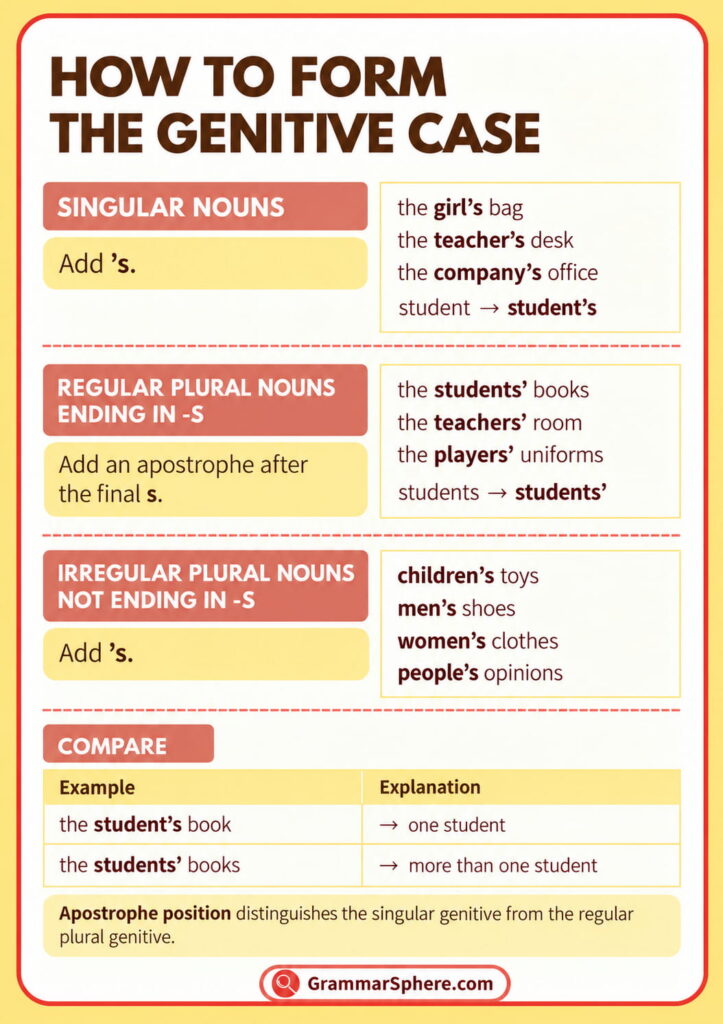
The way we form the genitive case depends mainly on whether the noun is singular or plural.
Singular nouns
For most singular nouns, add ‘s:
- the girl’s bag
- the teacher’s desk
- the cat’s tail
- the company’s office
For example:
The teacher’s office is upstairs.
Regular plural nouns ending in -s
If the plural noun already ends in -s, add only an apostrophe:
- the students’ books
- the teachers’ room
- the players’ uniforms
For example:
The students’ projects were displayed.
Irregular plural nouns not ending in -s
If the plural noun does not end in -s, add ‘s:
- children’s toys
- men’s shoes
- women’s clothes
- people’s opinions
For example:
The children’s classroom is upstairs.
Compare:
the student’s book
→ the book of one student
the students’ books
→ the books of more than one student
The position of the apostrophe shows whether the genitive refers to one noun or more than one.
Genitive Forms with Names Ending in -s
If a name ends in -s, we usually add ‘s to form the genitive.
For example:
- James → James’s car
- Chris → Chris’s office
- Charles → Charles’s book
Some writing styles use only an apostrophe after the final s:
- James’ car
- Charles’ book
Both forms are used in English. For learner writing, follow the style required by your school or teacher and use the same form consistently.
What the Genitive Can Express
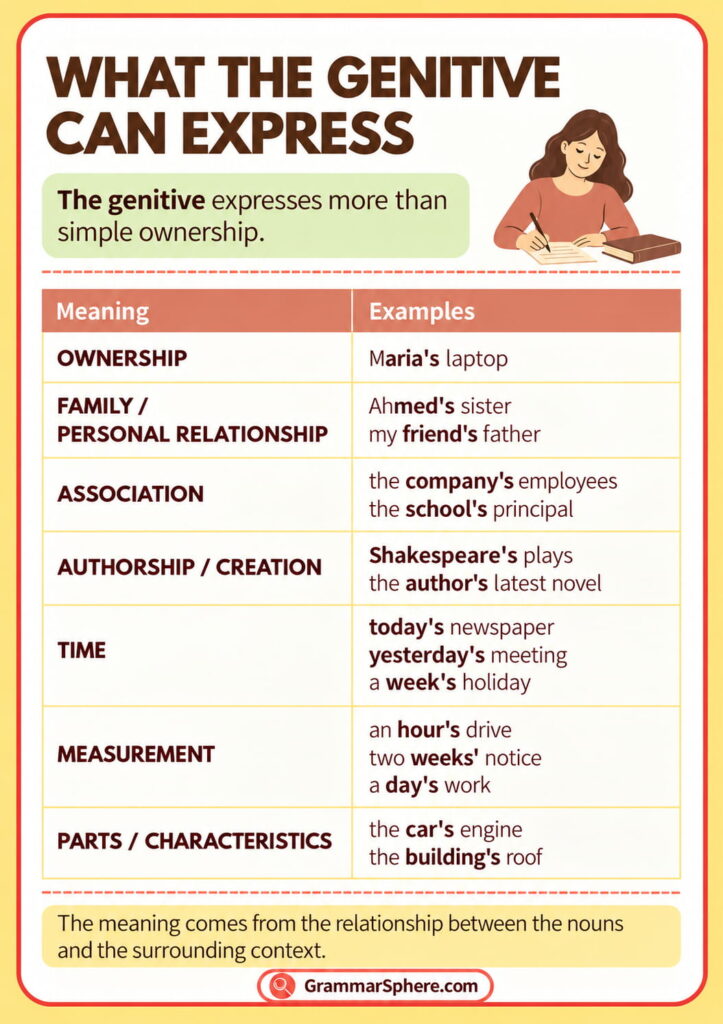
The genitive case can express several relationships between nouns. Ownership is one common meaning, but the genitive is also used for family relationships, association, authorship, time, measurement, and parts of something.
Ownership
The genitive can show that something belongs to someone.
- Maria’s laptop
- the teacher’s desk
Family or personal relationship
It can connect people through a family or personal relationship.
- Ahmed’s sister
- my friend’s father
Association
It can connect a person or thing with an organization, place, or group.
- the company’s employees
- the school’s principal
Authorship or creation
It can identify the person who created or produced something.
- Shakespeare’s plays
- the author’s latest novel
Time
The genitive can connect something with a particular time or period.
- today’s newspaper
- yesterday’s meeting
- a week’s holiday
Measurement
It can express a period of time or another measurement.
- an hour’s drive
- two weeks’ notice
- a day’s work
Parts of something
It can connect a part with the whole it belongs to.
- the car’s engine
- the building’s roof
The exact meaning depends on the relationship between the nouns. The genitive is therefore broader than simple ownership.e interpretation comes from the nouns involved and the context in which they occur.
The Genitive and Of-Phrases
English can often express the same relationship in two ways:
- with the ‘s genitive
- with an of-phrase
Compare:
the company’s decision
the decision of the company
Both forms connect decision with company.
Another example is:
the building’s roof
the roof of the building
The ‘s genitive is especially common with people, animals, organizations, and expressions of time.
For example:
- Sarah’s bag
- the dog’s tail
- the company’s policy
- today’s news
An of-phrase is common with many things and with longer noun phrases.
For example:
- the end of the road
- the top of the mountain
- the title of the book
This is not a strict rule. English also commonly uses the ‘s genitive with things:
- the car’s engine
- the world’s population
- the book’s cover
The natural choice depends on the nouns and the relationship between them.
Independent Genitive Forms
Sometimes a genitive form appears without another noun after it because the missing noun is already clear from the context.
For example:
This book is Sarah’s.
Here, Sarah’s means Sarah’s book.
Another example:
My car is newer than Ahmed’s.
Here, Ahmed’s means Ahmed’s car.
This form is also common when we talk about someone’s home, shop, office, or another familiar place.
For example:
- We had dinner at Sarah’s.
- I am going to the doctor’s.
In these sentences, words such as house or clinic are not repeated because the listener can understand the meaning from the context.
Noun Case and Pronoun Case
Case is easier to notice in pronouns because many pronouns change form when their grammatical job changes.
Compare:
She called him.
He called her.
In the first sentence, she is the subject and him is the object. In the second, he is the subject and her is the object.
Common subject and object forms include:
- I → me
- he → him
- she → her
- we → us
- they → them
Pronouns also have possessive forms:
- I → my / mine
- he → his
- she → her / hers
- we → our / ours
- they → their / theirs
Ordinary nouns usually do not change in the same way.
Compare:
Sarah called John.
John called Sarah.
The grammatical jobs of Sarah and John change, but the noun forms stay the same.
This is why case differences are usually easier to see in pronouns than in ordinary nouns.
Noun Case vs. Grammatical Function
Case and grammatical function are related, but they are not the same.
A noun’s grammatical function tells us what job it performs in the sentence.
Common functions include:
- subject
- direct object
- indirect object
- object of a preposition
Case is concerned with the form or relationship of the noun, while grammatical function tells us what job the noun performs in the sentence.
Consider:
The teacher gave Ahmed’s book to Sara.
In this sentence:
- the teacher → subject; ordinary noun form
- Ahmed’s → genitive form
- book → direct object; ordinary noun form
- Sara → object of the preposition to; ordinary noun form
Notice that teacher, book, and Sara all have ordinary noun forms, but they perform different grammatical functions.
Ahmed’s is different because the genitive relationship is clearly marked with ‘s.
So when you analyze a noun, ask two separate questions:
- What form does the noun have?
- What grammatical job does it perform?
Keeping these two ideas separate makes noun case easier to understand.
How to Identify Noun Case
To identify noun case, start by looking at the noun form.
If the noun has ‘s or an apostrophe showing a genitive relationship, it is in the genitive form.
For example:
- the girl’s bag
- the students’ books
If there is no genitive marker, look at the noun’s grammatical function in the sentence.
Compare:
The manager called us.
→ manager is the subject
We called the manager.
→ manager is the direct object
We spoke to the manager.
→ manager is the object of the preposition to
The noun manager stays the same in all three sentences. Its grammatical function changes, but its form does not.
Now look at a sentence that contains both ordinary and genitive noun forms:
The girl’s brother opened the door.
Here:
- girl’s → genitive form
- brother → subject; ordinary noun form
- door → direct object; ordinary noun form
A simple way to identify noun case is:
- Look at the noun form.
- Check for ‘s or an apostrophe.
- Identify the noun’s grammatical function.
- Keep the noun form and its function separate.
This method helps learners avoid confusing noun case with the grammatical job a noun performs in the sentence.
Common Mistakes with Noun Case
Learners often confuse ordinary plural forms with genitive forms, especially because both may contain -s.
1. Expecting the noun to change when its grammatical job changes
Ali called Sara.
Sara called Ali.
In the first sentence, Ali is the subject and Sara is the object. In the second sentence, their grammatical jobs change, but the nouns themselves stay the same.
2. Confusing plural and genitive forms
Compare:
- students → plural noun
- student’s → singular genitive
- students’ → plural genitive
The apostrophe is important because it separates a genitive form from an ordinary plural.
3. Using an apostrophe to make a normal plural
three student’s ✗
three students ✓
To make the ordinary plural of student, simply add -s. No apostrophe is needed.
4. Forming a plural genitive incorrectly
the students’s books ✗
the students’ books ✓
If a regular plural already ends in -s, add only an apostrophe.
5. Forming an irregular plural genitive incorrectly
the childrens’ toys ✗
the children’s toys ✓
Because children does not end in -s, add ‘s.
6. Thinking that the genitive only shows ownership
The genitive can express several other relationships.
For example:
- today’s meeting → time
- a week’s holiday → measurement of time
- the company’s decision → association
So, not every genitive form means that one person or thing owns another.
Noun Case Exercises with Answers
A. Identify the Noun’s Function or Form
- The teacher explained the lesson.
- We called Ahmed yesterday.
- I gave Sara a book.
- We spoke to the manager.
- Ali’s phone is on the table.
- The students’ projects were excellent.
B. Correct the Sentences
- The girl’s are playing outside.
- The students’s classroom is upstairs.
- Three student’s entered the room.
- The childrens’ toys were on the floor.
C. Analyze the Sentences
- Identify the subject, genitive noun, and direct object:
The teacher checked Ahmed’s homework.
- Explain the difference between these two forms:
The student asked a question.
The student’s question was difficult.
Answers
- The teacher → subject
- Ahmed → direct object
- Sara → indirect object
- the manager → object of the preposition to
- Ali’s → singular genitive form
- students’ → plural genitive form
- The girls are playing outside.
- The students’ classroom is upstairs.
- Three students entered the room.
- The children’s toys were on the floor.
- the teacher → subject
- Ahmed’s → genitive form
- homework → direct object
- Student is the ordinary singular noun used as the subject. Student’s is the singular genitive form.
FAQs About Noun Case
Is the genitive the same as the possessive?
The two terms are often used in a similar way, but genitive is broader. It can express ownership as well as family relationships, association, time, authorship, and measurement.
For example:
- Sara’s bag → ownership
- Ahmed’s brother → family relationship
- today’s meeting → time
- Shakespeare’s plays → authorship
Do English nouns have separate accusative and dative forms?
Ordinary modern English nouns usually do not change form for the accusative or dative.
Compare:
I called Ali.
→ **
You May Also Like

Leave a Comment