

Table of Contents
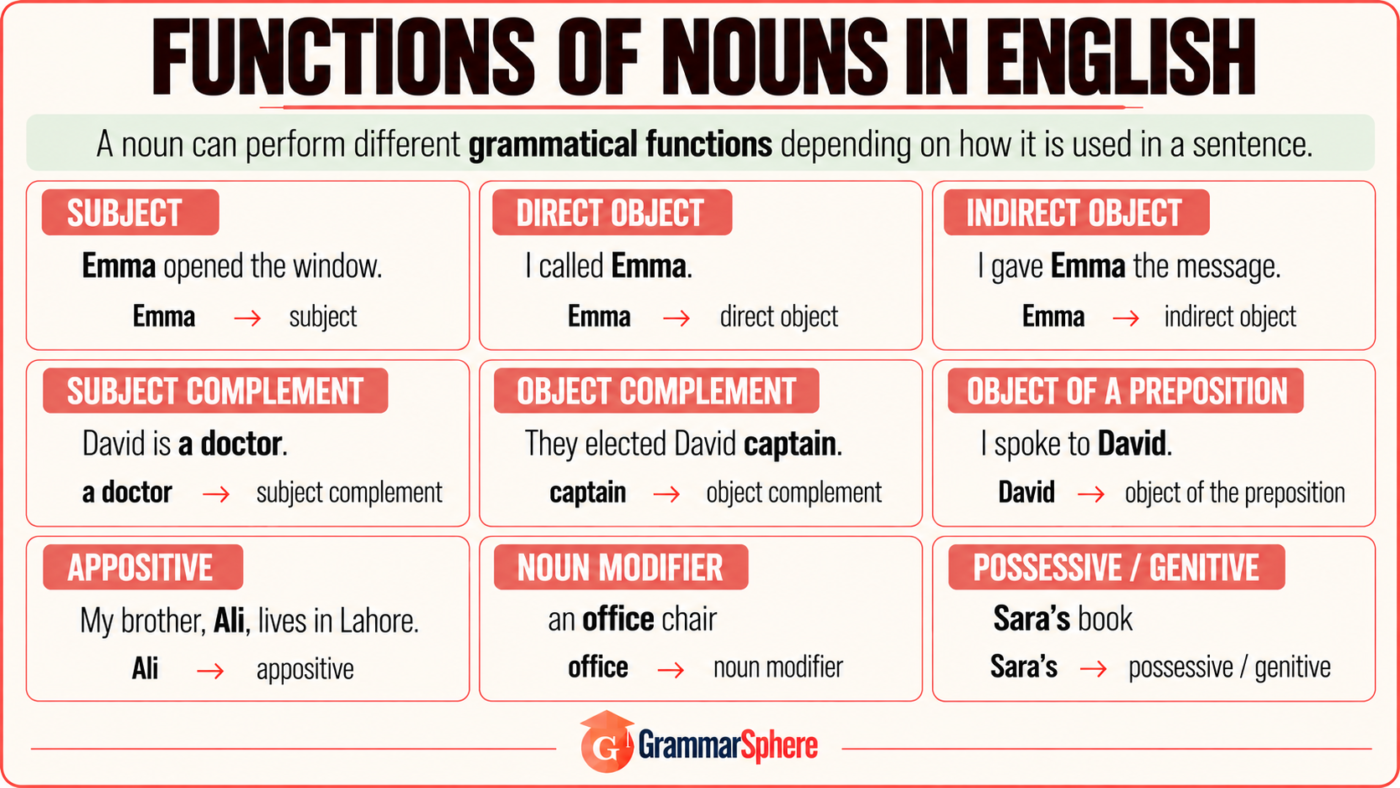
Nouns do more than name people, places, things, and ideas. They can also perform different grammatical functions in sentences.
Compare:
- Sara opened the door.
- I called Sara.
- Sara is a teacher.
Here, Sara functions as the subject in the first sentence and as the direct object in the second. In the third sentence, a teacher functions as a subject complement.
What Are the Functions of Nouns in English?
The function of a noun is the grammatical job it performs in a sentence.
A noun or noun phrase can function as:
- a subject
- a direct object
- an indirect object
- a subject complement
- an object complement
- the object of a preposition
- an appositive
- a noun in direct address
- a modifier
Noun as Subject
A noun or noun phrase can function as the subject of a sentence. The subject is usually the person, thing, place, or idea that the sentence is mainly about.
Consider:
The children are playing outside.
The children is the subject because the sentence tells us what the children are doing.
Other examples:
- Ali works in a bank.
- The baby is sleeping.
- My phone rang.
- Exercise improves health.
Noun as Direct Object
A noun or noun phrase can function as the direct object of a verb. The direct object usually receives or is directly affected by the action of the verb.
Consider:
She opened the window.
The noun phrase the window is the direct object of opened.
A useful way to find a direct object is to ask what? or whom? after the verb:
She opened what? → the window
Other examples:
- I bought a laptop.
- We watched the match.
- He called his brother.
The what? or whom? test can be helpful, but the sentence structure determines the grammatical function.
Noun as Indirect Object
A noun or noun phrase can function as an indirect object. The indirect object usually refers to the person or thing that receives or benefits from the direct object.
Compare:
She gave Ali a book.
She gave a book to Ali.
In the first sentence:
- Ali = indirect object
- a book = direct object
In the second sentence, Ali follows the preposition to and is the object of the preposition.
Other examples:
- I sent my friend a message.
- She told the children a story.
- He bought his mother a gift.
- The teacher gave the students homework.
Verbs such as give, send, tell, show, and offer commonly occur with indirect objects.
Noun as Subject Complement
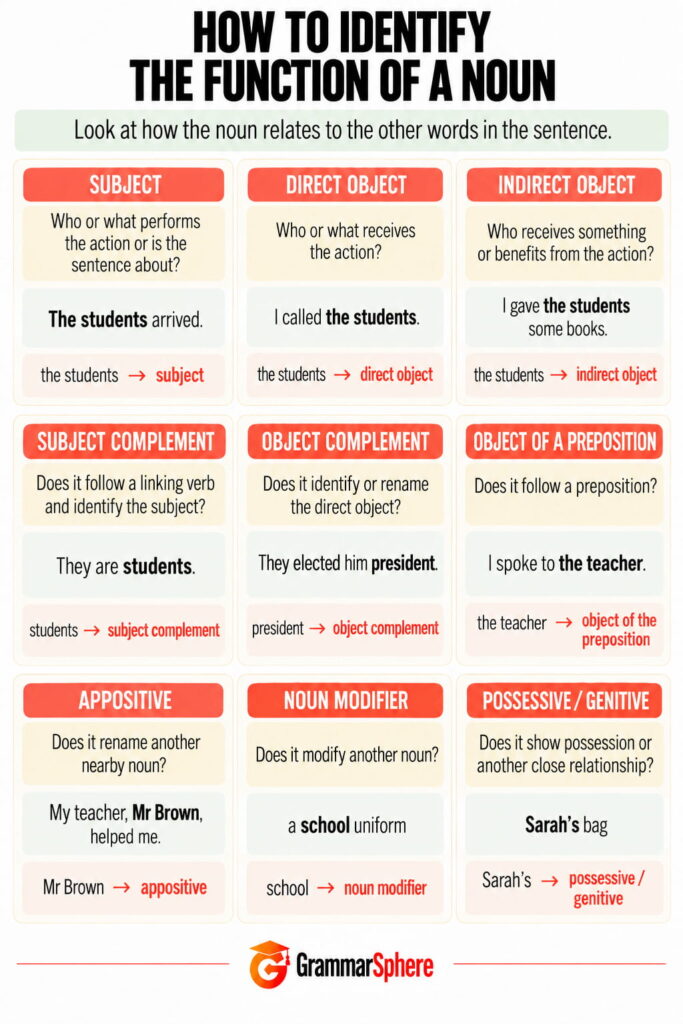
A noun or noun phrase can function as a subject complement. A subject complement follows a linking verb and identifies or renames the subject.
Consider:
Sara is a doctor.
Here:
- Sara = subject
- is = linking verb
- a doctor = subject complement
Sara and a doctor refer to the same person.
Other examples:
- My brother became a teacher.
- Mr Khan is our neighbour.
- Her greatest goal is success.
The verb be is the most common linking verb used with noun subject complements. Other linking verbs, such as become, can also occur in this structure.
Noun as Object Complement
A noun or noun phrase can function as an object complement. An object complement follows a direct object and identifies, renames, or gives a role to that object.
Consider:
They elected Sara president.
Here:
- Sara = direct object
- president = object complement
President identifies the role given to Sara.
Other examples:
- They named the baby Adam.
- We appointed Ahmed captain.
- She considers him a friend.
Compare:
Ahmed became captain.
They appointed Ahmed captain.
In the first sentence, captain is a subject complement because it refers to the subject Ahmed. In the second, captain is an object complement because it refers to the object Ahmed.
Noun as Object of a Preposition
A noun or noun phrase that follows a preposition can function as the object of the preposition.
Consider:
We talked about the problem.
Here:
- about = preposition
- the problem = object of the preposition
Other examples:
- She sat on the chair.
- He went to school.
- The keys are under the table.
- I received a message from Ali.
Compare:
I visited London.
I travelled to London.
In the first sentence, London is the direct object of visited. In the second, London is the object of the preposition to.
Noun as Appositive
A noun or noun phrase can be placed next to another noun to identify, rename, or explain it. This is called an appositive.
Consider:
My brother, Ahmed, lives in Lahore.
Ahmed identifies my brother, so it functions as an appositive.
Other examples:
- My friend Sara is a teacher.
- Mr Brown, our neighbour, has moved away.
- Islamabad, the capital of Pakistan, is a planned city.
Some appositives give extra information and are separated by commas:
Ahmed, my oldest friend, lives nearby.
Others help identify exactly who or what we mean:
My friend Ahmed lives nearby.
Noun in Direct Address
A noun can be used to directly address the person or people we are speaking to. This is called direct address.
Compare:
John opened the door.
John, open the door.
In the first sentence, John is the subject. In the second, John is used in direct address; the understood subject of the command is you.
Other examples:
- Sara, can you help me?
- Thank you, doctor.
- Please sit down, children.
A noun used in direct address is normally separated from the rest of the sentence by a comma or commas.
Noun as Modifier
A noun can come before another noun and give more information about it. In this use, the first noun functions as a modifier.
Examples:
- school bus
- coffee shop
- car door
In school bus, bus is the head noun and school is a noun functioning as a modifier.
Noun modifiers have additional patterns and rules, so they are best treated in more detail in a separate lesson.
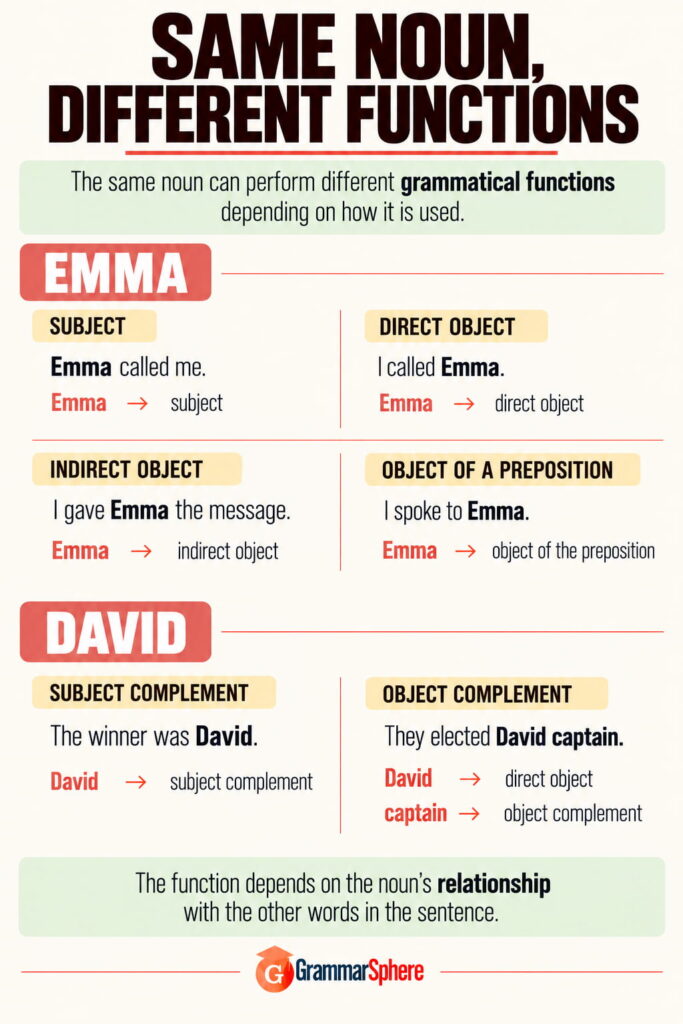
Same Noun, Different Functions
The same noun can have different functions in different sentences. Its function depends on the job it does in the sentence.
Compare:
- Emma called me. → subject — Emma does the action.
- I called Emma. → direct object — Emma receives the action.
- I gave Emma the message. → indirect object — Emma receives the message.
- I spoke to Emma. → object of a preposition — Emma comes after the preposition to.
The noun Emma is the same in every sentence, but its function changes.
Now compare:
- The winner was David. → subject complement — David identifies the subject the winner.
- They elected David captain. → David = direct object; captain = object complement — captain tells us the role given to David.
So, to find the function of a noun, look at what job the noun is doing in the sentence.
Common Mistakes with Noun Functions
1. Confusing the subject with the direct object
Emma invited Daniel.
Emma is the subject because she performs the action. Daniel is the direct object because he receives the action.
2. Confusing the direct object with the indirect object
The manager sent Maria an email.
Maria is the indirect object, while an email is the direct object.
3. Confusing a direct object with a subject complement
Compare:
David became a doctor.
David visited a doctor.
In the first sentence, a doctor identifies David and functions as a subject complement. In the second, a doctor is the direct object of visited.
4. Confusing a direct object with an object complement
They appointed Lisa manager.
Lisa is the direct object, while manager is the object complement because it identifies the role given to Lisa.
5. Confusing the object of a preposition with a direct object
Compare:
We visited the museum.
We went to the museum.
In the first sentence, the museum is the direct object. In the second, it is the object of the preposition to.
Noun Functions Exercises with Answers
A. Identify the function of the bold noun or noun phrase.
- The baby is crying.
- She opened the door.
- I gave Sarah the keys.
- My father is a doctor.
- They appointed Ahmed captain.
- We talked about the problem.
- My sister, Ayesha, lives in Karachi.
- I bought a coffee cup.
- James, please come here.
- Exercise improves health.
B. Identify the direct and indirect objects.
- She gave Ali a gift.
- I sent my friend a message.
- The teacher showed the students a picture.
- He bought his daughter a bicycle.
- Sarah told us the story.
C. Choose the correct answer.
- In The boy kicked the ball, the ball is:
a. subject
b. direct object
c. subject complement
- In Maria is a teacher, a teacher is:
a. direct object
b. object of a preposition
c. subject complement
- In They made John captain, captain is:
a. object complement
b. indirect object
c. subject
- In We spoke to the manager, the manager is:
a. direct object
b. object of a preposition
c. appositive
- In My brother, Ali, is studying, Ali is:
a. appositive
b. indirect object
c. noun modifier
Answers
A. Identify the function
- subject
- direct object
- indirect object
- subject complement
- object complement
- object of a preposition
- appositive
- noun modifier
- direct address
- subject
B. Direct and indirect objects
- Ali = indirect object; a gift = direct object
- my friend = indirect object; a message = direct object
- the students = indirect object; a picture = direct object
- his daughter = indirect object; a bicycle = direct object
- us = indirect object; the story = direct object
C. Choose the correct answer
- b. direct object
- c. subject complement
- a. object complement
- b. object of a preposition
- a. appositive
FAQs About Noun Functions
What are the main functions of nouns in English?
Nouns and noun phrases can function as subjects, direct objects, indirect objects, subject complements, object complements, objects of prepositions, appositives, modifiers, and nouns in direct address.
How do I identify the function of a noun in a sentence?
Look at how the noun relates to the verb, a preposition, or another noun. Position can provide a clue, but the grammatical relationship determines the function.
Can the same noun have different functions?
Yes. For example, Sara is the subject in Sara called me but the direct object in I called Sara.
What is the difference between a direct object and an indirect object?
A direct object is usually the person or thing directly affected by the verb. An indirect object usually identifies the recipient or beneficiary of the direct object, as in She gave Ali a book.
Can a noun function as a modifier?
Yes. A noun can modify another noun, as in school bus and coffee shop. School and coffee remain nouns but function as modifiers.
You May Also Like
Leave a Comment