

Table of Contents
Nouns do more than identify physical people, places, and objects. They also allow us to express emotions, recognize personal qualities, and discuss ideas without giving these meanings a physical form. Abstract nouns belong to this nonphysical side of meaning. Recognizing them involves distinguishing a concept from its physical expression, while using them correctly also requires attention to countability, articles, and verb agreement.
What Is an Abstract Noun?
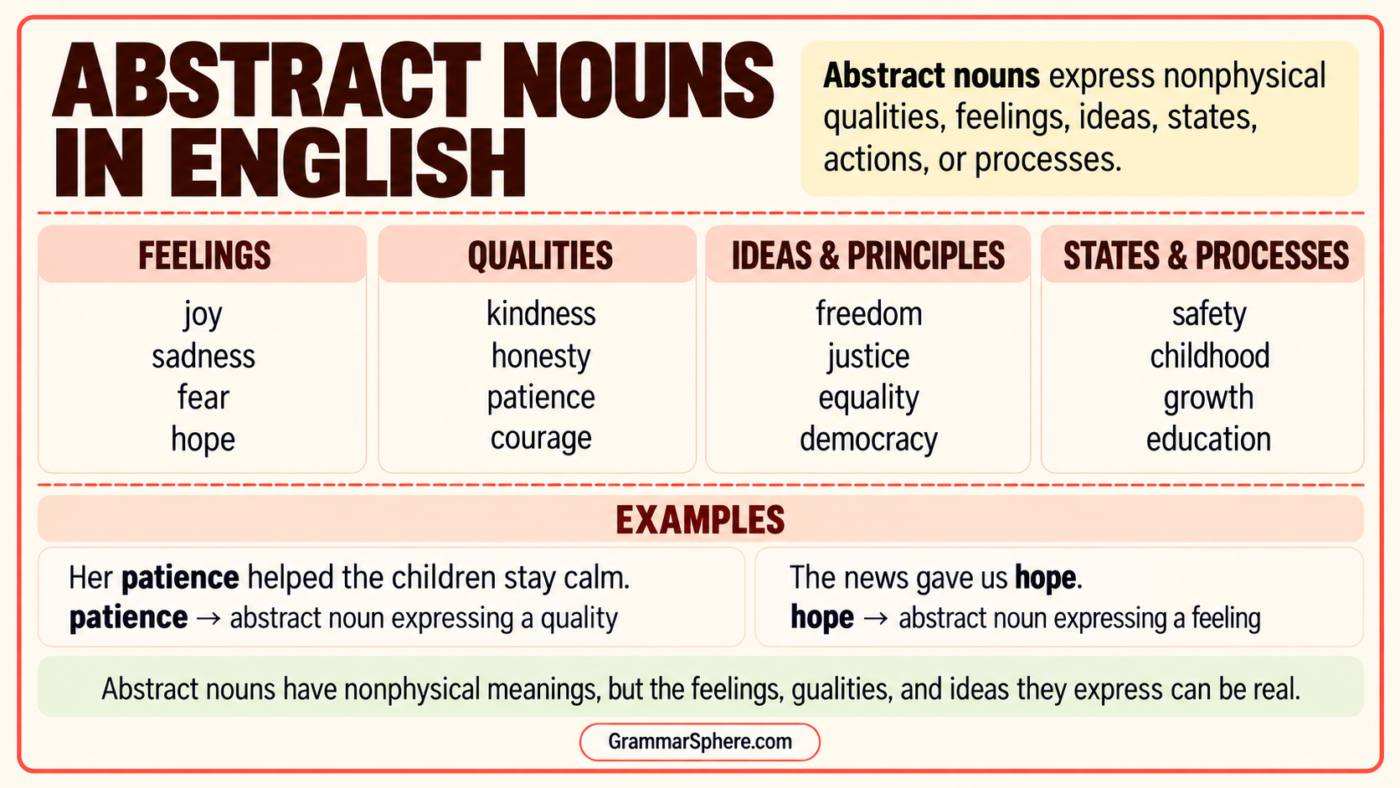
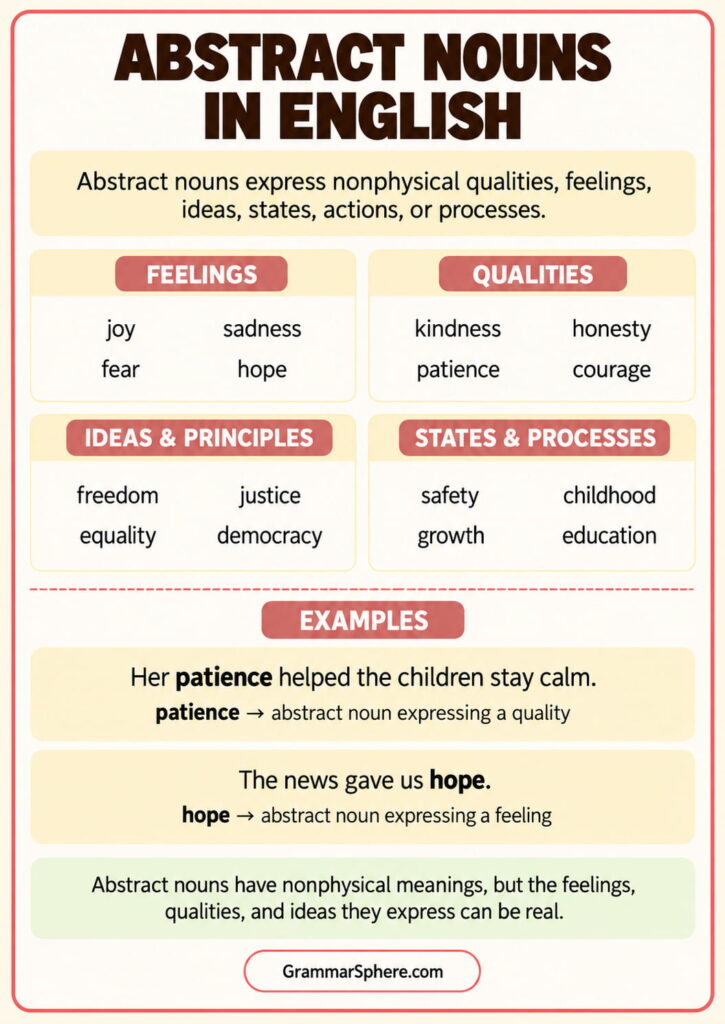
An abstract noun refers to a quality, feeling, idea, state, action, or process rather than a physical person or thing. Honesty, fear, freedom, and knowledge are familiar examples.
We can experience these concepts or recognize their effects, but we cannot perceive them directly as physical objects.
Her patience helped the children stay calm.
Here, patience expresses a personal quality. The woman’s behaviour provides evidence of that quality, but patience itself has no physical form.
The news gave us hope.
In this sentence, hope expresses a feeling about the future. The feeling is real, even though it is not a physical object.
Abstract does not mean imaginary, vague, or complicated. Everyday feelings such as love and anger are abstract because of their nonphysical meanings.
Examples of Abstract Nouns
Abstract nouns express many kinds of meaning. The following groups help organize familiar examples; they are learning aids rather than separate grammatical classes.
| Meaning | Abstract noun examples | Example in a sentence |
|---|---|---|
| Feelings and emotions | joy, sadness, anxiety, affection | She felt joy when her brother returned. |
| Personal qualities | courage, kindness, honesty, patience | His honesty earned our trust. |
| States and conditions | safety, childhood, illness, poverty | The children reached safety. |
| Ideas and principles | justice, equality, freedom, democracy | They demanded equality. |
| Thinking and understanding | knowledge, belief, curiosity, wisdom | Her curiosity encouraged further questions. |
| Actions and processes | movement, growth, discussion, education | The plants showed steady growth. |
An action or process can be abstract even when its effects are visible. In the growth of the tree, growth expresses the process of developing, whereas tree identifies the physical living thing.
Abstract Nouns and Concrete Nouns
The distinction between abstract and concrete nouns concerns what they mean. Concrete nouns refer to physical things that can be perceived through the senses; abstract nouns express nonphysical concepts.
| Concrete noun | Related abstract noun |
|---|---|
| medal | achievement |
| student | curiosity |
| gift | generosity |
| lock | security |
The medal represents her achievement.
The medal is a physical object. The achievement is what she accomplished, rather than the object she received.
The senses test requires care. A concrete noun does not have to identify something visible or touchable: a sound can be heard, even though it cannot be held. Conversely, seeing evidence of a quality does not make that quality concrete. Watching someone share food allows us to recognize generosity, but generosity itself remains abstract.
Context can also change how a noun is understood:
The parcel arrived at our home.
For her, home means comfort and belonging.
In the first sentence, home identifies a physical place. In the second, it expresses an emotional concept. Consider the noun’s meaning in its sentence rather than classifying the word in isolation.
How to Identify Abstract Nouns in a Sentence
First, establish whether the word functions as a noun. Then determine whether its meaning is physical or abstract.
Her confidence impressed the audience.
Confidence functions as the subject and expresses a personal quality, so it is an abstract noun.
We admired his determination.
Determination functions as the direct object of admired. It expresses a mental quality rather than a physical thing.
Meaning alone does not establish word class, because adjectives and verbs can also express feelings or qualities:
The child is happy.
The child’s happiness was obvious.
Happy is an adjective describing the child. Happiness is an abstract noun functioning as the subject of the second sentence.
The same distinction separates a verb from its related noun:
I believe you.
Her belief surprised me.
Believe expresses the mental action as a verb, whereas belief is a noun expressing what someone accepts as true.
Endings such as -ness and -tion can help you recognize abstract nouns, but they are clues rather than a complete test. Trust, peace, and fear are abstract nouns without these endings.
How Abstract Nouns Are Formed
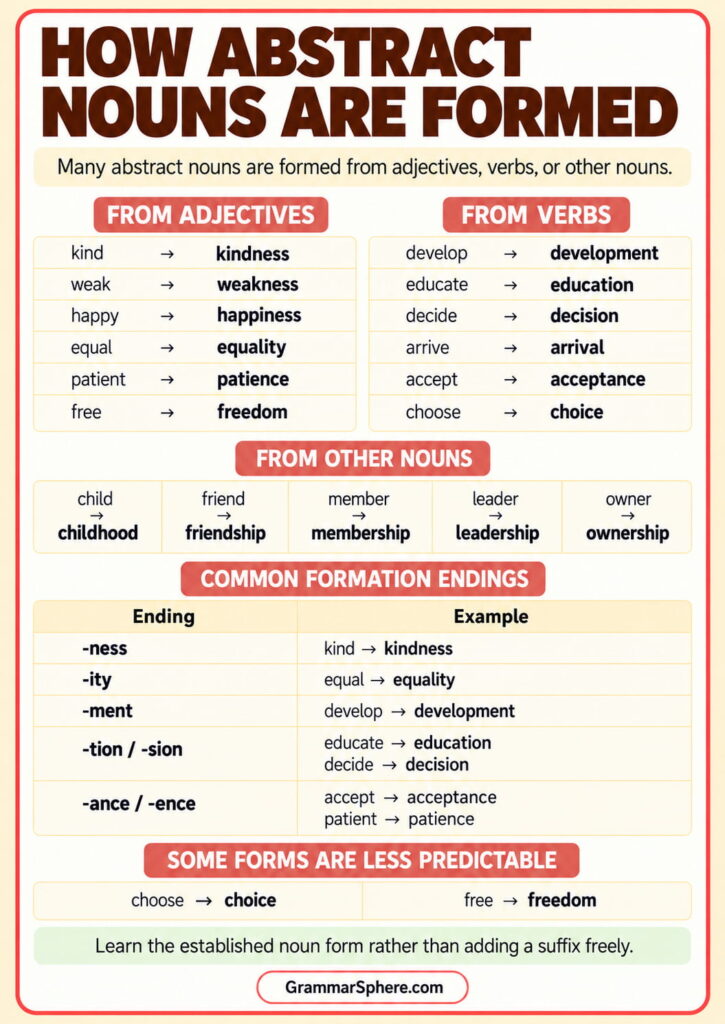
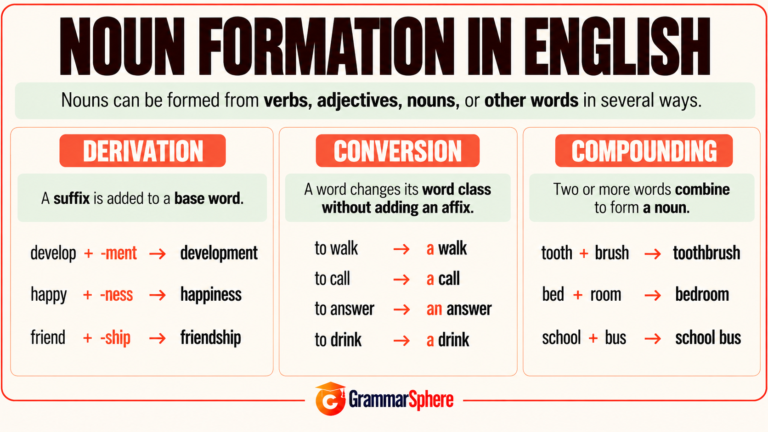
Many abstract nouns are formed from adjectives, verbs, or other nouns. A suffix often marks this change, sometimes with an accompanying spelling change. Other abstract nouns have less predictable forms.
Abstract Nouns Formed from Adjectives
An adjective describes a quality in someone or something. Its related abstract noun expresses the quality itself.
| Adjective | Abstract noun |
|---|---|
| kind | kindness |
| weak | weakness |
| happy | happiness |
| active | activity |
| equal | equality |
| patient | patience |
| free | freedom |
The nurse was kind.
We appreciated the nurse’s kindness.
Kind describes the nurse, while kindness expresses the quality being appreciated.
Some formations involve a spelling change. In happy → happiness, the final y changes to i before -ness.
Abstract Nouns Formed from Verbs
Nouns derived from verbs can express actions, processes, or their results.
| Verb | Abstract noun |
|---|---|
| develop | development |
| educate | education |
| decide | decision |
| arrive | arrival |
| accept | acceptance |
| fail | failure |
| choose | choice |
They decided to postpone the trip.
Their decision disappointed us.
The verb decided expresses the action. The noun decision presents its result as something that can function as the subject of another sentence.
No single suffix forms every noun derived from a verb. Learn the established form rather than adding an ending freely: choose becomes choice, not choosation.
Abstract Nouns Formed from Other Nouns
Some abstract nouns develop from nouns identifying people or roles. The derived forms can express a relationship, status, period of life, or condition.
| Original noun | Abstract noun |
|---|---|
| child | childhood |
| friend | friendship |
| member | membership |
| leader | leadership |
| owner | ownership |
Their friendship began at school.
Friendship expresses the relationship between the friends rather than identifying the people themselves.
Not every abstract noun requires an added suffix. Love, hope, and trust can function as nouns or verbs without a spelling change:
I trust her.
Mutual trust takes time.
The first trust is a verb; the second is a noun. Sentence structure helps distinguish their grammatical functions.
Countable and Uncountable Abstract Nouns
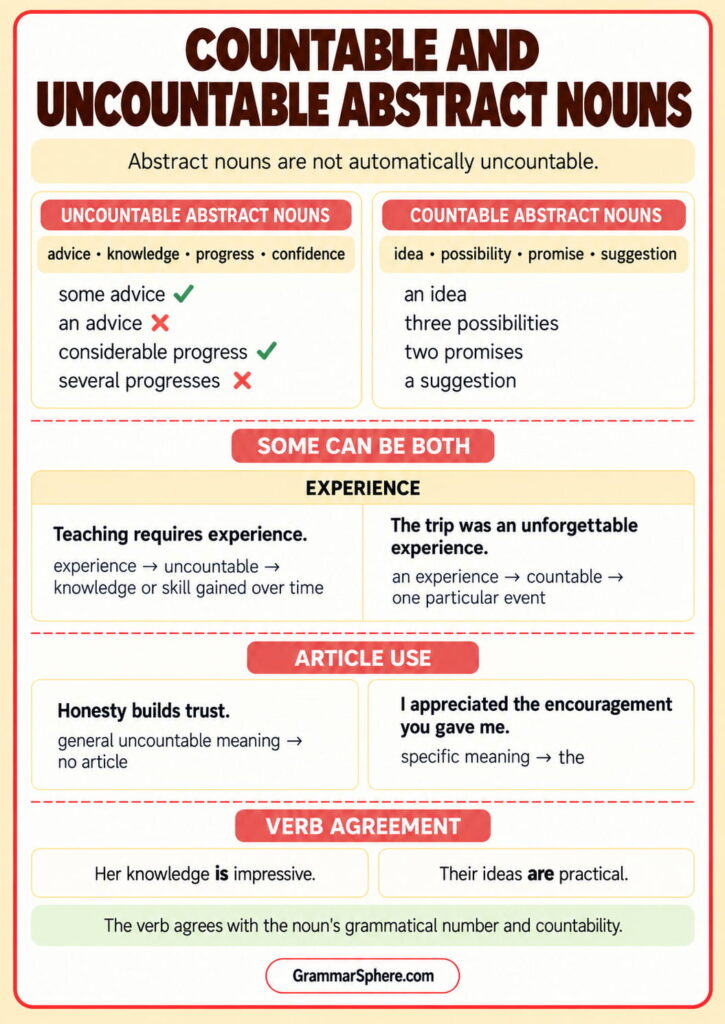
Abstract and uncountable describe different features. Abstract concerns a noun’s meaning; countability determines whether English treats that meaning as separate units.
Many abstract nouns are normally uncountable, including advice, knowledge, progress, and confidence. In their usual meanings, they take neither a/an nor a plural ending.
We need some advice.
She has made considerable progress.
Other abstract nouns are countable and therefore have singular and plural forms:
He suggested an idea.
We discussed three possibilities.
She made two promises.
Some abstract nouns have both countable and uncountable meanings:
| Noun | Uncountable meaning | Countable meaning |
|---|---|---|
| experience | accumulated knowledge or skill | a particular event someone experiences |
| success | achievement in general | a successful person, event, or undertaking |
| difficulty | the condition of being difficult | a particular problem or obstacle |
Teaching requires experience.
The exchange programme was an unforgettable experience.
The first sentence concerns knowledge gained over time. The second identifies one particular event in someone’s life.
A specific meaning does not automatically make an uncountable noun countable. The advice you gave me identifies particular advice, but advice remains uncountable. To distinguish separate items, say two pieces of advice.
Articles and Verb Agreement with Abstract Nouns
Article choice depends on countability and whether the noun expresses a general or specific meaning.
Uncountable abstract nouns usually take no article when expressing general concepts:
Honesty builds trust.
Children need encouragement.
Use the when the noun identifies something specific or already understood:
I appreciated the encouragement you gave me.
A singular countable abstract noun normally requires an article or another determiner:
That is an interesting suggestion.
Your suggestion deserves consideration.
Plural countable nouns can express a general meaning without an article or a specific meaning with the:
Opinions differ.
The opinions expressed in the meeting were helpful.
Verb agreement follows the subject’s number and countability, not its abstract meaning. An uncountable abstract noun or a singular countable abstract noun takes a singular verb. A plural abstract noun takes a plural verb.
Her knowledge is impressive.
This proposal needs revision.
Their ideas are practical.
How Abstract Nouns Function in Sentences
Abstract nouns perform the same grammatical functions as other nouns. Their nonphysical meanings do not restrict their position in a sentence.
| Function | Example |
|---|---|
| Subject | Cooperation reduces delays. |
| Direct object | We value loyalty. |
| Subject complement | Our main concern is safety. |
| Object of a preposition | They acted with caution. |
In Our main concern is safety, safety functions as a subject complement after is. In with caution, caution is the object of the preposition with.
Modifiers and complements can make an abstract noun’s meaning more precise:
Her remarkable ability to explain difficult ideas impressed us.
The adjective remarkable modifies ability, while to explain difficult ideas specifies the ability being discussed.
Common Mistakes with Abstract Nouns
Incorrect: She gave me an advice. ✗
Correct: She gave me some advice. ✓
Advice is uncountable in this meaning. For one item, say a piece of advice.
Incorrect: The team has made several progresses. ✗
Correct: The team has made considerable progress. ✓
Progress normally remains uncountable, even when several improvements have occurred.
Incorrect: His confidence are growing. ✗
Correct: His confidence is growing. ✓
The uncountable subject confidence requires a singular verb.
Incorrect: Her honest impressed everyone. ✗
Correct: Her honesty impressed everyone. ✓
The subject requires the noun honesty, not the adjective honest.
Abstract Noun Exercises
For sentences 1–3, identify the abstract noun.
- Her bravery impressed the firefighters.
- The students listened with curiosity.
- We finally reached an agreement.
For sentences 4–6, complete the sentence with the abstract noun formed from the word in brackets.
- Thank you for your ________. (kind)
- The director announced her ________. (decide)
- Their ________ continued for many years. (friend)
For sentences 7–10, choose the correct form.
- Could you give me an advice / some advice?
- His knowledge is / are valuable.
- She suggested three possibility / possibilities.
- I have five years of teaching experience / experiences.
Answers
- Bravery
- Curiosity
- Agreement
- Kindness
- Decision
- Friendship
- Some advice — advice is uncountable.
- Is — knowledge takes a singular verb.
- Possibilities — three requires a plural countable noun.
- Experience — accumulated teaching knowledge is uncountable.
Frequently Asked Questions About Abstract Nouns
Can an abstract noun also be a common noun?
Yes. The classifications describe different features. Courage is abstract because it expresses a nonphysical quality. It is also a common noun because it does not function as a proper name.
Does a noun ending prove that a word is abstract?
No. Endings can help identify a noun’s formation, but its meaning determines whether it is abstract. Education expresses an abstract process, whereas station commonly identifies a physical place, despite both ending in -tion.
Can an -ing form express an abstract activity?
Yes. In Swimming improves fitness, swimming expresses an activity and functions as the subject. Traditional grammar calls this a gerund. In They are swimming, however, swimming forms part of the verb phrase.
You May Also Like
Leave a Comment