

Table of Contents
Determiners are an important part of using nouns correctly in English because they help make the meaning of a noun clear and specific.
In this article, you will learn how determiners are used with different types of nouns, where they appear, and how to choose the correct one..
What Is a Determiner?
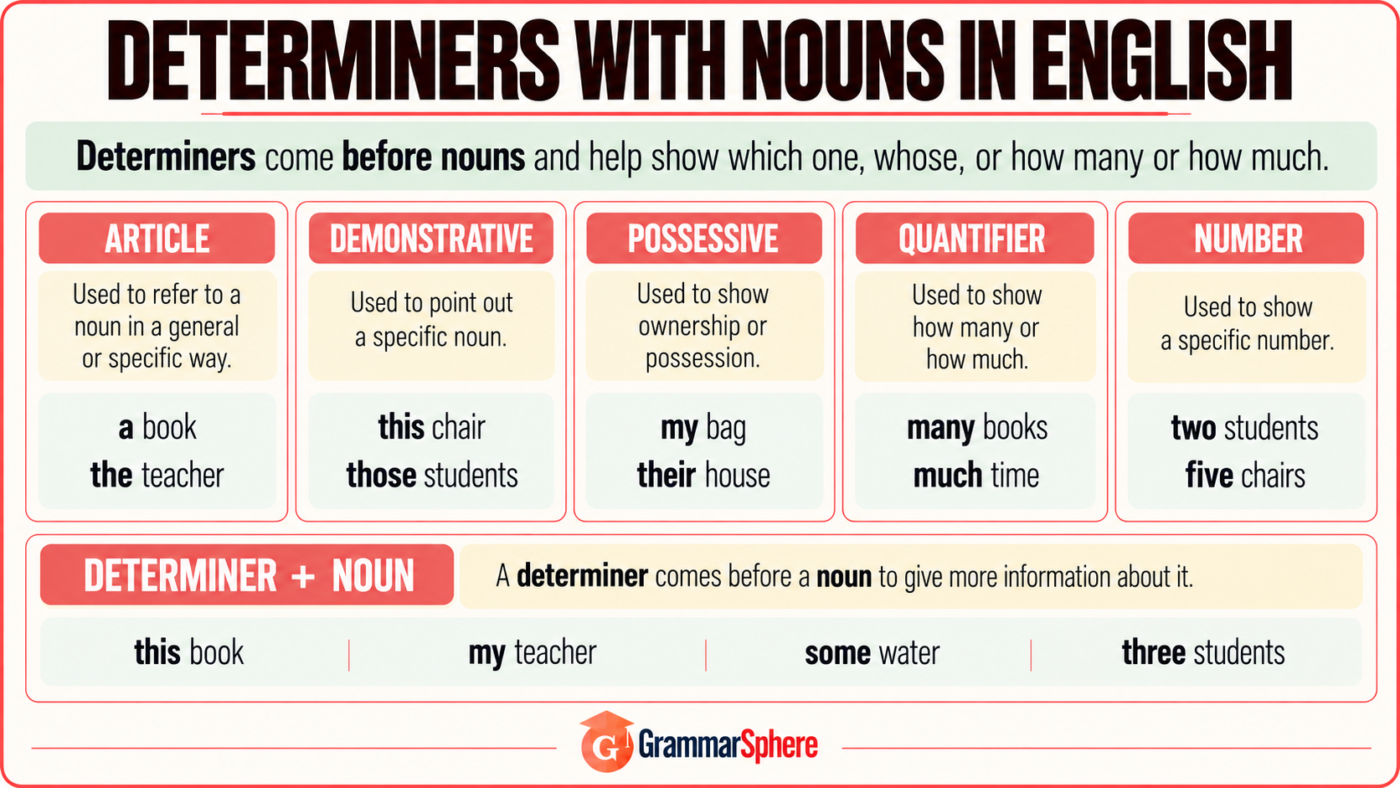
A determiner is a word used before a noun to identify it, limit its meaning, or give information about possession, number, or quantity.
For example:
- a book — one non-specific book
- the book — a particular or identifiable book
- this book — a particular book being pointed out
- my book — a book connected with the speaker
- some books — an unspecified number of books
Common determiners include:
- a, an, the
- this, that, these, those
- my, your, his, her, its, our, their
- some, any, much, many, few, little, several, enough
- each, every, either, neither
- all, both
Numbers can also occur before nouns to show an exact number:
- one student
- two books
- three questions
Not every determiner can be used with every noun. The noun type helps determine which forms are possible.
Determiners with Different Types of Nouns
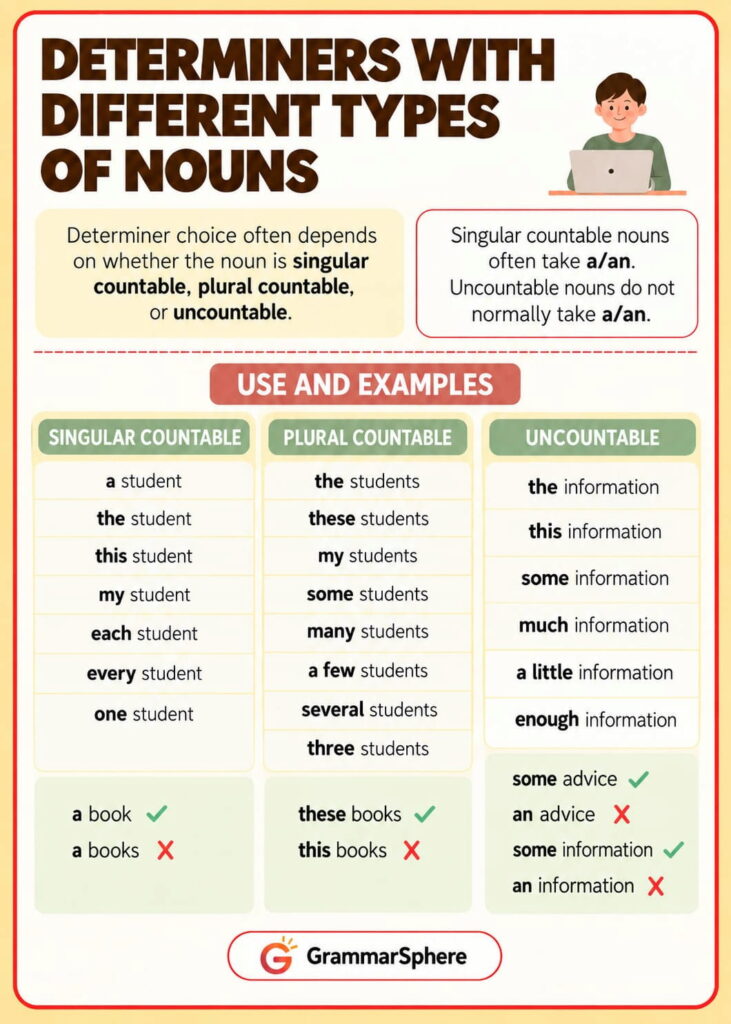
Determiner choice is closely connected with whether a noun is singular countable, plural countable, or uncountable.
Singular Countable Nouns
A singular countable noun refers to one person, place, thing, or idea.
For example:
- student
- book
- chair
- question
It can be used with determiners such as:
- a student
- the student
- this student
- that student
- my student
- each student
- every student
- either answer
- neither answer
- one student
An ordinary singular countable noun normally needs a determiner or another suitable word before it.
Student is waiting outside. ✗
A student is waiting outside. ✓
Use a/an only with singular countable nouns:
a book ✓
an idea ✓
a books ✗
an information ✗
Plural Countable Nouns
Plural countable nouns refer to more than one person or thing.
They can be used with determiners such as:
- the students
- these students
- those students
- my students
- some students
- many students
- few students
- a few students
- several students
- three students
Demonstratives must agree with the noun in number:
this book ✓
these books ✓
this books ✗
Plural nouns can also appear without a determiner when they refer to people or things generally:
Students need regular practice.
Dogs need exercise.
Uncountable Nouns
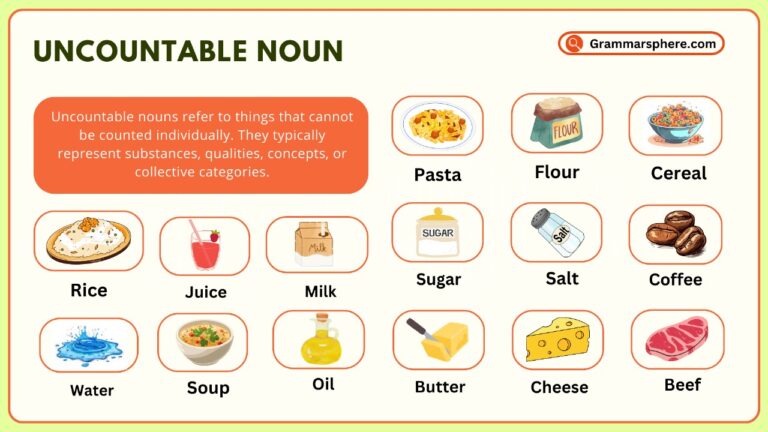
Uncountable nouns are not normally counted as separate individual units.
For example:
- information
- advice
- water
- money
- furniture
They can be used with determiners such as:
- the information
- this information
- some information
- much information
- little information
- a little information
- enough information
We do not normally use a/an directly with an uncountable noun:
an advice ✗
some advice ✓
an information ✗
some information ✓
When we need to count something expressed by an uncountable noun, we can use a countable unit:
- a piece of advice
- two pieces of information
- a bottle of water
- three items of furniture
Position of Determiners Before Nouns
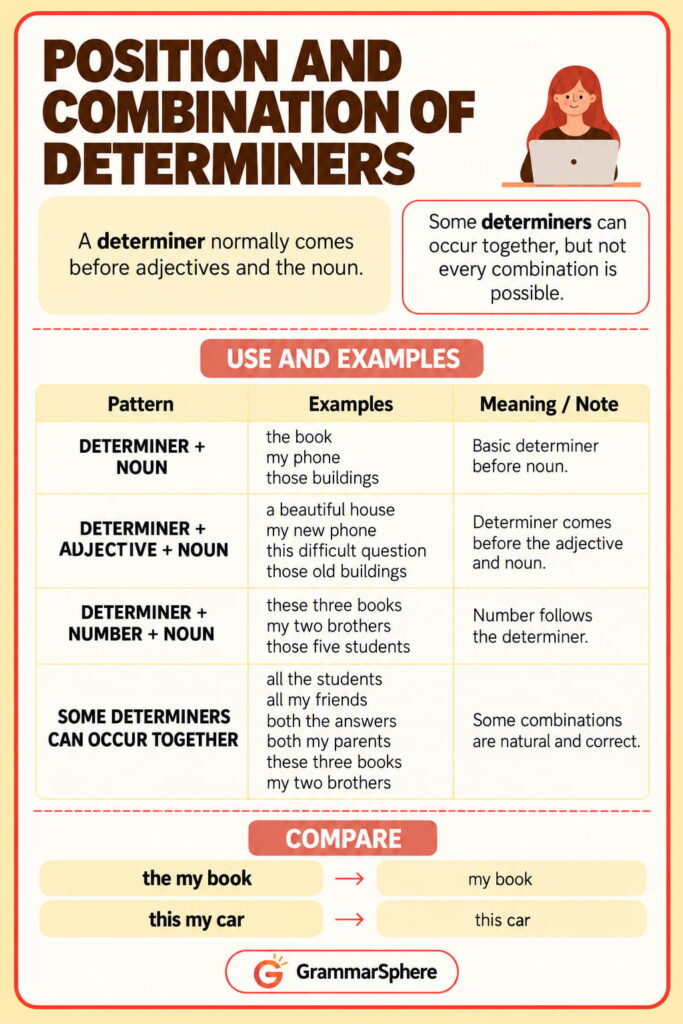
A determiner normally comes before the noun and before any adjective that describes the noun.
Compare:
book
old book
the old book
In the old book:
- the = determiner
- old = adjective
- book = noun
The usual pattern is:
determiner + adjective(s) + noun
For example:
- a beautiful house
- my new phone
- this difficult question
- those old buildings
Numbers and quantity words can also occur before the noun:
- three books
- many students
- a few questions
When a demonstrative or possessive determiner is used with a number, it normally comes first:
- these three books
- my two brothers
- those five students
Using More Than One Determiner with a Noun
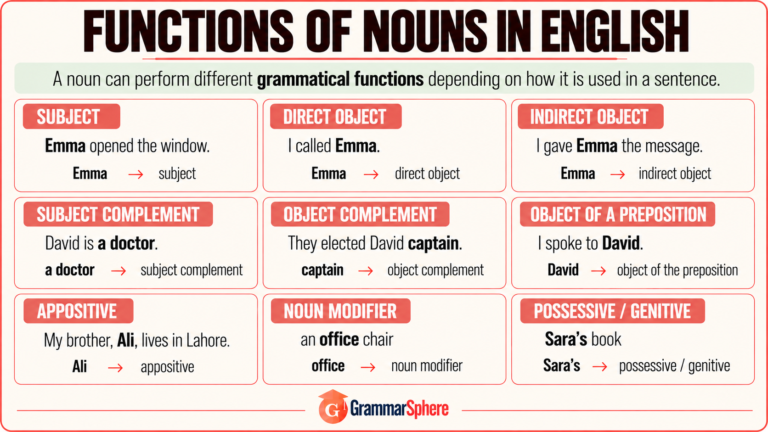
Some determiner combinations are possible, but determiners cannot be combined freely.
Common patterns include:
- all the students
- all my friends
- both the answers
- both my parents
- these three books
- my two brothers
For example:
All the students completed the exercise.
Both my parents work from home.
Some combinations are not normally possible:
the my book ✗
this my car ✗
Use:
my book ✓
this car ✓
It is better to learn common determiner combinations rather than assume that any two determiners can appear together.
When No Determiner Is Used
A noun does not always need a determiner.
Plural countable nouns can appear without a determiner when they are used generally:
Teachers help students learn.
Cars can be expensive.
Uncountable nouns can also appear without a determiner when they have a general meaning:
Water is essential for life.
Education is important.
Ordinary singular countable nouns are different. They normally need a determiner or another suitable word:
I bought book. ✗
I bought a book. ✓
I bought the book. ✓
I bought this book. ✓
Many proper nouns also occur without a determiner:
Ali lives in Pakistan.
The main learner rule is:
ordinary singular countable noun → normally needs a determiner
How to Choose the Right Determiner
To choose a determiner, follow two steps.
1. Check the noun type.
Ask whether the noun is:
- singular countable
- plural countable
- uncountable
This tells you which determiners are grammatically possible.
2. Decide what meaning you want to express.
For example:
- a/an → one non-specific singular countable noun
- the → something specific or identifiable
- this, that, these, those → pointing to particular people or things
- my, your, his, her, our, their → possession or relationship
Determiners with Nouns Exercises with Answers
A. Choose the Correct Determiner
- She bought a / some new laptop.
- I need a / some advice.
- This / These books belong to me.
- We don’t have many / much information.
- There are few / little chairs in the room.
- Each / Many student received a certificate.
B. Correct the Sentences
- She gave me an information.
- This students are waiting outside.
- Every students needs a notebook.
- I spoke to the my teacher.
C. Complete the Sentences
- I saw ___ dog outside. ___ dog was standing near our gate.
- She bought ___ umbrella because it was raining.
- I need ___ information before I decide.
- ___ two brothers live in Karachi.
Answers
A
- a
- some
- These
- much
- few
- Each
B
- She gave me some information. / She gave me a piece of information.
- These students are waiting outside.
- Every student needs a notebook.
- I spoke to my teacher.
C
- a, the
- an
- some
- My
FAQs About Determiners with Nouns
Does every noun need a determiner?
No. Plural countable nouns and uncountable nouns can appear without a determiner when they have a general meaning.
Books are useful.
Water is essential.
An ordinary singular countable noun normally needs a determiner or another suitable word:
I bought book. ✗
I bought a book. ✓
Can we use more than one determiner before a noun?
Some combinations are possible:
all the students
both my parents
these three books
However, determiners cannot be combined freely. For example, the my book is not normally correct.
What is the difference between a determiner and an adjective?
A determiner helps identify, limit, or show the quantity of a noun, while an adjective describes the noun.
In those beautiful houses:
those = determiner
beautiful = adjective
houses = noun
Where does a determiner come in a noun phrase?
A determiner normally comes before adjectives and the noun.
The usual pattern is:
determiner + adjective(s) + noun
For example:
the old house
my new phone
those beautiful flowers
Can proper nouns take determiners?
Many proper nouns are used without a determiner:
Ali lives in Pakistan.
However, some proper names and fixed expressions are used with determiners, depending on standard English usage.
You May also Like
Leave a Comment